
How Voice AI Uses NLP for Real-Time Insights
Streaming STT, NLU, and TTS enable sub-second voice AI that cuts costs, boosts CX, and turns calls into actionable insights.

Voice AI, powered by Natural Language Processing (NLP), is transforming how businesses handle customer interactions. By understanding spoken language, interpreting intent, and responding in under one second, Voice AI delivers fast, natural, and efficient communication. Here's what you need to know:
- Real-time performance: Processes like transcription, reasoning, and response occur in milliseconds, ensuring smooth conversations without awkward pauses.
- Cost savings: AI-managed calls cost significantly less - around $1.84 per call compared to $7.20 for live agents.
- Applications across industries: From healthcare to finance, Voice AI automates tasks like scheduling, identity verification, and compliance monitoring.
- Core technology: Combines Speech-to-Text (STT), Natural Language Understanding (NLU), and Text-to-Speech (TTS) in a streaming pipeline for low-latency performance.
- Business impact: Improves efficiency, reduces missed opportunities, and supports compliance with regulations like HIPAA.
Voice AI systems integrate seamlessly with tools like Salesforce, Athena, and Epic, turning conversations into actionable insights. With proper implementation from an AI consulting agency, businesses can reduce costs, enhance customer experience, and streamline operations.
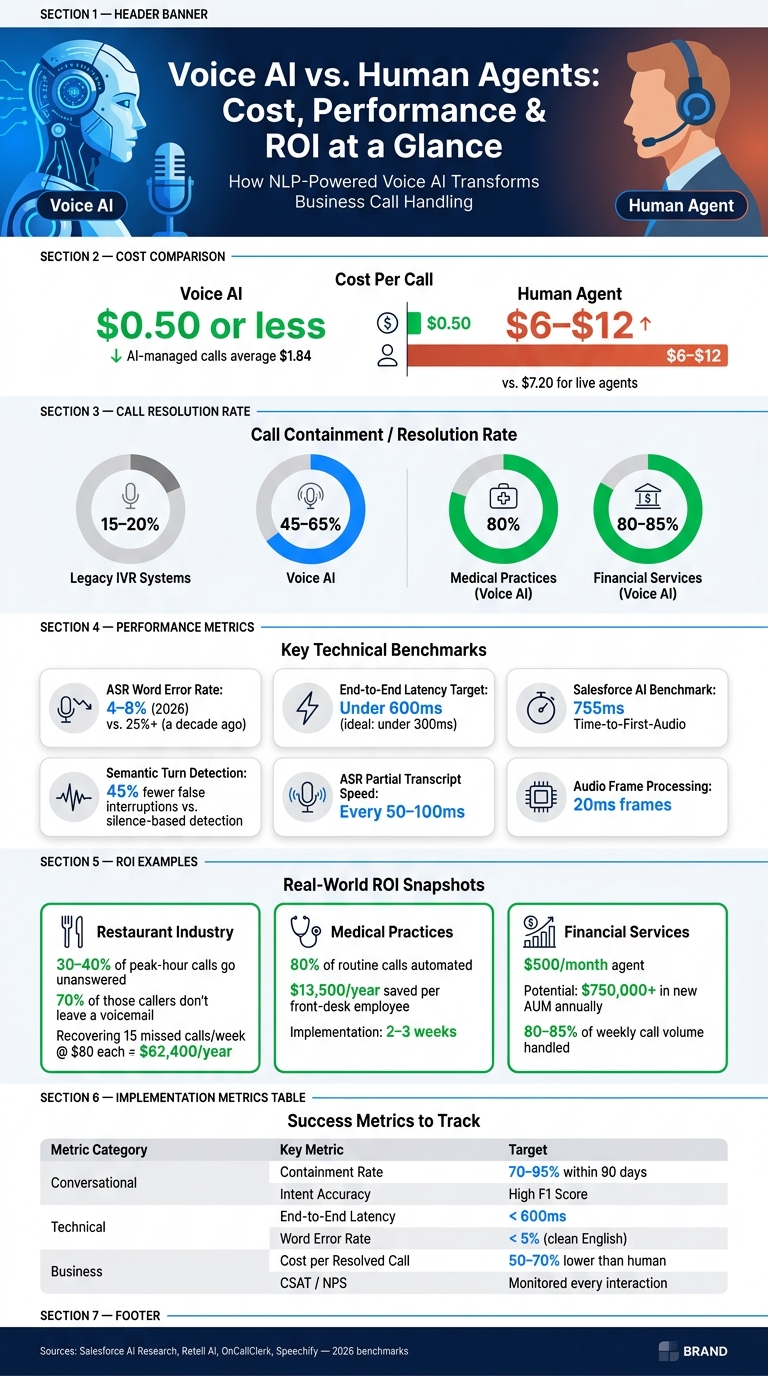
Voice AI vs. Human Agents: Cost, Performance & ROI at a Glance
How NLP Powers Voice AI Systems
Speech-to-Text as the Starting Point
Every interaction with a Voice AI system kicks off with Automatic Speech Recognition (ASR), also known as Speech-to-Text (STT). Modern ASR systems work incredibly fast, generating partial transcripts every 50–100ms. This allows downstream processes to start working even before the speaker finishes their sentence.
Accuracy is everything here. In 2026, leading ASR providers report Word Error Rates (WER) of just 4%–8% for clean speech - a huge improvement from over 25% a decade ago. Features like speaker diarization and confidence scores add an extra layer of reliability. For instance, if the system detects uncertainty about critical details, such as a phone number or account ID, it automatically prompts the user for confirmation.
"If the ASR mishears the caller, every downstream stage works on bad input." - OnCallClerk Team
Once a high-quality transcript is produced, the system shifts gears to interpret the intent and context using advanced Natural Language Processing (NLP).
Processing Language in Real Time
After converting speech into text, Natural Language Understanding (NLU) takes over. Powered by transformer-based models, this step identifies the user’s intent and extracts important details like names, dates, or account numbers.
What’s remarkable is that this analysis happens on partial transcripts, not just after the entire sentence is spoken. The system begins interpreting the user’s meaning while they’re still talking. This keeps the interaction smooth and conversational, avoiding the clunky back-and-forth feel of slower systems. To achieve this, NLP tasks are integrated into a continuous streaming pipeline, ensuring real-time responsiveness.
Streaming NLP for Low-Latency Performance
With accurate ASR and real-time NLU in place, the system employs a streaming pipeline to minimize delays and deliver instant feedback. The trick isn’t just about having fast models - it’s about running the ASR, NLU, and Text-to-Speech (TTS) processes simultaneously. Each stage feeds data into the next as it becomes available, creating a seamless flow.
"The single biggest latency optimization in voice AI is not model selection, hardware, or network routing. It's eliminating sequential waiting by streaming across all three stages simultaneously." - Tian Pan, Engineer-Founder
Audio is processed in 20ms frames, and tokens from the language model are streamed one by one instead of waiting for the full response. These tokens are then passed to the TTS engine at natural sentence breaks - like periods or question marks - so the user hears the start of the response almost instantly.
In March 2026, Salesforce AI Research showcased this efficiency by using Deepgram Nova-3 STT, a self-hosted vLLM (Qwen2.5-7B), and ElevenLabs TTS in a benchmark test. By overlapping all three stages, they achieved an end-to-end Time-to-First-Audio of 755ms, proving that pipeline design is the real key to speed, not just raw model performance.
A crucial part of this setup is semantic turn detection. Instead of relying on 600ms or more of silence to decide if the speaker has finished, advanced systems analyze the transcript for grammatical and contextual completeness. This method reduces false interruptions by approximately 45% compared to traditional silence-based detection approaches.
sbb-itb-f123e37
Building a Real-Time Voice AI Architecture
Core Components of a Voice AI System
A fully operational voice AI system relies on eight interconnected layers: Telephony/Transport layer, Voice Activity Detection (VAD), Streaming STT, Endpointer, LLM/Orchestration, TTS, Barge-in Handler, and Post-call Processing.
The Orchestration layer serves as the system's control center. It manages the conversation state, keeps track of context across multiple exchanges, and triggers external systems like CRMs or internal databases. This layer ensures all components work in sync and the conversation remains coherent.
The endpointer plays a vital role by identifying when a user finishes speaking. Using a learned approach to assess sentence completeness, it minimizes delays by up to 300ms.
"The endpointer is the choke point. It's the only stage that cannot overlap with anything else - by definition, it's the moment we decide to stop listening and start replying." - Tyler Weitzman, Co-Founder & Head of AI, Speechify
The choice of transport layer also affects performance. WebRTC, for example, adds just 20–50ms of latency, while traditional PSTN phone lines can introduce delays ranging from 150ms to 700ms. For browser-based applications, WebRTC is often the preferred option due to its lower latency.
Once these foundational layers are in place, the system can be further enhanced by integrating autonomous AI agents.
Adding Autonomous AI Agents to the Pipeline
With the core pipeline established, autonomous AI agents integrate into the Orchestration layer, turning raw NLP outputs into actionable tasks. These agents use function calling to execute workflows during live conversations - such as checking order statuses, booking appointments, or retrieving account details - all without disrupting the dialogue.
For tasks that require brief processing time, agents use short filler phrases to maintain a natural flow instead of leaving users in silence. Additionally, real-time guardrails run asynchronously alongside the transcript, allowing the system to interrupt responses if it detects policy violations, such as fabricated pricing details or restricted terms.
NAITIVE AI Consulting Agency specializes in optimizing components like state machines, barge-in logic, and speculative streaming to ensure smooth, natural interactions.
These agents bridge the gap between system architecture and user-facing outcomes, enabling dynamic task execution with minimal interruptions.
Delivering Real-Time Feedback to Users
Real-time insights aren't limited to backend processes - they are also presented to users when necessary. During live calls, agent interfaces display key information like intent classifications, suggested responses, and sentiment changes, while supervisor dashboards provide an overview of trends, escalation alerts, and call volumes.
After the call, the Post-call Processing layer (Layer 8) converts interactions into structured, actionable data. This includes automated transcript storage, generating structured notes, syncing with CRMs like Salesforce or HubSpot, and triggering follow-up actions such as sending SMS messages or creating support tickets. For U.S. businesses, this layer often delivers strong ROI by turning individual conversations into searchable, business-ready data.
API integrations ensure a smooth flow of insights into existing tools, creating an efficient end-to-end system that captures data and transforms it into meaningful, actionable results.
How to Implement Voice NLP in Your Business
Defining Use Cases and Success Metrics
Start by focusing on a specific, well-defined call type, such as appointment scheduling, order status inquiries, or password resets. Before diving into development, establish success metrics by comparing them to your current human agent performance. A good benchmark is achieving a containment rate of 70–95% within the first 90 days.
Track your progress using three layers of metrics:
| Metric Category | Key Metric | Target |
|---|---|---|
| Conversational | Containment Rate | 70–95% within 90 days |
| Conversational | Intent Accuracy | High F1 score |
| Technical | End-to-End Latency | Less than 600ms |
| Technical | Word Error Rate (WER) | Below 5% on clean English |
| Business | Cost per Resolved Call | 50–70% lower than human costs |
| Business | CSAT / NPS | Monitored for every interaction |
Be sure to document your compliance needs upfront. For example, healthcare businesses will need to meet HIPAA standards, while payment-related interactions must comply with PCI requirements. Also, set up a clear escalation process to transfer calls to human agents when necessary.
"Teams that aim for 100% automation underperform teams that aim for the right 80%." - Retell AI
Once your metrics are in place, select technologies that align with these goals.
Choosing and Configuring the Right Technologies
A robust voice AI system is built on four main components: STT (speech-to-text), an LLM or reasoning engine, TTS (text-to-speech), and an orchestration layer that handles turn-taking and system integrations.
When choosing your STT engine, focus on domain-specific needs. General-purpose models may struggle with product names, medical terms, or industry jargon. To minimize errors, use tools like vocabulary biasing or custom pronunciation lexicons tailored to your field.
"The hard problems aren't the speech models. They're prompt design, integrations into your business systems, evaluation, and the operational discipline of running a contact center." - Cliff Weitzman, CEO & Co-Founder, Speechify
For connectivity, WebRTC is ideal for browser-based applications, while SIP works well for traditional telephony systems. Fine-tune your TTS using SSML to adjust pacing and pronunciation, ensuring the voice aligns with your brand. Additionally, configure barge-in logic so users can interrupt the AI naturally, avoiding awkward overlaps.
Deploying and Improving Voice AI Over Time
With your use cases and technologies defined, roll out the system in phases to minimize risks. Incorporate your compliance requirements and human escalation paths into the initial deployment. Start small - use a canary approach by routing only 20% of real traffic to the AI agent. Once the system proves stable, expand to full deployment.
To optimize performance, co-locate your STT, LLM, and TTS providers in the same region. This can reduce latency by 100–200ms per conversational turn. Use filler phrases during processing to keep the interaction smooth and engaging.
Improvement doesn’t stop at launch. Continuously monitor metrics like WER, intent accuracy, containment rate, and Mean Opinion Score (MOS) for voice quality. As your system handles more calls and encounters new scenarios, retrain your models with real-world data and refine your prompts. The goal is to create a system that evolves and improves over time.
Full Workshop: Realtime Voice AI - Mark Backman, Daily
Benefits and Applications of Voice AI
By using real-time natural language processing (NLP), Voice AI turns everyday tasks into quick, actionable results.
Common Voice AI Use Cases
Voice AI, powered by real-time NLP, streamlines repetitive tasks across various industries. Here's a snapshot of where it makes the biggest difference:
| Industry | Application | Key Integration |
|---|---|---|
| Medical | Triage, prescription refills, lab updates | EHR/EMR (Epic, Athena) |
| Financial | Prospect qualification, market alerts | CRM (Salesforce, Wealthbox) |
| Restaurant | Reservations, order tracking, waitlists | POS (Toast, Square), Resy |
| Customer Service | Agent assistance, compliance monitoring | Knowledge bases, APIs |
One standout application is automated scheduling. Voice AI agents seamlessly connect with systems like Athena or Salesforce, handling tasks like booking appointments, managing cancellations, and notifying waitlisted callers of open slots - all in real time. In financial services, these agents gather essential client details, such as asset ranges or service needs, before a human advisor steps in.
Compliance monitoring is another area where Voice AI shines. It logs every interaction with precise timestamps and audit trails, ensuring adherence to regulations like HIPAA or financial standards. Systems can even detect critical phrases - such as "chest pain" or "selling securities" - and escalate the situation to a human representative immediately.
These applications demonstrate how Voice AI can lead to significant efficiency improvements and cost reductions.
Cost, Scalability, and ROI
Voice AI doesn't just enhance operations - it also delivers measurable financial benefits. For example, 80% of routine calls in medical practices - including scheduling, prescription refills, and general inquiries - can be fully managed by AI. In financial services, this figure increases to 80–85% of weekly call volume. This dramatically reduces staff workload while maintaining service quality.
In the restaurant industry, missed calls can significantly impact revenue. During peak hours, 30–40% of calls go unanswered, and 70% of those customers don't leave a voicemail - they simply move on to a competitor. Recovering just 15 missed calls per week, valued at $80 each, could add $62,400 in annual revenue. Similarly, medical practices can recover substantial revenue by addressing missed appointments with AI.
The cost of implementing Voice AI is relatively modest. Restaurant-focused voice agents range from $299 to $599 monthly, while financial advisor agents start at $500 per month. With token usage per call averaging 1,200–1,300 tokens, scaling costs is straightforward. Additionally, saving 3 hours of daily phone work (at $18/hour) for front-desk staff can result in $13,500 in annual savings per employee.
How NAITIVE AI Consulting Agency Can Help
Creating a high-performing Voice AI system - one that's compliant, seamlessly integrated, and responsive - requires more than just plugging in an API. That's where NAITIVE AI Consulting Agency comes in. They specialize in building custom Voice AI solutions tailored to your business, whether you're using systems like Epic, Athena, Salesforce, Wealthbox, Toast, or Square.
Their process begins with a discovery call to identify your most frequent call types and compliance needs. From there, they manage everything: HIPAA-compliant configurations (including signing BAAs as required), system integration, escalation protocols, and staff training to ensure smooth transitions between AI and human agents. Most implementations are up and running within 2–3 weeks.
Conclusion
Voice AI, powered by NLP, has reached a point where it can understand natural language, perform actions in real-time, and seamlessly integrate with tools like Epic, Athena, and Salesforce.
Key Takeaways for U.S. Businesses
Real-time Voice AI is reshaping customer interactions by handling calls more efficiently than traditional systems. While older IVR systems manage only 15–20% of calls, Voice AI resolves 45–65%, significantly reducing workloads. Plus, it’s cost-effective - AI-handled calls cost under $0.50 each, compared to $6–$12 for human-handled calls.
Here’s what businesses should focus on for successful implementation:
- Keep latency low: Ensure end-to-end latency stays under 300ms for natural, fluid conversations.
- Stay compliant: Meet regulations like HIPAA right from the start.
- Target the right calls: Automate high-volume, repetitive tasks such as scheduling, billing inquiries, and order tracking to see a quick return on investment.
The financial benefits are clear. For example, a $500/month voice agent can help a mid-size financial advisory firm secure over $750,000 in new Assets Under Management annually by ensuring every prospect call is answered. Similarly, medical offices can save approximately $13,500 per year per front desk employee by automating 80% of routine calls.
These operational advantages are critical for improving efficiency and cutting costs in today’s competitive business landscape. By partnering with experts like NAITIVE AI Consulting Agency, businesses can deploy a tailored, compliant Voice AI system in just 2–6 weeks.
"In wealth management, trust starts on the first call. An AI agent that picks up in two seconds... that's a first impression that closes." - NAITIVE
Voice AI is no longer just a tool - it’s a necessity for businesses aiming to streamline operations and achieve measurable financial gains.
FAQs
What’s the difference between STT, NLU, and TTS in Voice AI?
In Voice AI, three core technologies - STT (Speech-to-Text), NLU (Natural Language Understanding), and TTS (Text-to-Speech) - combine to deliver smooth and engaging interactions:
- STT takes spoken audio and converts it into text.
- NLU processes the text to interpret intent and meaning.
- TTS turns the system’s text-based response into speech that sounds natural.
Together, these elements form the backbone of real-time, conversational voice experiences.
How do Voice AI systems keep responses under 1 second?
Voice AI systems deliver responses in under a second by leveraging streaming architectures, predictive turn detection, optimized models, and co-located infrastructure. These methods work together to overlap processing stages, significantly cutting down latency. The result? Median response times often clock in at under 500ms.
What data and integrations are needed to deploy Voice AI in my business?
To set up Voice AI effectively, start by linking it with essential data sources like CRM systems (e.g., Salesforce) to enable tailored interactions. Pair it with tools such as ticketing platforms or scheduling systems to streamline task automation. Use APIs, webhooks, or SDKs to facilitate secure, real-time data sharing.
For voice functionality, integrate with telephony providers and services for speech recognition and synthesis. Prioritize security and compliance by implementing encryption, strict access controls, and adhering to data privacy regulations.