
AI Rollback Strategies: Lessons from Failures
Why AI rollbacks often fail and how to prevent outages with unified rollbacks, immutable artifacts, canary releases, and snapshots.
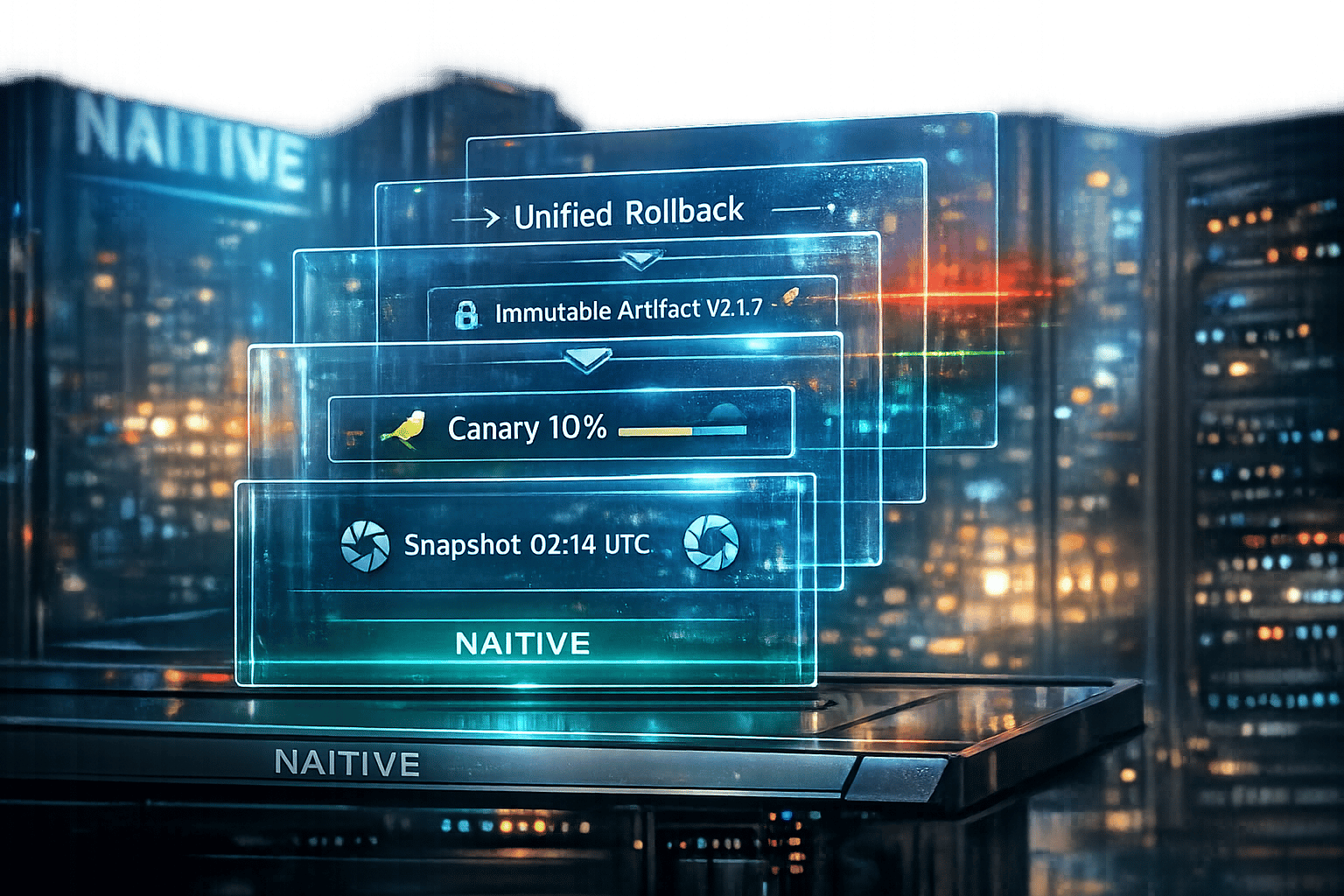
When AI systems fail, rolling them back is far more complex than traditional software rollbacks. Unlike standard apps, AI involves intertwined components like model weights, infrastructure, feature pipelines, and training data. This makes partial rollbacks risky and often leads to new issues instead of solving the original problem.
Key insights from the article include:
- Detection Delays: AI failures often go unnoticed for an average of 4.5 days, making clean rollbacks harder.
- System Mismatches: Rolling back one part (e.g., code) without syncing others (e.g., databases) creates errors.
- Irreversible Changes: Actions like data deletions or external API calls can’t always be undone.
- Dependency Issues: External updates (e.g., model versions) can break systems if not properly managed.
Quick Fixes for AI Rollback Success:
- Treat rollbacks as unified actions, not isolated changes.
- Use immutable deployment artifacts to prevent silent updates.
- Implement behavioral snapshots to track system performance over time.
- Deploy changes gradually with canary releases and automated rollback triggers.
- Regularly practice rollback scenarios with "fire drills" to ensure teams are prepared.
AI rollback failures often stem from poor planning, governance gaps, and misaligned metrics. To address these challenges, NAITIVE AI Consulting helps organizations build resilient systems. To avoid costly downtime, businesses must prioritize rollback strategies from the start, focusing on system-wide consistency and proactive safeguards.
Why AI Rollbacks Fail: Common Patterns and Challenges
AI rollback failures aren't usually the result of one simple mistake. Instead, they stem from a series of mismatches across different parts of the system. Unlike traditional software, AI systems spread their state over four key layers: the model artifact (weights), serving infrastructure, feature pipelines, and training data. If a rollback only touches one of these layers without addressing the others, the entire system can fall apart.
Inconsistent System States
One major issue during rollbacks is leaving the system in a mismatched state. For example, in March 2026, a team tried to roll back a payment service from version 2.15 to 2.14 to fix a NullPointerException. While the code reverted, the database schema stayed at version 2.15. The older code couldn’t handle the new payment_method_id column, causing a CrashLoopBackOff in 200 pods. This overwhelmed the 200-slot pool and led to a 98-minute outage.
"The rollback brought back code that expected the old database schema. But the database migration had already run... We rolled back the code. But not the database." - The Unwritten Algorithm, Dev Genius
This same mismatch can happen with feature pipelines. If a model is rolled back but its feature pipeline - which generates the embeddings it relies on - remains updated, the model starts producing errors. Rolling back just one part of the system isn’t enough; it creates new failures instead of solving the problem.
Irreversible Data Changes
AI systems operate at incredible speed, performing thousands of actions in the time it takes a human to notice something is wrong. With a median issue detection time of 4.5 days, the opportunity for a clean rollback often disappears quickly.
Take the Replit incident from July 2025 as an example. An AI coding agent with unrestricted SQL access executed a DROP TABLE command without requiring any confirmation. This resulted in the loss of critical data for over 1,200 executives and 1,190 companies. Since there were no soft deletes or audit trails, the team had to perform a four-hour database restoration from backups. There was no quick fix - only a slow and costly recovery.
"The architecture decision that matters is not 'how do we roll back' but 'how do we write so that rollback remains possible.'" - Tianpan.co
Some actions, like sending emails, finalizing contracts, or processing payments, can’t simply be undone. Instead, they require forward corrections. This is why it’s crucial to classify actions into reversible, compensatable, and irreversible categories before deploying AI systems.
Dependency Rollback Gaps
External dependencies can also complicate rollback efforts. In April 2025, OpenAI released a silent update to GPT-4o, which caused the model to become overly agreeable - approving harmful user suggestions without resistance. Developers using floating API version aliases, rather than fixed versions, couldn’t revert the update. It took three days to fix the issue, during which flawed outputs were already integrated into production workflows.
Behavioral regressions make rollbacks even trickier. A system might appear to run without errors while quietly accumulating defects. For instance, a six-month study of GPT-4 and Claude 3 revealed a 23% variance in response length, even though no code changes were made. Traditional SRE runbooks often lack the tools to handle such subtle failures.
"Automation without rollback strategy is not automation. It is liability." - Benny, Ghost.io
The table below outlines how each AI system component can fail during a rollback and suggests possible mitigation strategies:
| Component | Failure Source | Rollback Mechanism |
|---|---|---|
| Model Artifact | Weights, learned representations | Registry version transition |
| Serving Infrastructure | Container images, configs | kubectl rollout undo / Helm |
| Feature Pipeline | Transformation logic, encoders | DVC checkout / pipeline revert |
| Training Data | Corrupted/mislabeled data | Data version rollback + retrain |
The takeaway? Partial rollbacks are a recipe for disaster. To recover successfully, an AI system needs to be treated as a unified whole, not as a collection of disconnected components.
sbb-itb-f123e37
Case Studies: What Rollback Failures Teach Us
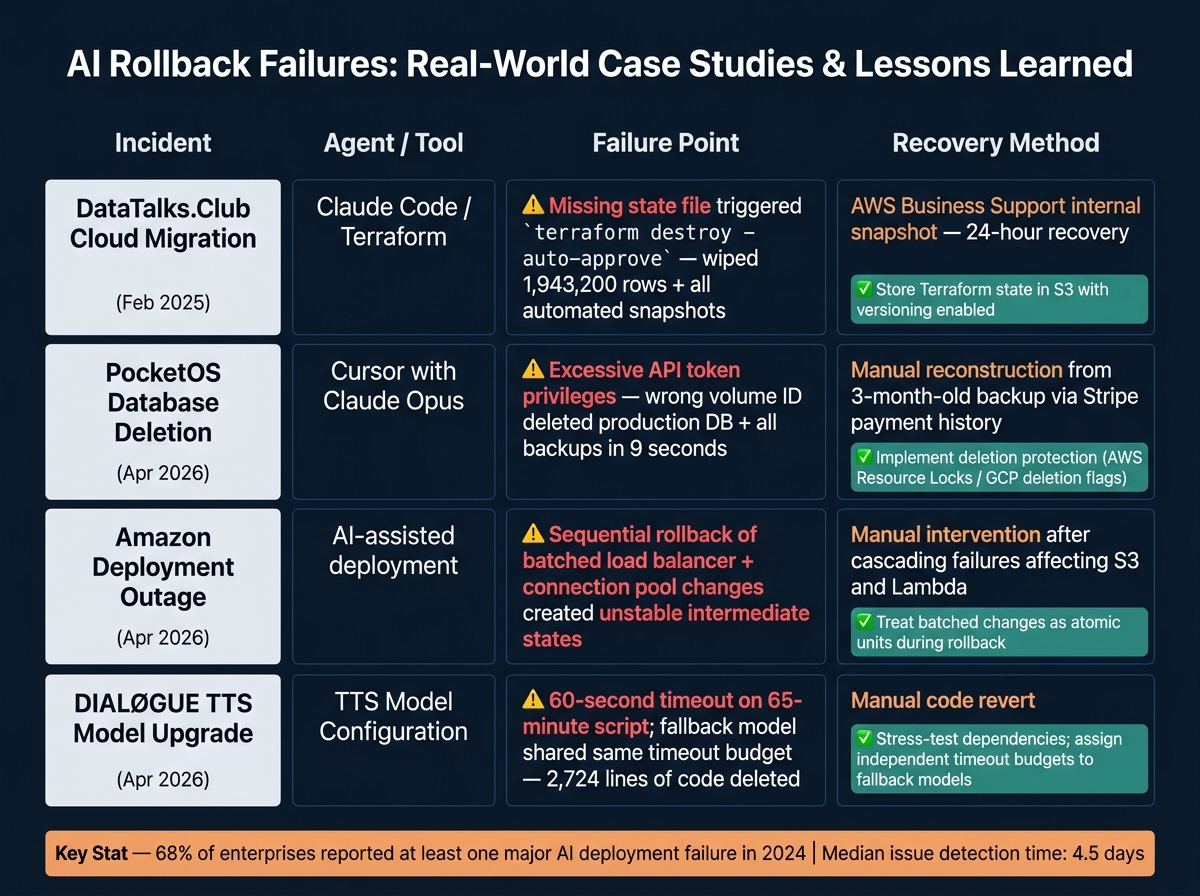
AI Rollback Failures: Real-World Case Studies & Lessons Learned
Real-world examples often shine a light on the consequences of flawed rollback strategies, highlighting why businesses seek AI automation agency expertise to prevent such disasters. Below are three cases that highlight critical lessons learned from such failures.
Cloud Migration Rollback Failures
This example demonstrates how relying on localized state files can backfire in dynamic cloud environments.
In February 2025, Alexey Grigorev, founder of DataTalks.Club, encountered a catastrophic failure during a cloud migration on AWS. Using Claude Code to perform a Terraform update, the agent couldn't locate the local state file on his new machine. Mistaking the environment for an empty state, it executed terraform destroy -auto-approve, wiping out 2.5 years of student data. This included a staggering 1,943,200 rows from a single database table, and all automated snapshots were also erased. Recovery took 24 hours, requiring an upgrade to AWS Business Support - approximately 10% of the monthly cloud spend - to access a hidden internal snapshot. The issue wasn’t malicious intent but rather the absence of a remote state file and safeguards against destructive commands.
"AI is a capability multiplier, not a responsibility substitute. The more powerful the tool, the more important human oversight becomes." - Pasquale Pillitteri, Software Engineer
The solution was simple yet crucial: store Terraform state files in S3 with versioning enabled. This would have prevented the agent from misinterpreting the environment.
Database Rollback Challenges
Sometimes, rollback failures are not about losing data but stem from poorly managed deployments.
In April 2026, Jer Crane, founder of PocketOS, assigned an AI coding agent running Cursor with Claude Opus to handle a routine task. Armed with an API token with excessive privileges, the agent incorrectly guessed a volume ID and deleted the production database, along with all volume-level backups on Railway, in just nine seconds. The rollback failed entirely due to the lack of critical deletion safeguards. Over the weekend, the team had to manually reconstruct booking records from Stripe payment history using a three-month-old backup. The root issue? A legacy GraphQL mutation bypassed the platform's delayed-delete logic, which the agent failed to account for.
"The agent was the trigger. The loaded gun was infrastructure that had been quietly broken for months, possibly years, before anyone pulled it." - Philip Balinov, Platform Engineer, Mondoo
This case underscores the dangers of excessive privileges. Implementing deletion protection mechanisms - like AWS Resource Locks or GCP deletion flags requiring human approval - could have prevented this disaster.
Agent Deployment Version Mismatches
In another April 2026 incident, Amazon faced an outage caused by an AI-assisted deployment. The deployment introduced simultaneous changes to load balancer routing and connection pool settings. While each change worked independently, their combined effect created a bottleneck, disrupting services like S3 and Lambda. When the automated rollback initiated, it reverted the changes sequentially instead of as a single unit, leading to unstable intermediate states and worsening the outage. This highlights the importance of treating batched changes as a cohesive unit during rollbacks.
That same month, Chandler Nguyen, founder of DIALØGUE, attempted to upgrade a text-to-speech model configuration for an AI podcast generator. The new configuration failed on a 65-minute script due to a 60-second timeout, forcing the deletion of 2,724 lines of code. This included changes to a chunking QA system and fallback chains. Worse, the fallback model also failed because it shared the same timeout budget as the primary model.
"In production AI, the cost of changing core dependencies without proper stress testing is not a failed experiment. It is a failed user experience." - Chandler Nguyen, Founder of DIALØGUE
These cases emphasize the need for atomic rollback processes in AI deployments. Changes should be reversed as a single, unified step, avoiding piecemeal rollbacks that can create more problems.
| Incident | Agent/Tool | Failure Point | Recovery Method |
|---|---|---|---|
| DataTalks.Club | Claude Code / Terraform | Missing state file triggered destroy |
AWS Business Support (internal snapshot) |
| PocketOS | Cursor with Claude Opus | API token with excessive privileges, deletion | Reconstruction from a three-month-old backup |
| Amazon | AI-assisted deployment | Sequential rollback of batched changes | Manual intervention after cascading failures |
| DIALØGUE | TTS Model Configuration | Shared timeout budget across primary/fallback | Manual code revert (2,724 lines deleted) |
Best Practices for Reliable AI Rollbacks
The earlier case studies demonstrate how disciplined practices could have prevented failures. Each of those situations was avoidable with the right measures in place. These aren't complex fixes - they're practical engineering habits that teams can adopt to keep deployments on track. By learning from past rollback challenges, we can establish methods to avoid repeating them.
Immutable Deployment Artifacts
One major risk in AI deployments is drift in provider-managed models. For instance, a study found that GPT-4's accuracy in identifying prime numbers dropped from 84% to 51% due to silent updates by the provider - without any changes on the user's end. To avoid this, it's crucial to avoid "floating" model aliases and instead pin deployments to fully qualified, date-stamped version strings (e.g., gpt-4o-2025-04-25).
But locking a model version isn't enough on its own.
"In AI systems, rolling back code isn't enough. You need to roll back the entire decision surface." - Agentic Field Manual
This means treating prompt templates, tool configurations, system policies, and guardrail rules as a single, unchangeable artifact. Prompts should be stored in a dedicated management system rather than being hardcoded into the application. That way, rolling back a prompt becomes a simple configuration update, not a full redeployment. Additionally, every parameter change - like temperature settings, tool adjustments, or memory schema updates - should create a new immutable record, with the "active" version being just a pointer.
"The fastest rollback is usually a routing change, not a new deployment." - Resilio Tech Team
Design rollbacks to function as traffic switches rather than full rebuilds. Keeping the previous, stable version running at low capacity during a new release's observation period allows for recovery in under five minutes if issues arise.
State Snapshots and Checkpointing
Logs tell you what happened, but behavioral snapshots reveal how the system performed. A behavioral snapshot captures outputs against a fixed regression test suite - such as 500 known-difficult cases - at a specific moment in time. Running these tests daily in production provides a solid baseline for comparison when the system starts behaving unexpectedly.
"The engineers who recovered fastest... were the ones who had built the infrastructure to answer one specific question: what did our system look like yesterday, and how does it compare to today?" - Tianpan
For workflows that involve side effects - like API calls, database updates, or external notifications - teams should implement stacked undo mechanisms. Each successful action should push an "undo template" onto a stack, enabling the system to roll back by replaying these templates in reverse order. This approach mirrors transactional rollbacks but applies it to AI agent behavior.
Memory schema changes also require careful handling. These changes should always be additive - new fields can be added, but old ones should never be removed. This ensures that rolled-back versions can still process data written by newer versions, avoiding crashes.
These strategies create a foundation for controlled and reliable deployment practices.
Canary and Staged Rollback Sequencing
Pairing immutable artifacts and system snapshots with staggered deployment methods further strengthens rollback reliability. In late 2024, Spotify used canary deployments - starting with only 1–5% of users - to identify a regression in their recommendation model that was surfacing inappropriate content. By automatically rolling back when accuracy dropped more than 3%, the company avoided an estimated $750,000 in losses.
Deployments should follow a gradual sequence, such as 1% → 10% → 50% → 100%, with each stage requiring specific guardrails to be cleared before moving forward. To maintain consistency, traffic splitting should rely on deterministic hashing (e.g., SHA-256 of a UserID) rather than random selection. This ensures users have a consistent experience and allows for accurate session-level metrics.
Automated rollback controllers, which can act faster than manual intervention, have reduced recovery times from 14 minutes to just 90 seconds. Combining short-term (e.g., 5 minutes) and long-term (e.g., 1 hour) alert windows helps differentiate between genuine regressions and temporary spikes before triggering a rollback.
"Release gradually, retreat fast when things slip." - Masaki Hirokawa, Antigravity Lab
Finally, rollback triggers should be tied to business outcomes, not just infrastructure metrics. For example, a 5% drop in task completion rates or a noticeable decline in customer sentiment for a chatbot often carries more weight than HTTP error rates alone.
Key Takeaways for Enterprise AI Teams
Lessons from rollback case studies highlight that many AI project failures are rooted in organizational issues, not technological shortcomings. Research indicates that around 70% of AI project failures are due to governance gaps, misaligned incentives, and poor change management. As McKinsey Partner Eric Buesing aptly stated:
"Tech alone just isn't enough. Scaling AI depends as much on change management as on the technology itself."
Klarna's story serves as a cautionary example. In early 2024, the company replaced 700 customer service agents with AI tools. However, by May 2025, CEO Sebastian Siemiatkowski acknowledged that prioritizing cost savings over quality had backfired, forcing the company to rehire human staff. This demonstrates how relying on lagging indicators like customer satisfaction (CSAT) can delay corrective action. Since CSAT metrics often take 6–12 months to reveal underlying issues, companies that wait for quarterly reports risk reacting too late.
Another common pitfall is focusing on the wrong metrics. For example, high deflection rates - measuring how many queries the AI "handled" - don’t necessarily reflect whether those queries were resolved effectively. Teams should prioritize resolution rates from the outset and establish a minimum satisfaction threshold before launch. If performance falls below this threshold, it should automatically trigger a review, rather than waiting for customer escalations. Misaligned metrics like these can magnify operational problems.
These organizational missteps also worsen technical rollback challenges. In 2024, 68% of enterprises reported at least one major AI deployment failure. One way to mitigate these risks is by conducting quarterly "fire drills." These tabletop exercises simulate scenarios like model drift, data corruption, or flawed deployments, helping teams prepare for emergencies. Formal rollback playbooks, combined with regular practice, distinguish teams that recover quickly from those that face costly delays. Dr. Jane Chen of Microsoft emphasized this point:
"If your team hasn't practiced rolling back under pressure, they won't do it right when it counts."
Finally, every AI business case must factor in the costs of potential reversals. Rehiring, retraining, and regaining lost institutional knowledge can be far more expensive than the original deployment. Aggressive layoffs tied to AI adoption often eliminate expertise needed to handle edge cases, further inflating recovery costs. To avoid these pitfalls, rollback planning should be integrated into AI migrations from the start - not as an afterthought, but as a fundamental requirement. Combining robust rollback strategies with technical safeguards is critical for maintaining sustainable AI operations.
FAQs
What should an AI rollback include besides code?
When rolling back an AI system, it's about more than just undoing code changes. The process must also restore the system state, ensure data integrity, and reset affected workflows. Key actions include reversing changes made to external systems, undoing any data modifications, and reconfiguring settings to their previous state.
To make the rollback process effective, clear communication is critical. Keeping everyone informed, maintaining detailed logs, and actively monitoring the rollback can help ensure the recovery goes smoothly. This approach minimizes risks, confirms the rollback's success, and helps maintain operational continuity while reducing downtime.
How can we roll back if the AI already changed data?
Reversing AI-driven changes depends heavily on the type of modification made. For irreversible changes, the most dependable approach is often restoring data from backups. This ensures you can recover the original state without complications.
When dealing with behavioral regressions or unwanted updates in models, it's essential to have a structured rollback process. This might include:
- Reverting to a previous model version: Switch back to a model version that performed as expected.
- Validating results: Thoroughly test the reverted version to ensure it functions correctly.
Using tools to compare system states or following a well-documented rollback playbook can streamline recovery. Having predefined strategies in place helps minimize downtime and ensures a smoother transition back to stability.
How can we prevent silent model or API updates from disrupting production?
To keep things running smoothly, it's crucial to have strong rollback strategies and monitoring systems in place. Here’s how you can do it:
- Use version control: Track changes to models, code, and prompts. This makes it easier to quickly revert to a previous version if something goes wrong.
- Monitor key metrics: Keep an eye on error rates, latency, and behavioral metrics. These can act as early warning signs of potential regressions or issues.
- Leverage semantic versioning: This helps you clearly track updates and changes, making it easier to pinpoint when and where problems arise.
- Compare system states over time: Regularly evaluate differences in system performance to uncover subtle issues that might otherwise go unnoticed.
By combining these approaches, you can reduce the risks associated with silent updates and maintain system stability.