
Voice AI in Healthcare: ROI Case Studies
Voice AI case studies showing rapid ROI, large cost and time savings, and improved patient experience.

Voice AI is transforming healthcare by automating routine tasks, saving time, and cutting costs. Healthcare providers are achieving impressive results, including:
- 300%-600% ROI in the first year.
- Cost savings: Evergreen Family Medicine saved $650,000 in 2 months; Medtronic saved $6 million in under a year.
- Time efficiency: Organizations reclaim thousands of staff hours (e.g., 20,000 hours in 2 months at Evergreen).
- Improved patient experience: Reduced hold times, increased call containment rates, and fewer no-shows (up to 45% reduction).
Voice AI integrates with systems like Epic and athenahealth, automating tasks such as scheduling, insurance verification, and payment processing. Whether for small clinics or large hospital networks, the financial and operational benefits are immediate and measurable.
The ROI on Voice AI Is More Than Just Cost Savings with Sneh Patel, CEO of Delfino AI
sbb-itb-f123e37
Voice AI ROI Case Studies
Voice AI is helping U.S. healthcare organizations tackle inefficiencies while delivering impressive returns on investment (ROI). These case studies highlight a range of implementations and the rapid financial benefits they bring to different healthcare environments.
Sully.ai: Boosting Call Efficiency for Clinics
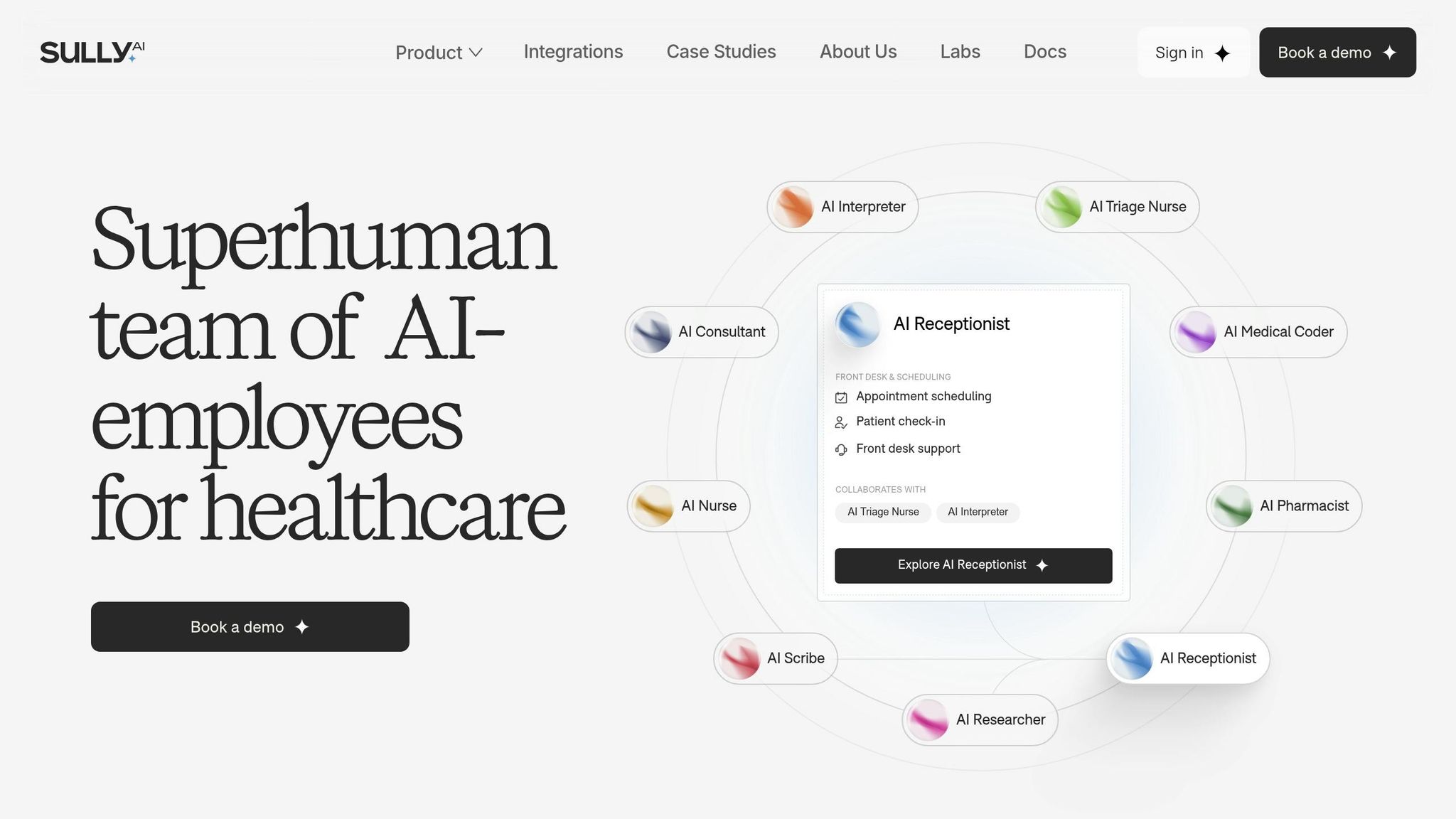
Small and mid-sized clinics using Sully.ai's AI Receptionist have seen dramatic improvements. By automating tasks like scheduling, refill requests, and general inquiries, clinics achieved a 100% call answer rate and saved 15–20 hours of staff time weekly. This translated into an average annual cost savings of $87,000 and a 14x ROI. Sully.ai integrates seamlessly with EHR systems, eliminating manual data entry for appointments. Its 24/7 availability also ensures after-hours appointments are captured, making it a game-changer for smaller practices looking to streamline operations.
Wellstar Health and 3CLogic: Optimizing Contact Center Operations
Larger healthcare systems, like Wellstar Health in Georgia, have also reaped significant benefits from voice AI. Using 3CLogic's ServiceNow-native AI, Wellstar improved its Service Desk operations, which support 26,000 employees. The results? Monthly staffing savings of 250 hours - equivalent to 18 full-time employees annually - along with a 55% reduction in agent wrap-up time, a 58% drop in idle time, and a 75% decrease in administrative escalation audits. By reducing its contractor count from 80 to 45, Wellstar maintained service quality while cutting costs.
Dianne Kokotoff, Executive Director of Enterprise Solutions & Automation at Wellstar Health, highlighted the impact:
"The connection of the conversation with the ticket has saved us an enormous amount of hours."
This example shows how voice AI can scale to meet the needs of large, complex organizations.
HCA Healthcare Continental Division and Parlance IVR
HCA Healthcare's Continental Division implemented Parlance voice AI across 10 hospitals in just six weeks. From day one, the system achieved a 52% call offload rate, eventually handling over 70% of external calls. This allowed HCA to consolidate telecommunications operations and reduce full-time staff by 50%. Even more impressive, HCA achieved full ROI within 90 days - a swift turnaround for such a large-scale deployment. The system's medical lexicon ensured it could handle complex department names and medical terminology with ease.
Andy Draper, Regional CIO of HCA Healthcare, shared:
"ROI for Parlance occurred within 90 days! If you're a CIO looking for a quick win in the budget cycle, I would do this."
This rapid ROI underscores the financial benefits voice AI can deliver across hospital networks.
Syntora AI Voice Agents: Affordable Automation for Small Clinics
Smaller clinics using Syntora's custom voice agents reported a 60–80% reduction in staff time spent on routine calls. Unlike subscription-based pricing, Syntora charges a fixed build cost with predictable monthly hosting fees, often under $100. These voice agents handle tasks like appointment scheduling, insurance verification, and prescription refill requests while integrating directly with EHR systems such as Epic, Cerner, and athenahealth. Most clinics see ROI within six months, proving that even small practices can benefit from advanced automation.
These examples demonstrate how voice AI is transforming healthcare operations, from small clinics to large hospital networks, with measurable and often rapid financial returns.
ROI Comparison Across Case Studies
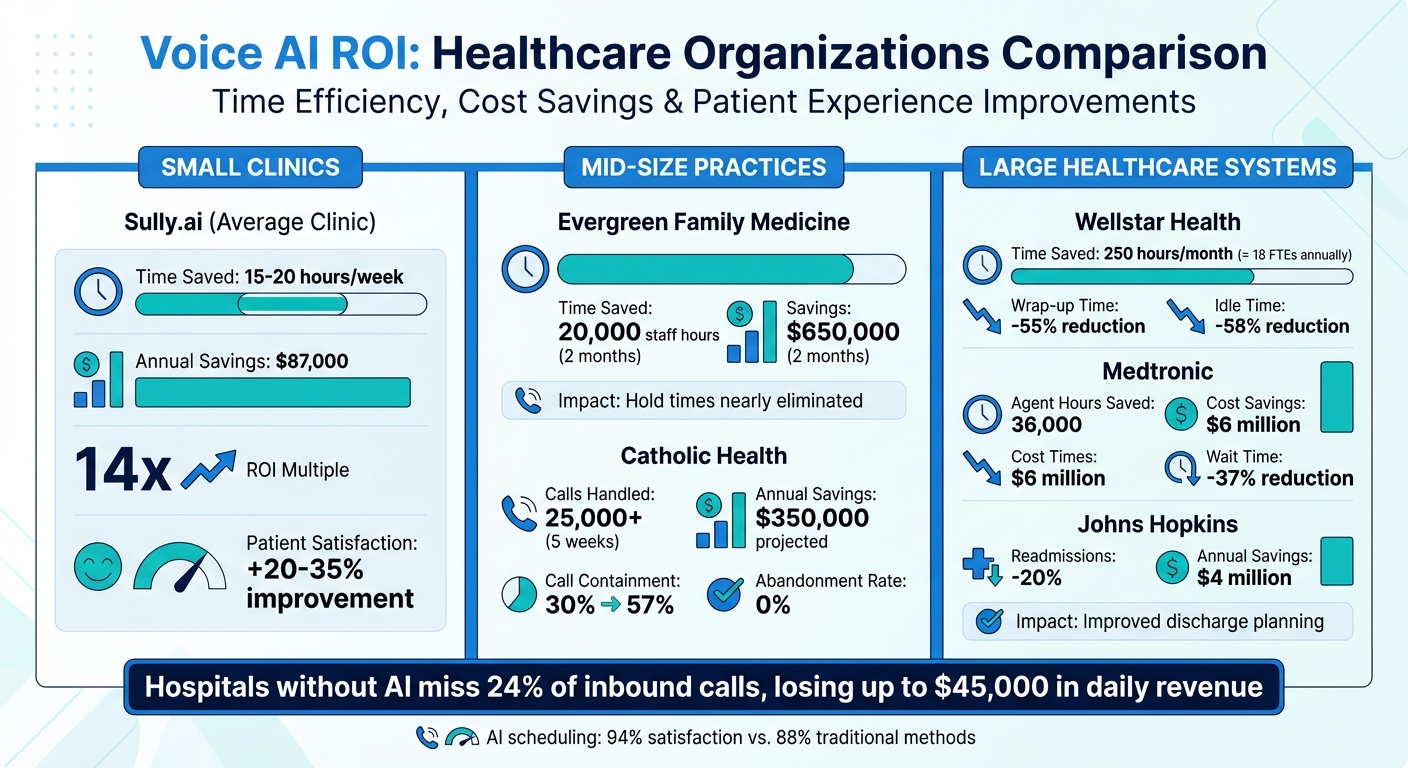
Voice AI ROI Comparison: Healthcare Organizations Cost Savings and Efficiency Gains
Looking at the case studies, it's clear that the return on investment (ROI) varies significantly depending on the size of the healthcare organization and the scope of the implementation. Smaller clinics save around $87,000 annually, while mid-sized practices like Evergreen Family Medicine report $650,000 in savings within just two months. On the other end of the spectrum, large systems such as Johns Hopkins Hospital achieve $4 million in annual savings by reducing readmissions.
Time savings also grow with the size of the organization. For instance, smaller practices recover 15–20 staff hours weekly, while larger systems like Wellstar Health save the equivalent of 18 full-time employees annually. These efficiencies translate directly into better operational workflows and reduced administrative burdens.
When it comes to patient experience, the improvements are consistent across different implementations. For example, voice AI scheduling systems achieve a 94% satisfaction rate, outperforming the 88% satisfaction rate of traditional scheduling methods. Catholic Health demonstrated notable success, increasing call containment rates from 30% to 57% while maintaining a 0% abandonment rate. This is critical, as hospitals without AI solutions miss an average of 24% of inbound calls, potentially losing up to $45,000 in daily revenue.
ROI Metrics Comparison Table
Here's a closer look at the ROI metrics across various organizations:
| Organization | Time Efficiency Gain | Financial Impact | Patient/Staff Improvement |
|---|---|---|---|
| Evergreen Family Medicine | 20,000 staff hours reclaimed (2 months) | $650,000 saved in 2 months | Hold times nearly eliminated |
| Sully.ai (Avg. Clinic) | 15–20 hours saved per week | $87,000 annual savings; 14x ROI | 20–35% satisfaction improvement |
| Catholic Health | 25,000+ calls handled (5 weeks) | $350,000 projected annual savings | 57% call containment; 0% abandonment |
| Wellstar Health | 250 hours saved per month | Savings equivalent to 18 FTEs annually | 55% reduction in wrap-up time |
| Medtronic | 36,000 agent hours saved | $6 million cost savings | 37% wait time reduction |
| Johns Hopkins | 20% fewer readmissions | $4 million annual savings | Improved discharge planning |
This table highlights a key trend: organizations that integrate voice AI directly with their EHR systems or ITSM platforms see quicker and more impactful results. By eliminating manual data entry and cutting down on administrative tasks, these integrations drive both financial gains and operational improvements.
NAITIVE AI Consulting Agency: Delivering Healthcare ROI with Voice AI
While the earlier examples highlight strong results, achieving these outcomes requires deep expertise in healthcare operations and AI technology. NAITIVE AI Consulting Agency specializes in creating autonomous voice agents tailored for medical practices, handling the technical intricacies to provide immediate returns.
Custom AI Solutions for Healthcare Providers
Every project begins with a 30-minute discovery call to outline call types, scheduling processes, compliance requirements, and escalation protocols. From there, NAITIVE develops a solution specifically designed for the practice. Their voice agents integrate seamlessly with major EHR/EMR platforms like Athena, Epic, NextGen, Kareo, and DrChrono.
These solutions can manage up to 80% of routine medical office calls, which often include tasks like:
- Appointment scheduling: 35% of calls
- Prescription refills: 20% of calls
- Lab result notifications: 10% of calls
Each implementation ensures strict compliance with healthcare regulations. This includes signed Business Associate Agreements (BAAs), HIPAA-compliant infrastructure, and comprehensive audit logs, with no PHI stored on unsecured systems.
NAITIVE’s agents are designed with adaptive intelligence, enabling them to handle complex scenarios. For instance, after-hours calls are triaged based on urgency - emergencies are directed to 911, while non-urgent matters are queued for the next morning. This ensures patient safety while reducing potential revenue loss.
By tailoring these integrations to the unique needs of each practice, NAITIVE sets the foundation for measurable financial gains.
Track Record in ROI-Driven Deployments
NAITIVE’s focus on customized solutions has consistently delivered rapid and measurable results. From the initial discovery call to go-live, deployments are completed in just 2–3 weeks. Practices often see reduced front-desk workloads within the first week.
The financial benefits are clear. Automating just 3 hours of daily phone time saves approximately $13,500 annually per full-time employee. For a solo practice missing 15 appointments weekly (valued at $150 per visit), NAITIVE’s agents can help recover a significant portion of the $117,000 in annual revenue typically lost to no-shows.
One standout example comes from the Midwest Regional Health Network in Chicago. In March 2024, they wrapped up a 9-month deployment of NAITIVE’s voice assistant integrated with their EHR. The results were impressive:
- Call wait times: Reduced from 25 minutes to under 3 minutes (an 88% improvement)
- Call automation: 67% of incoming calls handled by the AI
- Cost savings: Approximately $1.2 million annually in operational expenses
- Scheduling accuracy: Improved to 98.5%
"NAITIVE architects for maximum impact, tangible ROI to your business. Not another widget that echo's claims from a monotonous past."
- NAITIVE AI Consulting Agency
To maintain and enhance these results, NAITIVE also provides managed services (AIaaS). This includes regular updates, fine-tuning, and performance monitoring to ensure long-term success.
Key Takeaways on Voice AI ROI in Healthcare
The examples above highlight some key strategies that drive success when implementing Voice AI in healthcare. By examining these real-world applications, it's clear that certain approaches consistently lead to strong returns on investment (ROI).
Success Factors for Voice AI Implementation
Certain elements stand out as critical for successful Voice AI adoption in healthcare:
- Deep system integration: Healthcare providers like Evergreen Family Medicine and Wellstar Health ensured that Voice AI tools seamlessly connected with their existing platforms, such as Epic, athenahealth, and ServiceNow. This eliminated the need for manual data entry, allowing patient information to flow directly into electronic health records (EHR) and support systems.
- 24/7 availability: Intermountain Health found that 27% of patient inquiries occurred after normal business hours. Automating these after-hours interactions helped reduce night-shift costs while boosting patient satisfaction.
- Focusing on high-volume, routine tasks: Automating tasks like appointment scheduling and prescription refills allowed organizations to recover costs quickly while enabling staff to focus on more complex patient care.
- Exact transcription for accuracy: Capturing patients' exact words - rather than summaries - proved essential for clinical decision-making. This approach ensured providers had the full context needed for accurate diagnoses and treatment plans.
These factors provide a solid foundation for actionable strategies that healthcare leaders can adopt.
Recommendations for Healthcare Decision-Makers
To maximize ROI, healthcare leaders should consider these practical steps from an AI consulting agency:
- Start with continuous clinical documentation: If reducing physician burnout is a priority, focus on automating after-hours documentation. This approach, often referred to as reducing "pajama time", can deliver ROI within 6–12 months. For example, enterprise deployments have shown an average ROI of 451% across 150 implementations.
- Leverage real-time analytics: From the outset, ensure Voice AI solutions provide real-time insights. Catholic Health used analytics dashboards to boost call containment rates from 30% to 57%, saving approximately $350,000 annually.
- Adopt phased rollouts: Gradual deployment allows organizations to test high-impact areas, measure results, and scale effectively. Medtronic’s phased approach saved $6 million and supported over 1.05 million voice sessions by mid-2023.
- Ensure HIPAA compliance from the start: Choose solutions with built-in HIPAA safeguards and Business Associate Agreements. This avoids the costs and delays of retrofitting compliance measures later on.
As Sneha Patel, CEO of Metroplex Medical Centres, puts it:
"You can be afraid of AI, or you can use it to free staff to care for patients."
FAQs
How do I calculate ROI for a voice AI rollout in my clinic?
Calculating ROI involves evaluating the financial benefits your investment brings, such as saving staff hours, reducing no-shows, and boosting revenue through improved patient engagement. Start by translating these benefits into dollar amounts. Then, subtract the total costs of the investment - this includes software, integration, and training expenses. Finally, divide the net benefit by the initial investment to determine the ROI percentage.
Real-world case studies reveal that ROI can often hit impressive levels, ranging from 300% to 600% in the first year, especially when tracking metrics like cost reductions and added revenue.
What EHR systems can voice AI integrate with?
Voice AI can work seamlessly with Electronic Health Record (EHR) systems like Epic, athena, and other widely used digital tools in healthcare. By connecting these platforms, it simplifies workflows and boosts efficiency in patient care processes.
How is HIPAA compliance handled for voice AI phone agents?
Ensuring HIPAA compliance for voice AI phone agents involves building systems that adhere to stringent security and privacy standards. This means implementing secure data transmission, strong access controls, and effective management of protected health information (PHI). These steps align with healthcare AI deployment guidelines, helping to safeguard the confidentiality and integrity of sensitive patient information.