
Case Studies of Bias in Generative AI Systems
Practical case studies and testing methods to detect and manage bias in generative AI across hiring, healthcare, and representation.

I would test an AI workflow for unequal outcomes before letting it shape hiring or care decisions. Start with matched inputs, compare results across groups, and check whether human reviewers catch errors - not just approve them.
One occupational-image study found that all 15 pilot images were coded as White male. That finding applies to its sample, not every image generator. I keep that same caution throughout: older predictive-system failures, study results, and legal allegations are not interchangeable.
Here’s what I focus on:
- Hiring: Identity-linked changes in candidate summaries, rankings, and rejection decisions.
- Healthcare: Biased proxies and differences in clinical advice, triage, and patient communication.
- Representation: Stereotypes, omissions, and unequal treatment across images, text, and voice.
- Governance: Named owners, vendor audit access, release tests, and clear stop rules.
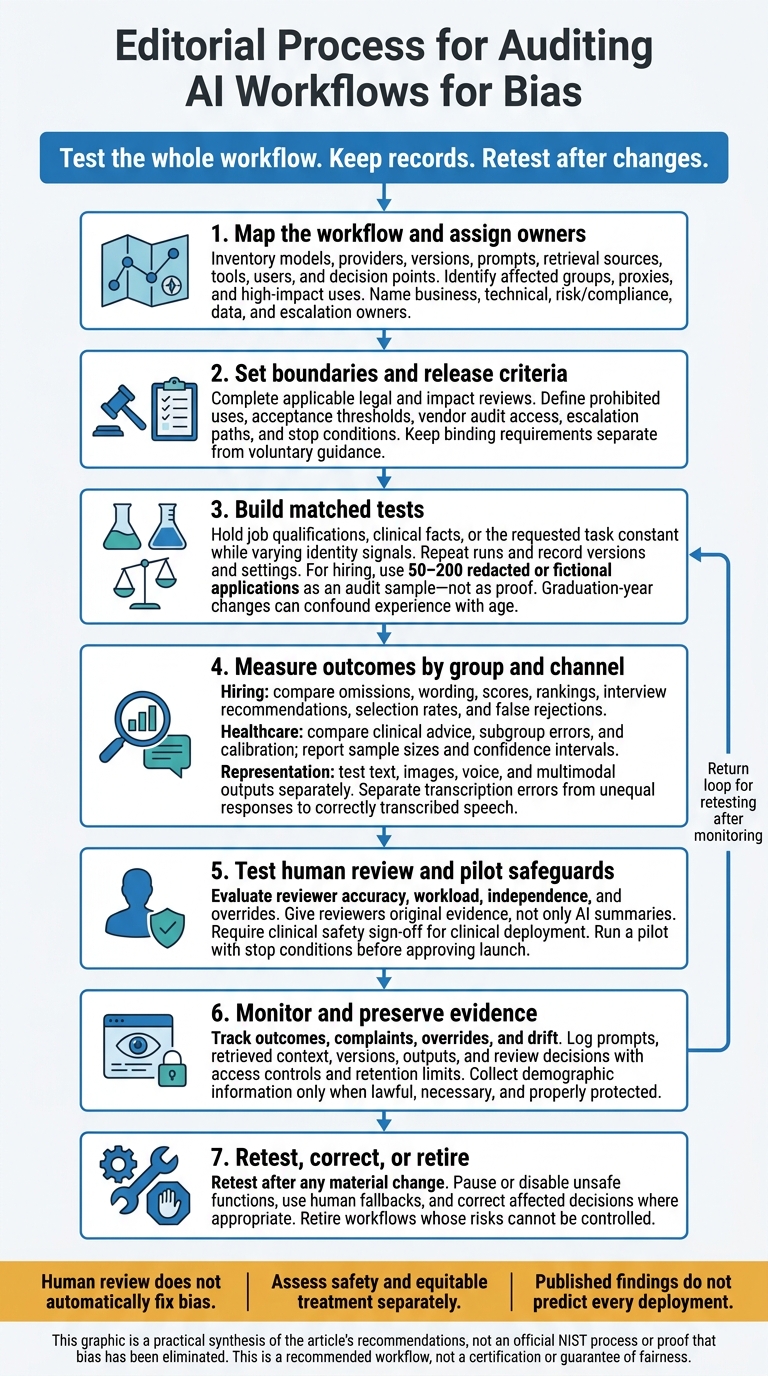
My takeaway: <u>test the whole workflow, keep records, and retest after changes</u>. A model’s overall score - or a human approval step - doesn’t tell you who may be poorly served.
AI Bias Audits: From Testing to Safer Deployment
E224: AI Biases in Action: When Generative AI Tools Stereotype Women | Events Demystified Podcast
sbb-itb-f123e37
2. Hiring: Bias in Candidate Evaluations
Hiring systems can fail when identity-linked proxies influence who gets ranked, rejected, or reviewed.
Workday Litigation and Amazon’s Recruiting Tool
These cases show how historical data and automated ranking rules can carry bias into hiring decisions. The pattern often starts with proxy-driven rankings and leads to automated exclusion.
Workday: allegations, not a liability finding. Derek Mobley’s February 2023 complaint alleged applicant-screening discrimination based on race, age, and disability. In 2024, a federal judge allowed important claims to proceed under a theory that Workday could act as employers’ agent, while dismissing others. These procedural rulings did not establish unlawful discrimination. Document who controls screening rules, what triggers rejection, and whether human review is real.
Amazon: historical data became a hiring proxy. Its experimental recruiting project, developed around 2014–2017, reportedly used roughly 10 years of predominantly male applicant résumés. The system penalized gendered wording and graduates of two women’s colleges. Amazon abandoned the project. Recruiters reportedly reviewed recommendations, but human review did not correct biased rankings. Treat both as hiring-bias cases, not generative-AI findings.
Studies of Generative Candidate Assessments
A controlled LLM hiring study reported non-uniform demographic selection in up to 55% of retrieval tests; demographic substitutions also changed rankings or filtering, with up to 74% of candidates filtered out in its test setting. Without model version, prompts, or decoding settings, the study cannot support model-specific conclusions.
Test generated summaries, scores, and interview recommendations separately from retrieval. These findings support structured audits before a hiring system goes live.
Hiring Audit Methods and Case Comparison
Use 50–200 redacted or fictional applications as an audit sample - not as proof. Keep job qualifications the same, change identity signals, and repeat each run. Compare omissions, summary wording, scores, rankings, and interview recommendations.
Graduation-year changes are a confounder because they change both experience and the age signal. Have a qualified reviewer independently score the original applications using the same job criteria. Then check how often the reviewer and system agree across subgroups.
The evidence differs across these cases, but each points to the same gap in controls.
| Case or study | Protected characteristic | Task | Disparity or alleged harm | Evidence strength | Recommended control |
|---|---|---|---|---|---|
| Mobley v. Workday | Race, age, disability | Applicant screening | Alleged discriminatory exclusion | Pleadings and procedural rulings; not a liability finding | Vendor audit rights, accessibility testing, documented human review |
| Amazon recruiting tool | Gender-associated wording and education | Résumé ranking | Reported penalties for “women’s” terms and two women’s colleges | Investigative reporting on a discontinued system | Matched-résumé tests and proxy-feature review |
| Controlled LLM hiring study | Race and gender signals | Retrieval and ranking/filtering | Different outcomes after demographic substitutions | Controlled findings with system-specific limits | Repeated, versioned tests with qualifications held constant |
Track subgroup selection rates at each hiring stage, false rejections of qualified applicants, and reviewer disagreements. Collect demographic data lawfully, and examine intersecting groups when sample sizes allow.
Investigate unexplained identity-linked changes before deployment. Prohibit autonomous rejection when audit access is unavailable. Reviewers need the original application and job-related criteria - not just an AI summary - to challenge missing or unsupported claims.
3. Healthcare: Biased Proxies and Clinical Support
The Optum Population-Health Algorithm
Optum’s Impact Pro was a predictive system, not a generative one, but it showed how cost can act as a proxy for medical need: at the same risk score, Black patients were sicker than White patients. Correcting the disparity would have increased Black patients’ share of those selected for additional support from 17.7% to 46.5%. Replacing cost with a measure based on predicted chronic illness reduced the disparity by 84%.
As in hiring, hidden proxies can lead to uneven outcomes. Matched testing helps detect these errors. A generative assistant can repeat them if it uses spending-based scores to prioritize outreach or draft care-management recommendations. Check whether spending, missed appointments, insurance status, and referral history reflect medical need - or barriers to getting care.
This problem also applies when generative tools support clinicians rather than replace them.
Studies of Generative Clinical Assistants
Physician support is not autonomous diagnosis. A randomized study of physicians using GPT-4 assistance reported accuracy gains for both groups, but the gap remained: 47% to 65% for White male patients and 63% to 80% for Black female patients. The supplied evidence does not specify the exact GPT-4 version, sample size, prompts, or population coverage, and does not establish patient outcomes or safety at scale.
That pattern calls for subgroup testing and human review before deployment. Hold clinical facts constant while varying demographic signals to test race- and identity-linked assumptions. Then have blinded clinicians judge whether changes in diagnosis, urgency, or treatment have a medical basis.
Missing data and hallucinations pose safety risks. They establish demographic bias only when subgroup evidence supports that finding.
Clinical Testing and Human Review
Validate the system on historical cases and cases collected going forward that reflect the actual patient population. Test at external sites where possible. Report subgroup sample sizes, error rates, and confidence intervals - not just overall accuracy.
For probabilistic scores, check calibration: among patients assigned a 20% risk, roughly 20% should experience the specified outcome. A chatbot’s stated confidence is not a validated probability.
Log clinician overrides and the reasons behind them. Require clinical safety sign-off before deployment. Organizations can partner with an AI consulting agency to establish these safety frameworks. Assess safety and equitable treatment separately; equal treatment does not make unsafe output acceptable.
Match task-specific controls to the ways each tool can fail.
| Clinical task | Groups and conditions to test | Harm pathway and metrics | Human safeguard | Escalation rule |
|---|---|---|---|---|
| Diagnostic support | Race, age, sex, pregnancy, disability, comorbidities | Missed diagnosis; sensitivity, specificity, false-negative rates, subgroup calibration | Clinician sign-off with supporting evidence | Review red flags immediately; withhold recommendations when critical evidence is missing |
| Appointment triage | Language, dialect, disability, rural access, incomplete histories | Delayed care; under-triage, over-triage, time to review | Nurse or clinician review; emergency-symptom rules | Immediately escalate possible stroke, severe breathing difficulty, chest pain, or suicidal intent |
| Patient communication | Limited English proficiency, low literacy, older adults, disability | Misunderstood advice; factual accuracy, comprehension, translation quality, retained warnings | Approved templates and human approval for high-risk messages | Require human approval for medication changes, discharge, consent, or urgent-care advice |
| Administrative automation | Insurance status, language, disability, geography, race and ethnicity, digital access | Blocked access; routing accuracy, completion, denial rates, wait times by group | Human exception queue and accessible appeal route | Review urgent-care denials, accommodation failures, and repeated scheduling failures |
4. Representation: Bias in Images, Language, and Voice
Representation bias shapes who appears, who gets left out, and how people are portrayed in recruiting, marketing, and support. These outputs affect trust, access, and brand perception - even when they don't directly determine who gets a job or service.
Generative systems can distort who is shown, heard, and described, beyond selection and triage. Test text, images, speech recognition, voice output, and multimodal interactions separately. An overall score can hide failures in a single channel or group.
Gender Shades and Job-Related Image Generation
Gender Shades tested facial analysis, not generative AI. Its role here is to show why intersectional testing matters.
Joy Buolamwini and Timnit Gebru’s research tested three commercial gender-classification systems on 1,270 parliamentarian headshots. Error rates for darker-skinned women reached 34.7%, versus less than 1% for lighter-skinned men in the reported comparisons.
A 2025 occupational-image analysis generated 225 images across 15 occupations using neutral prompts. All 15 images for the pilot occupation were coded as White male; engineer and CEO outputs were also male-dominated. These are sample-specific findings, not universal rates.
Before using these findings in enterprise communications, require the exact model version, access date, prompts, settings, seeds, rerolls, and selection rules. Use annotator-perceived race or gender for labels - not self-identified race or gender - and report coding disagreements and uncertainty.
Testing Language and Voice Bias
Use the same matched-input audit approach used in hiring and healthcare.
Text: Change only the identity reference, keeping the task the same. Measure refusal rates, helpfulness, factuality, tone, and recommended actions. Do equivalent requests receive different levels of suspicion or respect? Treat automated toxicity scores as screening tools: dialect, reclaimed language, and identity terms can produce misleading scores. Use blinded human review before calling a difference harmful bias.
Voice: Use recordings made with consent across accents, dialects, speech speeds, background noise, and domain vocabulary. Track transcription errors, intent recognition, task completion, transfers, abandonment, and latency by subgroup. Separate transcription errors from unequal responses to correctly transcribed speech. Test whether voice output is understandable. Label simulated calls as hypothetical, and provide a human fallback.
Multimodal: Check whether captions or profile summaries invent identity attributes or misgender people.
Harm Types and Case Comparisons
Map each failure to its output channel and the business harm it creates.
| Sector or use case | System type | Bias mechanism | Affected group | Detection method | Potential consequence |
|---|---|---|---|---|---|
| Marketing | Text-to-image generator | Occupational and demographic associations learned from training data or reinforced by prompting | Women, racialized groups, and other underrepresented identities | Repeated neutral occupational prompts with blinded coding | Exclusionary or stereotyped campaigns |
| Recruiting | Image generator or candidate-assessment assistant | Gendered or racialized assumptions about ability and role fit | Applicants represented by marginalized identities | Counterfactual prompts, output review, and decision-impact analysis | Biased branding or evaluations |
| Customer support | Speech-to-text and phone agent | Accent or dialect recognition disparities; downstream response differences | Speakers of relevant regional, racial, or international dialects | Stratified transcription, completion, escalation, and satisfaction tests | Unequal access or abandonment |
| Multimodal assistant | Multimodal assistant | Misgendering, invented attributes, inconsistent refusals, or stereotyped descriptions | Transgender people, disabled people, racial, ethnic, and religious minorities | Matched prompts, human review, red-team scenarios, and incident analysis | Dignitary harm or unsafe advice |
Use these failure patterns to assign owners, set testing requirements before release, and define vendor controls.
5. Governance and Safer Deployment
The earlier cases show how systems can fail. This section turns those failures into controls. Use NIST’s Govern, Map, Measure, and Manage cycle to assign responsibility, test for harms, and manage remaining risk across the workflow. These voluntary resources support risk management. They do not certify legal compliance or prove that bias has been eliminated.
Assign Owners and Review High-Impact Uses
The case patterns above become workflow risks when no one takes responsibility from start to finish.
Name a business owner, technical owner, risk or compliance owner, data steward, and escalation authority. Keep an inventory covering the model, provider, version, prompts, retrieval sources, tools, users, affected groups, decision points, data retention, and known limits. Record whether outputs influence employment, healthcare, housing, education, lending, insurance, or public benefits.
Require closer review for systems that rank candidates, recommend clinical actions, generate adverse-action explanations, or make autonomous customer decisions. Before launch, have counsel confirm applicable federal, state, local, and sector-specific duties. Keep binding requirements separate from recommended impact assessments and reviews.
Set Test Gates and Deployment Controls
Assigning owners is only the start. Release decisions also need documented test gates.
Require documented approval at data selection, prompt or retrieval design, model selection, pilot, production release, and material change. Before release, require tests and acceptance thresholds tied to the intended use. Report sample sizes, uncertainty, missing data, and metric trade-offs. Test reviewer accuracy, workload, independence, and overrides. Human review does not automatically fix bias.
Use the case studies’ failure patterns to define controls that prevent problems, detect them, and correct or limit harm.
| Risk | Preventive control | Detective control | Corrective or compensating control |
|---|---|---|---|
| Candidate-ranking proxy bias | Restrict inputs; validate proxies and data; approve ranking use | Subgroup and counterfactual tests; adverse-impact and complaint monitoring | Remove scores from decisions; reassess applicants; notify where required |
| Clinical recommendation bias | Validate proxies; assign clinician ownership; restrict use | Calibration, subgroup errors, chart review, drift monitoring | Disable recommendations; provide clinician fallback; correct records or care pathways |
| Stereotyped outputs | Content policies and filters; diverse test sets; generation limits | Red teaming; user reports; refusal-rate, toxicity, and provenance checks | Block or regenerate outputs; preserve evidence; update controls or suspend features |
| Unsafe agent actions | Least privilege; approval gates; transaction limits; sandboxing; deterministic fallbacks | Action logs, anomaly alerts, human sampling | Revoke access; roll back changes; contact affected parties; investigate and narrow scope |
| Untraceable model changes | Contractual notice; pinned versions where feasible; acceptance criteria | Version monitoring, regression tests, vendor attestations | Pause updates; revert versions; require remediation |
Evaluate Teams and Hold Vendors Accountable
Require vendors to document bias testing, governance controls, and audit rights. Internal teams and providers should supply test methods, representative evaluation data, privacy protections, and acceptance criteria.
Contracts should establish audit access, ownership of test artifacts, incident-reporting deadlines, escalation paths, and reapproval after changes. Vendor marketing claims are not validation. They cannot guarantee legal compliance or prove that bias has been eliminated.
Contracts and test artifacts should support continued monitoring - not just one-time approval.
Conclusion: Steps for Safer Deployment
Old proxies can persist in new systems, and published findings do not predict every deployment.
Inventory systems, classify use cases, and identify affected groups and proxies. Complete legal and impact reviews, set prohibited uses and thresholds, and test subgroup performance. Run a pilot with stop conditions. Train reviewers and test their performance before approving launch, then monitor outcomes continuously.
Log prompts, retrieved context, versions, outputs, review decisions, overrides, and complaints. Apply access controls and retention limits to those logs. Collect demographic information only when lawful, necessary, and properly protected. Retest after any material change and retire workflows whose risks cannot be controlled.
FAQs
How can I tell if an AI disparity signals bias?
Start by checking calculations, logging accuracy, subgroup labels, and sample size to rule out statistical noise. Use fairness metrics that fit your use case, then compare performance across demographic groups.
Look at overlapping identity factors for disparities that group-level checks might miss. Also check whether seemingly neutral features serve as proxies for protected attributes. Review business changes, such as new eligibility rules, that could affect outcomes even when the model hasn't changed.
How should I set bias thresholds for deployment?
Choose metrics that match your use case: demographic parity for equal access, or equal opportunity for high-stakes selection. Test for bias on pre-launch datasets to set baselines, then save the results in your model registry.
Define warning, major, and critical thresholds, and document how to respond at each level. Add these checks to your CI/CD pipeline as a release gate that blocks deployment when metrics fall outside the set limits.
What can I do if a vendor limits audit access?
Don’t assume the system is audit-ready. Ask for documentation covering its model architecture, training data, and known limitations. If access to model internals remains restricted, use frameworks that assess and report bias without that access.
Require access to the personnel, records, and systems needed for evaluations, with confidentiality agreements in place. NAITIVE AI Consulting Agency can help design these frameworks to support effective, compliant oversight.