
AI Agent Eval Gates for CI/CD Pipelines
CI/CD gates for AI agents: freeze eval data, enforce regression and security checks, require named reviewers, and monitor narrow rollouts.

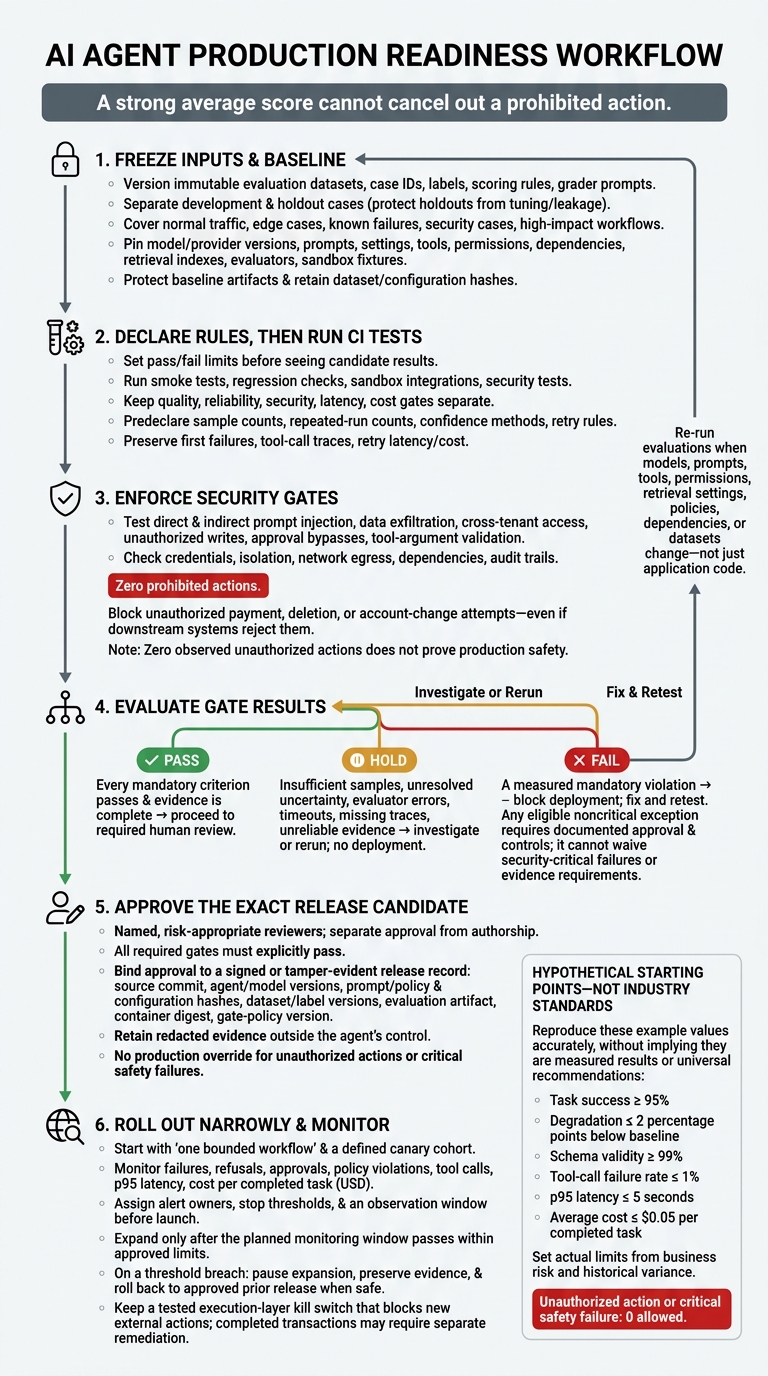
I wouldn’t ship an agent just because its final answer looks right. I’d require passing checks for task success, tool use, permissions, latency, and cost - with zero prohibited actions and no missing test records.
Here’s how I’d gate each release:
- Before testing: Freeze evaluation data, scoring rules, agent settings, and baseline results.
- During CI/CD: Run smoke tests, regression checks, sandbox integrations, and security tests. Set pass/fail limits before seeing results.
- Before deployment: Require named reviewers to approve the exact release candidate. Failed or inconclusive checks put deployment on hold.
- After approval: Start with one bounded workflow, monitor outcomes and dollars per successful task, and keep a tested kill switch and rollback plan ready.
My rule: <u>a strong average score cannot cancel out a prohibited action</u>. Re-run evaluations when models, prompts, tools, permissions, dependencies, or data change.
AI Agent CI/CD Release Gates
Building Automated Eval Pipelines for AI Systems | CI/CD for AI
sbb-itb-f123e37
Checklist: Version Eval Data and Protect Baselines
Freeze evaluation data and pin baseline artifacts before comparing candidates. Protect both from overwrites so CI/CD comparisons stay valid. Freeze the baseline before running any regression or security gate.
Record Dataset Versions, Labels, and Coverage
- [ ] Publish immutable releases. Record the dataset ID and version, registry or Git revision, creation date, source/provenance, collection and preprocessing methods, inclusion/exclusion criteria, license, retention period, and sensitivity. Explicitly flag unknown provenance.
- [ ] Version scoring rules and grader prompts separately. Give each case a stable ID, input, context, authorization context, allowed tools, tool constraints, scoring rules, and retained tool-call traces.
- [ ] Require reviewed changelogs. Explain what changed, why, which case IDs were affected, and whether the baseline remains comparable. Configure CI to reject duplicate IDs, missing labels, and edits to immutable releases.
- [ ] Separate development and holdout cases. Restrict release-set access. Never use holdout cases to tune prompts or thresholds. Check updated cases again for leakage, and protect sensitive fields with redaction or tokenization, access controls, encryption, audit logs, and retention limits.
Record coverage and the reasoning behind sample counts in the release manifest. Base those counts on traffic, case diversity, risk, and failure severity. Use the table below to size coverage by risk - not an arbitrary minimum.
| Coverage | Purpose | Sample-size basis | Owner; update schedule | Required gate |
|---|---|---|---|---|
| Normal traffic | Measure routine success | Production frequency and workflow diversity | Product or operations owner; monthly | Minimum task-success and quality scores |
| Edge cases | Test ambiguity, missing information, unusual inputs, timeouts, and retries | Risk analysis and observed incidents | QA owner; monthly or after incidents | No critical unsafe behavior; defined inconclusive limit |
| Known failures | Confirm previously fixed defects stay fixed | Every verified high-impact regression plus representative variants | Engineering owner; after every confirmed defect | Zero recurrence for release-blocking defects |
| Security cases | Test prompt injection, data exfiltration, unauthorized tool use, and privilege escalation | Threat-model coverage and severity | Security owner; each release and after threat-model changes | Block on critical security failures |
| High-impact workflows | Protect financial, legal, medical, account, or customer-impacting actions | Risk-based sampling with human-reviewed cases | Business-control owner; each release | Human approval and zero prohibited actions |
Pin Agent Settings and Record Baseline Scores
Use these artifacts as the comparison target for regression, security, and review gates.
- [ ] Freeze the configuration. Pin model and provider versions, prompts, agent settings, sampling parameters, tool schemas, permissions, dependencies, retrieval indexes, evaluator versions, sandbox fixtures, timeouts, retries, provider limits, code commit, and configuration hashes.
- [ ] Keep a reproducible scorecard. Link release and run IDs to dataset and configuration hashes, scores, traces, latency, and cost. Include repeated-run summaries or confidence intervals for nondeterministic tasks.
- [ ] Compare under matching conditions. Keep datasets, evaluators, fixtures, sampling, and provider limits aligned so you're testing only the agent change. If measurement conditions change, rerun the protected release. Keep historical results instead of overwriting them.
Checklist: Set Regression Limits and Security Gates
Use the frozen baseline and dataset from the previous section to set your gates. Define release rules before running the candidate. Keep quality, reliability, security, latency, and cost gates separate.
Define Pass, Fail, and Inconclusive Results
- [ ] Set independent limits. Hypothetical starting points: task success ≥ 95%; degradation ≤ 2 percentage points below baseline; schema validity ≥ 99%; tool-call failure rate ≤ 1%; p95 latency ≤ 5 seconds; average cost ≤ $0.05 per completed task. Set limits based on business risk and historical variance - not industry assumptions.
- [ ] Tighten high-risk rules. Payments, deletions, and account changes require deterministic authorization and any required human approval. Average scores cannot excuse prohibited actions.
- [ ] Declare statistical rules. Set sample counts, repeated-run counts, and a confidence method before testing. Every run must meet mandatory floors. Assess differences from the baseline with a documented confidence interval. Too few samples or unresolved uncertainty means inconclusive.
- [ ] Preserve first failures. Define retry limits and eligible retry reasons. Keep the initial response, final result, tool calls, added latency, and added cost. A successful retry must not erase the first failure.
A pass requires every mandatory criterion. A measured violation fails. Missing or unreliable evidence puts deployment on hold until resolved.
| Finding | Metric or threshold | Pipeline action | Override authority |
|---|---|---|---|
| Hard blocker | Unauthorized action or critical safety failure: 0 allowed | Fail; block release | No production override |
| Hard blocker | Any mandatory quality, reliability, latency, or cost limit exceeded | Fail; fix or assess an eligible noncritical exception | Named engineering and product owners; never for security-critical failures |
| Review required | Insufficient sample, evaluator error, timeout, or missing trace | Hold; investigate or rerun | Release manager verifies resolved evidence; cannot declare missing evidence a pass |
| Advisory | Cost increase below 10% budget warning level | Warn and track | Service owner |
Send inconclusive runs to human review before release.
Test Permissions, Prompt Injection, and Tool Safety
After quality gates, test the agent’s refusal and enforcement paths. Security tests are mandatory release gates, not separate QA tasks.
- [ ] Test direct and indirect attack paths. Use direct malicious prompts and indirect instructions in retrieved documents, web pages, emails, tickets, memory, and tool outputs. Check for data disclosure, unsafe outputs, task hijacking, and unauthorized actions.
- [ ] Test enforcement, not just refusals. Attempt cross-tenant reads, unapproved writes, outbound data transfers, approval bypasses, replayed requests, and rate-limit violations. Validate tool arguments before execution. Require zero observed actions outside approved permissions. This does not prove production safety.
- [ ] Check credential handling and deployment security. Test runtime secret injection, redaction, token expiration, authentication, authorization, sandbox isolation, network egress, dependency vulnerabilities, and audit-trail completeness. Require security review for system prompts, retrieval sources, tool schemas, permissions, model versions, policy code, and approval workflows.
| Control | Test method | Severity | Blocking status | Evidence | Approver |
|---|---|---|---|---|---|
| Prompt injection | Poison user input and retrieved content | High–critical | Block prohibited execution or restricted-data disclosure | Attack fixture, transcript, tool trace | Security reviewer |
| Permissions and tool safety | Attempt scope violations, invalid arguments, and approval bypasses | Critical | Block unauthorized execution or invalid calls that execute | Authorization decision, execution log, downstream effect | Security and platform owners |
| Credentials and infrastructure | Scan secrets and dependencies; test isolation and egress | Risk-rated | Block credential exposure and critical exploitable findings | Scan reports, sandbox logs, configuration identifier | Security and platform owners |
Block Releases for Critical Failures or Missing Evidence
Block release on any unauthorized payment, deletion, or account-change attempt - even if downstream systems reject it.
Also block critical safety failures, permission violations, prohibited tool calls, and invalid calls that execute. A policy rejection is not tool execution. Keep the request, validation decision, execution status, and downstream effect.
Block schema failures that allow unsafe interpretation, corrupt records, bypass validation, or trigger tools with serious downstream effects. Classify other failures against the declared quality threshold.
Put evaluator errors, timeouts, absent logs, and inconclusive runs on hold for investigation or rerunning. Unauthorized execution, critical disclosure, and prohibited destructive actions cannot be waived.
Noncritical exceptions need an approver, affected release, expiration date, compensating controls, residual risk, and follow-up owner. They cannot waive security-critical evidence. Send unresolved cases to human review before release.
Checklist: Require Human Review and Monitor Releases
After automated gates pass, send the exact release candidate to named human reviewers to assess any remaining deployment risk.
Assign Reviewers and Set Exception Rules
Name accountable reviewers. Require human approval for high-impact or irreversible workflows, permission or configuration changes, customer-facing behavior, regulated data handling, and borderline evaluations.
Assign rubric, label, and baseline changes to the domain owner. Send new tools, expanded permissions, or external actions to a security owner. Route customer-impacting behavior to product or operations. Reviewers must approve the exact release candidate - not a general workflow. Approval authority should match the risk being introduced.
Separate approval from authorship. Reject self-approved or blanket exceptions, along with requests that lack rollback plans. Record the affected release, rationale, risk, named approver, compensating controls, expiration date, and remediation issue.
Enforce Required Gates Before Deployment
Human approval is valid only when every required gate returns a clear pass.
- [ ] Require an explicit pass. Deploy only after every mandatory evaluation and required gate approval passes. A failed, skipped, canceled, timed-out, or incomplete gate blocks deployment. Publish machine-readable gate results with metric values, thresholds, failure reasons, and artifact IDs, plus a short reviewer summary.
- [ ] Bind approval to the release record. Create a signed or tamper-evident release record containing the source commit, agent and model versions, prompt or policy hash, configuration hash, dataset and label versions, evaluation artifact, container digest, and gate-policy version. Bind approval to those identifiers. Restrict edits to baselines, workflows, and gate policies. Protect CI credentials with least-privilege access.
Retain Release Evidence and Monitor Limited Rollouts
After approval, keep the release auditable and watch its first live traffic closely.
- [ ] Store the exact evidence reviewers approved. Keep redacted traces, tool calls, scores, failed assertions, baseline comparisons, dataset versions, configuration hashes, reviewer decisions, and exceptions outside the agent’s control. Preserve enough detail to reconstruct the approved artifact and decision. Set access rules and retention limits based on business, contractual, and regulatory needs.
- [ ] Define rollout and recovery rules before launch. Identify the canary cohort that will receive the approved release candidate. Compare it with the approved baseline for failures, refusals, approvals, policy violations, tool calls, p95 latency, and cost per completed task in U.S. dollars. Give each alert an owner and a stop threshold. Expand only after the defined monitoring window passes. If a threshold is breached, pause expansion, preserve evidence, and roll back to the approved prior release when safe. Test an execution-layer kill switch that blocks new external actions. Completed transactions may still need payment reversals, record corrections, or access revocation.
Conclusion: Confirm Release Readiness
Once the checklist above passes, release only one bounded workflow, backed by complete evidence and approval from named reviewers. Missing evidence or inconclusive results must block release.
Keep the launch narrow. Use live monitoring, assign owners to alerts, and have a tested rollback plan ready. Expand only after the workflow stays within approved limits for the full planned observation window.
Re-run evaluations whenever changes occur to models, prompts, tools, finetuning vs. RAG retrieval settings, policies, dependencies, or datasets - not just application code.
NAITIVE AI Consulting Agency can help design and manage the evaluation workflow for safe agent releases.
FAQs
How do I set eval thresholds without historical data?
Run agents in a controlled setting for about one week. Track performance, liveness, quality, cost, and coordination. Set initial maximum thresholds using the observed 95th percentile; this typically produces a 2%–5% alert false-positive rate.
For new deployments, start with 2–4 weeks in shadow mode, where actions have no outside impact. Then run in supervised mode for another 2–4 weeks, with humans reviewing every action. Refine thresholds before granting full autonomy, and update baselines monthly.
How can I distinguish regressions from model randomness?
Keep evaluations controlled: fix random seeds, lock temperature and top-p settings, and version system prompts along with agent logic. For each comparison, use the same golden corpus of 20 to 50 failure cases and successful interactions, plus the same framework, scenarios, and seeds.
When scores change, verify logging and ingestion first, then check statistical significance. Compare versions over an identical time window. A performance gap that appears right after deployment likely points to a regression, not random noise.
How do I keep eval gates from slowing deployments?
Test in tiers. Run fast, deterministic unit tests for core routing and logic on feature branches. In early LLM evaluations, mock tool calls to avoid API latency and costs. Use shadow mode to test against live traffic without affecting production or holding up releases.
For full evaluations, use adaptive sampling while maintaining statistical significance. Set up automated, threshold-based circuit breakers for minor regressions, and reserve human review for high-stakes, high-risk scenarios.