Case Study: AI Agents in Retail Returns Management
Practical guidance to pilot AI agents for retail returns: system connections, refund controls, staff review, and pilot metrics.

KPMG reports that an AI agent cut one retailer’s in-store return-resolution time from days to minutes. My takeaway: test a narrow returns workflow using a multi-agent research team, set refund limits, and require staff review when records or risk checks fail.
That result is not a measure of how soon customers received their money. The retailer is unnamed, and the public case does not disclose sample sizes, automation percentages, or an independent audit.
For a U.S. pilot, I’d focus on three things:
- Controlled access: Connect purchase, policy, and payment records, with separate permissions for return approval and refund execution.
- Payment safeguards: Prevent duplicate refunds, log each action, and send uncertain or high-risk requests to staff.
- Separate measures: Track return-resolution time, refund posting, accuracy, fraud losses, and complaints.
<u>Return approval is not refund confirmation.</u> I’d use this case as a starting point for testing - not a promise of the same results.
How the Agent Handles a Return
AI Retail Returns: From Verification to Refund Confirmation
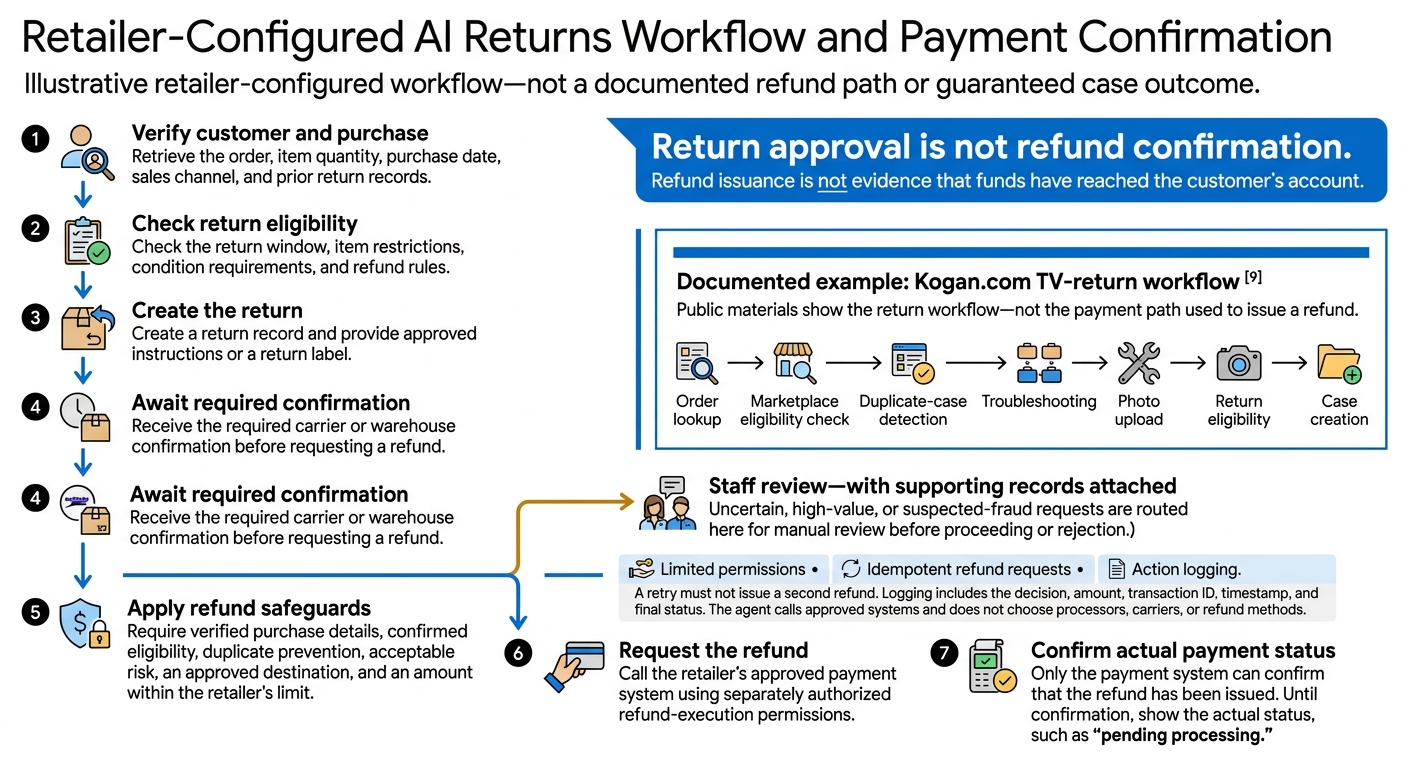
Salesforce says Agentforce for Retail can issue returns and update orders when permissions are configured. In Kogan.com’s documented TV-return flow, the agent follows seven enforced steps: order lookup, marketplace eligibility check, duplicate-case detection, troubleshooting, photo upload, return eligibility, and case creation. The public materials show the workflow - not the payment path used to issue a refund.
That case documents the agent’s return workflow. Connecting it to refunds requires a retailer-configured process.
From Purchase Lookup to Refund Confirmation
The agent would first verify the customer and look up the purchase. It could retrieve the order, item quantity, purchase date, sales channel, and prior return records. It would then check the return window, item restrictions, condition requirements, and refund rules.
Once eligibility is confirmed, the agent could create a return record and provide approved instructions or a return label. After receiving the required carrier or warehouse confirmation, it could request a refund through the retailer’s payment system.
Return approval is not refund confirmation. Only the payment system can confirm that the refund has been issued. Until then, the agent should display the actual status, such as pending processing.
This process depends on tightly controlled system access - not broad autonomous control.
System Connections and Agent Permissions
A retailer may connect the agent to order, customer, payment, warehouse, policy, and case systems. Its access should stay limited to approved business actions. Keep eligibility checks, fraud review, and refund execution separate: meeting the return policy does not, by itself, authorize payment.
A refund action should require verified purchase details, confirmed eligibility, duplicate prevention, acceptable risk, an approved destination, and an amount within the retailer’s limit. The agent calls approved systems; it does not choose processors, carriers, or refund methods.
Require staff review for uncertain, high-value, or suspected-fraud requests, with supporting records attached. Make refund requests idempotent so a retry cannot issue a second refund. Log the decision, amount, transaction ID, timestamp, and final status.
sbb-itb-f123e37
Deployment Steps and Refund Controls
The case does not disclose rollout steps or refund limits. The controls below are recommended safeguards for a U.S. pilot, not case findings. They show how to resolve returns in minutes while keeping transactions under control.
Connect Systems, Test, and Pilot
Connect only the systems needed for returns through an agentic foundation: order management, POS, payments, customer accounts, inventory, shipping, the returns portal, fraud tools, and the live policy repository. The agent should retrieve current transaction status and policy versions.
A comparable retail deployment connected order management, product catalog, returns portal, and knowledge-base systems, with high-confidence requests handled automatically and complex cases escalated.
Once those connections are stable, set approval rules and refund controls.
Before enabling transactions, document each system’s owner, data fields, API permissions, uptime expectations, and fallback process. Set refund limits before testing. Start in a masked-data sandbox, then run one low-risk workflow in recommend-only mode before allowing autonomous refunds.
Testing should cover valid receipt returns, missing orders, partial orders, gift purchases, split tenders, exchanges, damaged goods, high-value items, suspected fraud, duplicate requests, canceled payments, unavailable APIs, conflicting policy records, and policy changes during an open return.
Use an idempotency key tied to the order, return authorization, refund amount, and payment transaction. Block repeat refunds until payment status is confirmed. Reconcile payment, order, and ledger records daily.
When Agents Act and When Staff Approve
Treat these handling modes as recommendations, not case findings. Assign each return to the lowest-risk action that fits its records and payment status. Risk and verification failures should override amount-based permissions.
| Handling mode | Eligibility certainty | Transaction value | Fraud risk | Required approval |
|---|---|---|---|---|
| Autonomous | High; receipt, item, policy, and payment records match | Low; any dollar limit is hypothetical | Low, with no unusual history | No additional approval; automated logging required |
| Assisted | Moderate; one rule or record needs review | Medium; threshold is hypothetical | Moderate, or signals need context | Staff confirms the agent’s recommendation |
| Human | Low, conflicting, or exception-based | High; threshold is hypothetical | High, suspected abuse, or sensitive product | Approval from a named staff member or specialist |
| System unavailable | Any certainty level when systems or payment status are unavailable | Any value | Unknown because verification failed | Manual processing after reconciliation |
Use separate credentials for read-only retrieval, return creation, and refund execution. Require testing and approval before policy changes. Keep rollback capability and a kill switch for autonomous refunds.
Maintain an immutable audit record that includes the request, policy and model or workflow versions, data used, decision, tool calls, approval, refund ID, timestamps, notification, and final status.
Protect logs and customer data with encryption, payment-data tokenization, role-based access, retention limits, redaction, and monitoring for access without permission. Assign named owners across operations, payments, fraud, information security, privacy, customer service, and technology. Set service-level targets for payment failures, suspected fraud, complaints, and outages.
Reported Results and Evidence Limits
Before-and-After Results
KPMG reports that its Canadian team deployed an AI-powered agent for a large multinational retailer’s in-store returns process. Return-resolution time fell from several days to minutes, but the case has not been independently audited. The public description leaves out the sample size, measurement period, retailer’s identity, control groups, confidence intervals, and measurement definitions.
| Metric | Baseline | Reported result | Measurement method | Source status |
|---|---|---|---|---|
| Resolution time | Several days | Minutes | Exact timestamps and denominator undisclosed | KPMG-reported result; audited method not reported |
| Routine human intervention | Manual review required | Routine intervention eliminated | Scope of routine work and exception rate undisclosed | KPMG-reported claim; calculation method not reported |
| Refund arrival time in the customer’s account | Not reported | Not reported | No documented measure of account posting time | Not established by the case documentation |
Removing routine intervention does not mean every return ran without staff. Complex cases still went to employees. The reported minutes cover in-store return resolution - not the time until funds reached the customer’s account. The case does not establish performance for online returns, disputed transactions, all refund methods, or use across the United States. A U.S. pilot therefore needs to track resolution time and payment settlement separately.
Metrics to Track in a Pilot
Track what the case left out: timing, exceptions, and payment settlement. Set a predeployment baseline and a defined postdeployment period, using the same eligibility rules for both. Record the sample size and measurement period. Report results weekly and monthly, broken down by store, return type, payment method, merchandise value, and fraud-risk tier.
Measure resolution time from return initiation to retailer confirmation, and report both the median and 95th percentile. Track funds availability separately, from refund submission to account posting.
Use the same definitions before and after deployment:
- Auto-completion rate: Returns completed without staff intervention ÷ eligible returns.
- Escalation rate: Returns transferred to staff ÷ eligible returns.
- Refund accuracy: Correct approval, denial, or adjustment decisions ÷ audited decisions.
- Duplicate-refund rate: Transactions receiving duplicate refunds ÷ total refunded transactions.
- Fraud-loss rate: Confirmed fraud losses ÷ returned merchandise value.
- Customer-complaint rate: Return-related complaints ÷ completed returns.
Keep denominators fixed. Identify the reporting period, audit sample size, and any later fraud-loss updates.
Treat lower cost per return, faster refunds, and better policy consistency as pilot hypotheses, not case outcomes. Before scaling, evaluate operating cost per completed return, separate refund-submission and posting timestamps, audited policy compliance, and the share of completed returns with a usable reason code. Do not assign savings or an automation rate without supporting data.
Conclusion: Requirements for U.S. Retailers
This case supports testing a returns workflow with clear limits - not assuming the same results will apply elsewhere.
Readiness Checks and Pilot Criteria
Turn return policies into machine-readable rules covering eligibility, exclusions, proof of purchase, shipping, and refund methods. Check that core records are accurate across systems. Confirm secure API access, role-based permissions, audit logs, privacy controls, and compliance with U.S. requirements.
Start with one store, one channel, or one standard return category. Name staff owners and set response targets for disputed decisions, conflicting records, and suspected fraud.
Test failed connections and interrupted refund calls. Pause automated actions if refunds cannot be reconciled or the agent acts beyond its authority. NIST guidance calls for documented oversight and continued monitoring.
Implementation Support and Agent Management
NAITIVE AI Consulting Agency can help assess readiness, design and deploy autonomous agent workflows for returns handling, and manage them after launch. Any engagement should define scope, integration responsibilities, security controls, acceptance tests, data ownership, monitoring, and staff handoff.
Keep the workflow within defined limits, measure verified outcomes, and assign accountable people to oversee it.
FAQs
How do I estimate ROI for an AI returns pilot?
Start by recording baseline costs, handling times, and error and rework rates. Then track hours saved, cost savings per return, processing speed, and revenue recovered or retained. Compare pilot results against those benchmarks using:
ROI = (cost savings + revenue lift + efficiency gains) ÷ AI integration cost
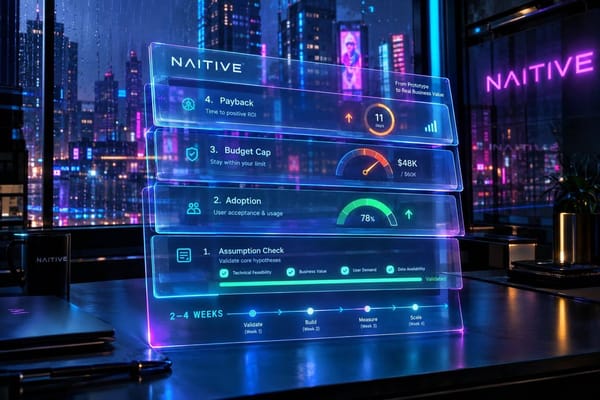
Run the prototype in phases over 2–4 weeks, with a firm budget cap. Review results weekly, and scale only if the payback period fits your target window.
How can customers appeal an AI return decision?
Customers can appeal an AI return decision by asking for a human review. The AI should also pass complex issues or requests it can’t confidently interpret to a human agent, including after multiple failed attempts.
The agent should receive the full interaction context: a transcript or summary, extracted details, and the reason for escalation. That way, customers don’t have to repeat themselves, and the agent can recheck the decision using the same workflows governed by policy and data.
When is my returns pilot ready to scale?
Your returns pilot is ready to scale only when it consistently meets service and quality thresholds during a phased rollout. Before implementation, use 12 months of historical data to set clear benchmarks.
During the pilot, track financial performance, operational efficiency, and customer experience using metrics such as cost per interaction, error frequency, and satisfaction scores. Expand deployment only after results consistently meet those benchmarks.