
ISO Standards for AI Compliance Reporting
Use ISO/IEC 42001 as the backbone for AI compliance reports; map requirements to owners, controls, tests, and evidence.
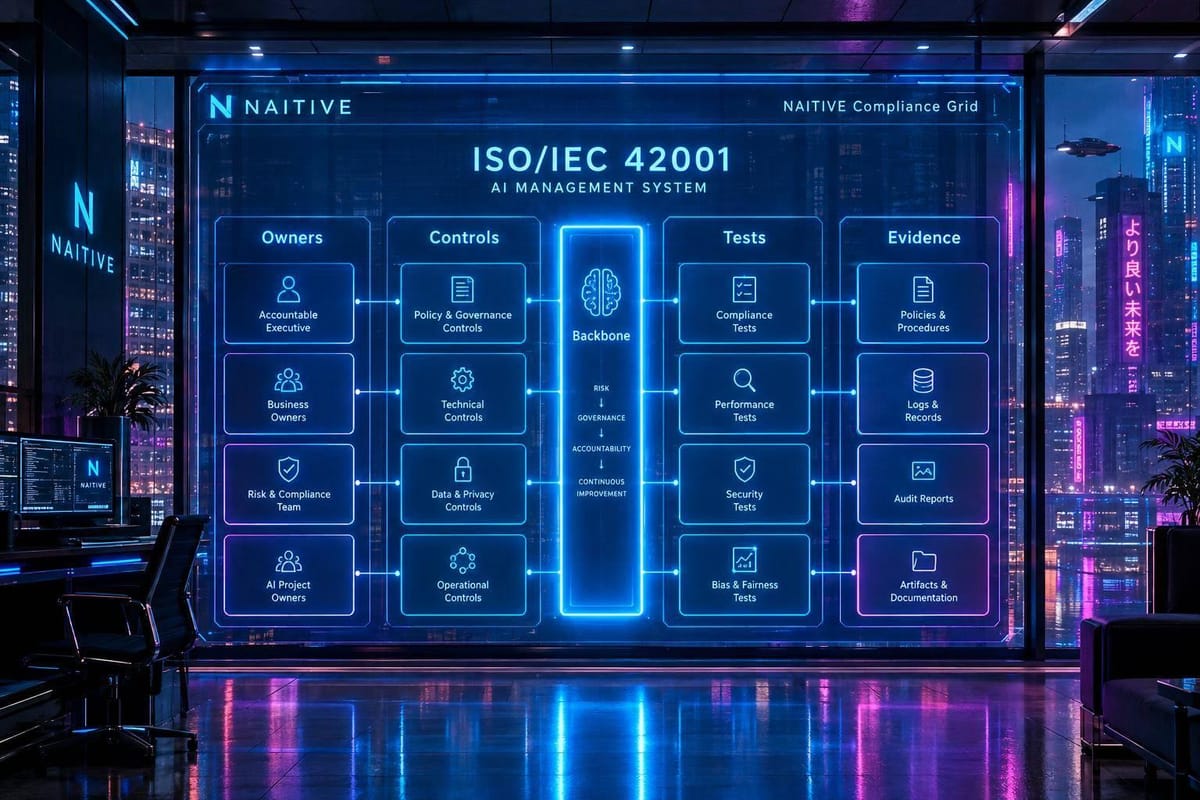
As an AI consulting agency, I use ISO/IEC 42001 as the starting point for AI compliance reporting - not as proof of legal compliance. First, define which AI systems the report covers. Then link each requirement to an owner, a control, and records that show whether it worked.
Here’s how I separate the 5 standards covered in this guide:
- ISO/IEC 42001: Requirements for an AI management system.
- ISO/IEC 23894: Guidance for assessing and treating AI risks.
- ISO/IEC 38507: Guidance for AI oversight and accountability.
- ISO/IEC 42005: Guidance for assessing effects on people and society.
- ISO/IEC 42006: Requirements for bodies that certify AI management systems - not the organizations seeking certification.
My reporting rule is simple: <u>keep ISO conformity, legal compliance, and assurance conclusions separate.</u> Use controlled records, test controls, track findings, and check that fixes work. A certificate or an automated workflow cannot replace those checks.
ISO Standards for AI Compliance Reporting
ISO/IEC 42001: AIMS Requirements and Documentation
Use ISO/IEC 42001 as the backbone of your compliance report. Add supporting guidance where you need evidence for risk, governance, or impact. The report should connect each AIMS requirement to the evidence that shows how it’s met.
ISO/IEC 42001:2023 is the core AIMS requirements standard. ISO’s catalog lists it as the first edition, published in December 2023. Its Plan-Do-Check-Act cycle connects planning, operation, review, and improvement. Your reporting should show how staff competence, operating controls, monitoring, internal audits, and management reviews support that cycle.
Separate required records from supporting evidence. Supporting evidence may include the AIMS scope, approved AI policy, objectives, risk-treatment records, impact assessments, Statement of Applicability (SoA), internal-audit reports, management-review minutes, corrective-action logs, and change approvals. An evidence index or control register can keep these records organized, but the standard doesn’t require those exact document names or a single template. Corrective-action records should show the issue, the action taken, and whether it worked - not just that someone closed a ticket.
Map risk treatments to Annex A to check control coverage. The Statement of Applicability should identify applicable controls, record their implementation status, and explain why Annex A controls are included or excluded. Those controls apply only when risk treatment requires them. Link each treatment plan to its owners, residual-risk approval, evidence, and reassessment triggers.
With the AIMS core documented, connect companion standards to the relevant evidence. Organizations often seek AI consulting services to align these technical requirements with business strategy.
ISO/IEC 23894, 38507, and 42005: Risk, Governance, and Impact Guidance
These companion standards support different AI decisions; they don’t replace ISO/IEC 42001 requirements. ISO/IEC 42005:2025, published in May 2025, extends impact assessment to people and society - not just organizational loss.
Use the table to match each reporting need with the right evidence.
| Standard | Primary purpose | Reporting evidence | Lifecycle stage | Relationship to ISO/IEC 42001 |
|---|---|---|---|---|
| ISO/IEC 23894:2023 | Guidance for managing AI-specific risks and integrating risk management into AI-related activities | AI risk methodology, risk registers, treatment decisions, residual-risk approvals, monitoring results, and reassessments | Planning, development, deployment, operation, change, and retirement | Supports AIMS risk-management processes |
| ISO/IEC 38507:2022 | Guidance for governing organizational AI use, especially governing-body oversight and accountability | Governance charters, delegated authority, oversight reports, organizational goals, and escalation records | Long-term planning, procurement, deployment oversight, and continued governance | Supports AIMS leadership, accountability, and governance |
| ISO/IEC 42005:2025 | Guidance for AI system impact assessments | Stakeholder analysis, impact findings, affected-group assessments, mitigation plans, consultation records, decision rationale, and reassessment results | Design, development, deployment, operation, and material changes | Supports AIMS impact-assessment processes |
ISO/IEC 42006: Certification Body Requirements
ISO/IEC 42006:2025 sets requirements for the certification body that audits an AIMS against ISO/IEC 42001, building on ISO/IEC 17021-1. The organization supplies evidence that its AIMS meets ISO/IEC 42001. The certification body evaluates that evidence, documents findings, and makes the certification decision. Don’t treat ISO/IEC 42006 as an organizational certification.
sbb-itb-f123e37
ISO/IEC 42001:2023 AIMS Lead Auditor -10.1- Writing the Perfect ISO/IEC 42001:2023 Audit Report
Build a Controlled Evidence Workflow
AI Compliance Reporting: The Evidence Workflow
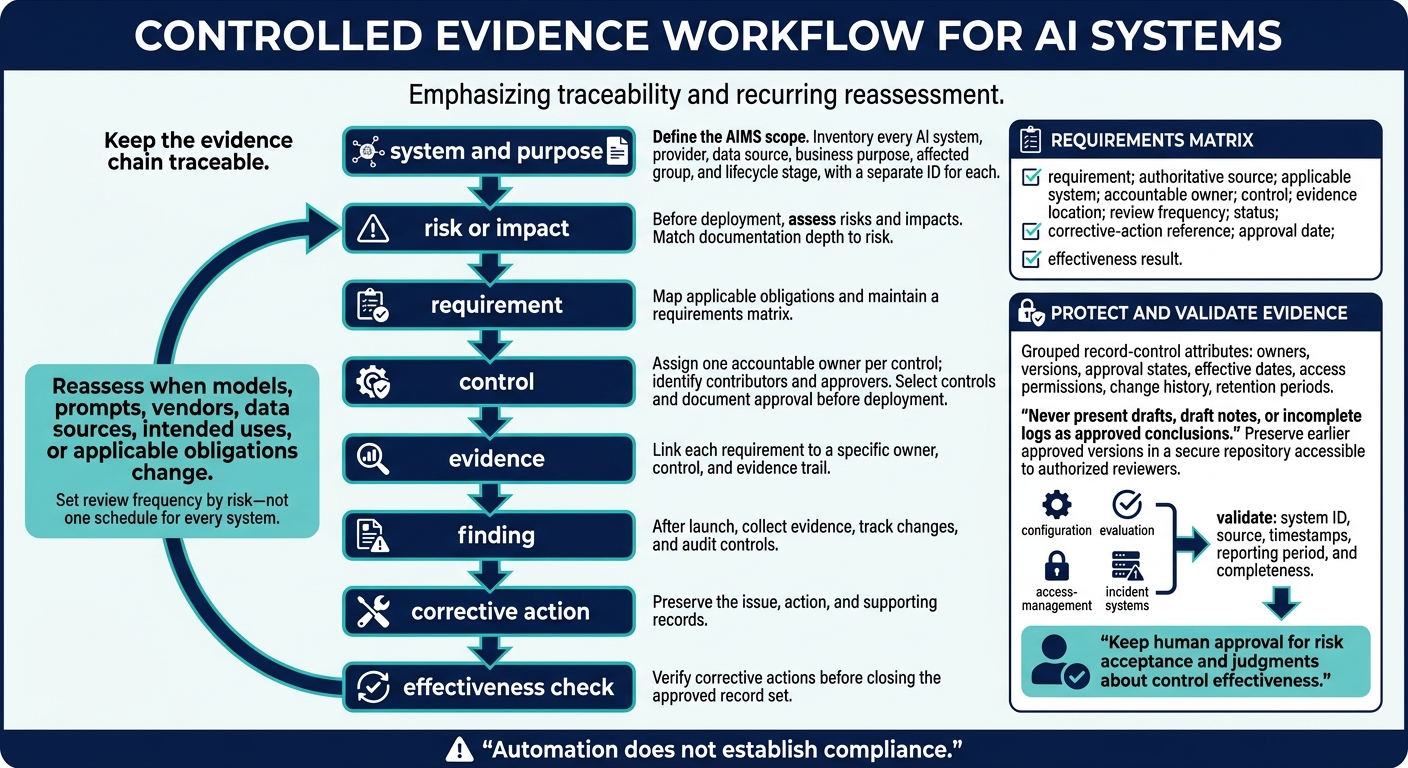
Use the AIMS scope to set the evidence workflow’s boundaries. Inventory every AI system, provider, data source, business purpose, affected group, and lifecycle stage, supported by business consulting for strategic alignment, with a separate ID for each. Before deployment, map applicable obligations, assess risks and impacts, select controls, and document approval.
Match documentation depth to risk. A low-risk internal tool needs less evidence than a customer-facing voice agent handling sensitive data. Within that scope, connect each ISO requirement to a specific owner, control, and evidence trail.
After launch, continue collecting evidence, tracking changes, and auditing controls. Verify corrective actions before closing the approved record set. Reassess when models, prompts, vendors, data sources, intended uses, or applicable obligations change. Set review frequency by risk - not one schedule for every system.
Link Requirements to Owners, Controls, and Evidence
With the scope defined, map each requirement to one control owner and one evidence path. Keep a requirements matrix that records each requirement, authoritative source, applicable system, accountable owner, control, evidence location, review frequency, status, and corrective-action reference. Include the approval date and effectiveness result.
Keep this chain traceable: system and purpose → risk or impact → requirement → control → evidence → finding → corrective action → effectiveness check.
Assign one accountable owner per control, and make clear who contributes and who approves. Keep enough context in the record for an auditor to follow it without relying on staff memory.
Manage Documents and Automate Evidence Collection
Protect evidence integrity by defining owners, versions, approval states, effective dates, access permissions, change history, and retention periods. Clearly label drafts, draft notes, and incomplete logs. Never present them as approved conclusions. Preserve earlier approved versions, and store records in a secure repository where authorized reviewers can access them.
Automate collection from configuration, evaluation, access-management, and incident systems. Then validate each record’s system ID, source, timestamps, reporting period, and completeness. Keep human approval for risk acceptance and judgments about control effectiveness.
A voice agent that changes often shows how this works in practice.
Hypothetical voice-agent deployment: A customer-support voice agent that routes billing disputes to human representatives needs linked configuration approvals, prompt versions, escalation tests, logs, and incident records. Each record should identify the version, environment, date range, reviewer, and approval status. If testing reveals failed escalation for an affected customer group, retain the failed result, corrective-action record, and retest - not just the final passing result. Prefer call IDs, masked transcripts, and escalation outcomes over copied audio or full customer records. Restrict access, encrypt sensitive evidence, and apply retention, legal-hold, and deletion procedures.
Prepare Reports and Check Audit Readiness
Once requirements and evidence are mapped, build a report that shows status, exceptions, and follow-up actions. Use controlled evidence to summarize AIMS status, open issues, and management actions needed during the reporting period. Keep ISO conformity, legal or regulatory compliance, and assurance conclusions separate. ISO/IEC 42001 does not prescribe one report format; this template is an internal aid.
Create an AI Compliance Report Template
Include a title, version, preparation date, approval status, and reporting period. Use U.S. date format and label sample periods as illustrative.
Illustrative reporting period: October 1–December 31, 2026.
Adjust the suggested review schedules and escalation triggers to fit your risks and obligations.
| Report section | Supporting evidence | Owner | Review cadence | Escalation threshold |
|---|---|---|---|---|
| AIMS scope and boundaries | Approved scope and exclusions | AIMS manager | Annually; material changes | Unclear or unapproved boundary |
| Inventory changes | Additions, retirements, material modifications | AI portfolio owner | Monthly | Unassessed material change |
| Assessment criteria | Applicable ISO clauses, Annex A controls, policies, laws, contracts | Compliance lead | Each report; criteria changes | Missing or outdated requirement |
| Accountability | Assigned roles and approval authority | Executive sponsor | Quarterly | Unowned critical control |
| Risks, impacts, and residual risks | Assessments, treatment plans, risk acceptances | Risk owner | Monthly or quarterly | Risk above tolerance |
| Controls and performance indicators | Tests, monitoring, validation, exceptions | Control owner | Monthly or quarterly | Control failure or threshold breach |
| Incidents and complaints | Severity, affected parties, investigation and response status | Incident manager | Per event; quarterly trends | Severe harm or reporting obligation |
| Audit findings | Audit reports and open findings | Internal-audit lead | Monthly until closure | Repeat or overdue finding |
| Management decisions | Review minutes, approvals, resource decisions | Executive sponsor | Each management review | Unresolved decision or resource gap |
| Corrective actions | Root cause, due date, status, effectiveness result | Action owner | Until verified effective | Overdue or ineffective action |
| Certification status | Certificate scope, audit dates, surveillance records, limitations | Compliance lead | Each certification event | Expiry, suspension, or scope mismatch |
| Evidence register | Evidence references and availability | Records owner | Monthly | Missing or unverifiable support |
Keep report content separate from the tests that support each conclusion.
Test Control Design and Performance
Weak or missing evidence belongs in a finding - not a passing conclusion.
Design effectiveness asks whether a control is clearly defined and can work as intended. Operating effectiveness asks whether it worked during the reporting period. Record the population, sampling method, sample size, period coverage, exceptions, and limitations. Base conclusions on operating evidence, not policy text alone.
You can use these optional internal labels: conforming when criteria are met, partially conforming for incomplete coverage, nonconforming for unmet criteria, not applicable for a justified exclusion, and pending evidence for unverified support. These labels are not mandatory ISO categories and do not replace formal audit findings. Missing evidence limits what you can conclude; it cannot justify a passing result.
Resolve Findings and Reassess AI Changes
Management review should cover changes in context, stakeholders, and risks, along with performance, complaints, incidents, audit findings, resources, and improvement opportunities. Record decisions, owners, and deadlines.
For each finding, track the immediate correction, root cause, corrective action, due date, and closure evidence. Completion alone is not grounds for closure. Verify that the action works over a suitable period. If the problem returns, reopen or escalate it.
Use simple evidence-depth labels only when they help explain reporting status. Keep the report focused on findings, actions, and verified results.
Reassess material changes before the next reporting cycle. Update affected controls, evidence, and report conclusions, and record any effect on AIMS scope or certification status.
Conclusion: Keep Reporting Grounded in Evidence
Once you’ve mapped requirements, controls, and evidence, keep the hierarchy clear. Use ISO/IEC 42001 as the reporting backbone, with ISO/IEC 23894, 38507, and 42005 as supporting guidance. Treat ISO/IEC 42006 as guidance for certification bodies only.
Keep your AI inventory current across internal, third-party, embedded, agentic, and experimental AI systems. Whenever a system changes, run a scoped gap review, assign accountable owners, and set a risk-based reporting schedule. Maintain the same evidence chain through closure: scope → owner → control → record → test → corrective action. Reporting is a repeating evidence cycle, not a one-time task.
For help putting this workflow into practice, contact NAITIVE AI Consulting Agency to integrate evidence collection and documentation workflows. Leave ISO conformity assessments, certification decisions, and legal advice to qualified professionals. Automation does not establish compliance.
FAQs
How can I reuse existing compliance records for ISO/IEC 42001?
Build on the compliance records you already have. Map them to ISO/IEC 42001’s governance requirements instead of starting from scratch. Add the inventory and risk management data you need to records such as GDPR Records of Processing Activities (RoPA) or ISO/IEC 27001 asset registers.
Use version control to keep records audit-ready. Link evidence - including test results, risk registers, and approval logs - to the matching AI models and software releases, so your documentation stays in step with your systems.
What AI compliance evidence should I request from vendors?
Ask for Model Cards that explain the system architecture, performance metrics, and known limitations. Request Data Cards detailing training data sources, labeling guidelines, and steps taken to reduce bias.
Ask for risk assessment records, performance logs, and documentation explaining how the vendor handles your data. Check that the vendor follows ISO/IEC 42001 or NIST guidelines and meets your internal compliance requirements.
How much evidence is enough to show a control works?
Keep auditable records that show the AI control works in daily use, not just on paper. Link each major risk to an owner, a control, a test result, a decision, and a follow-up action.
Include dated test results, risk-treatment decisions, failed tests, and rejected deployments. Records created during routine work carry more weight than those produced after a complaint or inquiry.