AI Ethics Certification for Compliance Officers
Assess AI ethics programs that enable risk reviews, vendor oversight, controls, and audit-ready records for compliance officers.
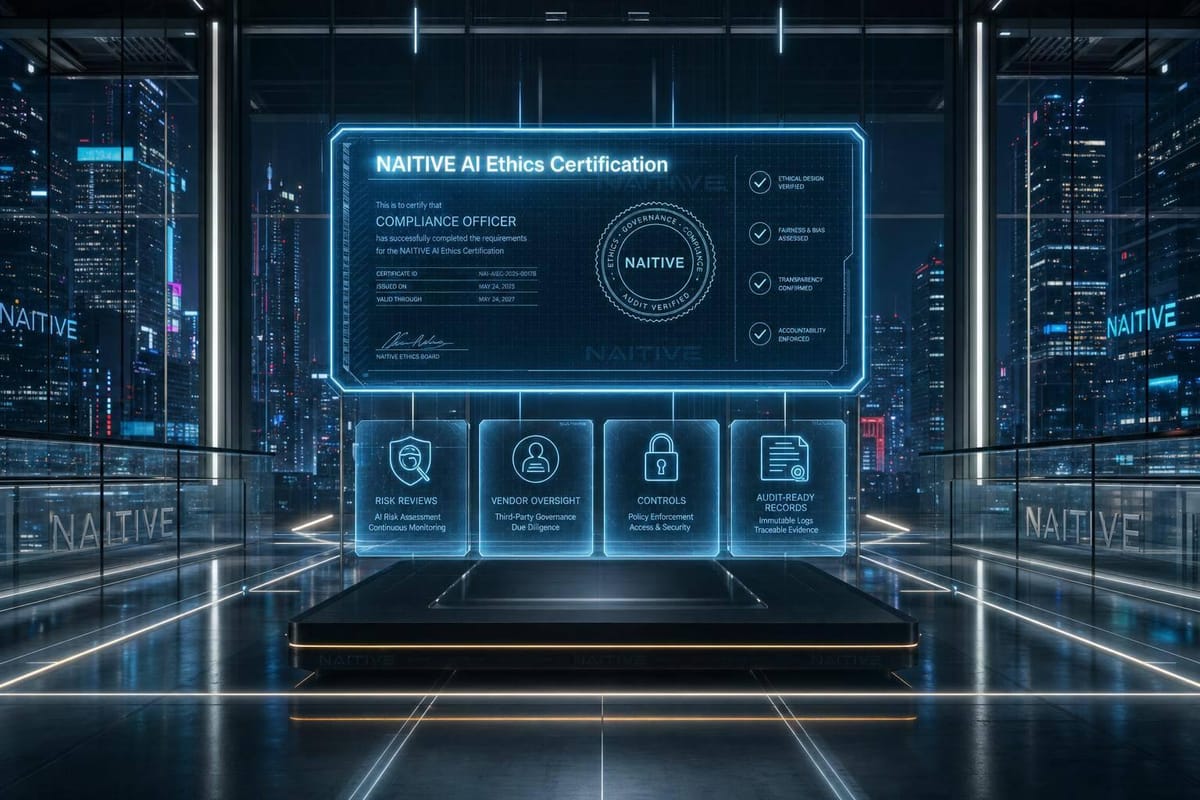
Most AI ethics certificates do not prove compliance. They usually prove one of three things: you finished a course, you passed a personal exam, or your company’s AI management system was checked against a standard like ISO/IEC 42001.
If I were choosing a program today, I’d focus on one question: Will this help me review AI use, document risk, test controls, check vendors, and keep audit records? That matters because 70% of organizations lacked a defined AI governance model, 24% of firms had policies for third-party AI use, and only 15% included AI safeguards in third-party codes of conduct.
Here’s the short version:
- Course certificate: shows attendance or completion, not independent skill testing
- Personal certification: shows a person passed an assessment on AI governance or ethics topics
- Company certification: shows a management system was audited against a published standard
- None of these alone: prove a model is safe, lawful, accurate, or ready for every use case
- Best use for compliance officers: better risk review, vendor checks, approval gates, monitoring, and recordkeeping
A strong program should help me work through:
- AI inventory and ownership
- Risk classification
- Impact assessments
- Privacy and data controls
- Bias testing and human review rules
- Vendor due diligence
- Monitoring, incidents, and retention
- Frameworks like NIST AI RMF, ISO/IEC 42001, ISO/IEC 23894, and the EU AI Act
AI Ethics & Governance Certification (AIGP) Study Guide Exam Prep - Who Controls AI?
sbb-itb-f123e37
Quick Comparison
| Credential type | What it shows | What it does not show | Best fit |
|---|---|---|---|
| Course-completion certificate | I finished training | I passed a separate skills exam | Basic learning |
| Personal certification | I met the provider’s assessment standard | My employer is compliant | Compliance, risk, audit, governance staff |
| Company certification | A company system matched a standard at audit time | Every AI output is correct or lawful | Enterprise AI governance programs |
Bottom line: I’d treat AI ethics certification as a tool for better oversight, not as proof of compliance. The right program should help me turn broad ideas into review steps, evidence files, and control decisions I can defend.
Why Certification Matters and Which Knowledge Areas to Check
According to EY's 2025 AI Governance, Risks and Compliance Survey, 70% of organizations lacked a well-defined AI governance model. ACA Group's 2025 AI Benchmarking Report found that only 24% of firms had policies and procedures governing third-party AI use. Those numbers set a useful benchmark. If a certification program doesn't help close gaps like these, it's hard to call it worth your time.
Certification matters when it teaches a repeatable control method. The point isn't to wait for AI problems to pop up and then scramble. It's to spot risks early, tie them to specific controls, and build records that can stand up to review. A good program should help you do that in a way you can use on the job.
| Area | Advantages | Limitations | Practical impact |
|---|---|---|---|
| Risk identification | Teaches structured methods for spotting foreseeable, civil-rights, operational, and security risks | Training may not reflect every industry or state requirement | Improves initial risk classification and escalation decisions |
| Policy translation | Helps turn laws, standards, and internal policies into concrete review criteria | Not a substitute for legal counsel | Supports documented, repeatable compliance decisions |
| Vendor oversight | Provides a framework for assessing model providers, data sources, testing practices, and incident response | A certificate cannot validate a supplier's representations | Strengthens due diligence and contract negotiations |
| Internal controls | Supports approval gates, access controls, monitoring, testing, and change management | Controls still require technical owners and operational resources | Makes AI oversight auditable and repeatable |
| Audit readiness | Emphasizes inventories, impact assessments, test results, logs, and remediation records | Documentation goes stale after deployment changes | Reduces evidence gaps during audits or regulatory inquiries |
The next step is simple: the curriculum should show that it can support those controls in day-to-day practice, not just on paper.
Core Ethics and Governance Topics Every Program Should Cover
A strong program should teach enforceable controls, not just broad ethics talk. At a minimum, check whether the curriculum covers fairness and non-discrimination, including adverse-impact analysis and controls for discriminatory outputs. It should also cover transparency, such as when AI use must be disclosed and how to explain why it was used. Then there's explainability: the explanation has to fit the situation, whether the audience is the person affected, an internal reviewer, or an auditor.
It should also cover privacy and data minimization, safety and security - including testing for harmful failures, unauthorized access, and unsafe outputs - plus accountability, meaning clear system owners and escalation paths. You also want human oversight, with rules for when a person must review or override an AI-supported decision, and AI lifecycle governance, from design through retirement.
NIST identifies trustworthy AI characteristics across these areas, including validity and reliability, safety, security and resilience, accountability, transparency, explainability and interpretability, privacy enhancement, and fairness with harmful bias managed.
Risk, Documentation, and Third-Party Oversight Skills
Knowing the principles is only half the story. In practice, compliance runs on records. A well-built program should teach you how to create and review the documents that matter: impact assessments, risk registers, validation plans, monitoring dashboards, incident logs, and change-control tickets. Documentation must be current and usable - not just something prepared for a one-time audit and forgotten.
Third-party oversight needs close attention too. A 2025 Ethisphere report found that only 15% of companies included AI safeguards in third-party codes of conduct, and only 14% had audited at least half of their third-party vendors. That's a red flag. If a program treats vendor claims as enough on their own, it's missing the point.
A strong certification program should teach you to treat vendor statements as a starting point, not the finish line. That means setting contract controls around data use, model changes, incident notification, audit rights, and regulatory cooperation. And when a vendor can't provide useful documentation, that gap should be logged as a risk. That's the kind of discipline that makes AI governance auditable.
How to Evaluate AI Ethics Certification Programs
Not every program labeled "AI ethics certification" is built for compliance work. Some are broad AI awareness courses with a certificate tacked on at the end. To judge a program properly, look at its focus, audience, prerequisites, duration, assessment, credential validity, renewal, and framework coverage. That’s how you separate compliance-ready credentials from general awareness training. Use the checklist below to tell the difference between real compliance training and a certificate that mostly signals attendance.
The fastest way to check quality is the syllabus. Look for named standards - NIST AI RMF, ISO/IEC 42001, ISO/IEC 23894, and ISO/IEC 38507 - not vague promises about "responsible AI" or "AI awareness." If a program names these standards and shows how they connect to day-to-day controls, it carries more weight than a broad awareness course.
Frameworks and Standards That Should Appear in the Curriculum
Start with frameworks. Then check whether the course turns them into actual controls.
A compliance-ready curriculum should treat frameworks as working tools, not side reading. A strong program should map NIST AI RMF to controls, records, and monitoring evidence - things like risk registers, approval gates, monitoring plans, and audit evidence.
Beyond NIST, look for ISO/IEC 42001, ISO/IEC 23894, and ISO/IEC 38507. NIST has published crosswalks that connect these ISO standards to the AI RMF. So if a program maps them together, that’s a good sign the curriculum goes deeper than surface-level theory. The EU AI Act should show up too, taught as a rule set to analyze - not as a stand-in for jurisdiction-specific legal advice.
In the U.S., the curriculum should also cover privacy, consumer protection, employment, fair-lending, health data, and civil-rights issues, along with recordkeeping and model-risk controls where they apply. The point is not legal interpretation. The point is issue spotting, documentation, and escalation.
How to Check Program Quality Before Paying Tuition
Before you pay tuition, get written answers to a short set of questions. Ask about:
- Exam format
- Passing score
- Proctoring method
- Retake policy
- Credential validity period
- Renewal requirements
If the provider won’t share these basics, treat the credential as low-confidence.
Next, check instructor backgrounds for direct compliance experience - internal audit, privacy, model risk, employment law, cybersecurity, or AI implementation. academic credentials alone don’t prove hands-on governance knowledge, which is why many firms partner with an AI consulting agency for implementation support. Also add up the full cost: tuition, exam fees, retakes, study materials, membership dues, and any annual renewal charges. The credential should help with governance reviews, vendor oversight, and audit support - not just sit on a resume.
There’s one more thing worth checking: how the provider handles updates. NIST describes the AI RMF as a living framework and says a revision is in progress. NIST has also published a separate Generative AI Profile that addresses risks such as data leakage, hallucinated output, prompt injection, and human overreliance. A current program should explain how it handles version changes and new guidance.
Once you’ve checked those basics, compare the program type and the credential structure.
Examples of Program Types Compliance Officers May Compare
The table below gives a quick comparison of common program formats. Compare programs based on how well they support actual compliance work. Use these as starting points, then verify current details on each provider’s site.
| Program | Intended audience | Prerequisites | Duration | Assessment | Validity | Continuing education | Framework coverage to verify |
|---|---|---|---|---|---|---|---|
| Georgetown Certificate in AI Governance & Compliance | Organizational decision-makers and strategists | Open enrollment; no application required | 6 weeks; 32 contact hours | Modules, discussions, case studies, practical exercises, and capstone project | Certificate (verify renewal terms directly) | 3.2 CEUs | AI governance, legal and ethical considerations, and trustworthy AI; whether syllabus names NIST, ISO standards, and EU AI Act explicitly |
| Certified Responsible AI Governance and Ethics | Professionals seeking a responsible-AI governance credential | Provider requirements | Provider schedule | Proctored, scenario-based exam | Expiration and renewal rules | Required credits and renewal cycle | Named NIST, ISO, regulatory, and sector frameworks |
| AI Governance Practitioner | Practitioners implementing AI governance controls | Experience or training prerequisites | Provider schedule | Practical assessment, exam, or both | Credential term | Continuing-education policy | Inventories, risk assessments, controls, monitoring, and audit evidence |
| NovelVista AI Governance Professional Certification | Professionals comparing an AI-governance-specific certification | Provider prerequisites | Provider schedule | Exam blueprint, passing score, and proctoring | Validity and recertification | Renewal requirements | NIST AI RMF, ISO/IEC 42001, ISO/IEC 23894, and related standards |
| Diligent AI Ethics and Board Oversight Certification | Compliance, governance, risk, and board-facing professionals | Enrollment requirements | Provider schedule | Board reporting and governance scenarios | Validity period | Continuing-education requirements | Board oversight, accountability, risk reporting, and applicable AI governance frameworks |
Verify whether the program is a university certificate, professional certification, or completion certificate before giving it much weight.
Applying Certification Knowledge to an Enterprise AI Compliance Program
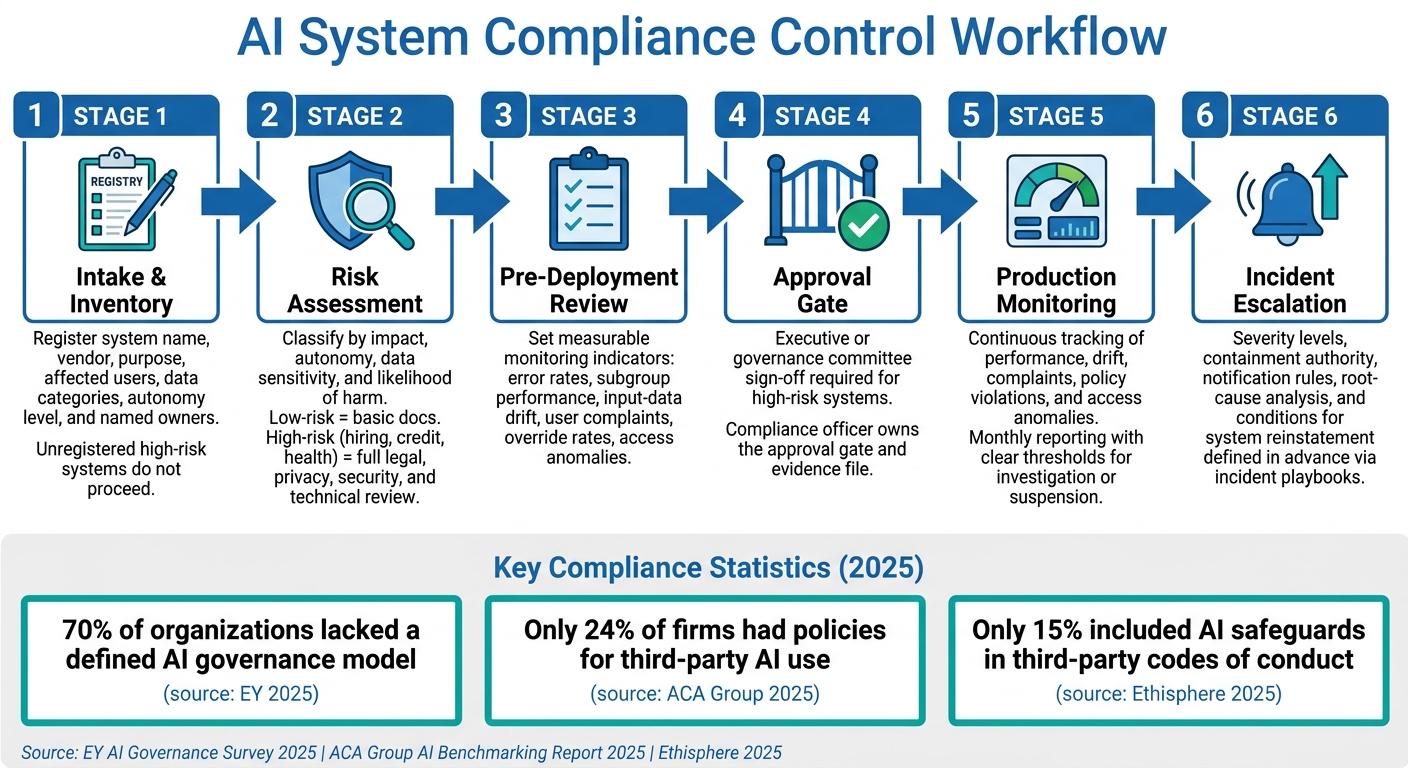
AI System Compliance Control Workflow for Compliance Officers
Certification knowledge helps turn each AI use case into something the business can own, control, and audit. That starts with a control workflow for every system, not just a set of written principles.
A Step-by-Step Control Workflow for AI Systems
Start at intake. Every AI system should be registered with its system name, vendor or developer, business purpose, affected users, data categories, level of autonomy, and named business and technical owners. If a high-risk use case is not registered, it should not move forward.
Use six stages across the lifecycle: intake and inventory, risk assessment, pre-deployment review, approval gate, production monitoring, and incident escalation.
Risk classification should shape the depth of review. A low-impact internal productivity tool may only need basic documentation, security checks, and business-owner sign-off. But a system that affects hiring, credit, health care, or access to core services needs a much tougher review before production. That usually means input from legal, privacy, security, and technical teams, plus approval from an executive or governance committee.
Launch day isn't the finish line. Before deployment, set measurable monitoring indicators such as error rates, subgroup performance, input-data drift, user complaints, override rates, and access anomalies. Then set clear thresholds for investigation or suspension. Incident playbooks should also be ready in advance, with severity levels, containment authority, notification rules, root-cause analysis steps, and the conditions for putting a system back into service.
The table below maps those controls to ownership, evidence, and review timing.
| Certification knowledge area | Compliance activity | Required evidence | Control owner | Review cadence |
|---|---|---|---|---|
| AI governance and accountability | Maintain the AI inventory; assign business, technical, privacy, security, and compliance owners | Approved inventory record, RACI matrix, ownership attestations | AI governance lead | Monthly review; immediate update after material change |
| Risk management | Classify each use case by impact, autonomy, data sensitivity, and likelihood of harm | Completed risk assessment, tiering rationale, residual-risk approval | Compliance and business owner | At intake, before deployment, and at least annually |
| Privacy and data governance | Validate lawful purpose, minimization, retention, access, and data-transfer practices | Data-flow diagram, privacy assessment, retention schedule, vendor data terms | Privacy officer | Before deployment and after data or purpose changes |
| Fairness and human rights | Test for disparate performance or outcomes; define human-review requirements | Test plan, subgroup metrics, limitations, remediation log, appeal process | Model risk or responsible AI lead | Before launch and after material model or data changes |
| Security and resilience | Restrict access, protect model interfaces, test abuse scenarios, manage secrets | Access reviews, threat model, penetration or red-team results, continuity plan | CISO or security owner | Quarterly access review; annual security assessment; event-driven testing |
| Transparency and explainability | Provide user notices, appropriate explanations, and documented limitations | User disclosures, model card, decision rationale, communication templates | Product owner and legal/compliance | Before launch and after significant changes |
| Vendor and third-party oversight | Evaluate providers, contract for audit rights and incident notification, and monitor subcontractors | Due-diligence file, contract clauses, certifications, service reports, vendor attestations | Procurement and third-party risk | Pre-contract, annually, and on material vendor change |
| Testing and validation | Establish acceptance criteria and independently review high-risk systems | Validation report, benchmark results, approval sign-off, unresolved-issue register | Technical owner and independent reviewer | Pre-deployment and after major updates |
| Records and retention | Preserve decisions, versions, incidents, and approvals | Audit trail, version history, meeting minutes, retention evidence | Records manager and system owner | Continuous; periodic sampling |
| Monitoring and incident response | Track performance, drift, complaints, policy violations, and incidents | Monitoring dashboard, alert thresholds, incident tickets, corrective-action reports | Operations and compliance | Continuous monitoring; monthly reporting; immediate escalation for serious events |
Where Certified Compliance Officers Add Value Inside the Organization
A credentialed compliance officer often serves as the link between governance goals and daily business decisions. In plain terms, that can mean drafting the AI governance committee's charter, putting together risk-based portfolio dashboards for senior leadership and the board, and reviewing vendor contracts and due-diligence files before procurement gives final approval.
Just as important, they keep teams moving in the same direction. Take an AI recruiting tool. One review can pull in privacy, security, model risk, legal, procurement, and HR. It also needs a documented human-review process. The compliance officer may not run each workstream, but they usually own the approval gate and the evidence file. That's a big deal, because if the file is thin, the control is thin too.
A certification on its own does not prove compliance. The proof comes from evidence that shows the controls worked over time.
NAITIVE AI Consulting Agency and Governance for Real AI Deployments
For more complex deployments, outside implementation support can help turn governance requirements into controls that work in production.
NAITIVE AI Consulting Agency helps organizations govern advanced AI deployments, including autonomous agents and automation. For compliance officers, that kind of support can help assess an agent's tool permissions and access scope, set approval points, test failure and escalation paths, document vendor and system responsibilities, and tie operating evidence back to the enterprise AI inventory and audit process.
The organization still keeps accountability for its risk decisions, controls, and regulatory duties. Even so, a partner with strong technical depth can help close the gap between what a governance framework says should happen and what an autonomous system is actually doing in production.
Career Impact and Final Takeaways
Certification matters most when it helps you do the job better.
And right now, the job market is sending a pretty clear signal: AI governance skills are in demand. Cisco found that demand for AI governance skills increased 150% and demand for AI ethics skills increased 125% in the 2025 AI Workforce Consortium findings. ServiceNow's 2025 Workforce Skills Forecast also pointed to a shortage of workers with skills like data auditing and stewardship, information assurance, AI ethics, and IT risk management.
For compliance officers, that matters in very practical ways. Better training can lead to stronger oversight, faster risk triage, and smoother audit readiness. This demand shows up most in roles that own AI controls, review decisions, and examine audit evidence.
Roles That Benefit Most from This Credential
This credential is most useful for people whose daily work centers on governing, assessing, or auditing AI systems. That includes AI compliance officers, AI governance managers, responsible AI program managers, privacy officers, technology risk managers, internal auditors, model risk professionals, and AI assurance specialists.
Different job titles, same core work: these roles help manage AI controls, reviews, and audit evidence.
The 2025 AI Workforce Consortium report names AI Risk & Governance Specialist as an emerging role focused on managing AI-related risks, ensuring governance compliance, and developing responsible-use frameworks. If you're coming from a nearby field and moving into AI governance, a certification can help show you're ready. But let's be honest - hiring teams will still want proof that you've done the work, not just studied it.
Key Points to Remember Before Choosing a Program
For these roles, program quality matters more than polished sales copy.
Start with the basics. Check whether the program is an exam-based professional certification or a certificate of completion. Those are not the same, and treating one like the other on a résumé can hurt your credibility.
Then look at the curriculum. Does it cover the frameworks and controls that show up in day-to-day enterprise AI governance work? Focus on programs that include:
- Risk assessment
- Impact assessments
- Vendor oversight
- Monitoring
- Documentation
- Audit readiness
Programs tied to NIST AI RMF or ISO/IEC 42001 are usually easier to judge because the scope is clearer.
When you list the credential, use the exact details provided by the issuer: official name, issuer, award date, and renewal date if one applies. Then pair it with one measurable governance result. The credential shows what you know. The work product shows what you can do.
It also helps to check renewal rules before you enroll. They can vary quite a bit from one program to another.
FAQs
Which certification type is best for compliance officers?
For compliance officers, the best fit is an auditable AI governance certification based on ISO/IEC 42001, which is a certifiable AI management system standard.
Why does that matter? Because compliance teams usually need more than good intentions. They need records. They need clear ownership. They need proof that controls didn’t just exist for one meeting or one launch, but stayed in place over time.
An ISO/IEC 42001-based certification helps show that:
- roles and responsibilities are defined
- risk controls are in place
- reviews happen on a set basis
- audit-ready records are maintained over time
That kind of paper trail is critical when you’re dealing with regulatory alignment and audit scrutiny.
That said, it’s not a magic shield. It does not replace legal compliance on its own.
Does AI ethics certification prove legal compliance?
No. AI ethics certification does not prove legal compliance.
Programs like ISO/IEC 42001 can help a company build a repeatable governance structure. But they’re voluntary, and they do not replace binding legal duties. A company can hold a certification and still miss specific federal, state, or industry rules.
Certification is a useful governance tool, not a legal safe harbor.
What should I verify before paying for a program?
Verify that the curriculum lines up with recognized governance frameworks, such as the NIST AI Risk Management Framework and the EU AI Act.
Also make sure it teaches practical, audit-ready skills. That includes documenting system architecture, training data sources, model validation results, bias detection, data quality review, audit trails, vendor risk management, and ongoing automated compliance monitoring.