AI Governance Frameworks: Reducing Legal Risks
No single framework eliminates legal risk—use the EU AI Act for duties, ISO 42001 for auditable governance, and NIST for daily controls.

If I had to sum it up in one line: none of these frameworks wipes out legal risk, but each one helps in a different way.
If I’m a U.S. company using AI, I should think about these three frameworks like this:
- EU AI Act = binding law with fines tied to global revenue
- ISO/IEC 42001:2023 = a certifiable management system for AI governance
- NIST AI RMF = voluntary guidance for day-to-day risk control
That matters because one AI tool can trigger several legal issues at once: privacy, bias claims, IP disputes, security failures, contract fights, and consumer or employment law issues.
A few facts stand out fast:
- The EU AI Act entered into force on August 1, 2024
- Some bans started on February 2, 2025
- More rules and enforcement steps began on August 2, 2026
- Top penalties can reach €35 million or 7% of worldwide annual turnover
So the main takeaway is simple: I should use the EU AI Act for legal duties, ISO 42001 for audit-ready governance records, and NIST for daily risk work. That layered setup can lower exposure, but it does not erase liability.
AI Governance as Compliance with Bennett Borden
sbb-itb-f123e37
Quick Comparison
| Framework | What it is | Main job | Legal force | What it helps prove | Main limit |
|---|---|---|---|---|---|
| EU AI Act | EU law | Sets duties for covered AI systems | Binding | Whether legal duties were met | Does not replace privacy, employment, IP, or contract law |
| ISO/IEC 42001:2023 | AI management system standard | Builds governance and audit records | Voluntary | That roles, controls, reviews, and records exist | Certification is not the same as legal compliance |
| NIST AI RMF | Risk framework | Guides daily control work | Voluntary | That risks were identified, tested, tracked, and addressed | No single checklist or legal safe harbor |
What I like about this comparison is that it keeps the roles clear: law sets the floor, ISO builds the governance system, and NIST helps teams run it in practice.
EU AI Act: Binding Rules and Legal Exposure
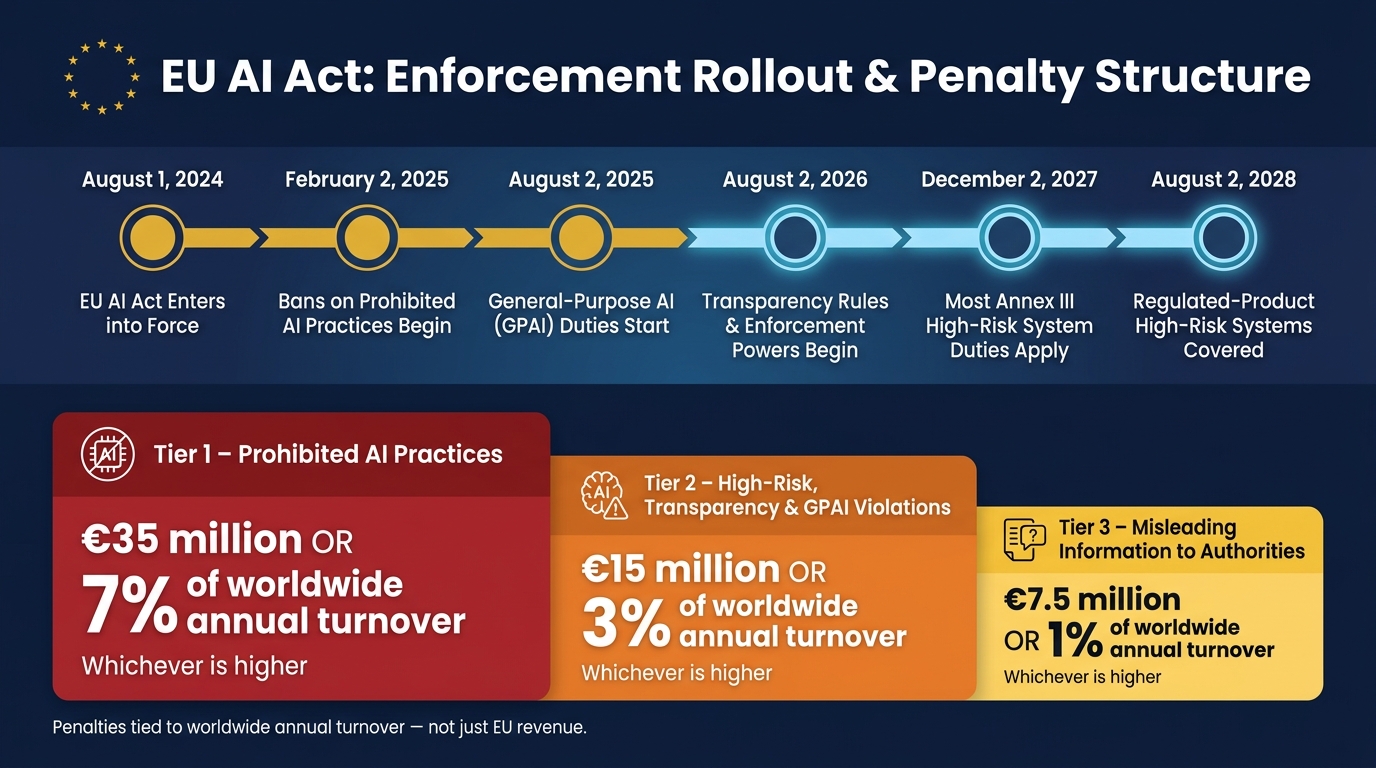
EU AI Act Enforcement Timeline: Key Dates & Penalties
Legal Force
The EU AI Act is binding law, and its duties roll out in stages. It entered into force on August 1, 2024. Bans on unacceptable practices started on February 2, 2025. GPAI duties start on August 2, 2025. Transparency rules and enforcement powers begin on August 2, 2026. Many Annex III high-risk duties start on December 2, 2027. Regulated-product high-risk systems follow on August 2, 2028.
The first step is simple: figure out whether the company is acting as a provider, deployer, importer, distributor, or authorized representative, and whether the system or its outputs are used in the EU.
That part matters fast. Penalties are tied to worldwide turnover, so even a company with modest EU revenue can face major legal risk. In plain English, classification and control design are not nice-to-haves. They sit at the center of the job.
Lifecycle Controls
The Act applies across the full AI lifecycle, from design through retirement. For high-risk systems, providers must keep a documented risk-management process and show a set of core controls in practice. That includes identifying foreseeable risks, reducing them, keeping data-governance records and technical documentation, logging automatically, giving deployer instructions, supporting human oversight, and showing accuracy, robustness, and cybersecurity.
Classification is one of the biggest decision points. A tool may look administrative or assistive on the surface, but it can still fall into the high-risk bucket if it affects employment, education, law enforcement, migration, justice, or access to needed services. The starting point should be the system's intended purpose, its role in the business process, who uses it, who may be affected, where it is deployed, and whether it is a general-purpose AI model. A sound classification record should spell out the use case, the risk category, the provider or deployer role, the legal basis, the deadline that applies, and the proof behind that call.
Get that call wrong, and the rest can go sideways too. You may apply the wrong controls, work to the wrong deadline, and walk into the wrong penalty risk.
The next issue is just as important: can the company prove those controls were in place and did what they were supposed to do?
Audit Evidence
The Act asks for auditable records, not just polished policy language. For high-risk providers, the evidence set includes risk-management files, data-governance records, technical documentation, testing and validation results, cybersecurity and accuracy assessments, logging design, human-oversight procedures, quality-management records, instructions for use, conformity-assessment materials, declarations of conformity, and any required registrations.
Deployers should also keep proof that they followed provider instructions, assigned capable human oversight, monitored system operation, kept logs when required, reported serious incidents, and carried out any required fundamental-rights impact assessment.
A practical move here is to version-control the evidence and link it to each model and software release. If models, prompts, user groups, jurisdictions, or decision-making functions change, the records should change too. Otherwise, the paper trail stops matching the system people are actually using.
Risk Coverage
The Act directly targets unsafe or discriminatory high-risk systems, weak oversight, poor traceability, cybersecurity failures, prohibited manipulation, and GPAI noncompliance. But compliance with the EU AI Act does not eliminate exposure under other laws. A company can still face claims or enforcement under the GDPR, consumer-protection law, employment and antidiscrimination statutes, product-safety rules, intellectual-property and copyright law, sector-specific rules, or contract law.
That’s why this can’t live in a legal silo. It needs to connect with privacy, security, procurement, product-safety, and litigation-risk work. Organizations often benefit from AI consulting services to bridge these departmental gaps.
| Violation Type | Maximum Penalty |
|---|---|
| Prohibited AI practices | €35 million or 7% of worldwide annual turnover |
| High-risk, transparency, and general-purpose AI violations | €15 million or 3% of worldwide annual turnover |
| Supplying incorrect, incomplete, or misleading information to authorities | €7.5 million or 1% of turnover |
That evidentiary burden is where ISO/IEC 42001 becomes useful.
ISO/IEC 42001:2023: Auditable AI Management System
Legal Force
ISO/IEC 42001:2023 is a voluntary, certifiable AI management-system standard. In the United States, it does not carry automatic legal force.
That matters because certification is not the same as legal compliance. A company can be certified and still fail to meet rules that apply to a given AI use case. What certification can show is that the business identified risks, assigned clear responsibility, and tracked controls over time.
That paper trail can help with:
- regulator reviews
- customer due diligence
- contract discussions
- internal oversight
- litigation defense
Still, it does not replace compliance with privacy, employment, consumer-protection, intellectual-property, or sector-specific law. So the standard is useful as a control framework, but it is not enough by itself.
Lifecycle Controls
The AIMS covers AI governance across the full lifecycle: planning and requirements, design, development or procurement, deployment, operation, monitoring, and retirement.
That broad scope is one reason teams like it. Its ISO format lines up well with existing security, privacy, and compliance programs, so companies usually don't have to start from scratch, especially when working with an AI consulting agency to align frameworks.
And here's the part that often gets missed: many legal problems don't start at launch. They show up later, after deployment, when monitoring slips, updates go out without enough review, or incident response falls apart.
Audit Evidence
The standard requires documented information that shows governance works in day-to-day practice, not just on paper. In plain English, a policy sitting in a folder isn't enough.
A solid AIMS creates a connected evidence trail. Each material risk should link to an owner, a control, an approval decision, a monitoring metric, an escalation path, and a stored record.
Timing matters too. Evidence put together after a complaint or regulator inquiry is much weaker than records created during normal AI operations. Dated test results, review logs, risk-treatment decisions, and documented exceptions carry more weight when they were created at the time the work happened.
Risk Coverage
ISO/IEC 42001 addresses governance risks tied to accountability, data quality, transparency, monitoring, and third-party oversight. Its controls should scale based on the risk level of the use case.
Just as important are its limits. The standard does not decide whether a given use complies with the EU AI Act, U.S. employment law, copyright law, or state-level AI rules. It also does not guarantee model accuracy or remove bias.
Those duties have to be identified on their own and then mapped to AIMS controls. The strongest approach is to use ISO/IEC 42001 as the management-system backbone, then add legal review for each jurisdiction and each use case.
NIST turns this governance structure into day-to-day operational risk controls.
NIST AI Risk Management Framework: Day-to-Day Risk Controls
Legal Force
NIST sits below the law. It takes high-level governance goals and turns them into repeatable day-to-day controls. The NIST AI RMF 1.0 is voluntary guidance, not a federal rule, a certification program, or a stand-alone penalty system.
For U.S. companies, NIST works best as an internal control standard, not a legal shield. It does not replace duties under laws such as the Fair Credit Reporting Act, the Equal Credit Opportunity Act, Title VII, consumer-protection laws, privacy statutes, or sector-specific rules. So if a company says it aligns with NIST, that should not be treated as proof of legal compliance.
That said, a documented, risk-based program still matters. When regulators, plaintiffs, customers, or auditors look at an AI-related decision, good records can help show reasonable governance, due diligence, oversight, and remediation.
Lifecycle Controls
The framework uses four iterative functions: Govern, Map, Measure, and Manage. In practice, those functions should lead to controls you can test and follow-up actions you can document.
- Govern sets leadership accountability, policies, risk tolerance, roles, and oversight.
- Map records the system's purpose, users, affected stakeholders, data, operating context, intended uses, limits, and possible impacts.
- Measure uses qualitative, quantitative, or mixed methods to test and monitor risk, including accuracy, privacy, security, bias, explainability where it matters, robustness, and harmful or unexpected behavior.
- Manage ranks identified risks, assigns treatment actions, handles residual risk, and supports incident response and continual improvement.
A good place to start is a scoped pilot for one high-impact use case, often supported by AI cloud consulting. Begin with an AI inventory and a risk-tiering method. Then assign clear owners, set minimum predeployment tests, and add monitoring before rolling the program out more broadly.
Audit Evidence
The AI RMF does not hand you a fixed checklist. NIST's Playbook gives aligned actions, but each organization still has to build its own control matrix.
A strong evidence package links each major risk to five things: an owner, a control, a test result, a decision, and a follow-up action. Keep the bad news along with the good. Failed tests, rejected deployments, accepted residual risks, and corrective actions often say more than a folder filled only with passed evaluations.
Risk Coverage
NIST can help cut exposure, but legal review is still a separate step. The AI RMF supports controls for validity and reliability, safety, security and resilience, accountability and transparency, explainability and interpretability, privacy enhancement, and fairness with harmful bias managed.
Just as important are the limits. The framework helps teams design controls, but it does not decide what is lawful, and it does not give legal advice or a single risk threshold that works for every case. Legal and compliance teams still need to review jurisdiction, the laws that apply, and the duties tied to the specific use case.
Strengths and Limits of Each Framework for U.S. Enterprises
No single framework wipes out legal risk. That’s the core point here.
This isn’t about naming a winner. It’s about showing which kind of legal risk each framework helps reduce best. Read the table as a decision matrix built around three things: legal duty, governance evidence, and day-to-day control.
| Dimension | EU AI Act | ISO/IEC 42001:2023 | NIST AI RMF |
|---|---|---|---|
| Enforceability | Binding law; direct penalties for covered violations | Voluntary standard; no penalties | Voluntary guidance; no penalties |
| Procurement usefulness | Essential for vendor contracts with EU exposure | Strongest for supplier assurance; third-party certification is available | Useful for control specifications and questionnaires |
| Assurance value | Legal conformity mechanisms for covered high-risk systems | Independent third-party certification available | No universal certification under the framework itself; evidence comes from documented implementation |
| Implementation load | Highest for in-scope systems; requires technical files, logging, monitoring, and impact assessments where required | Sustained management-system program; internal audits and management reviews required | Lowest barrier to entry; the enterprise sets its own thresholds and evidence standards |
| Primary relevance | Strongest for EU market exposure; can shape global product design | Globally portable international standard | U.S.-centered; adaptable internationally, but not a substitute for foreign statutory duties |
| Vendor governance support | Allocates provider and deployer duties in contracts | Covers supplier controls, subcontractors, and model-change management | Supports vendor questionnaires and control requirements |
| Human oversight | Most prescriptive; requires competence, authority, and the ability to intervene or stop the system | Requires proportionate oversight documented to identified risks | Contextual; enterprise defines oversight model based on risk |
| Autonomous agents | High-risk rules apply where relevant; general-purpose AI model obligations may also apply | Applicable; enterprise must document why the oversight model is proportionate | NIST AI 600-1, released July 26, 2024, provides a generative AI profile; practical controls must be defined by the enterprise |
| What it does not cover | Does not independently address privacy, IP, employment, or cybersecurity law | Certification scope may not cover all enterprise AI systems or products | Nonbinding; two organizations can claim alignment while using very different controls |
A simple way to think about it:
- Use NIST for daily controls
- Use ISO/IEC 42001 for auditable governance
- Use the EU AI Act as the legal layer where it applies
For U.S. enterprises, the most defensible setup is a layered one: NIST for day-to-day risk control, ISO/IEC 42001 for governance evidence, and the EU AI Act for statutory duties. That mix makes sense because each framework does a different job. One helps teams run the machine. One helps prove the machine is being run with discipline. One sets hard legal duties.
There’s also a trap here. Standards alignment is not the same thing as legal compliance. Legal counsel should check whether the controls in your crosswalk meet the actual statutory requirements. If not, you can end up with neat documentation and a weak legal position.
The same goes for vendors. Treating vendor certification as a stand-in for contract terms, independent testing, and ongoing monitoring leaves a governance gap. On paper, that may look tidy. In practice, it can fall apart the moment a regulator, customer, or litigant asks for proof.
These tradeoffs lead straight to the next issue: how to combine all three frameworks without turning governance into duplicate process. Working with an AI cloud consulting agency can help streamline this integration.
Conclusion
The comparison points to one clear path: layer law, management systems, and day-to-day controls.
The strongest legal-risk approach for a U.S. enterprise doesn't come from betting on a single framework. It comes from using three together. Applicable law sets the floor. For enterprises that fall within scope, that includes the EU AI Act. Voluntary standards don't replace binding legal duties.
ISO/IEC 42001:2023 builds the governance structure on top of that floor. It covers policies, assigned roles, documented decisions, internal audits, and continual improvement. Certification may strengthen that record, but it is not a legal safe harbor. NIST AI RMF then puts that system into practice, giving teams a repeatable way to identify, measure, manage, and monitor risk across the AI lifecycle. Put simply: law sets the duty, ISO/IEC 42001 builds the management system, and NIST turns that into daily controls.
That setup only works when ownership is clear. Legal, privacy, security, HR, procurement, product, and engineering each need to own their piece of the control stack. A designated executive or AI governance committee should settle conflicts and approve high-risk deployments. Without named accountability across those groups, even a well-built framework can turn into a paper exercise.
Frameworks can cut risk and improve defensibility, but they don't make risk disappear. The EU AI Act still carries major fines for noncompliance. No governance program or certification protects an enterprise from enforcement, litigation, regulatory investigations, or contractual disputes on its own. Controls have to work in practice, not just sit in a policy document.
The goal isn't to pick one framework and ignore the rest. It's to give each one a clear job. If your organization is building or deploying AI systems, NAITIVE AI Consulting Agency can help map frameworks to operational controls and governance workflows. The enterprise still keeps full responsibility for its legal compliance and governance decisions, but outside help can speed up control design and implementation.
FAQs
Does the EU AI Act apply to my U.S. company?
Yes. The EU AI Act can apply to your U.S. company if you provide or deploy AI systems in the European Union, or if your AI system’s output is used there.
That’s because the law has extraterritorial reach. So even if your business is based in the United States, working with the EU market can still bring you under the Act’s scope.
If your company falls into that bucket, your systems need to meet the law’s rules. NAITIVE AI Consulting Agency helps businesses build governance frameworks aligned with the EU AI Act.
Is ISO 42001 certification enough to prove legal compliance?
No. ISO/IEC 42001 certification helps you set up a repeatable AI governance management system, but it does not prove legal compliance on its own.
Legal compliance also depends on meeting the federal, state, and industry-specific rules that apply to your situation. It means keeping evidence and audit trails, and matching your controls to those requirements.
Think of ISO 42001 as the system that helps you stay organized. You still need region- and use-case-specific measures alongside it.
How should I combine the EU AI Act, ISO 42001, and NIST AI RMF?
Use NIST AI RMF as the lifecycle operating model, ISO/IEC 42001 as the management-system backbone, and the EU AI Act as the legal requirements layer.
Then set up stage-gated checkpoints across development, deployment, and retirement. At each gate, review the right records, confirm approvals, and complete DPIAs when needed. This gives teams a clear path forward instead of a last-minute scramble.
After that, run internal and third-party assurance so your inventory, controls, and evidence stay lined up across all three frameworks. That way, when someone asks, “Can you show how this system was governed?”, you’re not digging through folders - you already have the trail in place.