Data-Driven Decision Frameworks in AI Consulting
Link strategy, data, CRISP-DM, DataOps, MLOps, decision design and human oversight so AI changes decisions and delivers measurable business impact.
Most AI programs fail at one simple point: they produce predictions, but they do not change decisions.
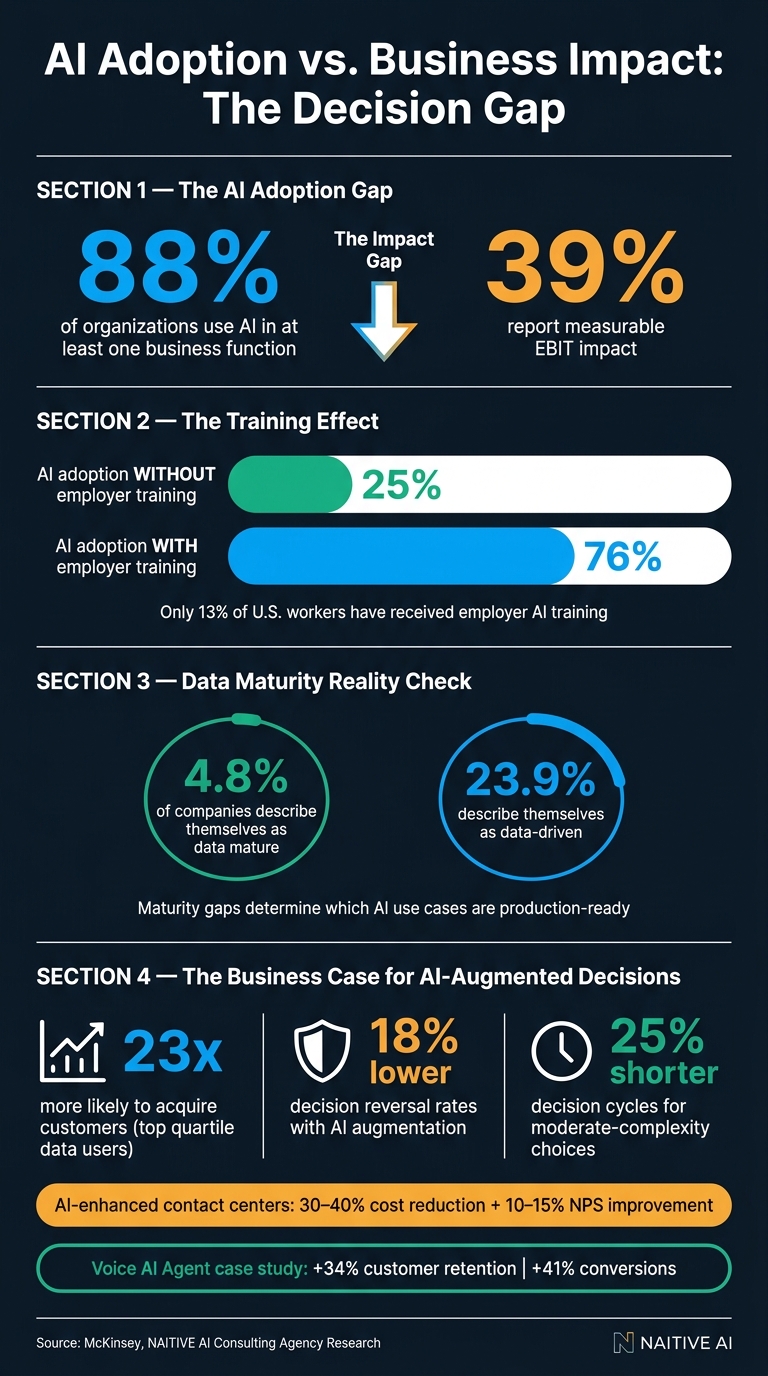
I see the article making one clear case: if you want AI to affect cost, speed, risk, or consistency, you need a linked system for strategy, data, model delivery, decision rules, and human review. The numbers support that point. 88% of organizations use AI in at least one business function, but only 39% report measurable EBIT impact. And while only 13% of U.S. workers have received employer AI training, adoption jumps from 25% to 76% when training is provided.
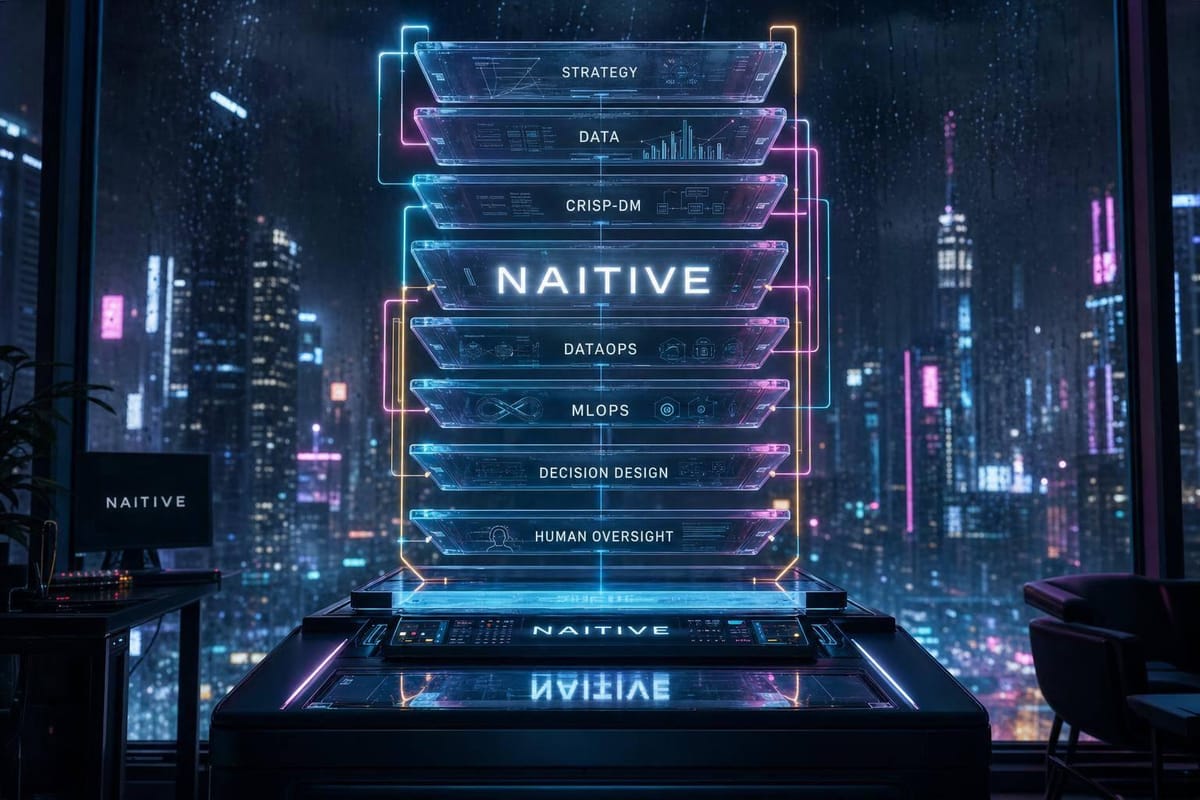
If I had to boil the whole piece down, it says you need to get five things right:
- Set direction first with a data and analytics plan tied to business goals
- Check readiness before funding AI use cases your team cannot support yet
- Build with process using CRISP-DM, DataOps, and MLOps
- Turn outputs into actions with decision design, rules, constraints, and workflow links
- Pick the right level of human review based on risk, volume, and business impact
A few points stand out fast:
- Companies should not jump from messy reporting straight to AI automation
- Model accuracy alone is not enough; business results and system health also need tracking
- Regulated decisions need explainability, validation, audit trails, and clear ownership
- Shadow mode is a smart way to test AI recommendations before giving systems live authority
- High-volume decisions often fit automation, while high-stakes decisions still need people in the loop
| Area | What it does | Why it matters |
|---|---|---|
| Strategy & roadmap | Links AI work to business goals and ownership | Stops teams from building disconnected pilots |
| Maturity assessment | Checks data, governance, talent, and reporting readiness | Helps sequence use cases in the right order |
| CRISP-DM | Guides the project from business problem to deployment | Keeps model work tied to the actual decision |
| DataOps & MLOps | Keep data flows and models stable in production | Helps teams spot whether issues come from data, drift, or process change |
| Decision design | Connects predictions to rules, actions, and feedback loops | Turns analytics into decisions people can use |
| Human review model | Sets when people approve, monitor, or set limits | Reduces risk in high-impact use cases |
Bottom line: I’d summarize the article this way: AI consulting works best when it treats decisions as systems, not just models. That means business goals, clean data, production controls, workflow execution, and measured outcomes all need to line up from the start.
AI Adoption vs. Business Impact: The Decision Gap
How to Create Decision Clarity During AI Transformation
sbb-itb-f123e37
Data and Analytics Strategy Frameworks in AI Consulting
Strategy-level frameworks help consultants tie business goals to the data, analytics, AI, governance, and operating capabilities needed to support specific enterprise decisions. Put simply, they turn business limits into a plan for what to build first and what can wait.
Data and Analytics Strategy and Operating Model
This is the layer that turns business goals into roles, decision rights, and governance. A data and analytics strategy and operating model (DASOM) converts business goals into a target operating model. It covers vision, value propositions, capability gaps, data ecosystem, architecture, delivery model, and execution readiness.
In day-to-day work, consultants often use current capability gaps as the link between strategy and operating-model design. If analytics talent is thin, data definitions don’t match, or governance is loose, those gaps shape which AI use cases are realistic right now and how the operating model should be set up.
The operating model then spells out who owns data products, how analytics teams work with business units, and which governance gates must be cleared before a model moves into production. That’s what makes the recommendations usable in actual workflows instead of staying stuck in slide decks.
Data Strategy Planning Frameworks and Roadmaps
Once the operating model is set, consultants need a practical way to turn it into action. A common pattern uses four phases: Discover, Map, Navigate, and Adjust.
- Discover baselines the current data and analytics state
- Map turns that view into a prioritized roadmap
- Navigate puts high-value use cases into action
- Adjust updates the roadmap as conditions change
This kind of roadmap helps teams move from planning to delivery without losing sight of governance, ownership, or business priorities.
Analytics Maturity Models for Sequencing AI Investments
Maturity models answer a simple but important question: what AI use cases can this organization support today?
Common frameworks move through five levels: manual or ad hoc reporting, standardized reporting, diagnostic analytics, predictive analytics, and prescriptive or decision intelligence. Some add a sixth stage for automated decisioning, where AI agents act with minimal human intervention.
That sequence matters more than many teams want to admit. A company that still struggles with inconsistent KPI definitions and manual reporting isn’t likely to get dependable results from a churn prediction model, no matter how strong the algorithm looks on paper.
Consultants use maturity assessments to explain that sequencing to stakeholders and to guard against over-investment. Only 4.8% of companies describe themselves as data mature, and 23.9% describe themselves as data-driven. That gap explains why maturity should guide use-case sequencing. The assessment then shows which AI use cases are ready for production.
Used together, these frameworks set the destination, the route, and the order of investment.
| Framework | Purpose | Key Inputs | Key Outputs | Strengths | Limitations |
|---|---|---|---|---|---|
| Strategy & Operating Model (DASOM) | Align AI initiatives with business vision, stakeholder outcomes, and enterprise capabilities | Business goals, stakeholder needs, current-state capabilities, governance structure | Target operating model, capability gap analysis, governance design, delivery roles | Creates enterprise-wide alignment; ties AI to business value | Can become abstract without measurable milestones |
| Data Strategy Planning Framework (Discover–Map–Navigate–Adjust) | Translate strategy into a governed, phased execution roadmap | Current-state assessment, use-case priorities, architecture principles, ownership model | Prioritized roadmap, ownership assignments, implementation milestones, refresh cadence | Practical and sequenced; easy for executives and finance leaders to act on | Requires ongoing refresh; can stall if ownership is unclear |
| Analytics Maturity Model | Assess readiness and sequence AI investments by capability stage | Data quality, governance maturity, talent, architecture, analytics adoption | Maturity score, realistic use-case portfolio, sequenced investment plan | Prevents over-investment; grounds roadmap in actual organizational readiness | Maturity scoring can be subjective; stages may not map cleanly to every industry |
Analytics and AI Lifecycle Frameworks for Decision-Making
Strategy tells you what to focus on. Lifecycle frameworks make sure that work holds up in production.
Three frameworks drive this execution layer: CRISP-DM, DataOps, and MLOps. Each handles a different part of the job, and they work best when they're connected instead of treated like separate playbooks. Put them together, and AI moves from a plan on paper to repeatable delivery.
CRISP-DM for Decision-Centric AI Projects
CRISP-DM lays out the analytics lifecycle from business problem to deployment. Its six phases are: business understanding, data understanding, data preparation, modeling, evaluation, and deployment.
For decision-focused AI, the first phase gets very specific. Business understanding should define the decision being improved, plus its constraints, risk tolerance, and KPIs. Data understanding then narrows in on the data elements that directly shape that decision. Data preparation turns those decision drivers into features that line up with how people actually make the call.
Model selection should follow the decision itself. Use interpretable models for regulated approvals, online-learning methods for pricing, and optimization models for routing. Evaluation should measure decision impact, not just prediction accuracy. Consultants often run scenario tests to estimate what business outcomes would have looked like if the model's recommendations had been used. Deployment should also fit the decision channel: batch scoring for daily updates, APIs for real-time routing, and workflow integrations for approvals.
In regulated sectors, variations such as FIN-DM extend CRISP-DM with direct governance, compliance, and risk management tasks. That builds auditability into the process from the start instead of tacking it on at the end.
DataOps and MLOps for Reliable AI Operations
DataOps handles data pipelines through contracts, validation, lineage, and access controls. Data contracts define schema, update frequency, volume expectations, and quality thresholds. Automated validation runs at every pipeline stage: schema checks, referential integrity checks, distribution drift checks, and business-rule validations. If a feed misses an expected update, a quality gate blocks bad data before it reaches the model. Lineage and access controls keep inputs traceable and secure.
MLOps starts where DataOps stops. It covers model training, deployment, monitoring, retraining, and retirement. A model registry stores approved models with metadata such as version, owner, and validation status. Drift detection uses statistical tests like the KS test or Population Stability Index (PSI) to compare production feature distributions against training baselines, then trigger alerts or automated retraining when thresholds are crossed. Every prediction is logged for monitoring and audit.
When DataOps and MLOps share SLAs, monitoring dashboards, and change management workflows, teams can diagnose problems much faster. If decision quality drops, they can tell whether the issue came from a data pipeline failure, model drift, or a change in the underlying business process. That's a big deal, because those problems can look the same from the outside while needing very different fixes.
Metrics for Measuring Whether AI Improves Decisions
Track three layers: model quality, business impact, and operational reliability.
Business metrics come first because they answer the main question: did the decision get better? That might mean revenue lift in USD, lower loan default rates, better on-time delivery percentage, or reduced inventory carrying costs. Model metrics such as precision, recall, F1, AUC, and calibration error measure prediction quality. Operational metrics show how well the system works in production, including prediction latency, system uptime, exception rates, and the share of decisions that still need manual review.
These layers affect each other in ways that matter. A model with slightly lower AUC but better probability calibration may lead to steadier business outcomes and fewer regulatory problems than a model that looks stronger on paper but behaves unpredictably at the edges. In practice, that tradeoff matters more than many teams expect.
Consultants usually set up dashboards that show all three layers side by side against pre-AI baselines. That gives stakeholders a clear view of how changes in model performance flow through to business and operational results over time.
Once these controls are in place, the next issue is simple to state and hard to answer: who should make the final call - people, systems, or both.
| Framework | Primary Focus | Key Stakeholders | Decision Impact |
|---|---|---|---|
| CRISP-DM | Structuring the analytics and AI build process from business problem to deployed model | Data scientists, business analysts, project sponsors | Ensures models are built to solve the right decision problem with appropriate evaluation criteria |
| DataOps | Reliable, tested, observable data pipelines that feed AI systems | Data engineers, data governance teams, compliance | Protects decision quality by preventing bad data from reaching models |
| MLOps | Model lifecycle management from training through monitoring and retirement | ML engineers, model risk teams, operations | Maintains decision reliability over time through drift detection, retraining, and audit trails |
Decision Intelligence and AI-Powered Decision Frameworks
Controls and pipelines help keep AI systems steady. But a steady system doesn't automatically lead to better choices. Decision intelligence is the layer that connects model output to the decisions people and systems make every day. Once data, lifecycle, and operating controls are in place, DI shows how those capabilities change a specific business decision. In plain English: it turns AI suggestions into approved actions inside enterprise workflows.
Decision Intelligence: Bridging Insight and Action
Decision intelligence (DI) brings together data science, AI, operations research, and human judgment in structured workflows tied directly to business results, like revenue growth, cost reduction, risk mitigation, and customer experience gains. The point isn't to build more models. The point is to connect the data, analytics, and AI you already have to decision flows that can be tracked and improved.
The loop is pretty straightforward. Teams pull trusted data from core business systems, analyze it, rank options, apply constraints, execute, and then track whether the action improved the target result. If it didn't, policies can change.
That gap between analytics power and business impact is still very real. A McKinsey summary reports that 88% of organizations regularly use AI in at least one business function, but only 39% report measurable EBIT impact.
So the next step isn't asking whether AI can help with decisions. It's deciding which decisions AI should support, supervise, or automate.
AI Decision Support and Decision Automation Methods
Not every choice should be automated. And not every choice needs a person involved at every step. The right setup depends on decision criticality. A practical place to start is with three groups:
- Strategic: high-stakes, long-horizon choices where AI is best used for support
- Tactical: mid-range choices where AI can recommend and humans can approve
- Operational: high-volume, rule-based choices that fit automation best
Consultants often use process mining, decision profiling, and workload analysis to spot good automation candidates. But before any system gets real execution authority, teams usually test it in shadow mode. That means the AI gets live inputs and records its recommendations, while the current process still makes the actual decision.
During that stage, teams watch AI-human agreement rate, override rate, speed, and fairness. It's a simple idea, but it matters a lot: shadow mode lets teams catch misalignment before it hits live outcomes.
The payoff can be big. Organizations in the top quartile for data use in decisions are 23× more likely to acquire customers and 6× more likely to retain them. AI-augmented decisions also show 18% lower reversal rates and 25% shorter decision cycles for moderate-complexity choices than non-augmented processes.
Human Oversight Models for Enterprise AI Decisions
Automation doesn't mean people disappear. It means people step in at the right points. In enterprise AI, three oversight modes are common, and each fits a different level of risk.
Human-in-the-loop puts a person inside every decision cycle. That's the right fit for high-stakes, regulated, or high-consequence cases like credit approvals, healthcare diagnoses, and legal judgments. Human-on-the-loop moves people into a monitoring role. They watch system behavior in aggregate and step in when thresholds are crossed instead of approving each decision one by one. That works well in medium-risk, high-volume settings where speed matters. Human-in-command fits strategic decisions, where people set the limits and AI works only inside them.
Human-in-the-loop, by itself, isn't enough as a governance plan. Oversight also needs clear authority, escalation paths, and decision evidence. Governance committees, sometimes called AI risk councils, set organization-wide decision policies, approve threshold changes, and help maintain regulatory compliance across all three modes.
These models draw the line between insight, recommendation, and execution.
| Decision Intelligence Frameworks | AI Decision Support | AI Decision Automation | |
|---|---|---|---|
| Decision Context | Strategic, cross-functional | Tactical, complex | Operational, repetitive |
| Degree of Automation | Low to medium | Medium | High |
| Oversight Model | Humans set the boundaries | Human-in-the-loop | Escalate exceptions |
| Deliverables | Decision blueprints, roadmaps | Ranked recommendations, dashboards | Autonomous execution, audit logs |
From here, consulting work moves from decision design into implementation and rollout.
How AI Consulting Engagements Apply These Frameworks
From Assessment to Roadmap to Production
Frameworks matter only when they move through delivery in the right order. In most AI consulting engagements, that work unfolds across six stages: current-state assessment, use-case prioritization, roadmap design, pilot delivery, production deployment, and continuous improvement. Each stage takes raw data, turns it into a better decision, and then checks what changed.
Consultants usually begin with a hard look at four areas: data quality, decision latency, process consistency, and governance maturity. That review helps surface high-frequency, high-cost, or high-error decisions like fraud review or pricing. Just as important, it shows what can be done now and what needs to wait. Those gating issues shape the roadmap.
From there, each framework has a job. Roadmaps set the operating model and sequencing. CRISP-DM guides the pilot. DataOps and MLOps help keep production pipelines stable. Decision intelligence connects model outputs to people, workflows, and business accountability. The sequence matters: strategy first, maturity second, lifecycle third, decision intelligence last. After that, the focus shifts from planning to day-to-day reliability.
The business case isn’t hard to see. AI-enhanced contact center operations have shown 30% to 40% cost reductions and 10% to 15% Net Promoter Score improvements in reported client results. That’s where implementation partners turn framework logic into systems people can use.
Where NAITIVE AI Consulting Agency Fits
NAITIVE AI Consulting Agency applies the full framework stack, from strategy and roadmap work through autonomous AI agents, voice agents, AI automation, and business process automation, to live production use cases. In one engagement, a NAITIVE-designed Voice AI Agent handling 200 outbound calls per day delivered a 34% increase in customer retention and a 41% boost in customer conversions.
That result didn’t happen by luck. It came from clear KPIs, a controlled rollout, and a feedback loop tied directly to business metrics.
Conclusion: The Framework Stack for Data-Driven AI Decisions
The frameworks in this guide work best as a stack. Strategy frameworks set direction. Maturity models help time investment. Lifecycle frameworks like CRISP-DM, DataOps, and MLOps move work from plan to delivery. Decision intelligence makes sure AI outputs lead to accountable business action instead of sitting in a dashboard unused.
The table below shows how each framework fits into the delivery flow.
| Framework | Assessment | Strategy & Roadmap | Build & Pilot | Deploy | Govern & Improve |
|---|---|---|---|---|---|
| Data & Analytics Strategy | ✓ | ✓ | |||
| Target Operating Model | ✓ | ✓ | |||
| Analytics Maturity Model | ✓ | ✓ | |||
| CRISP-DM | ✓ | ||||
| DataOps | ✓ | ✓ | ✓ | ||
| MLOps | ✓ | ✓ | ✓ | ||
| Decision Intelligence | ✓ | ✓ | |||
| Human Oversight Models | ✓ | ✓ | ✓ |
Each phase produces a different output: prioritized use cases, target architecture, pilot, production system, and then continuous improvement. Companies that treat these phases as one connected sequence, not a set of separate projects, are the ones that turn AI spend into measurable business results.
FAQs
How do I know if my company is ready for AI decision-making?
Assess readiness across data, technology, and organizational alignment.
You need:
- High-quality, structured, accessible data
- Infrastructure that can support AI and work with existing systems
- The right expertise in data engineering and AI governance
If there are gaps, outside support can help you prepare, maintain, and improve these solutions. And when this work lines up with broader business goals, it becomes much easier to track outcomes that matter.
When should AI make decisions instead of recommendations?
AI can move from recommendations to autonomous decisions when it runs on live, continuously updated data instead of static or outdated information.
That shift makes sense in use cases where timing matters and the system has to react right away, like fraud detection, autonomous systems, or trading signals.
But speed alone isn't enough. You also need a clear framework, strong audit trails, and human oversight to watch performance and make sure decisions stay aligned with organizational goals.
What metrics show AI is improving business decisions?
Track a balanced mix of metrics that tie day-to-day performance to business results, such as:
- cost savings, ROI, and payback period
- throughput, cycle time, and labor hours saved
- decision accuracy, error reduction, and human override rates
- CSAT, NPS, retention, and conversion rates
That way, you’re not just looking at activity. You’re seeing whether the work is saving money, speeding things up, cutting mistakes, and improving customer results.
For proof you can trust, compare results against a clear baseline. The best option is usually 12 months of historical data. And for more complex decisions, use before-and-after comparisons with control groups.