
BCRs for AI: Building Global Data Transfer Policies
BCRs enable compliant intra-group AI data transfers, only if approved, mapped, and backed by technical controls and active governance.

If your AI program sends EU personal data to group companies outside approved countries, BCRs can cover those internal transfers - but only if they are approved, binding, and used in day-to-day work.
I’d boil the article down to this: BCRs are for transfer legality inside a corporate group, not for AI compliance as a whole. They can cut contract sprawl when data moves across many affiliates, but they also bring regulator review, group liability, audits, training, complaint handling, and change control.
Before I rely on BCRs for AI, I need to make sure all of this is in place:
- A valid legal setup: BCRs under GDPR Articles 46 and 47, with regulator approval
- The right BCR type: controller BCRs, processor BCRs, or both
- A data map: datasets, entities, countries, transfer paths, and roles
- Binding group rules: intra-group agreements, staff duties, and enforcement steps
- AI-focused controls: minimization, purpose limits, access limits, logs, retention, and transfer checks
- An active program: audits, training, incident response, and updates when AI systems change
- The right use case: BCRs for internal group transfers; SCCs or adequacy for other cases
A key fact here is that BCR approval is not a paper exercise. The review usually covers the draft, submission, regulator questions, revisions, an EDPB opinion, and final approval. And under Article 47, an EU group entity may have to take liability for breaches by non-EU group members covered by the rules.
Here’s the short version: BCRs work best when AI data transfers are frequent, cross-border, and inside one corporate group. If I’m dealing with a one-off vendor transfer, SCCs may be the simpler route. If the destination country has an adequacy decision, that may be the lightest path.
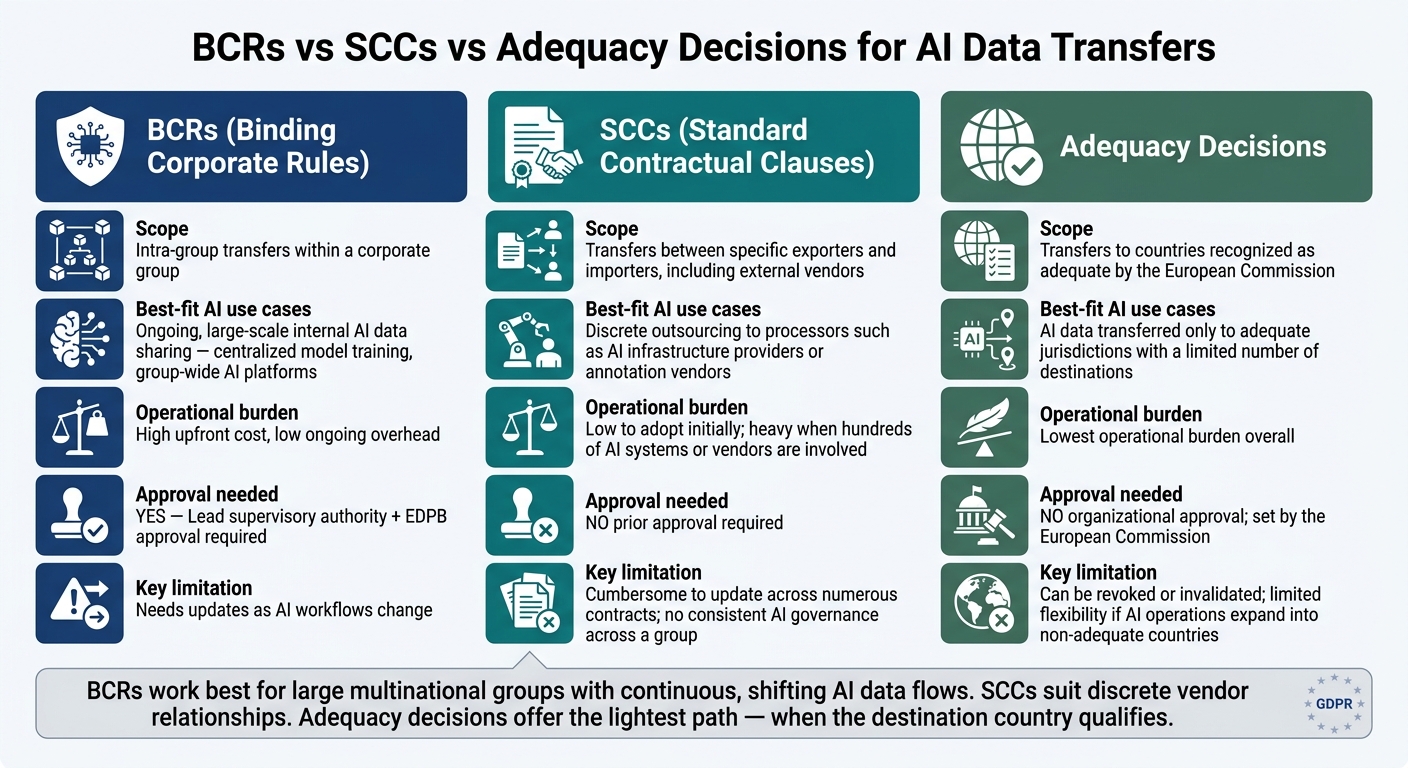
BCRs vs SCCs vs Adequacy Decisions for AI Data Transfers
GDPR Article 47 Explained | Binding Corporate Rules (BCRs) for Data Transfers
sbb-itb-f123e37
Quick Comparison
| Tool | Best used for | Approval needed | Main limit |
|---|---|---|---|
| BCRs | Repeated intra-group AI transfers | Yes | Long setup and regulator review |
| SCCs | Specific exporter-importer transfers, often with vendors | No | Hard to track across many entities and systems |
| Adequacy decisions | Transfers to approved countries | No | Only works for listed destinations |
So if I want BCRs to support AI, I need more than a policy. I need approved rules, mapped data flows, clear group roles, technical controls, and a program that people actually follow.
What BCRs require before they can support AI programs
Before BCRs can support AI data transfers, they need the right legal setup and regulator sign-off. Under GDPR Article 47, BCRs must be legally binding across the group, enforceable by data subjects, and approved by the competent supervisory authority. In plain English: they can't just sit in a policy folder. They need to function as a working governance tool, backed by intra-group agreements, training, and disciplinary measures.
Minimum content every BCR package must include
Every BCR package must cover group structure, transfers and their purposes, data categories, data subjects, third countries involved, the binding nature of the rules, security measures, onward transfer restrictions, data subject rights, complaint procedures, liability allocation, and audit mechanisms.
For AI programs, those points need to line up with actual data workflows. Training, validation, inference, and monitoring all involve personal data moving between group entities, and each flow should tie back to a specific BCR-covered purpose and recipient. That mapping is what turns the rules into something usable. If a regulator can't trace the path from a dataset to a covered entity and a stated purpose, the BCR scope is too loose.
The liability piece deserves special attention. Article 47 requires the EU-established controller or processor to accept liability for breaches by non-EU group members covered by the BCRs, unless it can prove the non-EU member was not responsible. For AI programs with model training, hosting, and support functions outside the EU, that's a serious risk. The BCR package needs to deal with it directly.
Controller BCRs vs. processor BCRs
The right BCR type depends on how group entities handle the data. Controller BCRs (BCR-C) apply when a group entity decides the purposes and means of processing for its own or shared AI use cases. Processor BCRs (BCR-P) apply when one group entity processes personal data on behalf of another entity, such as a hosted AI platform or a central AI operations unit.
| Controller BCRs (BCR-C) | Processor BCRs (BCR-P) | |
|---|---|---|
| Who decides the purposes and means? | The group entity itself | Another group entity (the controller) |
| Typical AI example | Customer analytics, HR AI tools, or personalization systems | Central AI ops team hosting, labeling, or running inference for other units |
| Processing relationship | Independent controller decisions within the group | Processing under instructions |
| When it applies | AI team controls why and how data is used | Receiving entity executes another entity's instructions |
EDPB guidance and national authorities require separate application forms and separate approval tracks for BCR-C and BCR-P. A lot of enterprise AI programs need both. One may cover business-line AI tools, while another covers shared internal platforms. Sorting out those roles early can save a lot of rework later.
Approval process and regulator expectations
Approval runs through a lead supervisory authority (LSA), usually tied to the group's main EU establishment. The LSA reviews the draft BCRs, coordinates with other concerned authorities under the GDPR consistency mechanism, and sends a draft decision to the European Data Protection Board (EDPB) for an opinion before final approval.
Regulators want proof that the paperwork matches day-to-day practice. Strong applications usually include data-flow maps, model lifecycle descriptions, incident escalation paths, and documented governance ownership for dataset and model changes. They will test whether the BCRs match how data moves through the AI stack in practice.
That means legal, privacy, security, and engineering teams need to be in sync before submission. Regulators will ask detailed questions, and they will expect revisions that match how the program actually runs, not just how it's described on paper.
Treat BCR approval as a gating item. Build the full review cycle into the AI roadmap from the start:
- Draft
- Submission
- Authority questions
- Revisions
- EDPB opinion
- Final approval
That timeline matters because BCR approval is not a side task. It sits on the critical path for cross-border AI data transfers.
Once the BCR framework is approved, the next step is to translate it into a working transfer policy. For organizations needing hands-on support, an AI automation agency can help align these legal requirements with technical workflows.
How to build a global AI data transfer policy around BCRs
Once BCRs are approved, the next step is to bake them into day-to-day AI work.
Map AI data flows, entities, and roles
Start with a full map of your AI use cases, datasets, systems, legal entities, and the countries involved in processing. The cleanest way to do this is with one central register and one standard template. Each record should cover the system name, business owner, data categories, data subjects, transfer paths, legal basis, and links to any DPIAs and security controls.
Use data discovery tools to spot likely flows, then check those results with process owners. That second step matters. Tools can show where data moves, but the people running the process usually know why it moves and whether the flow is still current. This map then becomes the working list for every BCR duty.
Use that inventory to assign controller, joint controller, or processor status to each AI use case. A U.S. parent that sets the purposes for an AI system will often be the controller. A regional hub that runs infrastructure or model training may be a processor or a joint controller, depending on how much decision-making power it has. For each AI use case, keep a RACI-style matrix and mirror those role assignments in your intra-group agreements.
Once roles and transfers are clear, they need to be binding on paper, not just understood in practice.
Write enforceable internal rules and binding mechanisms
Build BCR duties into policies, procedures, contracts, and disciplinary rules. BCRs have to bind the whole group. In plain terms, that means your intra-group agreements should spell out commitments on transparency, data subject rights, security, complaint handling, and cooperation with regulators for every group entity. Employee duties can also be backed up through employment contracts, codes of conduct, and documented governance bodies such as privacy committees or AI ethics boards.
Accountability should be explicit. Name a specific owner for each AI system covered by the BCRs, set clear escalation paths for incidents, and record the disciplinary steps that apply if obligations are missed. An annual attestation process can help keep this live rather than passive. In that process, key AI system owners confirm that their systems still follow BCR-based policies.
Add AI-specific transfer controls
After governance comes control design. General privacy controls don't go far enough for AI. Your policy needs safeguards that fit how AI systems move and use data during training, validation, inference, and monitoring.
Data minimization means keeping training and inference datasets limited to the attributes needed for the model to do its job. If identifiers aren't needed, remove them or pseudonymize them before data moves across borders. Purpose limitation means writing down the specific, compatible purposes for model training, fine-tuning, and downstream use, then blocking reuse of personal data for unrelated AI testing unless there is a legal basis and updated transparency.
Access controls should be role-based, so only the right people can view or export training and inference data across jurisdictions, in line with least-privilege rules. Logging should cover:
- Cross-border data access
- Model training and inference events
- Admin configuration changes
- Data exports
Those logs should be kept for set periods and reviewed for anomalies. Retention schedules should also treat different data layers differently. Raw input data, feature stores, model artifacts, and logs should not all sit on the same timeline. Personal data should be deleted, anonymized, or archived after set periods instead of piling up forever.
If an AI system involves automated decision-making or profiling, add a pre-deployment review focused on individual impact and transfer risk. No transfer should move ahead until the needed protections are documented and any required Transfer Impact Assessment is complete.
How to run BCRs as an active AI compliance program
BCRs only work if you keep them up to date as AI systems change. This is not a one-time filing. It’s an operating program. GDPR Article 47 says this plainly: BCRs must include ways to monitor compliance, run audits, deliver training, handle complaints, and manage change. The model below turns that legal requirement into day-to-day work.
Governance, audits, training, and incident response
This starts with clear ownership. A central data protection function - usually the DPO and privacy office - should oversee AI-related cross-border transfers across the group. Local privacy coordinators in key business units and regions can handle day-to-day checks. One EU entity should hold formal group-wide compliance ownership.
Privacy reviews for new AI use cases should be built into engineering and product workflows from the start. Not tacked on at the end. Before any transfer under BCRs, check the entities involved, confirm that the transfer falls within BCR scope, assess whether a DPIA is needed, and review any AI Act duties tied to data governance, training quality, or logging. A standard intake form inside your current ticketing system can make this much easier. It also gives teams a simple path for common cases, like cross-border model training.
Audits should happen once a year, and also after incidents, new high-risk AI projects, or rule changes. These reviews should involve more than one team: privacy, security, data science, and engineering all need a seat at the table. Findings should go to the DPO and senior management or the board - not stay buried inside a technical channel.
Training needs to reach the people who actually handle the data. Engineers and data scientists should know which environments fall under BCR restrictions and what a non-compliant transfer looks like in plain terms. For example, exporting raw training logs to a U.S. development environment without the right safeguards. Product and business teams also need to know when an AI feature triggers a cross-border transfer. Training should happen at onboarding and at least once a year, with refreshers when BCRs change or when major rule changes happen. That way, people are ready to act when a transfer issue or breach shows up.
Incident response has to be wired into AI environments on purpose. Monitoring should flag unusual cross-border access and unauthorized exports of training or inference data across training pipelines, inference logs, and export controls. If a breach happens, U.S.-based incident response teams need to spot when EU BCR notification duties apply and work fast with the EU DPO.
When to use BCRs instead of other transfer tools
Use BCRs when your group’s transfer pattern is large enough to justify the setup. The comparison below shows where BCRs, Standard Contractual Clauses (SCCs), and adequacy decisions fit best for multinational AI programs.
| Factor | BCRs | Standard Contractual Clauses (SCCs) | Adequacy Decisions |
|---|---|---|---|
| Scope | Intra-group transfers within a corporate group | Transfers between specific exporters and importers, including external vendors | Transfers to countries recognized as adequate by the European Commission |
| Best-fit use cases | Ongoing, large-scale internal AI data sharing - centralized model training, group-wide AI platforms | Discrete outsourcing to processors such as AI infrastructure providers or annotation vendors | AI data transferred only to adequate jurisdictions with a limited number of destinations |
| Operational burden | High upfront cost, low ongoing overhead | Low to adopt initially; heavy when hundreds of AI systems or vendors are involved | Lowest operational burden; limited flexibility if AI operations expand into non-adequate countries |
| Approval needed | Yes - lead supervisory authority and EDPB approval required | No prior approval; must be completed and supplemented appropriately | No organizational approval; set by the European Commission |
| Limitations for AI programs | Needs updates as AI workflows change | Cumbersome to update across numerous contracts; does not ensure consistent AI governance across a group | Can be revoked or invalidated, creating uncertainty for long-lived AI programs |
BCRs make the most sense when a group has several EU and non-EU entities running continuous, shifting AI data flows - shared data lakes, centralized model training, or group-wide inference platforms. In that setup, managing bilateral SCCs with every affiliate can become unworkable.
SCCs are still the better fit when one EU entity uses a third-party AI vendor in the U.S. Adequacy decisions work when all relevant destinations are on the Commission’s approved list. The catch is simple: that list may not include every destination needed for a global AI supply chain.
How consulting support can speed policy design and rollout
NAITIVE AI Consulting Agency can help map AI data flows, match controls to BCR scope, and turn the rules into engineering workflows and training. That can save teams a lot of back-and-forth, especially when legal, privacy, and engineering are all trying to work from the same playbook.
Conclusion: Core steps to make BCRs work for AI
BCRs fit recurring intra-group AI transfers well. But they work only when the rules are binding, approved, and enforced in day-to-day practice. In plain English: getting approval is only part of the job. The real test is whether the program works when people, systems, and teams actually use it.
The legal requirements are not optional. BCRs must be binding, enforceable, and supported by clear intra-group liability. That also means honoring EU data subject rights even when processing takes place outside the EU.
After the legal framework is approved, it needs to show up in the systems themselves. Technical controls turn approval into day-to-day use. That includes access controls, data minimization, oversight, and audit trails across training, inference, and monitoring workflows. Recent approvals show that large groups still rely on BCRs for complex cross-border AI operations.
Those controls matter only if the program is checked and updated over time. Governance keeps it current through clear ownership, periodic audits, training, and incident response built into AI workflows from the start. Cross-border transfers remain a major enforcement focus.
BCRs work only when legal rules, technical controls, and governance move together.
FAQs
Do BCRs cover vendors?
Not directly. BCRs mostly deal with how your organization transfers and handles personal data inside its own corporate group.
When you're dealing with vendors or other third parties, the focus usually shifts to contract terms. That often means data processing agreements or BAAs, audit rights, and third-party contract review instead of BCRs themselves.
How long does BCR approval take?
Securing approval for Binding Corporate Rules (BCRs) is a major undertaking. In most cases, the process takes 12 to 24 months.
The requirements are complex, so NAITIVE AI Consulting Agency helps businesses work through these regulatory demands and bring AI into the business in a practical way.
When should we use SCCs instead?
Use SCCs as the main tool for cross-border data transfers if your organization does not have BCRs. That’s often the practical route, since BCRs can be costly and take a long time to get in place.
If you use SCCs, you also need a Transfer Impact Assessment (TIA). The point is simple: check whether the destination country’s laws could weaken the protections built into the SCCs.
For transfers to the United States, SCCs can also serve as a backup if the EU-U.S. Data Privacy Framework is challenged.