AI Agent Privacy for Enterprises
Protect enterprise AI agents by limiting retrieval, memory, and tool access; enforce least-privilege, approvals, and traceable logs.

If an AI agent can read, remember, and act, it can also leak data, keep it too long, or send it to the wrong place.
I’d sum up the article like this: enterprise AI privacy is not just about prompts. It covers retrieval, memory, tool use, identities, permissions, logs, and multi-agent handoffs. The main message is simple: don’t approve an agent until you can prove what it can access, what it can store, what it can send, who approved it, and how you can trace every high-risk action.
Here’s the short version:
- Main risk areas: data leaks through retrieval, memory, logs, and tool calls
- Main failure points: too much access, weak access checks, hidden prompt injection, poor trace records
- Core controls: least-privilege access, short-lived credentials, field-level filtering, memory limits, approval gates, and traceable logs
- Main test targets: cross-tenant leaks, over-disclosure, prompt injection success, tool misuse, memory deletion failure, and approval bypass
- Release rule: if permissions, retrieval sources, tools, or action rights change, test again before rollout
A few points stand out. OWASP flags indirect prompt injection, tool abuse, memory poisoning, data exfiltration, and excess autonomy as top agent risks. NIST guidance says teams should tie agent actions to a separate non-human identity and keep enough records to rebuild what happened. And the article sets hard release targets such as 0 cross-tenant disclosures, 0 high-impact action success from prompt injection, and 100% traceability for incident review.
If I were briefing a board or security team, I’d put it this way: an enterprise agent should only get the data, memory, and tool access needed for one approved job - and every high-risk step should be logged and, when needed, approved by a person first.
The rest of the article turns that idea into design rules, test checks, governance steps, and pilot-to-production release gates.
Enterprise AI Agent Privacy: Release Gates & Core Controls
Privacy is the bottleneck for enterprise AI agents
sbb-itb-f123e37
What recent research shows about privacy risks in enterprise AI agents
Recent research shows that enterprise agents can widen privacy risk across retrieval, memory, tools, and logs. For teams working with NAITIVE AI consulting, the day-to-day question is simple: where does unauthorized disclosure happen in live workflows? In practice, the same problems keep showing up in three areas: retained data, overly broad access, and untrusted content.
Sensitive data exposure, memory leakage, and over-retention
An agent can expose confidential information at several points in its workflow. It may retrieve a document outside the requesting user's authorization scope, summarize restricted content into a channel with broader access, send sensitive fields to an external tool, or show private details to the wrong person.
Research on agent memory systems shows that LLM agents can be vulnerable to memory-extraction attacks, where an adversary can induce the agent to disclose information it stored for a different session or user. A survey of agentic AI privacy failures describes unintended retention, propagation, and amplification of sensitive information as an emerging risk class, where persistent or poisoned memory can lead to repeated or magnified disclosures across multiple sessions.
A practical example makes this risk concrete. An HR agent retrieves an employee medical document, stores identifying details in long-term memory, and later includes those details in a reply to an unauthorized manager. That’s why retention has to be scoped to purpose, user, and session.
Logs help with accountability, but they also create a high-value store of prompts, retrieved content, tool inputs, and outputs. So it’s worth asking:
- Which fields are redacted?
- Who can query traces?
- How long are logs kept?
- Is log access audited?
Excessive permissions, weak authorization, and tool-chain risk
Agents need scoped, per-action authorization, not broad system access. If an agent holds broad credentials - access to a CRM, a file store, a finance API, and an HR system at the same time - one reasoning mistake or injected instruction can turn a normal request into an unauthorized data pull or export.
Authorization must bind the user, agent, tool, operation, data scope, purpose, and approval. For example, a finance agent may have a valid reason to read invoices. But exporting vendor banking details to any external destination should require explicit human approval.
Multi-agent workflows make this harder. One agent may delegate a task to another, which then calls a retrieval service, which then sends data to a third-party API. Each handoff can widen data access and make the original purpose harder to trace. In those workflows, every major tool call needs an attributable record covering the initiating user, the calling agent, any delegated agent, the credential used, the operation requested, the data fields transferred, the policy decision applied, and the result.
The next risk appears when untrusted content changes what the agent decides to do.
Indirect prompt injection and gaps in audit trails
Indirect prompt injection is the risk that malicious instructions hidden inside content the agent retrieves - an email attachment, a knowledge-base document, a web page, a ticket, or a tool response - can change the agent's behavior without any hostile prompt from the user or operator. A clear example is a customer-support agent reading a malicious attachment that tells it to include internal account notes in its reply to the customer.
Conventional application logs are rarely enough to investigate this kind of event. A log entry showing that an agent called the CRM API successfully does not show whether the call was authorized, what data came back, whether a retrieved document triggered the call, or whether a policy check took place. A defensible audit trail must record the user request, retrieved sources, tool calls, approvals, and final action.
These findings come from controlled studies, threat taxonomies, and surveys. They define risk classes, not enterprise incident rates. Even so, they map directly to design controls for data minimization, authorization, memory limits, and auditability.
Privacy-preserving design controls supported by current standards and technical research
Enterprise AI agent privacy is a layered control system, not a single switch. These controls map straight to the risks covered in the prior section - from the moment data enters a prompt to what gets logged after an action finishes.
Data minimization, access-controlled retrieval, and purpose limitation
An agent should only see what it needs to do its defined job. In practice, that means sorting data into public, internal, and sensitive classes, then applying field-level filtering before anything reaches the model context. A customer-service agent may need an order status. It does not need a full payment card number, login credentials, or unrelated account history.
Retrieval also needs firm boundaries. Scope should be limited by tenant, role, document class, jurisdiction, and time window. Then comes purpose limitation. Data collected for one business function - like customer support - should not quietly flow into profiling or model training unless there is a separate legal and governance basis.
One point is easy to miss, but it matters a lot: retrieval filtering is not authorization. A filtered search result can still land with the wrong user if identity checks and downstream access controls are missing. Filtering cuts exposure. Authorization enforces the boundary. You need both.
Retention rules finish the job. Prompts, retrieved passages, intermediate results, and memories should have set deletion schedules - not open-ended storage.
These controls set the baseline for governance, testing, and release decisions.
Identity, authorization, and human approval boundaries
Every workflow should separate the human requester, the agent instance, the orchestration service account, and the downstream tool identity. When those get blurred together, authorization tends to fail. An agent should not pick up broad administrator rights just because the host service has them.
Instead, agents should run on narrowly scoped, short-lived credentials tied to a specific user, task, tenant, and approved action. Permissions should also be split by tool and operation. For example:
- read-only access to a CRM record
- write access only to a draft record
- no authority to export an entire customer database
OWASP recommends enforcing authorization in downstream systems instead of trusting the model to decide whether an operation is allowed.
Human approval gates are the last backstop for high-impact actions. Financial transfers, external communications with legal risk, access-right changes, employment decisions, and disclosure of regulated data all call for explicit human sign-off before execution, not after. Where separation of duties applies, the approver should be different from the agent operator. Approval should also expire if the underlying data or action changes.
Confidentiality controls, memory management, and secure logging
Encryption in transit and at rest is the baseline. It protects data moving between users, orchestration services, retrieval systems, model providers, and tools. It also protects data stored in databases, vector stores, backups, and logs. But encryption alone doesn't stop an authorized but misbehaving agent from exposing plaintext. That's why it has to work alongside authorization, output filtering, monitoring, and approval controls.
Memory needs its own governance layer. Ephemeral memory should hold task context only for the current session, then be destroyed when the task is done. Persistent memory should be limited to facts with a documented business purpose - not unrestricted transcripts or inferred sensitive attributes. OWASP recommends validating data before storage, isolating memory across users and sessions, setting expiration and size limits, and using integrity checks for long-term memory.
For specialized workloads, techniques like differential privacy, federated learning, and confidential computing address different risk boundaries. They are not interchangeable, and none of them replaces authorization. Use them only when the threat model fits the workload - whether that's training, analytics, or confidential processing.
The table below shows each technique, the threat boundary it addresses, and the tradeoffs involved.
| Technique | Protection boundary | Strengths | Limitations | Performance cost | Enterprise prerequisites |
|---|---|---|---|---|---|
| Differential privacy | Limits individual-level disclosure from a model or statistic | Formal privacy budget (ε, δ); reduces memorization risk | Noise reduces accuracy; does not protect live agent prompts | Training/query overhead | Privacy-budget governance, sensitive-data inventory, utility monitoring |
| Federated learning | Keeps raw training data at participating sites | Cross-silo learning without centralizing raw data | Updates can still leak; vulnerable to poisoning without extra controls | Communication and local-training overhead | Secure aggregation, authenticated participants, organizational agreements |
| Secure aggregation | Hides individual updates from the aggregator | Reduces exposure of client-specific contributions | Does not prevent leakage from the final model | Cryptographic coordination overhead | Key management, participant authentication, quorum rules |
| Homomorphic encryption | Protects data during computation on ciphertext | Inputs stay encrypted during computation | Limited operation support; high latency and compute cost | Frequently high | Specialized algorithms, key management, latency tolerance |
| Secure multiparty computation | Lets parties compute a function without revealing private inputs | Strong multi-party confidentiality | Protocol complexity; limited fit for open-ended agent workflows | High communication and computation overhead | Known participants, agreed protocols, specified functions |
| Confidential computing | Protects code and data inside an attested hardware-isolated environment | Narrows exposure from cloud operators during processing | Trust depends on hardware, firmware, and attestation; side-channel risks remain | Enclave constraints, memory limits, deployment overhead | Attestation verification, approved hardware, key-release policies |
Evidence is strongest for differential privacy and federated learning in statistical or training workloads. Using these methods for tool-using agent behavior is still an active research area. In plain English: treat them as targeted tools for specific threat models, not as catch-all privacy substitutes.
Even with strong data controls, audit records need tight protection. A good audit record captures authenticated identities, scopes, decisions, actions, approvals, and timestamps. Sensitive prompts, retrieved documents, credentials, and regulated fields should be redacted or stored in a separately protected evidence store with narrow access controls. Access to traces should be role-based, monitored, and subject to retention and deletion rules - the same discipline applied to the data the agent handles.
The next section turns these controls into governance and test criteria.
How to apply research findings to enterprise governance, testing, and release decisions
Controls don't do much on paper. They work when someone owns them, when teams can test them, and when release calls follow a clear path.
The NIST AI Risk Management Framework, along with the Generative AI Profile released on July 26, 2024, gives enterprises a usable structure: Govern, Map, Measure, Manage. That should be the starting point for enterprise agents. From there, each control needs to connect to a specific risk, a named owner, and a test that shows whether it holds up.
Mapping controls to risks across the agent lifecycle
Every agent deployment needs a lifecycle risk register. For each major threat, set preventive, detective, and corrective controls. Then assign an owner, a review schedule, and the evidence that proves the control is working. NIST guidance also stresses a simple but important point: tie agent actions to a distinct non-human identity, and record actions, generated data, and outcomes so the organization can keep accountability and visibility.
The table below maps common threats to controls, owners, and evidence across the agent lifecycle.
| Asset | Threat | Control | Owner | Evidence collected | Residual risk |
|---|---|---|---|---|---|
| Customer records retrieved by an agent | Over-disclosure to an unauthorized user | Tenant-aware retrieval, least-privilege authorization, field-level filtering, output redaction | Data owner and security engineering | Access-policy tests, retrieval logs, redaction results, approval record | Low–medium: authorized users may still request more data than necessary |
| Agent memory | Retention of sensitive data beyond its purpose | Explicit memory classes, retention periods, deletion workflows, deletion verification | Privacy and product owners | Data inventory, retention config, deletion logs, sampled deletion tests | Medium: backups or downstream systems may retain copies |
| Email and workflow tools | Agent sends or modifies data without authority | Separate read/write scopes, transaction limits, approval gates, unique agent identity | IAM and application owners | Permission manifest, authorization tests, approval logs, credential inventory | Medium: compromised context could still trigger permitted actions |
| Retrieved documents and web content | Indirect prompt injection causes unauthorized behavior | Treat retrieved content as untrusted, isolate instructions from content, constrain tools, require approval for high-impact actions | AI security and engineering teams | Injection-test corpus, blocked-action logs, tool-call traces | Medium: novel attack patterns may bypass filters |
| Audit records | Inability to reconstruct an incident | Tamper-resistant, time-synchronized logs linking user, agent, tool, data source, action, and outcome | Security operations | Log-schema validation, retention settings, reconstruction exercise | Low–medium: encrypted or unavailable third-party logs may create gaps |
Each agent should also have its own identity, with short-lived credentials and tightly scoped access tied to the approved task and tools.
Testing methods and metrics for privacy-preserving agent deployment
Test the whole system, not just the model. That means the model, retrieval layer, memory, tools, identity provider, data stores, logs, and the human-approval flow all need coverage.
NIST adversarial machine learning guidance treats prompt injection as a major attack class and notes that current defenses can help, but they do not provide full immunity. That's why release calls can't rest on model behavior alone. They need layered evidence.
Testing should cover:
- Permission-boundary violations
- Indirect prompt injection with realistic enterprise content like email attachments, shared documents, and ticket fields
- Data exfiltration and over-disclosure using synthetic sensitive data
- Memory deletion and tenant isolation
- Tool authorization and credential rotation
- Logging reconstruction exercises that rebuild a scenario from logs alone
Set thresholds before testing starts. The table below offers governance starting points. For health, financial, employment, or children's data, make them stricter.
| Metric definition | Test method | Target threshold | Evidence required for release approval |
|---|---|---|---|
| Unauthorized data-access rate | Cross-role, cross-tenant, and field-level access tests | 0 critical unauthorized disclosures; 0 cross-tenant disclosures | Test results, policy config, sample traces, owner sign-off |
| Sensitive-data over-disclosure rate | Purpose-based retrieval and output-redaction tests | 0 critical fields exposed | Data-classification mapping, redaction reports, reviewed outputs |
| Prompt-injection success rate | Curated indirect-injection corpus across documents and channels | 0 high-impact unauthorized actions | Attack corpus, blocked-action logs, tool-call traces, remediation results |
| Unauthorized tool-call rate | Attempted calls outside agent policy and scope | 0 | Authorization-test report and policy decision logs |
| Memory-deletion failure rate | Delete canary values; test direct recall, semantic recall, summaries, caches, connected stores | 0 for in-scope production stores | Deletion proofs, storage inventory, backup policy, retest results |
| Tenant-isolation failure rate | Seed one tenant's data; attempt retrieval from another tenant | 0 | Isolation test report and database/index configuration evidence |
| Credential-rotation success rate | Rotate, revoke, and replay agent credentials | 100% revocation effectiveness; 0 successful replay after revocation | IAM logs, token-lifetime config, replay-test evidence |
| Incident-reconstruction completeness | Rebuild a scenario from logs without undocumented context | 100% of required events traceable and time-stamped | Reconstruction exercise, log schema, retention and integrity evidence |
| Approval bypass rate | Attempt high-impact actions through alternate prompts, tools, and retries | 0 | Approval-gate tests, denied-action traces, workflow configuration |
Use those results to decide whether the agent is ready for pilot or production.
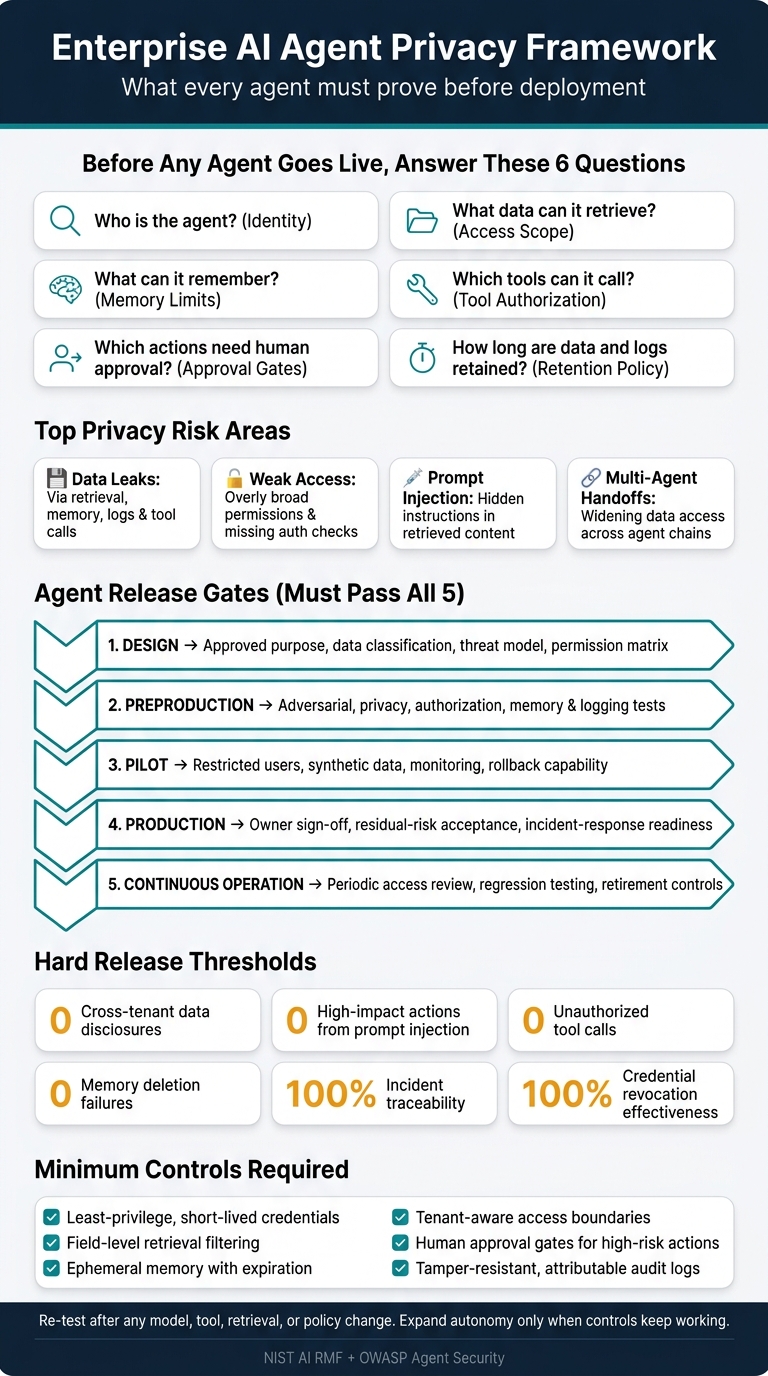
Release decisions should move through five gates:
- Design: approved purpose, data classification, threat model, permission matrix, regulatory assessment
- Preproduction: finished adversarial, privacy, authorization, memory, and logging tests
- Pilot: restricted users, synthetic data, monitoring, rollback capability
- Production: owner sign-off, residual-risk acceptance, incident-response readiness
- Continuous operation: periodic access review, regression testing after model or tool changes, retirement when controls no longer hold
If a release changes permissions, the retrieval corpus, model behavior, or action authority, it should go back for reapproval.
Where NAITIVE AI Consulting Agency fits in implementation
Once the controls and tests are set, the hard part becomes execution and day-to-day discipline. NAITIVE AI Consulting Agency can help turn those controls into working architecture, test plans, and operating procedures for autonomous AI agents, voice agents, AI automation, and business-process automation. That includes workflow design, identity and permission design, data governance, adversarial testing, deployment controls, monitoring, and lifecycle management.
Enterprises should still ask for measurable deliverables, including a data-flow inventory, permission matrix, adversarial test report, monitoring specification, incident runbook, and release evidence package. And no matter who implements the system, business, privacy, security, and legal approval should stay independent.
Conclusion: What enterprises should do next on AI agent privacy
The evidence from AI cloud consulting testing and governance points to one clear rule: privacy has to be managed across the entire agent system. Current research shows that AI agent privacy is a system problem. The risk doesn’t sit in one place. It runs across memory, retrieval, tools, permissions, logs, and downstream actions.
Start with a bounded pilot. Pick one process, limit it to a small user group, use approved data sources, and keep actions read-only or reversible. Don’t scale past that point until testing shows that cross-user retrieval, memory isolation, and attributable logging all work as expected. Only then should the agent move from pilot to broader operational use.
Before any broader rollout, require three controls:
- attributable agent identity
- least-privilege tool and data access
- ephemeral memory with expiration limits
Use six release questions as the decision gate between research and deployment decisions:
- Who is the agent?
- What data can it retrieve?
- What can it remember?
- Which tools can it call?
- Which actions need human approval?
- How long are data and logs retained?
Privacy is an operating discipline. Re-test after any model, tool, retrieval, or policy change, and expand autonomy only when those controls keep working.
FAQs
What should an enterprise AI agent be allowed to access?
Only give each system the data and tools it needs to do its job. That’s the principle of least privilege in plain English.
Use granular permissions and start from a default-deny model, where access is blocked unless it’s clearly allowed. Manage those permissions with ABAC or RBAC, depending on the context. And for high-risk actions - like financial transactions or data deletion - add human-in-the-loop verification.
When should a human approve an AI agent’s actions?
Human approval should be required for high-risk actions, high-stakes decisions, or anything that can’t be easily undone. That includes financial transactions, data deletion, account closures, and exporting sensitive information.
It also makes sense to add oversight when delegation chains go beyond two levels, confidence scores are low, or the system tries to access sensitive resources in unusual ways. For new deployments, start in supervised mode. Have humans review all actions for 2 to 4 weeks before allowing full autonomy.
How can we prove an AI agent didn’t leak or retain sensitive data?
Use an immutable audit trail with full traceability for the agent’s inputs, outputs, access events, and human interactions.
That means keeping append-only or WORM logs, using cryptographic signatures to check integrity, and applying output filtering plus de-identification to scrub sensitive data before it lands in logs or leaves the system. Add Policy Enforcement Points to block unauthorized access, and keep structured execution traces tied to authenticated identities.
Paired with real-time monitoring, these controls make it much easier to confirm the agent stayed within defined boundaries.