
Ultimate Guide to AI in Smart City Waste Management
AI routing and forecasting slash collection costs and overflows while improving recycling - prioritize prediction, then sensing, then sorting.

AI can cut waste collection costs, lower truck miles, reduce bin overflows, and improve recycling accuracy - if a city starts with routing and forecasting first.
If I had to sum up the whole topic in a few lines, it would be this:
- Collection is the biggest cost center, often 70%–85% of a city’s waste budget.
- AI works best when it solves the first problem first: where trucks should go, when they should go, and which bins need service now.
- Cities are using fill-level sensors, route models, and camera-based sorting to reduce fuel use, missed pickups, contamination, and manual checks.
- Reported results include up to 36.8% less travel distance, 20%–32% lower fuel use and CO2, 50% fewer overflow events, and sorting accuracy as high as 99.95% in some systems.
- The best rollout path is simple: forecasting first, then smart bins, then sorting, then agent-led coordination.
In plain English: fixed schedules waste time and money. AI helps cities move from “empty every bin on Tuesday” to “service the bins that need it, send the closest truck, and catch problems before residents complain.”
Here’s the short version of where AI fits:
- Collection: predict which bins will fill up
- Dispatch: build routes from live bin, truck, and traffic data
- Sorting: spot recyclables and contamination on conveyor lines
- Monitoring: detect fires, illegal dumping, gas, odor, or equipment issues
- Control: connect sensors, trucks, depots, and facilities in one system with human review when needed
A city does not need to do everything at once. If I were planning this for a U.S. city, I’d start where the dollars are: truck routes, fuel spend, missed pickups, and overflow rates.
That’s the core idea behind AI in smart city waste management: use data to decide what to collect, when to collect it, and how to sort it with fewer wasted trips and fewer mistakes.
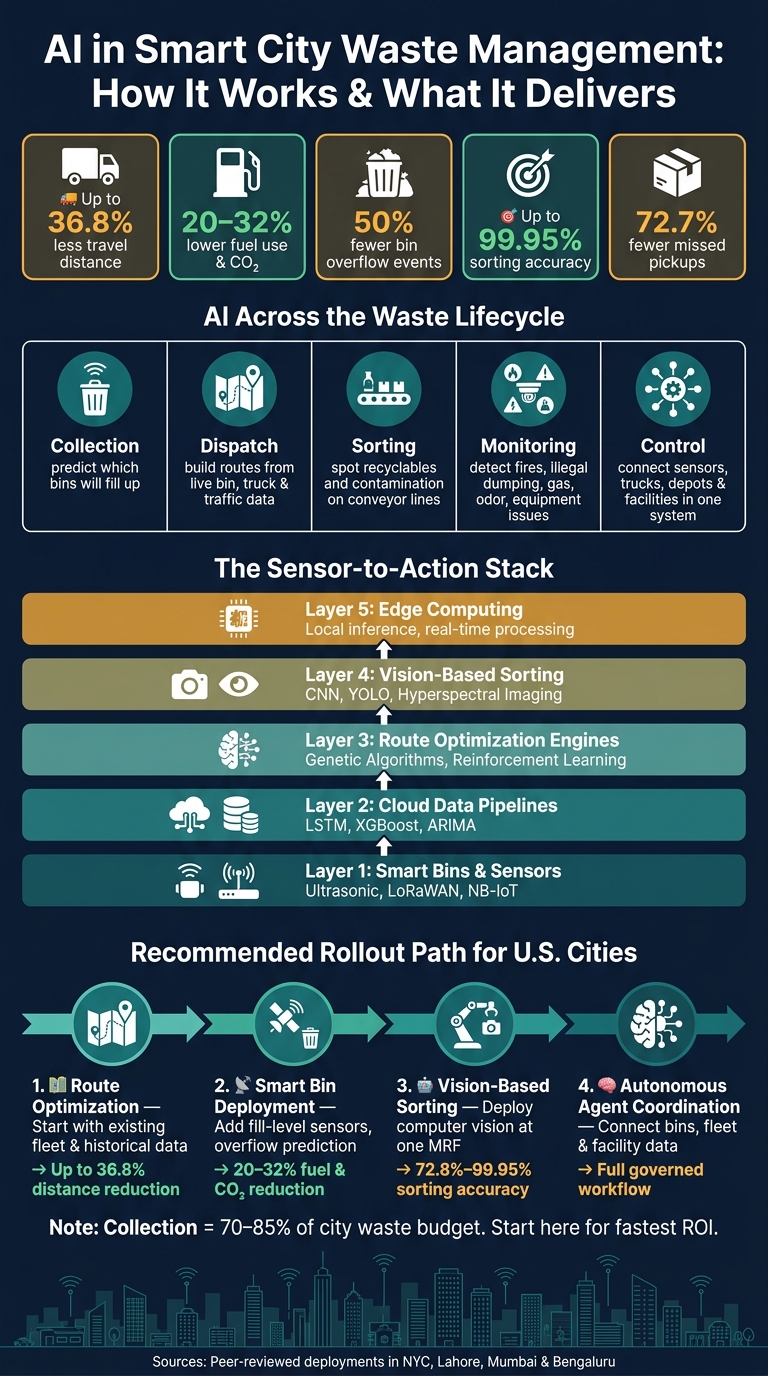
AI Smart City Waste Management: Phased Deployment Roadmap & Key Outcomes
Waste World - Episode 63: Cleaner Streets, Smarter Routes: How AI is Shaping Waste Collection
sbb-itb-f123e37
AI in smart city waste management: where it creates value
Basic digitization records activity. AI goes a step further by predicting demand, adjusting routes, and improving day-to-day operations.
A fixed pickup schedule empties bins on the same timetable, whether they need service or not. An ML model does something smarter: it predicts fill levels and reroutes trucks before bins overflow. Across collection, transport, sorting, and contamination control, AI turns waste handling into a managed workflow instead of a fixed routine. These use cases shift waste operations from rigid schedules to data-driven workflows.
Key AI use cases across the waste lifecycle
AI creates value in collection forecasting, route optimization, sorting, contamination detection, and service recovery.
Overflow forecasting is often the first step. Models such as XGBoost have reached 94.1% accuracy and 95.8% recall when identifying bins likely to overflow. In practice, that led to a 50% drop in overflow events and a 72.7% drop in missed pickups.
From there, dynamic route optimization uses network optimization models and genetic algorithms to build collection plans based on real-time bin priority, traffic congestion, and distance. In New York City, one study used gradient-boosted decision trees to forecast building-level waste with 88% average accuracy.
At sorting facilities, computer vision models identify plastics, metals, paper, and contaminants in real time. When paired with robotics, these systems have reached sorting accuracy from 72.8% to 99.95%.
Anomaly detection fills in another part of the picture. Sensors tied to AI can watch for temperature spikes, odor, and illegal dumping, then trigger alerts before conditions turn dangerous. Smart-bin telemetry can also flag missed pickups and equipment failures, which helps teams dispatch service faster.
Outcomes and KPIs that decision-makers track
Decision-makers watch the metrics these systems change most: cost, overflow, contamination, emissions, and safety.
| KPI | AI/IoT Technology | Documented Outcome |
|---|---|---|
| Miles per route / fuel spend | Genetic algorithms, GIS-network analysis | Up to 36.8% distance reduction; 13.35% cost savings |
| Bin overflow incidents | IoT smart bins, ML forecasting (XGBoost) | 50% reduction in overflow events |
| Missed pickups | Real-time fill-level monitoring | 72.7% reduction |
| Sorting accuracy / contamination rate | Computer vision, robotics, deep learning | 72.8%–99.95% accuracy |
| Emissions / fuel use | Dynamic routing, LCA-driven AI | 15.5%–30% fuel usage reduction |
| Worker injuries | Autonomous sorting, robotic collection | Reduced human exposure to hazardous materials and heavy lifting |
Those results rely on connected sensors, models, and dispatch systems, which the next section covers.
Core AI and IoT technologies in smart waste systems
Smart waste systems run on a simple idea: collect data from bins, turn that data into decisions, and send crews where they’re needed most. In practice, that means a sensor-to-cloud stack. Bins report what’s happening in the field, models estimate demand, and software helps route trucks and staff.
The target is day-to-day control. Lower miles. Fewer overflows. Better recycling quality. Faster service. To get there, the stack needs to stay connected from end to end: sensors gather data, models rank service needs, and vision systems sort materials.
Smart bins, sensors, and fill-level monitoring
The base layer is the sensor layer. Ultrasonic sensors measure the distance to the waste surface by using reflected sound waves. That gives operators a live read on fill levels. Many setups also include temperature and humidity sensors, which can help spot fire risk or other hazardous conditions.
Most deployments connect these devices through LPWAN protocols like LoRaWAN or NB-IoT, which help extend battery life and reduce device power use.
That telemetry then moves into cloud or edge systems, where software can flag overflow risk, trigger service actions, and estimate when a bin is likely to fill up based on location and time. In one 5G-IoT waste system pilot, the platform processed 200 million data points and reduced collection trips by 29%.
Route optimization, fleet dispatch, and predictive analytics
Once bin data is clean and up to date, optimization engines step in. Instead of sticking to a fixed pickup calendar, these systems build routes based on what’s happening now.
They use inputs such as:
- Bin fill status
- Truck capacity
- Traffic conditions
- Service constraints
Models such as genetic algorithms, reinforcement learning, and XGBoost use that input to create dynamic routes. In documented deployments, GA-based systems showed a 66% reduction in collection distance and cut trip time from 7 hours to 2.3 hours.
On top of that, predictive analytics adds a forward-looking layer. LSTM models handle time-series forecasting, while XGBoost can estimate overflow risk before it happens. That way, routing software isn’t just reacting. It’s planning ahead. The same data stream also feeds facility-level sorting systems.
Computer vision and robotics for sorting and recycling
Sorting is where cameras and robotics take over. These systems separate recoverable materials from contaminants in real time, which matters a lot when recycling lines move fast and mistakes add up.
Convolutional neural networks (CNNs) and YOLO-based vision models run on cameras mounted above conveyor lines. They identify plastics, metals, paper, and contaminants as items pass through. Some setups also use hyperspectral imaging to tell apart similar-looking materials and spot contamination that standard imaging can miss.
A hybrid setup often works best: edge devices handle time-sensitive tasks like instant image analysis or robotic control, while cloud platforms manage route planning and long-range forecasting. That split keeps response times low without pushing every heavy workload onto local hardware.
| Technology Layer | Primary Function | Key Protocols/Algorithms |
|---|---|---|
| Smart bins & sensors | Fill-level, temperature, anomaly detection | Ultrasonic sensors, LoRaWAN, NB-IoT |
| Cloud data pipelines | Aggregation, cleaning, overflow prediction | LSTM, XGBoost, ARIMA |
| Route optimization engines | Dynamic fleet dispatch | Genetic Algorithms, Reinforcement Learning |
| Vision-based sorting | Material identification, contamination detection | CNN, YOLO, Hyperspectral Imaging |
| Edge computing | On-site real-time processing | Small edge devices, local inference |
These layers make up the operating stack that autonomous agents coordinate in the next section.
Autonomous agents and operating frameworks for waste operations
Autonomous agents turn bin, fleet, and facility data into action. They can flag overflows, reroute trucks, and log exceptions without waiting for someone to stitch the picture together by hand.
How autonomous agents coordinate waste workflows
In waste management, an autonomous agent isn't one single system. It's more like a control layer that connects bins, trucks, depots, and sorting facilities. It watches sensor feeds all the time and reacts when something changes. If a bin's fill level crosses a set threshold, the agent can create a service ticket, update the nearest truck's route, and log the event for review.
Systems like ProWaste show what this looks like in practice. The system was validated across 57 Waste Collection Centers in Bengaluru using 6,954 daily records. It combined 15 variables, including population density, weather patterns, and maintenance history, to predict which collection points were getting close to a critical state. Using a Decision Tree Classifier with Binary Particle Swarm Optimization, ProWaste reached 99.8%+ macro-F1 accuracy in reprioritizing maintenance queues, which cut missed pickups and on-road inspections.
For U.S. cities, the takeaway is pretty direct: prediction matters only if it changes dispatch.
Some cases still need a person to step in. Hazardous materials, sensor recalibration, and QC flags should stay with human review. In those situations, agents should escalate the case instead of handling it on their own. That's not just safer. It's also part of compliance.
Interoperability matters too. Standardized protocols like MQTT and RESTful APIs let one agent framework pull in data from different hardware without building custom integrations for every device.
Data governance and performance monitoring
Once agents can trigger action, control becomes the next issue.
Governance has four parts: data inputs, tool permissions, audit logs, and exception escalation. The core idea is city control. Who can act? What gets logged? When does a human step in? Those are the questions that shape whether an agent system is safe to run at scale.
At the operating level, a few governance KPIs tell you a lot:
| KPI | What It Measures | Why It Matters |
|---|---|---|
| Override rate | How often humans override agent decisions | Signals model drift or edge-case gaps |
| Escalation time | Time from flag to human review | Measures responsiveness of the oversight layer |
| Audit-log completeness | % of automated actions with full decision records | Required for compliance and accountability |
| Exception resolution time | Time to close out flagged anomalies | Tracks whether escalation paths are working |
One more point often gets missed: track net emissions, not just route savings. If a system leans too hard on cloud compute, part of the CO2 gain can disappear.
How NAITIVE AI Consulting Agency supports implementation

With governance set, implementation becomes an integration job.
NAITIVE AI Consulting Agency can assess current operations, design the agent architecture, and build governed autonomous AI agents for dispatch coordination, anomaly escalation, and workflow handoffs.
Those controls are what make a phased deployment roadmap workable.
Case studies and a deployment roadmap for U.S. cities
What real deployments show
Actual deployments make one thing clear: AI in waste management can improve both collection and facility work. And when cities pair those systems with better scheduling, emissions can drop too. Across these pilots, the rollout pattern is pretty clear: forecasting first, then sensing, then facility automation.
In 2017, researchers built a short-term waste generation forecast model for New York City using a gradient boosting regression model and multiple historical datasets. The system achieved an average prediction accuracy of 88%, helping planners size infrastructure and schedule collection.
A 5G-IoT pilot in Lahore processed 200 million data points by combining fill-level monitoring with vehicle tracking across a university campus. The result was a 29% reduction in collection trips. In Mumbai, trials using AI-powered robotic sorting and hazardous gas monitoring cut truck usage by 20%.
| City / Solution | AI Technologies Used | Deployment Scope | Reported Outcomes |
|---|---|---|---|
| New York City | Gradient Boosting Regression | City-wide prediction | 88% prediction accuracy |
| Lahore | 5G-IoT, Fill-level sensors | Reference pilot | 29% reduction in collection trips |
| Mumbai | Robotics, AI sorting, Gas sensors | Facility pilot | 20% reduction in truck usage |
| Route optimization studies | GA, Reinforcement Learning | Fleet-wide | 36.8% distance reduction; 13.35% cost savings |
| Sorting Facilities | Computer Vision / Robotics | Material recovery | 72.8%–99.95% sorting accuracy |
The pattern here matters. A city can run one smart pilot and get some gains, sure. But the bigger payoff comes when systems talk to each other instead of working like separate islands.
A phased deployment roadmap
For U.S. cities, the fastest path usually starts with the most expensive work first. Waste collection makes up 70%–85% of a city's total waste management budget. So even a small cut in fuel, miles, or crew time can have a big effect on yearly spending.
A practical rollout usually looks like this:
- Route optimization: Start with the fleet you already have and use historical route data before scaling citywide. AI logistics can reduce transportation distance by up to 36.8%.
- Smart bin deployment and overflow prediction: Add ultrasonic fill-level sensors to reduce overflows and avoid pickups that don't need to happen. IoT-enabled pilots have reported 20–32% reductions in fuel use and CO2 emissions through dynamic scheduling.
- Vision-based sorting at one facility: Bring computer vision and robotic sorting into a single Materials Recovery Facility (MRF). This can improve recycling accuracy and cut manual work in hazardous settings.
- Autonomous agent coordination: Connect bin sensors, fleet dispatch, and facility data in one framework. Measure net emissions, not only route savings. Use context-aware rules that adjust sensing and communication rates.
Conclusion
That sequence is what turns separate tools into an operating model. AI in smart city waste management works best as a connected stack: prediction informs dispatch, dispatch links to facility operations, and autonomous coordination ties the workflow together under clear governance. The order of work stays the same: prediction first, then sensing, then sorting, then full autonomous coordination.
FAQs
How much can AI reduce waste collection costs?
AI can cut waste collection costs by improving routes and day-to-day efficiency. Research shows that AI-driven logistics and route planning can lower total collection costs by up to 13.35%.
In some pilot deployments, predictive analytics paired with IoT sensors has cut operational costs by up to 31%.
What should a city implement first?
Cities should first put in place an IoT-based monitoring network. That gives them the data base they need to track bin fill levels, weight, and temperature in real time.
Once that system is up and running, municipalities can add AI and predictive analytics to improve collection routes and pickup schedules. NAITIVE AI Consulting Agency helps cities build scalable, data-driven AI solutions for this shift.
What data does AI need to optimize waste operations?
AI runs on data from IoT sensors, such as bin fill levels, weight, and temperature. It also pulls from geographic information systems, computer vision for material identification and sorting, and past waste generation patterns.
Other inputs help too, including weather conditions, vehicle capacity, and operating costs. NAITIVE AI Consulting Agency designs and manages AI solutions that bring these data streams together so waste teams can run more efficiently.