AI ROI vs. Traditional Automation: Key Differences
Compare rule-based and AI automation costs, time-to-ROI, maintenance, and when each delivers better long-term value.

If you need payback fast, rule-based automation usually wins first. If you need more upside over time, AI often wins later.
That’s the core tradeoff.
Here’s the short version:
- Rule-based automation costs less to start
- It often reaches payback in 6 to 12 months
- But gains often flatten after 1 to 2 years
- AI automation costs more up front
- It may take 6 to 18 months to show positive ROI
- But it can keep improving as usage grows
- Rule-based tools fit stable, repeatable work
- AI fits messy inputs, high exception rates, and changing workflows
A few numbers stand out:
- Rule-based automation maintenance can run $5,000 to $50,000 per year
- AI maintenance can run $10,000 to $100,000+ per year
- 30% to 40% of engineering time may go to script upkeep
- AI in customer service returns about $3.50 for every $1 spent
- AI interactions can cost about $0.50 each, versus $2.50 to $4.00 for human-handled tickets
- Productivity gains can reach 70% to 90% in the right AI use cases
What this means for you: if your process is fixed and clean, start with rule-based automation. If your team deals with emails, documents, voice, edge cases, or constant process changes, AI consulting may deliver more over a multi-year window.
Is AI Worth It? Why Most Companies Get AI ROI Wrong
sbb-itb-f123e37
Quick Comparison
| Criteria | Rule-Based Automation | AI Automation |
|---|---|---|
| Upfront cost | Lower | Higher |
| Time to ROI | Sooner | Longer ramp |
| Best fit | Stable, repeatable tasks | Variable, messy tasks |
| Data needs | Clean, structured data | Structured + unstructured data |
| Upkeep | Script updates as rules change | Model checks, retraining, usage costs |
| ROI pattern | Early gains, then flatter growth | Slower start, then more upside |
| Human intervention | High when exceptions happen | Lower at scale, but still needs review |
I’d use this lens to make the call: speed now vs. more return later. For organizations ready to scale, AI consulting services can help bridge the gap between initial setup and long-term ROI.
Traditional Automation ROI: Lower Entry Cost, Faster Breakeven, Earlier Plateau
Traditional automation is the low-cost ROI baseline. It runs on predefined rules and rule-based workflows, so it tends to pay back fast in stable, repetitive processes. That’s why it’s the starting point for ROI comparison, not the end goal.
Cost Structure and Typical Payback Period
The upfront spend usually covers tool licenses, engineering time, integration, configuration, and staff training. Traditional tools like RPA can often go live in days or weeks instead of months, which helps speed deployment and connection with legacy systems.
Ongoing maintenance usually falls between $5,000 and $50,000 per year. For organizations using scripted automation to replace manual labor, the payback period is often 6 to 12 months.
Where the ROI Plateau Usually Appears
The issue tends to show up after the low-hanging fruit is gone. Returns often flatten after 1 to 2 years because the easiest efficiency gains are picked up early, while maintenance costs climb as business rules or processes shift.
Industry data shows that 30% to 40% of automation engineering time can go toward maintaining existing scripts. When rules or workflows change, someone has to update those scripts. That work helps preserve the gains already made, but it doesn’t do much to extend them. So the ROI curve often peaks early and then levels off.
That ceiling leads straight to the next question: when does AI’s higher upfront cost begin to return more?
How Traditional Automation Is Monitored
To manage early ROI, teams usually track a tight set of operational metrics. Enterprises watch cycle time, throughput, error rate, and labor hours saved on a monthly or quarterly basis.
Those metrics are centered on efficiency. They don’t measure learning or compounding value, and that difference matters a lot when AI automation enters the picture.
AI Automation ROI: Higher Upfront Investment, Stronger Long-Term Returns
Where rule-based automation hits a ceiling, AI can keep getting better after launch. That’s the upside. The catch is cost.
AI usually asks for more money up front, and that only makes sense when the workflow can improve after deployment. If the process is static, the extra spend may not pay off.
Upfront and Ongoing AI Costs in Enterprise Deployments
AI projects tend to come with heavier front-loaded costs than standard automation. For companies building in-house, that can mean $5M+ in upfront R&D, talent acquisition, and infrastructure.
After launch, the cost mix changes. Spending often moves toward:
- Cloud infrastructure
- Monitoring
- Retraining
- Usage-based fees that grow with volume
That shift matters. A project may look expensive at the start, then settle into a different cost pattern once it’s live.
Why AI ROI Can Compound Over Time
AI can improve with use, which means accuracy can go up while cost per task goes down over time. That kind of compounding shows up most clearly in workflows that involve triage, root-cause analysis, or autonomous decisions.
Customer service is a good example. Companies report an average return of $3.50 for every $1 invested in AI. At the interaction level, AI exchanges average about $0.50 each, compared to $2.50–$4.00 for tickets handled by people.
That gap is hard to ignore, especially at scale.
How to Measure AI ROI Beyond Simple Cost Savings
If you want a clear ROI picture, labor savings alone won’t cut it. You also need to account for the ramp-up period and spread migration and training costs over three years to get a more accurate annual view.
A useful scorecard should cover both operations and model performance.
On the operations side, track task time, defect rate, and downtime. On the model side, watch precision, recall, latency, and human correction rate - the percentage of AI outputs that still need human correction.
Set baselines before deployment. Without them, ROI turns into guesswork.
AI Automation vs. Traditional Automation: Key Differences That Change the Business Case
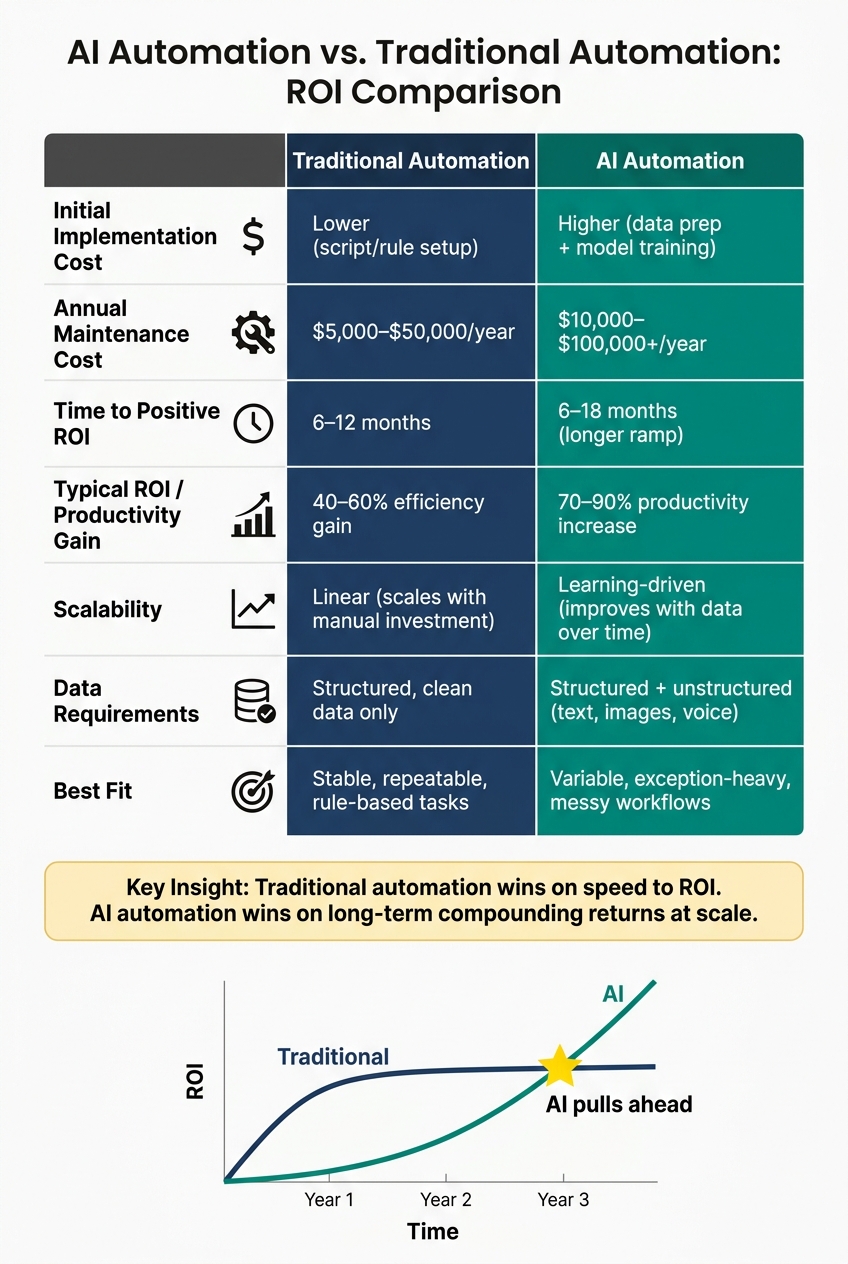
AI Automation vs. Traditional Automation: ROI Comparison
A higher upfront spend only pays off if the workflow gets better after launch. That’s what this business case turns on: initial cost, maintenance load, time to ROI, scalability, flexibility, and monitoring. Those six factors shape which path gives you the better return.
Direct Comparison Across Cost, Speed, and Long-Term Value
Traditional automation usually reaches break-even sooner. The upfront cost is lower, setup is simpler, and returns often show up faster. The downside is that the gains tend to be smaller and flatten out sooner. So while traditional automation often wins on early ROI, AI starts to pull ahead when scale grows and work becomes less predictable.
AI automation takes more time. The ramp is longer, the initial spend is higher, and the ROI curve doesn’t spike right away. But once it starts moving, the gains can be much larger. Productivity improvements can hit 70–90%, and AI can continue to improve after launch.
Where AI Outperforms and Where Rule-Based Automation Still Fits
AI makes more sense when inputs vary or come in messy formats. Think text, images, or cases that don’t follow the same pattern every time. One retail chain needed 17 distinct workflows just to deal with small inventory differences across locations. That’s a good example of how rule-based systems can get out of hand fast. AI is better at handling exceptions instead of stalling the whole process.
For manufacturing lines with fixed, clearly documented steps, rule-based automation still tends to be the lower-cost option. If the workflow is predictable, go with traditional automation. If exceptions, unstructured inputs, or growth keep creating manual work, AI is usually the stronger fit.
Comparison Table for Executive Decision-Making
The contrast is easiest to see side by side.
| Aspect | Traditional Automation | AI-Driven Automation | ROI Implication |
|---|---|---|---|
| Initial Implementation Cost | Lower; focused on script/rule setup | Higher; requires data prep and model training | Traditional has a lower barrier to entry |
| Annual Maintenance Cost | $5,000–$50,000/year | $10,000–$100,000+/year | AI costs more to maintain, but it can cut manual oversight over time |
| Time to Positive ROI | Faster for stable, repetitive tasks | Longer ramp-up, often 6–18 months | Traditional breaks even sooner; AI pays off over a longer horizon |
| Typical ROI Profile | 40–60% efficiency gain | 70–90% productivity increase | AI can deliver stronger multi-year returns when work varies |
| How It Scales | Linear; scales with manual investment | Learning-driven; improves as it learns from new data | Cost per task drops as volume rises |
| Data Dependence | Requires structured, clean data | Handles structured and unstructured data, including text and images | AI opens up ROI from data sources that were hard to automate before |
| Ongoing Oversight | High; humans must handle exceptions | Fewer daily exceptions, but ongoing model oversight | AI cuts the hidden cost of human intervention at scale |
Conclusion: How to Choose the Right Automation Model for ROI
There’s no one-size-fits-all winner here. The right pick depends on your process, your data, how often exceptions show up, and how long you can wait for payback. The table gives you the snapshot. The criteria below help turn that snapshot into an actual investment choice.
Key Decision Criteria Before Investing
Before you commit budget, take a hard look at these factors:
- Workflow volatility: Use traditional automation for stable, rule-based work. Use AI when exceptions happen often and the process changes a lot.
- Data maturity: AI needs high-quality, accessible data to do its job well. If your data is scattered or inconsistent, the ROI timeline gets longer.
- Exception rate: High exception rates make script upkeep expensive and slow.
- Speed to value: Pick traditional automation when payback needs to happen fast. Pick AI when you can accept a longer ramp.
- Long-term goal: If the goal is predictable labor substitution, traditional automation is enough. If the goal is compounding improvement across a growing, complex operation, AI is the stronger bet.
Key Takeaways for Business and Technical Leaders
Once those criteria are clear, the decision usually gets much simpler.
Use traditional automation for stable, structured work where fast payback matters. Use AI automation for high-volume, exception-heavy work where returns build over time as scale increases.
Whatever route you take, tie it to specific financial and operational KPIs from day one. Don’t stop at labor hours saved. Look at defect prevention, faster cycle times, and less manual oversight too.
If the choice still feels murky, start with a focused AI pilot on one high-volume, error-prone process - invoice processing or customer routing, for example. Measure labor savings, defect prevention, cycle time, and oversight reduction before you scale. That’s the fastest way to test the business case.
FAQs
How do I know if my process is too complex for rule-based automation?
A process is probably too complex for rule-based automation when it has to deal with exceptions, work through gray areas, or coordinate tasks across multiple departments.
The same goes for work that depends on multi-step reasoning, shifts based on new information, or involves high-stakes decisions that can't be fully written into fixed rules. In those cases, old-school automation usually starts to crack.
That’s where NAITIVE AI Consulting Agency comes in. The team helps businesses figure out when they need more capable AI agents instead of basic rule-based workflows.
What hidden costs should I factor into AI ROI?
To calculate true AI ROI, look past the license fee. That number is only part of the story.
In many cases, hidden costs make up 40% to 60% of the total lifecycle spend. And that gap can be bigger than teams expect.
Some of the biggest cost drivers include rework caused by low-quality outputs, implementation and maintenance costs of $75,000 to $200,000 upfront, plus 15% to 25% per year after that, and fully loaded labor rates that show the actual cost of staff time.
You also need to account for work that doesn’t stop after launch, like retraining, compliance reviews, scaling, and data integration.
Should I start with a pilot before scaling automation?
Yes. Starting with a pilot is a smart way to test automation before rolling it out more broadly.
It gives you a chance to try high-volume, repeatable tasks on a smaller scale, so you can prove value and check ROI before making a bigger move.
A phased approach also makes it easier to spot technical or process gaps in a controlled setting. Just as important, it helps build internal trust before full deployment. NAITIVE AI Consulting Agency can help design pilots that support smooth integration and clear, measurable results.