How to Engage Stakeholders in AI Risk Assessment
Engage the right stakeholders early to surface real AI harms and turn input into ranked risks, owners, and actions.

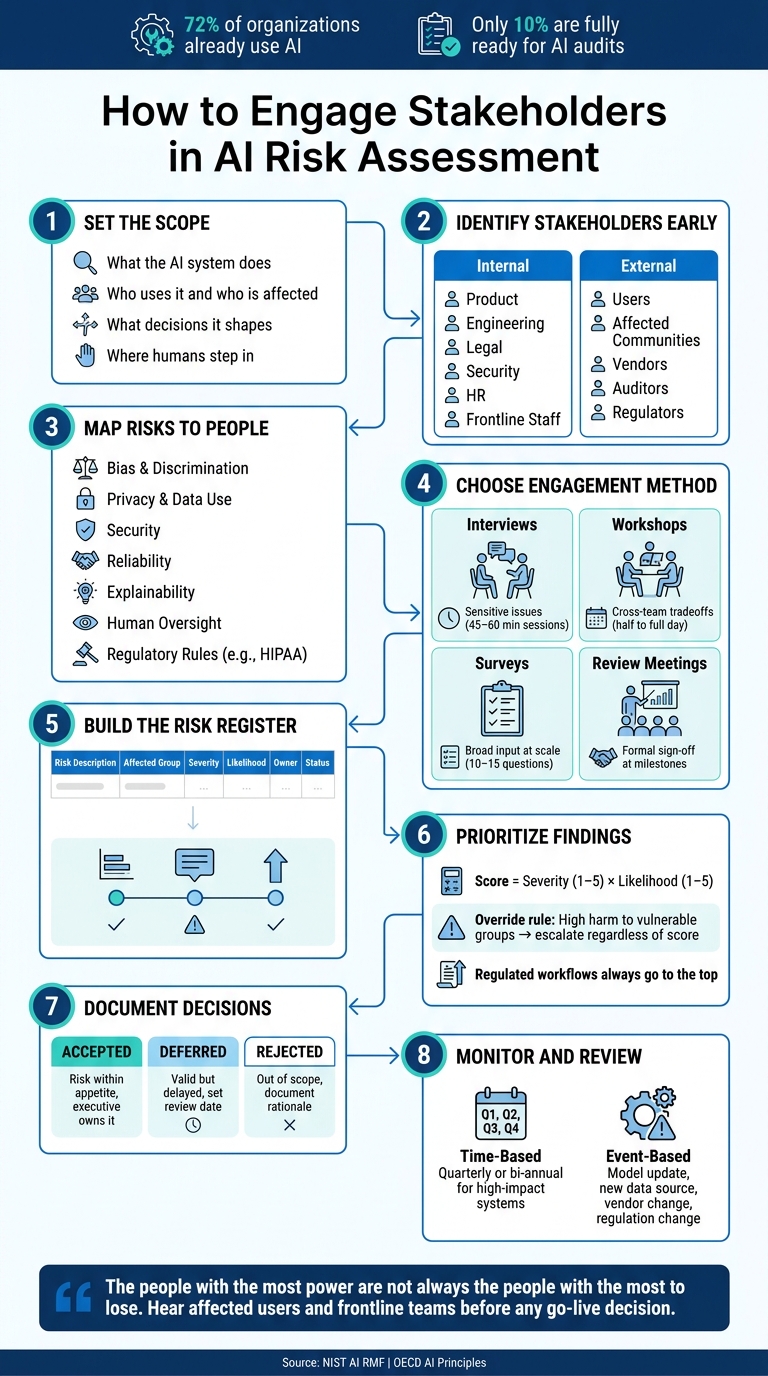
If the wrong people are left out, AI risk reviews miss the problems that matter most. With 72% of organizations already using AI and only 10% fully ready for AI audits, I’d treat stakeholder input as part of the work, not a side meeting.
Here’s the short version: I’d define the AI system clearly, identify internal and external groups early, match each group to the risks they face or control, use the right input method like interviews, workshops, surveys, or review meetings, and then turn that input into a ranked risk register, decision log, and action list. After that, I’d review it again when the model, data, vendor, users, or rules change.
If you want a simple way to do it, this is the flow I’d use:
-
Set the scope first
- What the AI agent does
- Who uses it
- Who is affected
- What decisions it shapes
- Where humans step in
- Which stage I’m reviewing
-
Bring in the right people early
- Internal teams like product, engineering, legal, security, HR, and frontline staff
- External groups like users, affected people, vendors, auditors, regulators, and community groups
-
Link people to specific risks
- Bias and discrimination
- Privacy and data use
- Security
- Reliability
- Explainability
- Human oversight
- Industry rules such as HIPAA
-
Pick the right way to get input
- Interviews for sensitive issues
- Workshops for tradeoffs across teams
- Surveys for broad input
- Review meetings for approval and escalation
-
Write everything down in working documents
- Risk register
- Impact assessment
- Mitigation plan
- Decision log
- Ownership model
-
Rank findings by harm, likelihood, and who is affected
- Don’t rely on score alone
- Put regulated use cases and high-harm user risks near the top
-
Turn findings into action
- Mark each issue as accepted, deferred, or rejected
- Assign an owner
- Set a deadline in MM/DD/YYYY
- Track proof that the fix was completed
-
Review it again over time
- On a set schedule
- After model, data, access, vendor, or rule changes
A simple point sits underneath all of this: the people with the most power are not always the people with the most to lose. That’s why I’d make sure affected users and frontline teams are heard before any go-live call.
Here’s a quick look at the main engagement methods:
| Method | Best Use | Who I’d Use It With | Output |
|---|---|---|---|
| Interviews | Sensitive concerns | Staff, users, ethics or risk roles | Detailed risk notes |
| Workshops | Team tradeoffs | Product, legal, engineering, compliance | Ranked risks and owners |
| Surveys | Broad input at scale | Frontline staff, customers, users | Pattern-level feedback |
| Review meetings | Approval decisions | Leaders, legal, audit, risk officers | Sign-off and escalation |
In short: good stakeholder engagement means getting the right people involved early, tying their input to named risks, and turning that input into decisions, owners, and follow-up work.
AI Risk Assessment: Stakeholder Engagement Process
AI Risk Assessment vs. PIA: Addressing Bias, Ethics, and Stakeholders
sbb-itb-f123e37
1. Identify Stakeholders Early
Once the scope is set, map the people who shape the AI agent or carry its risks. Do this before risk scoring starts. If people get added late, the harms that matter most often get missed.
The NIST AI RMF treats identifying all internal and external stakeholders who interact with or are affected by an AI system as part of the "Map" function. That means looking across the full lifecycle: build, deploy, monitor, and retire. Start with a full stakeholder map, then sort each group by the risks they can shape or absorb.
List Internal Owners, Operators, and Governance Roles
Include the teams and roles inside the organization that guide decisions or use the system day to day. That usually means executive sponsors, product owners, engineering and data science, legal and compliance, security and IT, HR, data governance, and frontline users. For each group, note the decisions it makes and the risks it can create, limit, or pass along.
Then widen the circle. Some groups don’t control the system at all, but they still live with the results.
Include External and Affected Groups
Add direct users, people affected by AI-driven decisions, vendors and technology partners, regulators and auditors, and advocacy or civil society groups. The OECD defines stakeholders broadly as:
"all organisations and individuals involved in, or affected by, AI systems, directly or indirectly,"
That’s a good reminder not to make the map too small.
Map Influence, Exposure, and Decision Authority
Once you have the full list, sort each stakeholder across three dimensions:
- Influence: can they shape how the system is designed or deployed?
- Exposure: how much are they affected if something goes wrong?
- Approval power: do they have formal authority to approve, block, or change the system?
| Stakeholder Group | Influence | Exposure | Approval Power |
|---|---|---|---|
| Executive sponsors | High | Low–Medium | High |
| Product owners | High | Medium | High |
| Legal & compliance | Medium | Low | High |
| Engineering & data science | High | Low | Medium |
| Security & IT | Medium | Low | Medium |
| Frontline users | Low | High | Low |
| Customers / end users | Low | High | None |
| Regulators & auditors | Medium | Low | Regulatory oversight |
| Affected communities | Low | High | None |
Use this map to decide who needs to be informed, consulted, or brought into approval. In plain terms, it sets who has a seat at the table and when.
Next, connect these groups to specific risks and pick the right way to engage each one.
2. Map Risks and Select an Engagement Method
Connect Stakeholders to Specific AI Risks
Use your stakeholder map to connect each group to the risks it owns, faces, or can shape. If you skip that step, the risk list stays vague, and nobody feels on the hook for it.
A simple way to do this is to build a stakeholder-risk-lifecycle matrix. List each stakeholder group, map it to the main risk categories, and mark the lifecycle stage where that risk shows up. For each match, note the group’s rights, responsibilities, and dependencies. For example, compliance should map to privacy and security, customer support to customer harm and reliability, and product managers to explainability and human oversight. In regulated industries, add sector rules such as HIPAA so ownership lines up with compliance duties.
That work sets up the next step. It helps you see when you need deep input for sensitive issues, broad input from many people, or a formal review before a decision is made.
Use Interviews, Workshops, Surveys, and Review Sessions
Once you know which stakeholders connect to which risks, pick the engagement method that fits the job. The best choice depends on sensitivity, required depth, and how many people need to be involved.
Use interviews for topics people may not want to discuss in a group. This includes discrimination concerns, internal accountability gaps, or cases where employees may fear retaliation. A 45-60 minute semi-structured interview often works well because it gives people room to speak plainly.
Use workshops when teams need to work through tradeoffs together in real time. Think product, legal, engineering, and compliance sitting at the same table and trying to balance model accuracy against fairness limits or regulatory rules. Every workshop should end with concrete outputs:
- Prioritized risk items
- Proposed mitigations
- Assigned owners
- Target dates in MM/DD/YYYY format
Use surveys when you need input from a large group, such as frontline staff or customers. A 10-15 question survey with Likert scales and open-ended responses can give you broad signals without slowing everything down.
Use formal review meetings when the goal is sign-off at a major milestone. These sessions should include senior leadership, legal counsel, and risk officers who need to accept, defer, or escalate findings.
Match the method to the decision in front of you. That’s the whole game here.
Comparison Table: Engagement Methods by Purpose and Effort
| Method | Primary Purpose | Depth of Feedback | Typical Stakeholders | Speed | Effort |
|---|---|---|---|---|---|
| Interviews | Surface sensitive concerns | High | Executives, ethics officers, individual users | 1-2 weeks to organize; 45-60 min per session | High per session |
| Workshops | Resolve cross-functional tradeoffs | High | Product, legal, engineering, compliance, operations | Half-day to full-day session | High (facilitation + prep) |
| Surveys | Broad trust and operational signals | Low-Medium | Frontline staff, end users, customers | Fast to deploy; 1-2 weeks for responses | Low to moderate |
| Review Meetings | Formal sign-off and governance decisions | Medium-High | Senior leadership, risk officers, legal, audit | Scheduled at milestones | Moderate |
| Participatory Design | Co-design safeguards with affected users | High | End users, affected communities, operators | Slow to organize; iterative | High (design facilitation) |
A common sequence is to start with a survey, move into interviews or workshops, and then use review meetings for sign-off. Feed the output from each method into the risk register and the ranking step.
3. Run the Assessment and Prioritize Findings
Capture Input in a Risk Register
Use the stakeholder-risk matrix from the last step to turn comments into ranked findings. Put all stakeholder input into one risk register and treat it as the single source of truth. Log every concern first, then check and confirm it.
Each entry should include:
- Risk description
- Affected group
- Source stakeholder
- Severity
- Likelihood
- Business impact
- Owner
- Proposed mitigation
- Decision status
Write each risk in plain, concrete terms. Don’t write “model may behave unfairly.” Write “model may deny service to non-native English speakers due to language pattern bias.” That level of detail makes the register useful when it’s time for a go/no-go call.
Prioritize by Severity, Likelihood, and Affected Group
Not every risk needs the same level of urgency. Score each risk for severity and likelihood on a 1–5 scale, then multiply the two scores.
But don’t stop at the math.
If a risk could cause serious harm to affected groups, that should outweigh the raw score. A moderate-severity issue that hits a vulnerable population or touches a regulated workflow, like privacy, employment, health, or finance, should move up the list even if the number looks manageable. Regulated workflows belong at the top.
Once the register is filled out, sort it by priority before review.
Comparison Table: Rank Stakeholder Findings by Risk and Influence
Use the table below to rank findings by risk and influence.
| Finding Source | Key Concern | Exposure to Harm | Recommended Priority |
|---|---|---|---|
| Affected Users | Algorithmic bias / discrimination | High | Critical - immediate mitigation required |
| Legal & Compliance | Regulatory fines (e.g., EU AI Act) | Medium | High - escalate and assign owner |
| Engineering / Dev | Technical complexity and data quality | Low | Medium - monitor and improve |
| End Users | Privacy and data protection | High | High - mitigate to protect trust and compliance |
| Business Owners | ROI and speed to market | Low | Medium - accept or defer within risk appetite |
| External Auditors | Auditability and explainability | Medium | High - document decisions and keep an audit trail |
| Communities | Environmental or sustainability impact | Medium | Low - monitor and revisit at the next review |
The main point here is simple: as an AI consulting agency, we find that the people with the most influence don’t always have the most urgent concerns. Affected users may have little power inside the organization but face the most harm. That’s often why their concerns end up as critical items. In practice, this helps keep the quietest voices from getting pushed aside.
These rankings should flow straight into mitigation tasks and the decision log.
4. Document Decisions, Apply Mitigations, and Monitor Over Time
Record Accepted, Deferred, and Rejected Concerns
Once findings are ranked, the next step is simple: turn them into clear decisions. After you prioritize the risk register, give every concern a status - accepted, deferred, or rejected.
- Accepted: The risk fits within the organization's risk appetite, and an executive owns the residual risk.
- Deferred: The concern is valid, but work is delayed because of a dependency. Add a review date.
- Rejected: The issue falls outside policy, is out of scope, or doesn't have enough support. Write down why and respond to the stakeholder.
For each item, log the risk ID, timestamp, concern, source stakeholder or meeting reference, category, severity, likelihood, status, rationale, owner, mitigation, deadline, budget, and evidence links. A consistent schema makes the log easier to search and easier to connect back to the risk register. Store it in a system with version history and traceability.
Turn Findings into Implementation Tasks and Review Cycles
Then move from decisions to owned work. Approved mitigations should become tracked tasks across four workstreams: engineering, policy, training, and monitoring. Each mitigation needs an owner, a deadline, and a linked risk ID.
Review cycles should use both time-based and event-based triggers. Time-based reviews may happen quarterly or twice a year for high-impact AI systems. Event-based reviews should kick off after any material change to the model, data, users, vendor, access permissions, or regulations.
This matters because risk can shift fast. A model update, a new data source, or a vendor change can alter the picture overnight. So it's smart to build these triggers into deployment gates or monitoring workflows. That way, a major model update automatically flags a risk register review before deployment moves forward.
Keep monitoring logs, incident tickets, root-cause analysis, corrective actions, and proof of completion together. That makes post-deployment review much easier and shows whether a mitigation worked in practice, not just on paper. Share progress with stakeholders through review meetings and dashboards so they can see what changed, what still needs work, and what remains open.
Conclusion: A Repeatable Process for Safer AI Deployment
Stakeholder engagement in AI risk assessment is not a one-time exercise. It's a governance loop: identify stakeholders early, map risks to roles, use structured engagement methods, prioritize findings in a risk register, document each decision with a clear rationale, and monitor against defined thresholds.
The organizations that do this well treat each step as a standing process, not just a project milestone. That closes the loop between stakeholder input and documented action.
FAQs
Who should lead the AI risk assessment?
AI risk assessment is a shared job, but it only works when ownership is clear. You want input from a cross-functional team, yet leadership should keep decision-making power and accountability.
That balance matters. A broad group can spot issues from different angles, while leaders make the call and own the outcome.
It also helps to appoint a team leader to run discussions and keep the work moving. And use a RACI model so one person is Accountable for each AI system or risk category.
How often should stakeholders review AI risks?
Stakeholders should review AI risks on a set schedule based on the system’s risk level and how often it changes.
- High-risk systems: review every month
- Moderate-risk systems: review every quarter
- Lower-risk systems: review less often
That schedule matters because AI risks can shift fast, especially when teams update models, data, or workflows.
Reviews should also happen at major lifecycle checkpoints, including development, deployment, and retirement. On top of that, teams should run periodic cross-functional reviews so people from different parts of the business can spot issues early and keep pace with changing risks.
What if stakeholders disagree on risk priority?
When stakeholders disagree on risk priority, the final call should sit with leadership or the right governing body.
Use established governance structures, such as cross-functional oversight committees or ethics boards, with clear decision-making and escalation paths. These groups should lean on documented impact assessments and objective criteria to settle disputes and keep AI decisions aligned with organizational and ethical goals.