
How to Build Scalable AI Bias Monitoring Systems
A practical system for continuous AI bias monitoring: inventory, metrics, alerts, logging, and remediation.

If you only test AI bias before launch, you're already late. In production, data shifts, user mix changes, and model updates can slowly create group gaps that turn into complaints, audit issues, or regulator review. And that risk is easy to miss when only 21% of organizations test AI tools for bias and compliance risk.
If I had to boil this down, I'd say you need one repeatable system that does four things:
- Tracks the right models first, especially in lending, hiring, insurance, healthcare, and other high-impact areas
- Measures group-level gaps over time using clear metrics, thresholds, and alert levels
- Logs the right data so teams can check predictions, outcomes, drift, and subgroup results
- Routes issues to named owners with tickets, deadlines, dashboards, and audit records
Here’s the article in plain English:
- Start with a risk-based model inventory
- Pick bias metrics that fit the decision type
- Build scheduled checks plus event-triggered checks
- Set up alerts with low-noise triage
- Tie results into CI/CD, model registry, and governance
- Fix issues with review, rollback, retraining, feature changes, or threshold updates
- Recheck results and update thresholds on a set review cycle
One point stands out: this is not just a model testing task. It’s a system of people, data, rules, and response steps that has to work across many teams and many production models.
The article then walks through how to set that up in a way teams can use at scale.
Monitoring AI Models for Bias & Fairness with Segmentation
sbb-itb-f123e37
1. Define Scope, Ownership, and Bias Metrics
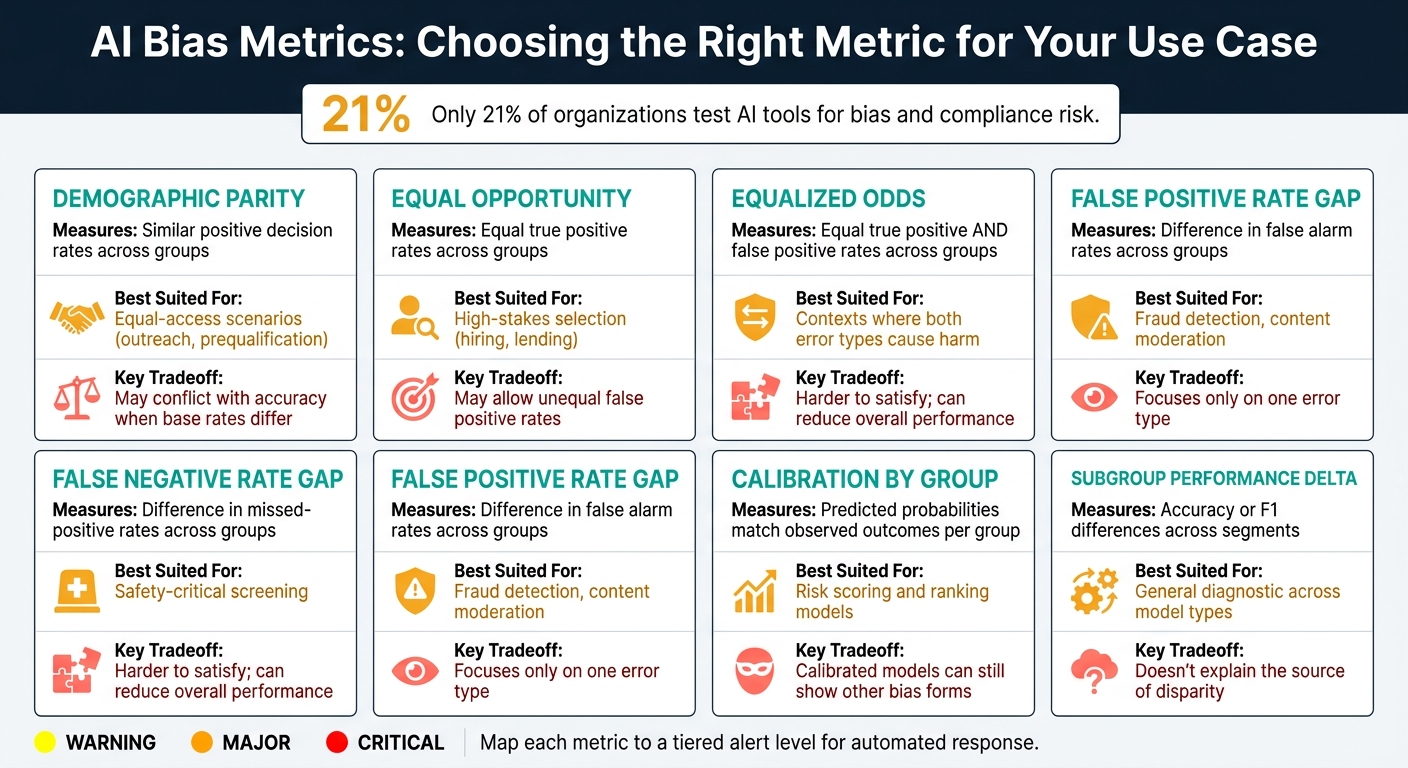
AI Bias Metrics Comparison: Choosing the Right Fairness Metric for Your Use Case
Set Monitoring Scope and Governance
Use the risk tiers from the last section to decide who owns what, how often each model gets checked, and how urgent alerts should be. Start with an AI system inventory. Think of it as a central record for every production model: owner, purpose, decisions it supports, jurisdictions, review cadence, metrics, and escalation contacts tied to risk level.
For each model, spell out the protected or sensitive attributes, decision points, outcomes, business cohorts, and policy rules it will be checked against. High-risk models - like those used for credit underwriting, hiring, or insurance - should be reviewed monthly. Moderate-risk systems can be reviewed quarterly. Those fields then feed the monitoring jobs, alerts, and audit records.
Governance is just as important as the inventory itself. Approval and implementation should be split. Business owners approve remediation. Model owners make the fixes. An independent risk function runs dashboards and reports, which is needed for credibility. Escalation paths should be written down in plain terms. If a fairness gap passes the alert threshold in a regulated domain, it should trigger an incident ticket within one business day, notify the model owner, business owner, and governance lead, and require a documented action plan within five business days.
Choose Bias Metrics and Thresholds That Match the Use Case
Pick the metric based on the kind of harm the model might cause. Demographic parity fits cases where equal access is the main goal, like marketing outreach or loan prequalification. But it can point teams in the wrong direction when base rates differ across groups for valid reasons. Equal opportunity - equal true positive rates across groups - is a better fit for high-stakes selection work like hiring shortlists or credit pre-approval, where the main risk is missing a qualified person. In fraud detection or content moderation, a false accusation can do real damage, so false positive rate gaps deserve close attention. For scoring models that feed into human decisions, calibration by group is a must. It checks whether a predicted probability of 70% means 70% for each group, not just in the overall average.
The table below maps common bias metrics to practical use:
| Metric | What It Measures | Best Suited For | Key Tradeoff |
|---|---|---|---|
| Demographic parity | Similar positive decision rates across groups | Equal-access scenarios, such as outreach or prequalification | May conflict with accuracy when base rates differ |
| Equal opportunity | Equal true positive rates across groups | High-stakes selection, such as hiring or lending | May allow unequal false positive rates |
| Equalized odds | Equal true positive and false positive rates across groups | Contexts where both error types cause harm | Harder to satisfy; can reduce overall performance |
| False positive rate gap | Difference in false alarm rates across groups | Fraud detection, content moderation | Focuses only on one error type |
| False negative rate gap | Difference in missed-positive rates across groups | Safety-critical screening | Focuses only on one error type |
| Calibration by group | Predicted probabilities match observed outcomes per group | Risk scoring and ranking models | Calibrated models can still show other bias forms |
| Subgroup performance delta | Accuracy or F1 differences across segments | General diagnostic across model types | Doesn't explain the source of disparity |
Set thresholds using pre-deployment results and risk tolerance. Then map them to three alert tiers - warning, major, and critical - so each threshold has a clear response attached to it. That way, when a line gets crossed, nobody is left guessing what happens next.
Define the Required Data and Logging Schema
Treat the logging schema as the data backbone for monitoring at scale. Its job is to support automated checks, dashboards, and investigations. Every inference event needs a consistent log record. At a minimum, each record should include:
- a unique event ID
- a timestamp in ISO 8601, with U.S. display formatting in dashboards
- the model name and version
- the input features, or a hashed form of them
- the prediction output
- a confidence score
- the outcome label once it becomes available, often logged later after the real-world result is known
For bias analysis, logs should also include subgroup attributes where legally allowed, such as age bands, ZIP code or region, language, or self-reported demographic data. If direct attributes are not available, teams can store proxy or contextual attributes, but that choice should come with clear governance notes explaining why. Feature attribution data - such as SHAP value summaries - should also be logged for a representative sample of requests.
Privacy controls are not optional. Sensitive fields should live in a separate logical or physical store with role-based access controls, so only authorized personnel - responsible AI team members and compliance-approved analysts - can query them. Raw PII should not appear in decision logs. Use hashed or pseudonymized identifiers instead. Retention policies for high-risk models often run from one to three years, subject to legal requirements. After that, sensitive fields should be deleted or anonymized. Dashboards should show only aggregated subgroup stats, never raw personal data.
This schema feeds the baselines, jobs, and alerts described next.
2. Build the Monitoring Architecture and Workflow
Monitoring only becomes useful when it turns metrics and logs into action. In practice, that means a clear flow: collect data, recompute metrics, compare results, and send issues to the right people. It starts with a baseline, then expands into scheduled checks and trigger-based checks.
Create Baselines, Scheduled Jobs, and Trigger-Based Checks
Before a model goes live, run a pre-launch fairness test on your pre-launch test set. Compute your catalog metrics and save those results as the baseline. Store that baseline as the production reference in your model registry and governance repository, along with the model version, dataset version, and threshold settings. From that point on, every production run is measured against it.
Scheduled jobs handle day-to-day monitoring. High-risk, high-volume systems like credit underwriting, hiring, and healthcare triage often run daily checks on a rolling 30-day production window. Lower-risk systems like marketing personalization may run weekly or monthly instead. Tools like Apache Airflow or Prefect can pull recent logs, recompute metrics by subgroup and intersection, and compare the results with baseline and threshold values on a set cadence. Those outputs then feed the alert rules and triage process described next.
Scheduled checks help, but they won't catch everything. Problems can show up between runs, and that's where trigger-based checks come in. Connect your bias monitoring system to event sources in your MLOps stack so key changes launch checks automatically. For example:
- A new model version deployed through CI/CD should start a post-deployment bias evaluation job.
- An upstream schema change should trigger a targeted recheck for every dependent model.
- A retraining event logged in the model registry should start both pre- and post-deployment bias tests to make sure the new model doesn't create regressions for specific subgroups.
Use a standard event taxonomy so each trigger maps to a defined test and response. That keeps the process from turning into guesswork.
Design Alerting, Triage, and Noise Reduction
Four alert types cover the bias issues teams run into most often. Threshold breach alerts fire when a metric crosses a business or regulatory limit, like a disparate impact ratio dropping below 0.8 in a lending setting, in line with U.S. EEOC four-fifths rule guidance. Subgroup degradation alerts flag cases where a group's performance drops hard against its own past baseline. Small-sample alerts warn when a subgroup has fewer than 100 observations in a given window, which makes the estimate shaky. Bias drift alerts rely on trend tests and rolling-window analysis to catch slow fairness shifts before they cross a hard limit.
Too many alerts can bury the team. Low-severity issues should go to email digests or dashboard summaries. Medium-severity alerts, such as early drift signals without confirmed impact, should go to technical owners in Slack or Microsoft Teams. High-severity alerts, such as a confirmed threshold breach affecting a protected class in a regulated area, should trigger immediate notices through email, chat, and your incident management platform, while also opening a ticket with a defined SLA. To cut noise, use time-based aggregation, hysteresis, and correlation rules so related alerts are grouped into one incident. If you plug bias alerts into existing SRE or DevOps incident tooling, you can use the on-call process your team already knows, with added AI governance steps layered in. Every alert should also flow into the dashboard and audit trail.
When an alert fires, the first step is simple: make sure it isn't a data issue. The monitoring team should check for ingestion failures, traffic spikes, upstream schema changes, and outages. If those checks come back clean, they can move to fast exploratory analysis, such as segment-level performance comparisons, feature distribution checks, and reviews of recent deployments. Only signals that are persistent and statistically meaningful - and that line up with qualitative feedback - should be escalated to model owners, legal or compliance, and the AI governance committee. That's the heart of scalable monitoring: filtering false alarms fast so people can focus on actual bias instead of noise. Log every triage decision in your ticketing system, whether that's Jira or ServiceNow, with timestamps and reasoning. That history matters for internal review and for outside regulatory questions.
Centralize Results in Dashboards and Audit Records
Data science, risk, compliance, and leadership all need one shared portfolio view of fairness. That view should show every monitored model, its current risk rating, its latest bias metrics, and any open incidents. Time series charts for key metrics by protected attribute and business unit make it easier to spot patterns and seasonality. Filters for model version, region, product line, and subgroup help teams narrow down where issues are clustering. Widgets that show recent deployments, data source changes, and policy updates next to metric movement can speed up root-cause analysis. The same dashboard should support daily operations and governance review.
Audit records need to do more than store alerts. They should capture the full chain of decision-making: alert history, triage notes, root-cause analysis, remediation plans, and stakeholder approvals. Regulators may ask why thresholds were chosen and how fairness trade-offs were handled. Use tamper-evident audit logs, and link each audit record to the matching ticket or change request in your IT service system. That way, the full path - from alert to remediation to approval - can be reconstructed in one place.
3. Scale the System Across Teams, Pipelines, and Production Environments
Once your monitoring setup works for one model, the hard part starts: making it work the same way across many models, teams, and environments. That means shared tests, bias checks built into release flow, and a clear path from monitoring results to governance action.
Use a Standardized Bias Test Battery Across Models
Use the baselines, alerts, and audit trail from the previous section as a shared control layer across the portfolio.
Without one standard, teams end up running different checks. And when that happens, comparing models becomes shaky. A standard test battery sets the minimum checks every model has to pass. Create one versioned test catalog with required checks, optional domain checks, and one fixed reporting template for every model.
A tiered setup keeps things lean instead of bloated:
- Tier 1: required for every model
- Tier 2: for higher-risk use cases like credit scoring, hiring, or healthcare
- Tier 3: for model- or domain-specific checks, like toxicity tests for language models or geographic fairness checks for pricing systems
Store the catalog in a versioned shared repository with clear ownership and change approval, so updates don't quietly break current configurations.
Integrate Bias Checks into CI/CD and Release Gates
To scale this across teams, bias evaluation needs to be a release gate.
A practical pattern is to run checks at three stages. At the feature branch stage, fast unit-level tests catch obvious fairness regressions before code is merged. In staging, the full test battery runs against near-production or historical production data, and the pipeline blocks promotion if a metric falls outside the set threshold. At pre-production, high-coverage fairness checks run on production-like data, and the results are logged before approval is granted. CI/CD platforms such as GitHub Actions, GitLab CI, and Azure DevOps can orchestrate these stages with reusable templates, which makes the process repeatable across teams.
When a model fails a gate, an automated ticket should open with the bias report attached. Exception workflows should require sign-off from the model owner, a risk officer, and legal or compliance, plus a documented mitigation plan and a mandatory re-evaluation date. Every exception should be tracked in the central dashboard so governance teams can see where and why standards were relaxed. Every failed gate should become a tracked exception, not an informal waiver.
Connect Monitoring to Enterprise AI Governance
Bias monitoring only matters if it changes approvals, funding, and escalation. If the results just sit in a dashboard, nothing moves. The monitoring system has to connect to policy enforcement, model lifecycle controls, and executive reporting, often requiring specialized AI consulting to align technical metrics with business governance.
In practice, that means attaching bias evaluation histories to each model in the registry so the model's risk status, threshold setup, and remediation roadmap sit next to its technical metadata. Governance committees such as AI ethics boards or risk committees can then use those records to spot which models have open incidents, which are getting close to threshold limits, and where the same problems are showing up across multiple systems. That also gives them a basis for assigning remediation ownership and funding.
When governance flags a pattern, move straight to root-cause analysis and mitigation. If repeated failures show up across models, the answer isn't a new threshold. It's finding what's driving the problem in the first place.
4. Investigate, Mitigate, and Improve Over Time
Finding a bias issue is just the start. What matters next is how fast the team checks it, what guardrails go in, and how carefully the fix gets tested. Otherwise, monitoring turns into a noisy alarm system that people learn to ignore.
Run a Root-Cause Analysis Before Changing the Model
Once an alert makes it through triage, shift from detection to diagnosis. First, confirm that the signal is real before touching the model. Check the metric math, logging integrity, and subgroup labels. Then verify sample size. Small samples can make fairness metrics jump around, so many teams tag low-support groups as monitor only until they hit a minimum volume threshold.
If the data checks out, compare the current version with earlier versions over the same time window. If the fairness gap shows up right after a deployment, that’s a strong clue that the release caused the regression. From there, use feature attribution analysis, such as Shapley values, to see whether a feature is acting as a proxy for a protected attribute. A common example is ZIP code standing in for race or past salary standing in for gender.
It also helps to step back and look at the business context. Sometimes the model didn’t change much, but the system around it did. New eligibility rules, a marketing push aimed at one demographic, or a macro shift like regional unemployment can all change who enters the system or how outcomes get judged.
Apply Controls and Model Fixes
For high-risk decisions like credit denials, hiring screens, or healthcare triage, add or expand human review for affected subgroups while the team works on the technical fix. Every manual review decision should be logged with a timestamp, such as 2026-08-21 14:35:00 ET, so later audits have a clear record.
Use the root cause to choose the lightest fix that stops harm fast. Here are the main options:
| Mitigation option | When to use | Speed | Limits |
|---|---|---|---|
| Decision threshold adjustment | Score distributions differ across groups but the model is still predictive | Hours to a couple of days | May hide deeper causes; can increase false positives; needs regulatory review |
| Rollback to prior version | A specific release clearly worsened bias vs. the previous model | Hours to days | Prior version may have accuracy or data-freshness issues; not a long-term fix |
| Targeted retraining | Training data imbalance or label bias is confirmed for specific subgroups | Days to weeks | Needs enough high-quality data; may increase infrastructure costs |
| Feature engineering or removal | A feature is confirmed to act as a proxy for a protected attribute | Days to weeks | Removing features can hurt performance; full revalidation required |
| Reweighting or fairness-aware training | Systematic fairness constraints are needed at the training level | Weeks to months | Technically hard; may reduce some performance metrics |
| Updated business rules | Organizational policy itself is reinforcing the disparity | Days to weeks depending on approvals | Must be legally defensible and documented for stakeholders |
Experimental work in credit scoring has shown that combining pre-processing, in-processing, and post-processing techniques can reduce disparity measures by 15–45% while keeping performance trade-offs within an acceptable range. In plain terms, short-term controls like threshold changes should run alongside medium-term structural fixes like retraining, not replace them.
After deployment, rerun the standardized bias battery against the original baseline. Then check for fairness leakage into other groups. Log each retest in the central audit dashboard with a clear record of what changed, when it changed, and why.
Recalibrate Metrics and Thresholds as Conditions Change
Once the fix is live, review whether the monitoring rules still fit current conditions. User populations shift. Regulations change. Products move into new channels. Data patterns move with business cycles. A threshold that made sense in one period can become too loose or too tight later, especially during high-volume U.S. retail periods like Black Friday or tax season, when customer behavior can swing hard.
The practical move is a formal review cycle. A quarterly or biannual AI fairness review led by a cross-functional group, including AI consulting experts, data science leads, product owners, legal, and compliance, should revisit:
- which outcomes are being monitored
- whether subgroup definitions still match the current customer base
- whether alert thresholds need updates based on recent incident trends
Dynamic thresholds that use robust statistics like the median and interquartile range over trailing windows can cut noise between scheduled reviews.
Document each recalibration decision with its rationale, tied to regulatory guidance, risk appetite, or monitoring evidence, so the system stays explainable and auditable. Document each recalibration decision with its rationale and update the monitoring registry and alert rules.
Conclusion: Core Design Principles of a Scalable AI Bias Monitoring System
After monitoring, triage, mitigation, and recalibration, one thing decides whether the system holds up: the parts have to stay connected.
Scalable bias monitoring is an operating system, not a single tool. Scope, ownership, data, baselines, checks, alerts, and remediation need to run as one loop. Pull out one part, and coverage starts to crack.
The rise in AI incidents in 2024 shows why bias monitoring has to be live, not reactive.
In practice, mature programs tie metrics, alerts, owners, and fixes into one documented workflow. That usually means shared thresholds, a maintained audit trail, and a retest cycle that closes after every remediation.
Key Takeaways for Business and Technical Leaders
The practical message is simple: start with your highest-impact AI systems and build the monitoring base there first.
Then keep the setup tight and clear:
- Standardize a small set of fairness metrics and tests across those models so results stay comparable.
- Connect every alert to a team with the authority and budget to act.
Bias monitoring should be treated as an ongoing operational control. Models change. Data shifts. Business conditions move. If your review process doesn't keep up, blind spots can creep in fast.
Regular reviews and versioned audit records help keep the system current. Organizations that need implementation support can work with NAITIVE AI Consulting Agency to design and operationalize this infrastructure.
FAQs
Which models should we monitor first?
Start with the models that pose the highest risk to your organization. Review your AI systems and pinpoint the ones that have the biggest effect on business results, compliance, and fairness for users.
Focus on high-risk applications first, like hiring, lending, or criminal justice. Then review their training data and test performance across demographic groups to spot gaps in accuracy or outcomes.
How much data is enough for bias checks?
There’s no one-size-fits-all data threshold for bias checks. The right amount depends on your use case and the level of risk involved. In some cases, research has improved accuracy for underrepresented groups with as few as 20,000 samples.
So instead of chasing a fixed number, put the focus on data that is diverse, high-quality, and representative. That matters more than raw volume alone. On top of that, continuous monitoring and regular audits can help spot gaps in representativeness before they turn into bigger problems.
What should happen after a bias alert?
After a bias alert, the system should kick off an intervention path right away. That means pausing auto-approvals and rolling back recent biased decisions, with a mean time to halt of two minutes or less.
For high-stakes decisions, send outcomes to human approval. For lower-risk cases, keep the system running, but log each decision for audit.
Also, document every override, investigate the root cause, then retrain the model or adjust the decision logic. After that, keep monitoring for any sign that the same problem shows up again.