
AI in Climate Change: ROI for Enterprises
How AI drives fast, measurable climate ROI - energy, predictive maintenance, supply-chain and ESG gains with payback often <12 months.

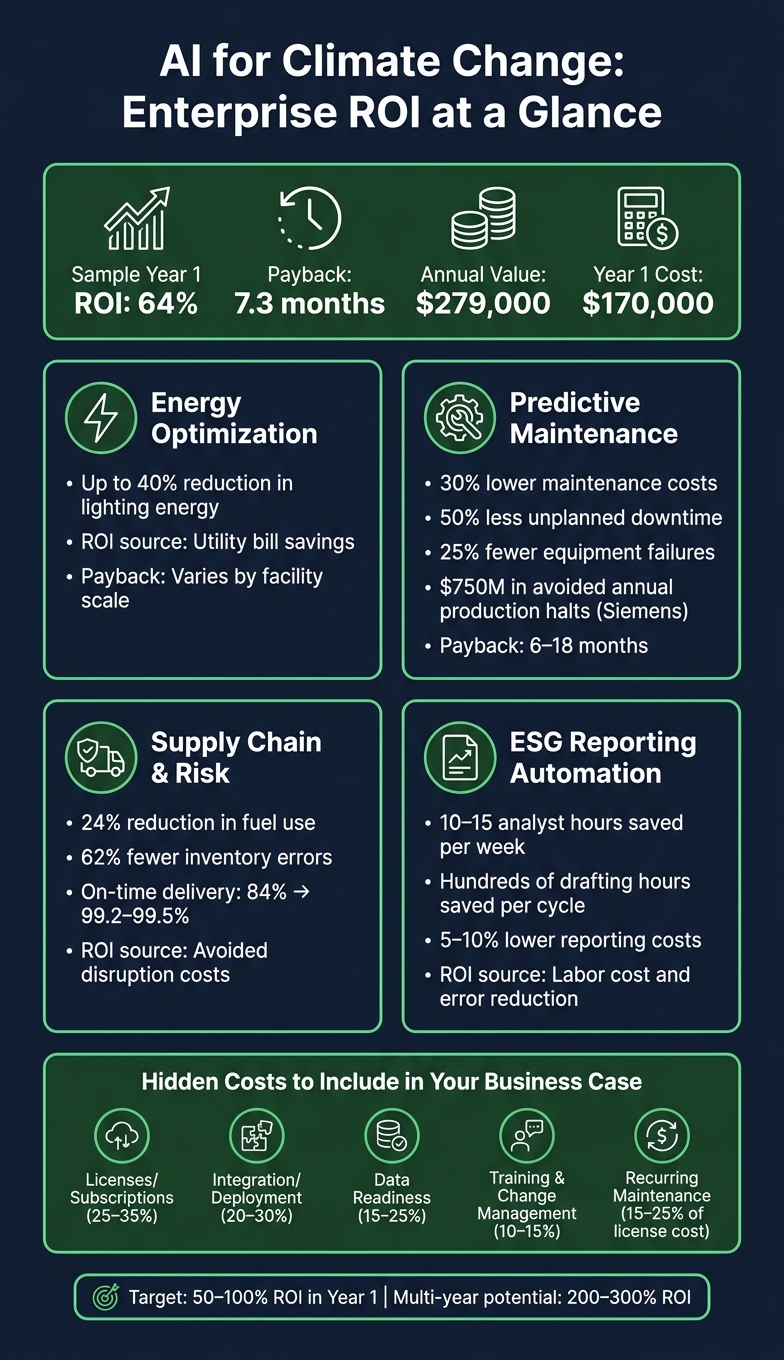
Yes - AI for climate work can pay off fast, but only when I tie it to hard numbers like energy bills, downtime, labor hours, and loss prevention. In the source article, the strongest cases point to payback inside 12 months, with one sample model showing $170,000 in Year 1 cost, $279,000 in annual value, 7.3 months to pay back, and 64% first-year ROI.
Here’s the short version of what matters:
- Best-fit use cases: energy management, predictive maintenance, supply chain and risk monitoring, and ESG reporting
- Main value drivers: lower power costs, less downtime, fewer labor hours, and fewer costly disruptions
- Main risk: weak ROI math if I skip integration, data cleanup, training, and yearly upkeep
- Typical hidden cost: yearly maintenance can add 15%–25% of the initial license cost
- Best way to judge a project: track before-and-after results in kWh, dollars, downtime hours, maintenance cost, reporting hours, scrap, and emissions per unit
A few numbers stand out. AI-based lighting control can cut energy use by up to 40% in large buildings. Siemens reported 30% lower maintenance costs, 50% less unplanned downtime, and 25% fewer equipment failures, tied to $750 million in avoided yearly production halts. In reporting, AI can save 10–15 analyst hours per week, trim drafting by hundreds of hours per cycle, and cut reporting costs by 5%–10%.
| Use case | Where ROI shows up | Example gains |
|---|---|---|
| Energy optimization | Utility savings | Up to 40% less lighting energy |
| Predictive maintenance | Lower repair cost, less downtime | 30% lower maintenance cost; 50% less unplanned downtime |
| Supply chain risk tools | Lower disruption and fuel cost | 24% less fuel use; 62% fewer inventory errors |
| ESG reporting automation | Lower labor cost and error rates | 10–15 hours/week saved; 5%–10% lower reporting cost |
My takeaway is simple: the math works best when the project starts small, uses clean baseline data, and targets a line item finance already tracks. That’s the lens I’d use for the rest of the article.
AI Climate ROI: Use Cases, Savings & Payback Periods for Enterprises
Research Findings: Cost Savings from AI for Climate Mitigation
Research shows that AI for climate mitigation can cut costs in clear, measurable ways, especially in energy use and maintenance. In industry, AI applications such as maintenance and energy management carry an annual savings potential of $259 billion. On top of that, enterprises are expected to capture 75% to 85% of the economic value AI creates in sustainability.
Building and Industrial Energy Optimization
The clearest ROI tends to show up first in buildings and plants that use a lot of energy. AI-driven energy management systems adjust HVAC and lighting based on occupancy and weather data. That means systems run when and where they’re needed, instead of wasting power.
One of the clearest examples is lighting. AI-driven lighting optimization can reduce energy consumption by up to 40% in large commercial buildings. And when a building already has sensor data in place, payback usually comes faster.
Predictive Maintenance and Asset Efficiency
AI can also cut waste on the maintenance side. It reviews temperature, vibration, and performance data to spot problems before they turn into breakdowns. The result is lower maintenance spending and less unplanned downtime.
Siemens put AI-powered predictive maintenance into use across its manufacturing operations and saw a 30% reduction in maintenance costs, 50% less unplanned downtime, and 25% fewer equipment failures. That helped avoid $750 million in annual production halts.
Comparison Table: Mitigation Use Cases and ROI Metrics
These use cases vary in size and setup, but they all connect savings to operating data you can track.
| Mitigation Use Case | Primary Climate Impact | Typical Efficiency Gain | Annual Cost Savings / ROI | Typical Payback Period | Evidence Type |
|---|---|---|---|---|---|
| Building Energy (HVAC/Lighting) | Electricity reduction | Up to 40% (lighting) | Varies by facility scale | Varies | Research + case study |
| Industrial Predictive Maintenance | Lower waste and improved asset efficiency | 25% fewer equipment failures | Up to $750 million per year | 6–18 months | Enterprise case study |
In many cases, the first efficiency gains show up within 0–6 months. The deeper cost cuts usually appear between 6 and 12 months.
The next ROI question moves from efficiency gains to avoided losses and resilience.
sbb-itb-f123e37
Research Findings: AI for Climate Adaptation, Risk Reduction, and Resilience
In adaptation use cases, ROI comes from losses that never happen. That means fewer outages, shorter disruptions, and less physical damage.
AI-enabled climate risk management could generate about €65 billion in annual value by 2028. And most of that value stays with the companies putting the tools to work: 75% to 85% goes to the users of the technology, not the AI vendors.
Climate Risk Analytics in Finance and Insurance
Banks and insurers are using AI to assess climate-related physical and transition risks across their portfolios. The payoff is pretty clear: better underwriting quality and stronger risk-adjusted returns.
AI is projected to increase productivity in banking and insurance by 34% to 38%. It does that by automating anomaly detection and compliance monitoring, while moving risk review from periodic checks to continuous monitoring.
That matters because climate risk doesn’t wait for the next quarterly review. A system that monitors conditions all the time can spot shifts earlier and support better decisions.
Those gains rely on better climate data. The same data also helps companies handle disruption across logistics and day-to-day operations.
Supply Chain and Agriculture Resilience
In supply chains, AI improves resilience by rerouting shipments around weather disruptions and tightening inventory forecasts. The ROI shows up in avoided disruption costs and lower operating waste.
This gets much easier to prove when AI changes metrics teams already track. Here’s how logistics performance shifts when companies move from manual systems to AI-driven ones:
| Metric | Manual/Legacy System | AI-Automated System |
|---|---|---|
| On-Time Delivery Rate | ~84% | 99.2%–99.5% |
| Fuel Consumption | High (fixed routes) | 24% reduction |
| Inventory Errors | High (manual counting) | 62% reduction |
| Route Adjustment | Static (morning plans) | Real-time, adaptive |
That’s where the business case starts to click. If on-time delivery jumps, fuel use drops, and inventory errors fall, the value is no longer abstract.
The same pattern shows up in agriculture. Weather-aware forecasting helps protect yields, inventory, and timing, which can make a big difference when conditions shift fast.
That same data base also cuts reporting effort and improves climate disclosures.
AI in ESG and Climate Reporting: Efficiency Gains and Compliance ROI
The same data foundation that helps with resilience can also cut the cost of ESG reporting. Climate reporting often means chasing emissions data, reconciling spreadsheets, and drafting disclosures by hand. Then teams do it all over again next cycle. AI is starting to change that in measurable ways, which is why ESG reporting is becoming one of the fastest climate-AI use cases to turn into dollars.
Where Reporting Teams Save Time and Money
A big part of the problem is messy data. Up to 80% of enterprise data is still siloed or unindexed, so AI often delivers value first by linking systems and cleaning up inputs. That alone removes a lot of manual effort.
The time savings add up fast:
- IDP can cut verification work from weeks to minutes, while generative AI can trim repetitive disclosure drafting by hundreds of writing hours per cycle.
- Data collection can recover 10 to 15 analyst hours per week.
- Compliance monitoring can cut reporting costs by 5% to 10% when AI handles routine flagging and anomaly detection.
These gains are easier to prove than many other AI projects because they tie straight to things teams already track: analyst hours, reporting cycle time, and document volume.
Risk Reduction From Better Climate Data
Better climate data does more than save time. It also lowers financial exposure tied to audit findings, disclosure mistakes, and avoidable cleanup work. AI can flag data issues in real time and create timestamped audit trails, which cuts audit prep and reduces the scramble right before deadlines .
Governed reporting systems also help limit exposure from unauthorized AI use in disclosure workflows. In plain English, teams deal with less reporting friction and fewer compliance surprises.
Comparison Table: ESG Reporting ROI Drivers
| ROI Driver | How AI Creates Value | Measurable KPI | Typical Savings / Gain |
|---|---|---|---|
| Data Collection | Automated telemetry and integration | Analyst hours recovered | 10–15 hours per week |
| Narrative Drafting | Generative AI workflows | Content production time | Hundreds of hours saved per cycle |
| Compliance Monitoring | Real-time risk flagging | Avoided fines and errors | 5%–10% reduction in reporting costs |
| Audit Trails | Timestamped automated logs | Manual evidence-gathering time | Lower manual prep time |
| Error Reduction | Proactive anomaly detection | Audit findings and corrections | Fewer audit findings and corrections |
Baselining analyst hours, error rates, and reporting cycle time before deployment makes ROI much easier to track afterward.
How Enterprises Should Read the Research and Build a Business Case
Published ROI studies can help, but they’re only a starting point. An enterprise business case has to begin with your own telemetry, costs, and pilot scope. That changes the conversation from “What does the model do?” to “What metric proves value?”
Known Limits in ROI Studies
Most AI ROI studies look at narrow pilots, not full enterprise rollouts. And that matters. Savings that look strong in a small test can shrink at scale, while costs can climb because of usage tiers and inference load.
There’s also a gap between deployment and financial impact. Only about 1 in 10 companies deploying AI report major financial benefits, often because they don’t measure results well enough. Vendor ROI decks have another problem: they often lean on industry averages instead of your own asset base, energy tariffs, or downtime history. That makes them shaky for board-level planning.
Gartner adds one more warning sign: over 40% of agentic AI projects will be canceled by the end of 2027.
The practical fix is simple: run a short pilot first, and give it clear pass/fail metrics.
What to Measure Before and After Deployment
Build the case around the metrics finance already uses. Before deployment, quantify the numbers that will show up in the P&L:
- Energy spend, in kWh and $
- Unplanned downtime hours
- Maintenance cost per asset
- Reporting labor hours per cycle
- Scrap or rework rates
- Emissions per unit of output
In short, track only P&L-linked metrics: kWh, downtime hours, maintenance cost, labor hours, scrap, and emissions per unit. If a metric doesn’t connect to money, it probably won’t help much in the business case.
It also helps to pressure-test your assumptions. Cut your value estimates in half. If the case only works when every forecast goes right, it’s not a case you can defend. After deployment, use the exact same metrics to see whether the investment paid off.
A solid Year 1 budget should include five cost buckets:
- Licenses/subscriptions: 25% to 35%
- Integration/deployment: 20% to 30%
- Data readiness: 15% to 25%
- Change management and training: 10% to 15%
- Recurring model maintenance: usually 15% to 25% of annual license cost
Miss these hidden costs, and ROI projections often fall apart.
The strongest business cases tend to look alike. They have measurable baselines, auditable metrics, and a tight deployment scope. These use cases work because the gains show up in places finance can verify: utility bills, downtime logs, labor hours, or avoided losses. That’s why energy optimization, predictive maintenance, resilience, and reporting automation sit at the top of the ROI list.
A practical first-year target is 50% to 100% ROI with payback inside 12 months. After setup costs are out of the way, multi-year returns of 200% to 300% are realistic. The firms that come out ahead start with measurement.
FAQs
Which AI climate use case should we start with?
Start with high-volume, repeatable, low-complexity tasks that need little human judgment. Think order tracking, appointment scheduling, password resets, FAQ replies, and lead qualification.
These tasks often account for 60% to 80% of total interaction volume. That makes them the fastest path to ROI, with clear cost savings and efficiency gains you can measure.
How do we prove AI climate ROI internally?
Build a business case that can hold up under scrutiny by using your own numbers. Start with a clear baseline from past records, like energy use, waste costs, or asset downtime before the rollout.
Then measure AI’s effect on savings, scrap or rework cuts, and analyst time you get back. Test those assumptions with a focused pilot, then compare year-one costs with annual net value so the ROI is easy to see.
What hidden costs can hurt payback?
Beyond licensing fees, the hidden costs in enterprise AI climate initiatives can add up fast. In many cases, they account for 40% to 60% of the total investment.
A lot of that extra spend comes from work that doesn't always show up in the first budget draft, such as:
- implementation and change management
- maintenance, tuning, and day-to-day upkeep
- governance and compliance
- retraining, data integration, and rework caused by low-quality outputs
That’s why the sticker price is only part of the story. The bigger cost often comes from what it takes to make the system work well inside the business.