
Custom Voice AI Solutions for Banks
How banks can deploy voice AI to verify callers, access live data, execute approved actions, and stay audit-ready.

Voice AI in banking works when it does three jobs in one call: verify the caller, pull live data, and complete approved actions. Banks that get this right can cut routine call costs from about $7.16 per human-handled call to around $0.30–$0.50 per contained AI call, with early programs often reaching 25%–40% containment and mature ones moving much higher.
If I had to sum up the article in plain English, I’d put it like this:
- Start with low-risk calls like balance checks, card activation, recent transactions, and application status.
- Group use cases by risk so the voice agent knows when to answer, when to act, and when to transfer to a person.
- Match verification to the task. Simple requests need light ID checks. Money movement and card closure need step-up checks.
- Build the call flow and system access together. The agent should not talk freely and then hit banking systems without rules.
- Use a restricted action path for transactions so only approved flows can trigger account or payment APIs.
- Disclose the bot and recording up front and log consent before account talk starts.
- Track every action with call ID, timestamp, intent, API call, outcome, and handoff events.
- Keep approved content separate from model output so fees, policies, and rights notices come from controlled sources.
- Watch fraud closely. Synthetic voice attacks in banking were reported up 149% in 2024, so fraud signals and human transfer rules need to be built into the system.
- Roll out in phases: self-service first, then agent assist, then limited transactions, then outbound programs.
A few numbers stand out. One bank cited in the article handled more than 5 million minutes of automated voice traffic per year with 42.4% voice containment. Another voice program covering 22 intents saw a 33% lift in session completion. Those results show the upside, but only when compliance, logging, and access control are part of the same setup.
Here’s the short version of what banks need to decide first:
| Area | What I’d focus on first |
|---|---|
| Use cases | High-volume, low-risk calls |
| Risk control | Tier intents by risk level |
| Verification | Use step-up checks for risky actions |
| System design | Split conversation from transaction execution |
| Data access | Use approved APIs and live event data |
| Compliance | Bot disclosure, recording consent, audit logs |
| Security | TLS, AES-256, RBAC, vault-based secrets |
| Launch plan | 60–90 day pilot with 5%–10% of call volume |
So the core message is simple: banks should not treat voice AI like a new phone tree. I’d treat it like a controlled banking channel with speech on top - measured, logged, and limited by policy from the first day.
Bland CEO on How Voice AI is Changing Banking
sbb-itb-f123e37
Designing Voice AI Use Cases and Conversations for Banking
Once banks decide which calls to automate, the next job—often handled by an AI consulting agency—is turning each one into a conversation that is safe, trackable, and fit for bank operations.
Good Voice AI design in banking starts with a clear catalog of intents. Each intent should map to a specific backend action, a set risk level, and the controls that go with it. And each intent needs to lead to one of three outcomes: answer, execute, or escalate. Risk tiers are what make this usable day to day.
Tier 1 covers informational requests like branch hours and routing numbers. Balance checks may need basic identification. Tier 2 covers low-risk transactions, such as scheduling a payment, and calls for stronger authentication. Tier 3 covers high-risk or legally sensitive actions such as card closures, fund transfers, and loan payoff quotes. These require step-up verification and tighter compliance controls. This tiering decides whether the assistant can finish the action, ask for added verification, or send the call to a human. It also shapes how much friction makes sense at each step.
Intent Design, Authentication, and Secure Action Flows
For every Tier 2 or Tier 3 intent, the flow should follow a secure action pattern: verify identity at the right level, confirm the action in plain language, execute it through an approved API call, and then summarize the outcome with a confirmation number. Each intent should map to one approved backend action and one dialogue state.
Authentication should match the level of risk. For a balance check, a name and the last four digits of a card may be enough. For a card closure or a transfer, the assistant should trigger step-up authentication, such as a one-time passcode sent by SMS or a push notification to the registered mobile banking app. It should also explain why the extra check is needed. If verification fails twice, the system should deny the action, offer read-only help, and route the caller to a human agent.
Every backend call the assistant makes should connect to a traceable interaction record. That record should include the interaction ID, timestamp, intent, and outcome. This conversation-to-transaction trace lets auditors rebuild exactly which voice turns led to which system actions.
Disclosure, Consent, and Human Handoff Rules
Even with a well-designed action flow, the call still has to meet disclosure and consent rules. The assistant should identify itself and give any recording disclosure in the first 10 seconds, before any account discussion, and log consent before moving forward. This is mandatory. California's bot disclosure law makes it unlawful for businesses to use automated systems to communicate with consumers without clearly disclosing that they're speaking with a bot. Outside California, roughly a dozen U.S. states require all-party consent for call recording, including Florida, Pennsylvania, Washington, and Illinois. That makes upfront disclosure the safest default across the country.
Escalation rules need the same level of care. Handoff should happen right away after repeated agent requests, two failed authentications, clear distress, or any fraud or legal dispute. That protects both the customer and the bank. During handoff, the assistant should pass a context summary to the agent, including intents attempted, actions completed, and key utterances, so the caller does not have to start over.
KPIs and Guardrails for Production Banking Calls
Measuring Voice AI in banking takes a focused set of metrics. The core KPIs are task completion rate, containment rate, escalation rate, authentication success rate, and error rate. Containment rate, the percentage of calls fully resolved without a human transfer, is calculated as (Total AI-handled calls − Escalated calls) / Total AI-handled calls. But there’s a catch: if containment is too high, it may mean the system is failing to escalate sensitive cases, which creates compliance risk.
Escalation rate should also be broken out by reason:
- Risk-based routing
- Customer request
- System failure
- Repeated failures to resolve the issue
That split shows where the problem sits. Maybe ASR struggles with card numbers. Maybe the authentication prompt is unclear. Or maybe the flow pushes too hard to handle calls that should go to a person.
Guardrails are the technical and governance layer that keeps the system safe between reviews. Confidence thresholds decide when the assistant moves ahead versus when it asks a follow-up question or escalates. For example, an intent confidence score below 0.7 might trigger clarification instead of action. Version-controlled compliance language approved by legal means required disclosures, such as certain Reg Z statements and dispute rights notices, are pulled from approved content instead of being generated on the fly by the model. API calls tagged to the dialogue state that triggered them help support both audit trails and incident investigations.
These guardrails should be reviewed on a regular basis with risk, compliance, and contact center leadership. Production call data should feed updates to flows, thresholds, and handoff rules. Those same thresholds and audit rules should also carry straight into the system architecture and logging layer.
Technical Architecture and Core Banking Integration
The conversation policies and guardrails from the previous section only matter if the architecture can enforce them. In practice, that means orchestration, API access, and logging can't be bolted on later. They need to sit inside the system from the start.
The cleanest way to do that is to build the stack in layers, with each part handling one job in the call flow.
Reference Architecture for Banking Voice AI
A banking Voice AI stack has six layers: telephony, STT, orchestration, RAG, TTS, and secure APIs. Each layer maps to a control.
Tier 1 intents can stay conversational. Tier 2 and Tier 3 intents need to move through a restricted execution path. Here’s how that works in a live call: the customer calls in, and audio streams in real time to an STT engine tuned for 8 kHz narrowband audio and calibrated for numbers, account identifiers, and financial terms. The transcript then moves to the conversational orchestration layer, which acts as the policy engine. It tracks authentication state, active intents, and which actions are allowed.
When the system needs to answer, the orchestrator calls a domain-tuned language model wrapped with retrieval-augmented generation (RAG). Instead of letting the model speak freely, RAG pulls from approved product terms, fee schedules, and policy documents. The response text then moves to TTS, which returns clear U.S. English speech. From there, a secure integration layer connects to core banking, card platforms, CRM, fraud and KYC systems, and ticketing through approved APIs, not direct database access.
A dual-path architecture makes this split explicit. One path handles free-form conversation. The other is a restricted execution path, and it's the only path allowed to call monetary APIs. Before anything runs, that path applies deterministic policy gates. For compliance and risk teams, that creates a clear area to inspect and audit.
Integration Patterns, Middleware, and Real-Time Data Access
Connecting Voice AI straight to core banking APIs is possible. But it also creates tighter coupling, which can turn system changes into a headache when core platforms shift.
A middleware or service layer between Voice AI and core systems gives banks one place to handle authentication tokens, rate limiting, retries, and error normalization. It also becomes the main point for audit trails and policy enforcement.
The tradeoff is pretty simple:
| Dimension | Direct Core API Integration | Middleware Integration |
|---|---|---|
| Security controls | Harder to enforce at the core level | Centralized, easier to audit |
| Maintainability | Tightly coupled to core schema | Versioned contracts, lower coupling |
| Implementation complexity | Fewer layers, higher risk surface | More components, better control |
For live account data, event-driven updates matter. Balances, fraud alerts, and posted transactions should come from current system events, not old cache. When core systems publish events such as TransactionPosted or FraudAlertRaised to a message bus, Voice AI can read the customer's current state during the call itself. That helps keep balance disclosures and transaction confirmations accurate.
Model Training, Knowledge Management, and Contact Center Support
A banking Voice AI model needs exposure to the language people in U.S. banking use every day: overdraft policies, Reg E disputes, APR, ACH, and FDIC coverage. Fine-tuning on de-identified historical call transcripts, email and chat logs, and internal knowledge-base articles helps the model learn that vocabulary while keeping the bank's tone in place.
RAG should pull only approved banking content. Product terms, fee schedules, policies, and procedures should sit in a searchable index with metadata like effective date and product line. This keeps responses tied to approved material. The model is prompted to retrieve before it answers, and if no relevant approved document is found, the system blocks the answer and falls back to human escalation or a standard fallback message. Strict rules also block personalized advice and speculative legal interpretations.
Voice AI can also help live agents by reusing the same intent and knowledge layers used in self-service. Agent assist uses real-time transcription and intent detection to surface knowledge snippets and next-best actions on the agent desktop during a live call. After the call, automated summarization records the reason for contact, actions taken, and follow-up items. That cuts after-call documentation and helps teams stay more consistent. A 2026 Deloitte survey found that 37% of U.S. banking executives already use generative AI in their contact centers, and another 37% plan to do so.
Compliance, Security, and Risk Controls for U.S. Banks
A Voice AI stack isn't ready for production if it can't hold up during a regulatory exam. For U.S. banks, there doesn't need to be a separate Voice AI rulebook. Existing supervisory standards already apply. The difference is that those duties now need to show up in access control, logging, model governance, and change management across the same transaction path covered in the architecture section.
U.S. Regulatory Requirements for Voice AI in Banking
Treat Voice AI audio, transcripts, and metadata as GLBA NPI. That means applying FTC Safeguards controls such as a written security plan, encryption, access control, monitoring, and vendor oversight. In plain terms, use the same protections you already use for online banking data.
State privacy law can add more duties. In California, CCPA may require added consent and data-use disclosures when Voice AI data is used for anything beyond direct servicing, like analytics or personalization.
Data minimization needs to be built in from the start. If an alternate authenticator works, don't collect a full account number or Social Security number. And before transcripts are stored or used for training, redact sensitive fields.
Security Architecture for Audio, Transcripts, and API Calls
Policy on paper isn't enough. The system has to control who can reach data, prompts, and live transactions.
Encrypt audio in transit with TLS, terminate it at hardened session border controllers, and store it with AES-256. Key ownership, rotation, and recovery should be documented clearly, especially when cloud or hosted vendors are part of the stack.
Use RBAC for recordings, transcripts, prompts, and intent settings. Keep API keys and certificates in dedicated vaults, not in source code or config files. Voice AI services should also be segmented from employee workstations and public-facing systems.
Audit logs need to record consent, authentication, intent, API calls, outcomes, and handoff events. Those logs should be tamper-evident and easy to query so compliance teams can rebuild any call during a dispute, fraud review, or exam. Every transaction request and response should be logged.
Risk Governance, Monitoring, and Control Coverage
Voice AI should sit inside the bank's Model Risk Management framework. Inventory it, validate it before launch, and monitor drift, hallucinations, and bias on a continuous basis. If performance slips, maybe intent accuracy falls, escalation rates jump, or complaints pile up around one flow, there needs to be a documented path to investigate and fix it.
Any customer-facing change should go through cross-functional approval. No prompt, knowledge base change, or flow update should reach production without business owner signoff, compliance review, and testing in a non-production environment.
Fraud pressure is climbing fast. Pindrop's analysis of more than 1.2 billion customer calls found that synthetic voice attacks in banking rose 149% in 2024, and deepfake fraud overall rose 1,300%. Those aren't abstract numbers. They mean real-time fraud signals need to feed into the same escalation path used for failed authentication and customer distress. That threat level should also shape hosting choices and incident response planning.
Use the comparison below to decide where key management, logging, and vendor oversight are easiest to enforce. The hosting model changes who controls keys, logs, and vendor access.
| Control | On-Premises | Private Cloud |
|---|---|---|
| Encryption | Bank controls keys directly; full isolation possible | Strong encryption required; key management duties must be defined in the contract |
| Access Control | Bank IAM/RBAC applies directly to internal systems | Same RBAC approach; vendor admin access must be restricted and monitored |
| Audit Trails | Logs stay fully inside the bank's environment | Logs should be centralized, immutable where possible, and available to the bank under contract |
| Retention | Bank controls retention and deletion locally | Retention rules must match across vendor systems, backups, and archives |
| Vendor Oversight | Lower reliance on outside providers | Stronger third-party risk management, SLAs, incident reporting, and exit controls required |
| Fraud Escalation | Internal systems may simplify step-up authentication | Cloud setup must not weaken real-time fraud detection or human handoff |
For banks sorting through these tradeoffs, NAITIVE AI Consulting Agency can turn regulatory expectations into concrete Voice AI security patterns, validation frameworks, and operating playbooks.
Implementation Roadmap, Operating Model, and Conclusion
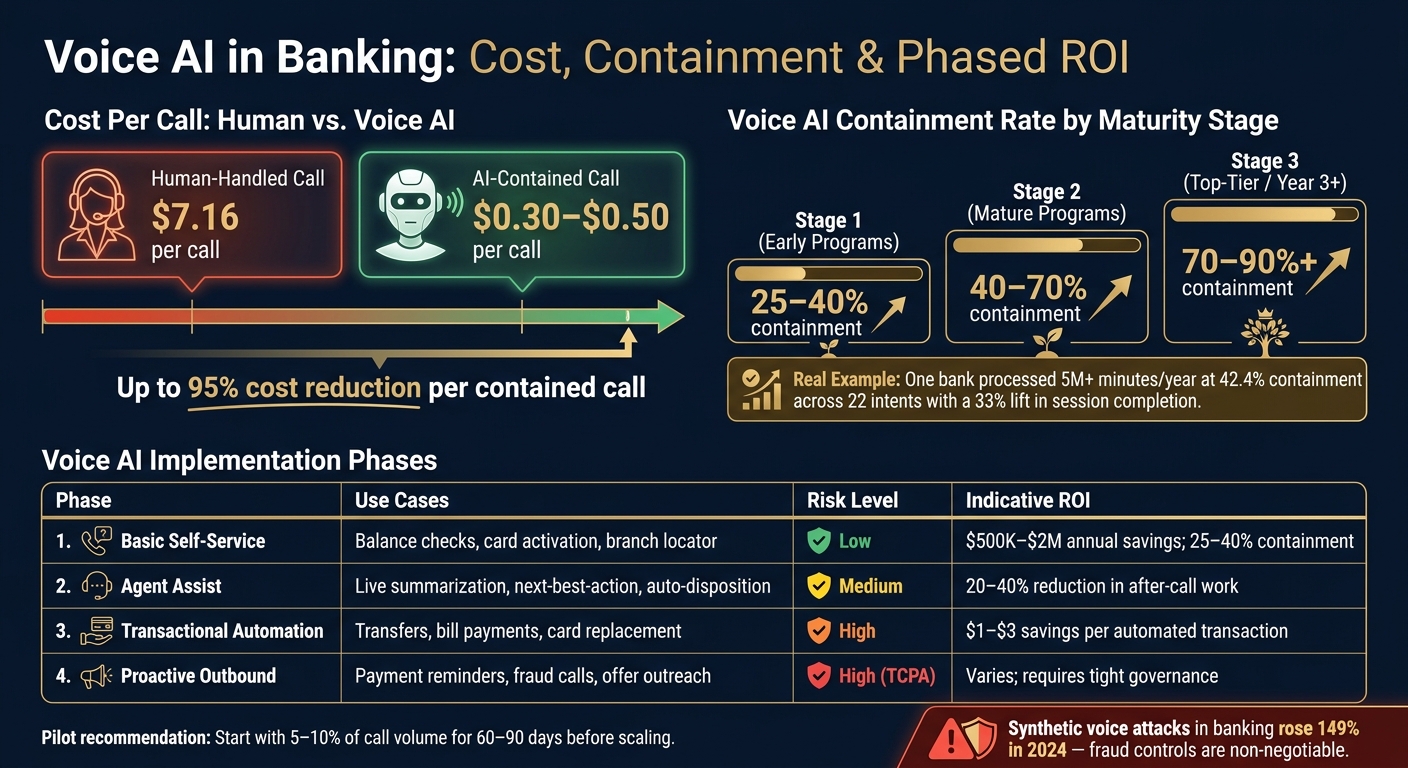
Voice AI in Banking: Cost, Containment & Phased Rollout ROI
Phased Rollout: From Basic Self-Service to Transactional Voice Automation
Roll out Voice AI in stages, starting with low-risk self-service. Each rollout stage should follow the same secure action, consent, and handoff rules already set for production calls. In many pilots, banks start with 5–10% of call volume for 60–90 days before sending more traffic through the system. That window gives the team time to check speech recognition quality, test integration stability, and see how customers respond before moving ahead.
Every phase should carry forward the authentication, logging, consent, and handoff rules defined earlier.
| Phase | Priority Use Cases | Business Objective | Risk Level | Indicative ROI |
|---|---|---|---|---|
| Phase 1: Basic Self-Service | Balance inquiries, card activation, branch/ATM locator, routing number, recent transactions | Deflect 20–40% of high-volume informational calls | Low | $500K–$2M annual savings for mid-size banks; 25–40% containment |
| Phase 2: Agent Assist | Live call summarization, next-best-action suggestions, auto-disposition coding | Reduce after-call work by 20–40%; improve first-call resolution by 5–10 points | Medium | Reduces contact-center labor pressure over time |
| Phase 3: Transactional Automation | Internal funds transfers, bill payments to known payees, card replacement requests, travel notices | Automate 10–20% of simple transactions; maintain fraud loss within existing thresholds | High | $1–$3 savings per automated transaction |
| Phase 4: Proactive Outbound | Payment reminders, fraud confirmation calls, eligible offer outreach | Reduce delinquency rates; improve proactive customer engagement | High (TCPA/consent obligations) | Varies by program; requires tight governance before launch |
The cost gap is hard to ignore. Industry benchmarks put the average human-handled inbound call at about $7.16 per call, while Voice AI contained calls usually cost $0.30–$0.50 per call. Mature programs often reach 40–70% containment, and top-tier programs can hit 70–90%+ by year three.
Cross-Functional Ownership and Continuous Improvement
Once phase one is live, ownership becomes just as important as the build.
Voice AI works best when IT, security, compliance, operations, and CX share responsibility. After launch, each control needs a clear owner so nothing falls through the cracks.
IT handles the platform, integrations, and observability stack. Security sets the authentication approach and reviews any change that affects audio, transcripts, or API access. Compliance maps each use case to approval needs and disclosure rules before launch. Contact center leaders manage routing logic, staffing changes, and handoff steps so agents can quickly see what happened before the call reached them. CX owns conversation design, tone, and satisfaction tracking.
Many banks now set this up through a Voice AI steering committee or a cross-functional product team. That usually includes representation from each function, clear RACI definitions, and regular strategy reviews.
Measurement also needs a steady rhythm. Weekly reviews should track intent containment by use case, error rates, escalation rates, and system health metrics such as speech recognition accuracy and latency. Monthly reviews should focus on cost per interaction, CSAT and NPS trends, and compliance dashboards. If one intent keeps driving complaints or unexpected escalations, it should be redesigned before staying in production.
Conclusion: What Banks Need to Get Right First
The pattern that works is pretty simple: start small, keep risk under control, and expand only when the operating model is steady.
Banks see results when they begin with low-risk calls, build authentication and handoff into every flow, use auditable integrations, and treat Voice AI as an ongoing operating capability.
Custom Voice AI works in banks only when conversation design, core integration, and governance are built together.
For banks that need support with strategy, voice agent design, core banking integration, compliance alignment, or ongoing governance, NAITIVE AI Consulting Agency helps financial institutions design and build Voice AI programs that are measurable, scalable, and audit-ready.
FAQs
How do banks choose the best Voice AI use cases first?
Banks should start with a discovery phase. The goal is simple: review current operations and spot high-volume, low-complexity tasks like password resets, order status questions, and appointment scheduling.
A close look at internal call logs can show which workflows are most likely to deliver the fastest ROI. NAITIVE AI Consulting Agency helps banks zero in on use cases that match business goals, compliance requirements, and the CRM and support tools they already use.
What security controls matter most for banking voice AI?
Banking voice AI needs layered security built around privacy, identity, and system integrity.
- Encrypt data with AES-256 at rest and TLS 1.3 in transit. For PII, use redaction or tokenization.
- Use RBAC, MFA, and voice biometrics to control access and verify users. For sensitive inputs, rely on DTMF instead of spoken responses.
- Keep signed audit logs for six years. Enforce retention policies, and run regular assessments, penetration tests, and a DPIA.
How long does a banking voice AI pilot usually take?
A controlled banking voice AI pilot usually runs for 2 to 4 weeks. During that time, teams fine-tune the system with daily performance checks and A/B testing before rolling it out at full scale.
NAITIVE AI Consulting Agency helps banks design and manage these pilots to improve customer service and day-to-day efficiency.