Kubernetes Security for AI Workloads
Secure AI on Kubernetes: isolate GPUs, enforce default-deny networking, sign models/images, and monitor runtime threats.
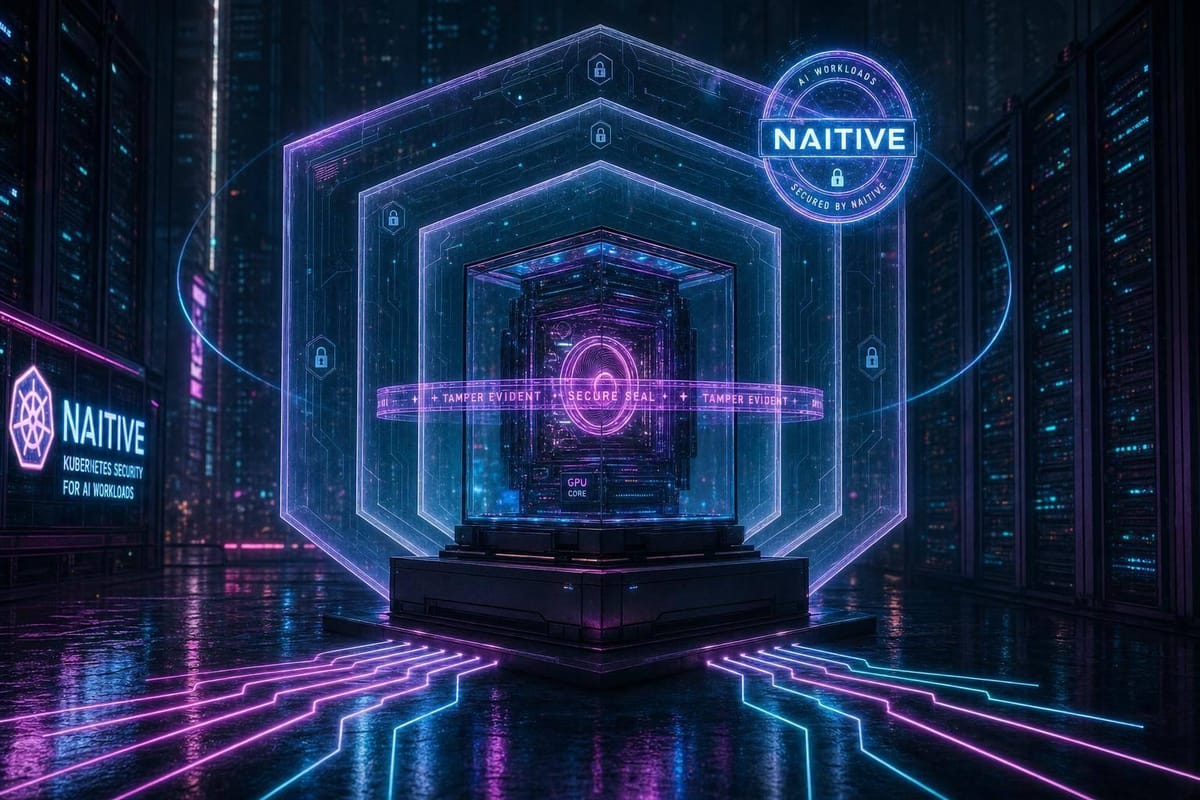
AI on Kubernetes is harder to secure than a normal app. You’re not just locking down APIs and databases. You’re also dealing with model files, training data, GPUs, vector stores, agents, and outside tools that can leak data or run the wrong actions.
If I had to boil this article down, I’d say this: separate every AI workload with NAITIVE AI consulting, block traffic by default, lock down GPU nodes, verify images and model artifacts before deploy, and watch runtime behavior closely. That matters even more for teams that need audit logs, encryption, incident playbooks, and alignment with frameworks like NIST AI RMF 1.0, HIPAA, SOC 2, and PCI.
Here’s the short version:
- Split trust boundaries early with namespaces, service accounts, RBAC, and Pod Security standards
- Treat GPUs like high-risk infrastructure, especially in multi-tenant clusters
- Use default-deny network rules for both ingress and egress
- Keep secrets out of images and env vars when possible; use external secret stores
- Sign and verify container images and model files before they run
- Separate training, evaluation, and serving so one issue does not spread
- Monitor for AI-specific threats like prompt injection, model tampering, data poisoning, odd egress, and GPU cryptomining
- Write incident playbooks for model compromise, secret leaks, agent misuse, and miner activity
A few facts stand out. The article points to OWASP’s Top 10 for LLM Applications, where prompt injection ranks #1. It also notes live attack activity, including cryptomining on Kubernetes ML pipelines using trusted TensorFlow images. And for shared GPU setups, it makes a clear point: hardware partitioning like NVIDIA MIG gives stronger isolation than software-only sharing.
If you run AI workloads in Kubernetes, the message is simple: security has to cover the cluster, the model supply chain, the network, the runtime, and the response plan at the same time.
F5 AI Security for Kubernetes: Guardrails, Red Team, and Remediate
sbb-itb-f123e37
Harden the Cluster Before Deploying AI Workloads
Cluster hardening isn't optional for AI workloads. It's the base layer everything else depends on. Before you run a single training job or ship an inference API to production, you need to lock down the cluster itself across the control plane, nodes, and workload policies. Once the threat model is set, the next step is hardening the cluster layers those workloads rely on.
Control Plane, RBAC, and Admission Policy Baseline
Lock down the control plane, node access, and admission policies before deploying AI workloads.
The API server is the main entry point to the cluster. Limit access to trusted networks or VPNs, enforce TLS, and require strong authentication for every human and machine identity. That can mean OIDC, client certificates, or enterprise SSO. Turn off anonymous access completely, and enable audit logging for control-plane actions so changes to GPU node pools, AI namespaces, and admission policies are traceable.
Etcd is the most sensitive component in the cluster. Turn on encryption at rest by creating an EncryptionConfiguration and pointing kube-apiserver to it with --encryption-provider-config. Use a KMS-backed key management system such as AWS KMS, Google Cloud KMS, or HashiCorp Vault. After the change, restart the API server and rotate keys on a regular schedule to shrink the blast radius if a key is ever compromised.
For RBAC, the default posture should be default deny, grant only least privilege. Platform engineers handle cluster-level resources such as nodes, storage classes, and admission controllers. ML engineers should be limited to namespaced resources like Deployments, Jobs, ConfigMaps, and Secrets inside their assigned AI namespaces. For example, an ai-deployer role might allow create and update on Deployments and Jobs in the ai-serving namespace, while giving zero access to nodes, clusterroles, or cross-namespace actions.
Admission controls are the last policy gate before a bad workload gets a chance to run. Enforce the Restricted Pod Security Standard at the namespace level with Pod Security Admission. This blocks privileged containers, hostPath mounts, host networking, hostPID and hostIPC, plus risky Linux capabilities like SYS_ADMIN, NET_ADMIN, and SYS_MODULE. Require allowPrivilegeEscalation=false, non-root execution, and a defined seccomp profile. AI tools such as Jupyter notebooks and distributed training stacks often ask for elevated privileges out of the box. The fix is simple in concept, even if it takes work: use hardened base images and standard deployment templates that don't ask for those permissions in the first place.
GPU Isolation and Node Security for Multi-Tenant AI
Once the control plane and policy baseline are in place, treat GPU capacity as its own trust tier.
Use dedicated GPU node pools with taints like gpu=true:NoSchedule and matching tolerations, hardened OS images, automatic security patching, and break-glass access only. That way, only workloads with the right tolerations, and only those in approved AI namespaces, can land on GPU nodes. Platform SREs reach those nodes through bastion hosts with MFA. ML engineers should have no direct node access.
For hardware-level tenant isolation, NVIDIA MIG is a strong choice. On supported Ampere-generation GPUs, MIG splits one GPU into isolated instances with dedicated compute and memory. That cuts down GPU memory snooping risk across tenants compared with software-only sharing methods such as time-slicing.
| GPU Isolation Strategy | Security Isolation | Performance Impact | Operational Complexity | Best-Fit AI Scenarios |
|---|---|---|---|---|
| Dedicated GPU nodes per tenant | Strong (node-level) | Near-native | Low | Large-scale training on proprietary or regulated models |
| Shared GPU nodes (time-slicing/MPS) | Weak (software only) | Noisy-neighbor risk | Low | Internal experimentation, low-sensitivity workloads |
| NVIDIA MIG partitioning | Strong (hardware-level) | Slight per-partition overhead, better overall efficiency | Medium-High | Multi-tenant inference APIs, regulated workloads |
| Confidential computing / secure enclaves with GPU support | Strong | Higher overhead | High | Highly regulated workloads with sensitive data |
For production multi-tenant or regulated setups, MIG should be the baseline over time-slicing or MPS.
Zero-Trust Cluster Design for Sensitive AI Environments
After node isolation, lock down east-west traffic inside the cluster so tenants can't move laterally.
Apply default-deny network policies on both ingress and egress for every AI namespace. Then add explicit allow rules for only the service-to-service and DNS flows you need. Tenant-specific resource quotas for CPU, memory, GPU, storage, and object counts stop any one AI workload from eating up shared cluster capacity. A simple rule works well here: one workload, one service account, one namespace, least privilege. Never reuse a high-privilege service account across tenants.
For workloads that handle U.S. regulated data such as PII, financial records, or health information, go further with confidential computing. Platforms like Intel TDX and AMD SEV-SNP encrypt workload memory so even a compromised hypervisor or node operator can't read it. Hardware attestation then cryptographically checks that a node is running approved, untampered software before a sensitive pod is admitted. In Kubernetes, this ties into admission controllers or external policy engines that allow pods only onto attested confidential nodes, with labels and taints making sure regulated workloads never land on standard infrastructure. Attestation logs, paired with formal data-handling policies, directly support HIPAA and GLBA compliance audits.
Secure Models, Pipelines, and Runtime Behavior
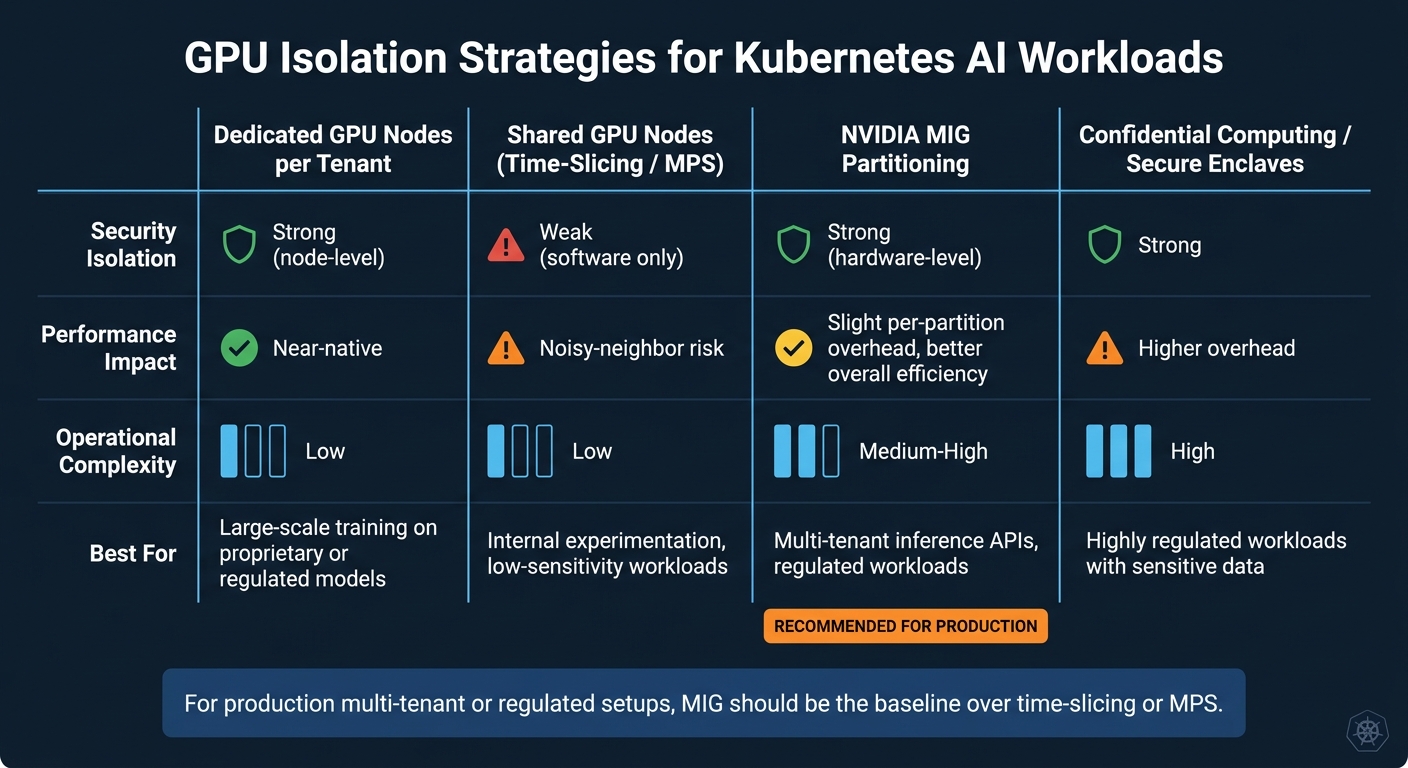
GPU Isolation Strategies for Kubernetes AI Workloads: Security vs. Complexity
Once the cluster is locked down and GPU nodes are kept separate, the next problem moves inside the workloads. That’s where model files, training data, and serving containers can slip in malicious images, poisoned model files, or changed dataset artifacts that sail right past network defenses.
Image and Model Artifact Supply Chain Controls
AI supply chains carry a lot of risk because model artifacts can be altered before they ever reach Kubernetes.
Treat model weights, checkpoints, and serialized model files as controlled artifacts. Store .pt, .safetensors, and .onnx files in a dedicated model registry or object store with tight access rules, encryption at rest, and audit logging. Log every read and write. If someone starts pulling large volumes of artifacts after hours, that should trip an alert.
Sign images and model bundles, then verify those signatures at admission. Use Sigstore Cosign or Notary v2 to sign container images and model bundles during the build process, then enforce signature and issuer checks through Kyverno or OPA/Gatekeeper before any pod starts. Pin images to SHA-256 digests instead of mutable tags. In plain terms, use image: my-ai-service@sha256:… instead of :latest. Admission policies should reject any pod that still points to a mutable tag. Generate SBOMs for container images and AI-BOMs for models and datasets, and record versions, sources, licenses, and known vulnerabilities to support SOC 2 and ISO 27001 evidence needs.
Avoid Python pickle when loading untrusted models. It remains a common path for object injection attacks in ML pipelines. Safer choices include non-executable formats like Safetensors or ONNX. When loading PyTorch checkpoints, use weights_only=True. That said, don’t treat that setting like a magic shield. Research shows that even weights_only protections can weaken as frameworks change, so you need to re-check your loading assumptions whenever you upgrade ML libraries.
Once you control artifact origin and integrity, the next step is simple: keep pipeline stages apart so one bad event doesn’t spread everywhere.
Isolate Training, Evaluation, and Serving with Least Privilege
Split training, evaluation, and serving into separate namespaces. Give each one its own service accounts, RBAC rules, quotas, and network policies. Each stage should have only the access it needs for its own job.
A training job should read only from approved training data buckets and write only to model registry output paths. It should have zero access to production API secrets, customer data, or the serving namespace. On the other side, a serving pod should read only approved, validated model versions. It should never write back to training data or publish new model versions into the registry.
Training egress should be limited to approved internal endpoints only, such as object storage, internal data APIs, and approved package mirrors. Never let training containers run pip install from the public internet at runtime. Inbound datasets should pass through approved ETL pipelines that log source systems, transformations, and checksums. That matters because studies on data poisoning show that poisoned samples are often built to blend in with normal data and dodge basic anomaly checks. If you can’t trace where the data came from and what happened to it, you’re flying blind.
That separation also makes runtime monitoring far more useful, because it gives you a clean baseline for what each stage is supposed to do.
Runtime Detection for AI-Specific Threats
Even tightly controlled pipelines still need runtime detection. Attackers go after the space between build-time checks and live execution. Stolen credentials and zero-day flaws can still place malicious workloads in the cluster. AI clusters with GPUs are a prime target. Microsoft reported a cryptomining campaign that abused Kubeflow ML pipelines and legitimate TensorFlow images, including tensorflow/tensorflow:latest and tensorflow/tensorflow:latest-gpu, to deploy Monero miners on Kubernetes clusters. The attack worked because the pipelines were misconfigured and no one was watching runtime behavior closely enough.
In AI environments, the main threats worth tracking include GPU cryptomining, unsafe deserialization, abnormal egress, and agent tool abuse. These aren’t things generic runtime tools handle well out of the box.
Use layers, not a single tool. In practice, AI attacks often leave clues in process activity, GPU usage, and network traffic all at once.
| Tool / Approach | Detection Coverage | AI-Specific Rule Support | Kubernetes Fit | Ops Cost |
|---|---|---|---|---|
| Falco-based tools | Strong syscall and process monitoring; limited native GPU awareness | Custom rules for ML behaviors such as unusual Python processes and deserialization; requires manual authoring | Native DaemonSet; rules via ConfigMaps; integrates with Kubernetes audit logs | Moderate; open source but rule tuning effort is non-trivial |
| Commercial CNAPP platforms | Broad coverage across processes, network flows, and sometimes container-level GPU usage via integrations | Growing AI/ML detection packs; can ingest GPU metrics and framework logs | Deep Kubernetes integration with namespaces, labels, RBAC, and cloud provider APIs | Higher: licensing cost and agent deployment, with managed onboarding and support |
| GPU telemetry + SIEM correlation | Strong GPU utilization visibility; limited direct syscall coverage without additional agents | Custom correlation rules for abnormal GPU use, cryptomining patterns, or out-of-schedule training | Standard Kubernetes monitoring stack; alerts into SIEM/SOAR | Lower agent complexity; higher engineering effort to build and maintain detection logic |
| Service mesh + network observability | Strong network-level detection of suspicious egress/ingress and API misuse; no process or GPU coverage | Enforces and observes AI API call patterns; detects agent tool abuse via unusual outbound flows | Tight Kubernetes integration; policies as CRDs; deployed cluster-wide | Moderate; requires mesh or CNI expertise; provides broad network control |
The strongest setup usually combines a runtime sensor, such as Falco or a CNAPP platform, with GPU telemetry and network observability. Then tune detection rules to the AI stack you actually run, whether that’s PyTorch, TensorFlow, or LLM serving frameworks. Pair alerts with clear runbooks that include workload context like model name, pipeline owner, and expected behavior. That way, the on-call engineer doesn’t have to guess whether a GPU spike is a normal training job or the start of an incident.
Protect Network Paths, Identities, and Data in AI Services
If you want to limit attacker movement, you need tight control over pod traffic, identity, and data flow. The goal is simple: each AI service should talk only to the systems it needs, use only the access it needs, and handle data in ways you can track and control.
Default-Deny Network Policy for AI Namespaces
Start by mapping the traffic you actually need, then lock things down around that map.
Build a traffic map that shows:
- which pods expose model inference APIs
- which services query vector databases
- which components send telemetry to Prometheus or OpenTelemetry collectors
- which pods need outbound access to external APIs
That map becomes your allowlist. Everything else gets blocked.
From there, turn the map into narrow allow rules by namespace and label. For example, a RAG backend may need ingress only from the API gateway namespace, egress only to the vector database service on one port, and outbound HTTPS only to one approved object store endpoint. If that RAG pod gets popped, it has nowhere else to go.
Labels such as role=model-api, role=rag-backend, and role=telemetry make these flow rules easier to define and manage. Paired with an egress gateway or service-mesh egress policy, this helps stop AI workloads from making odd outbound calls that could leak embeddings or training data.
That allowlist should then act as the baseline for ingress, egress, and service-mesh policy.
RBAC, Workload Identity, and Secrets Handling
Each AI component should have its own service account. Don't share the default account, and don't hand out more permission than a workload needs for its job.
Turn off automountServiceAccountToken for pods that don't need to call the Kubernetes API. If a pod does need API access, use projected service account tokens with short expiration times and audience limits. The kubelet rotates these tokens on its own, which cuts down the time a stolen token can be used. In AI systems, that matters a lot, because a stolen token can lead to model theft, dataset access, or agent misuse.
Keep credentials out of pod images and out of environment variables. Instead, use an external secrets operator to pull them from a secure store like HashiCorp Vault or a cloud-native secret manager, then inject them at runtime.
This matters even more for AI workloads that call external APIs. Autonomous agents handling financial transactions or other privileged actions should get short-lived, scoped tokens with automatic rotation, not static API keys sitting around forever. In regulated or high-risk setups, pair service-mesh mTLS with an external secret manager so you can tie cryptographic workload identity to centralized secret storage.
Those identities and secrets should then be enforced at the network and ingress layers.
Encryption, Ingress Protection, and AI API Abuse Controls
Encrypt data in transit across the board. A service mesh in STRICT mTLS mode handles east-west encryption for you, issuing short-lived X.509 certificates to each workload without code changes in the app.
At the ingress layer, enforce TLS 1.2 or 1.3, keep the cipher suite tight, renew certificates automatically, and use strict host and path-based routing. For outbound calls to external APIs, validate certificates and block downgraded connections.
Data at rest needs the same level of care. Persistent volumes, vector database storage, and model artifact registries should use disk-level encryption backed by a centralized key management service. AES-256 is the baseline.
At the ingress controller, add request authentication with OAuth2 or JWT, apply per-client rate limits, and check that requests match expected schemas and size limits. OWASP's Top 10 for LLM Applications lists prompt injection as the number-one LLM risk.
That means you need to inspect prompts for attempts to override system instructions, pull out internal context, or slip past safety controls. Log both accepted and rejected requests so anomaly detection can adjust as attack patterns change.
For autonomous agents that trigger high-risk actions, add stronger authentication at the moment of action. Also enforce strict output controls so the model can't return internal system details, raw database records, or content that breaks data-handling policy.
These controls should then feed directly into governance, monitoring, and incident-response playbooks.
Governance and a Production Security Roadmap
Controls don’t stay in place on their own. Over time, RBAC drifts, NetworkPolicies get worked around, and GPU nodes start carrying workloads nobody signed off on. That’s the job of governance: keeping your security setup from slowly coming apart in production.
A Phased Trust Model for Production AI Workloads
Not every AI workload needs the same level of scrutiny from day one. A practical way to handle this is simple: match controls to the workload’s risk and maturity, then tighten those controls as the workload moves closer to production. Once you have the baseline in place, spell out exactly when each control stops being optional and becomes required.
| Phase | Security Controls | Workload Types Allowed | Monitoring Depth | Governance Requirements |
|---|---|---|---|---|
| Prototype | Light policy, no production data, informal review | Experimental models, internal sandboxes | Basic logs, manual reviews | Informal team rules; no production data |
| Hardened Production | Strict per-workload RBAC, default-deny NetworkPolicies, signed images and model artifacts, mandatory TLS for service-to-service communication | Customer-facing AI services, fine-tuned models | Centralized audit logs, GPU metrics, anomalous request pattern detection | CIS benchmark alignment, documented threat model, deployment review gate |
| Governed Enterprise | Policy-as-code (OPA/Gatekeeper or Kyverno), mandatory signing and attestation of images and model artifacts, per-tenant namespaces or virtual clusters, GPU quotas via ResourceQuota | Autonomous agents, voice agents, regulated data pipelines, multi-tenant AI services | Full SIEM integration, behavioral baselines, GPU cryptomining detection, model safety telemetry | Quarterly access recertification, risk reviews, security SLAs, change control |
The move to production should be a formal gate, not a casual handoff. That means a reviewed threat model, verified controls, confirmed data classification, and RBAC scoped to service accounts. If those pieces aren’t in place, the workload isn’t ready.
Continuous Compliance, Observability, and Incident Response
Compliance in production can’t be a one-time check at cluster setup. CIS Kubernetes Benchmark checks need to run continuously. Tools like Kyverno or OPA/Gatekeeper can stop policy violations at admission, which is often the cleanest place to block bad changes before they land. On top of that, RBAC, NetworkPolicies, and secrets should be reviewed every quarter so privilege creep and drift don’t slip by.
Centralized logging is required in production. Kubernetes audit logs, container runtime events, and GPU utilization metrics should all feed into a SIEM so detection rules can connect the dots across signals. AI telemetry matters here too. The model version in use, blocked prompts, agent action logs, and admission controller denials shouldn’t sit off to the side. They belong in the same security view as the rest of your signals.
When something trips an alert, responders need playbooks built for the AI-specific failure mode in front of them. A generic Kubernetes incident guide won’t cut it. AI workloads need four dedicated playbooks, each with direct containment steps and clear communication paths:
- Model compromise: isolate the affected deployment, verify against signed baselines, roll back to a known-good version, and audit CI/CD logs for supply-chain tampering.
- Secret leakage: rotate all affected credentials at once, invalidate old tokens, identify affected workloads, and scan logs for unauthorized data access.
- Agent misuse: disable the agent through config or NetworkPolicy, block specific external endpoints through the service mesh, review the full audit trail of agent actions, and add human-in-the-loop approval gates before turning it back on.
- GPU cryptomining: cordon and drain affected nodes, terminate offending pods, scan images for unauthorized workloads, and tighten admission controls on GPU node pools.
Each playbook should feed lessons learned back into RBAC, NetworkPolicies, admission rules, and observability dashboards. Otherwise, teams end up fighting the same fire twice.
Conclusion: The Controls That Matter Most
Governance is what keeps the earlier layers doing their job: harden the cluster, isolate workloads, secure the supply chain, monitor behavior, and rehearse response. Each layer leans on the one before it. Skip cluster hardening, and the rest of the controls sit on weak ground. Skip incident response, and even a locked-down cluster can still fail badly when something breaks.
FAQs
Why are AI workloads harder to secure on Kubernetes?
AI workloads are tougher to secure on Kubernetes because they’re spread across many moving parts. That means more places to attack and a higher chance that one weak point can trigger failures elsewhere.
On top of that, their behavior isn’t always easy to predict. So security needs tight guardrails from the start: least-privilege identities, default-deny networking, and controlled outbound tool usage. Since these systems also rely on constant monitoring and frequent updates, security drift can creep in over time.
When should teams use NVIDIA MIG instead of shared GPUs?
Use NVIDIA MIG when you want to split one physical GPU across multiple workloads at a lower cost. Compared with time-slicing, it gives you stronger hardware isolation and more predictable latency.
It works best when several workloads don’t need an entire GPU on their own. If one workload has steady, high demand and needs top throughput, give it a dedicated full GPU instead.
What should be secured first: the cluster, the model, or the runtime?
None should come first on its own. Securing AI workloads in Kubernetes calls for a layered, defense-in-depth approach across the cluster, runtime, and model.
Start with identity and network boundaries: use least-privilege RBAC, isolated containers, and mutual TLS. At the same time, lock down models and container settings to cut the risk of tampering.