
Reducing AI Carbon Output: Framework
Measure full AI workloads, set enforceable carbon budgets, optimize builds and production, and enforce delivery rules to cut CO₂e.

Reducing AI emissions starts with measuring the whole workload - not just model training. Track electricity use, monthly kg CO₂e, and g CO₂e per 1,000 successful tasks. Count failed attempts, retries, supporting services, and each workload’s share of hardware manufacturing emissions.
This framework turns those measurements into delivery rules:
- Establish a baseline with NAITIVE AI Consulting: Define the task, measurement scope, data gaps, and owners.
- Set carbon budgets: Compare rules, smaller models, and deployment options against quality, safety, and latency limits.
- Cut build emissions: Cap experiments, shut down idle resources, and test energy savings on the target hardware.
- Control production emissions: Reduce repeated work, limit agent loops, and monitor both total emissions and emissions per completed task.
- Enforce delivery rules: Require approval records, supplier data, reporting, and time-limited exceptions.
The test is simple: lower emissions for the required outcome, without trading away quality or safety. Lower emissions per task alone are not enough if growing demand pushes the total higher.
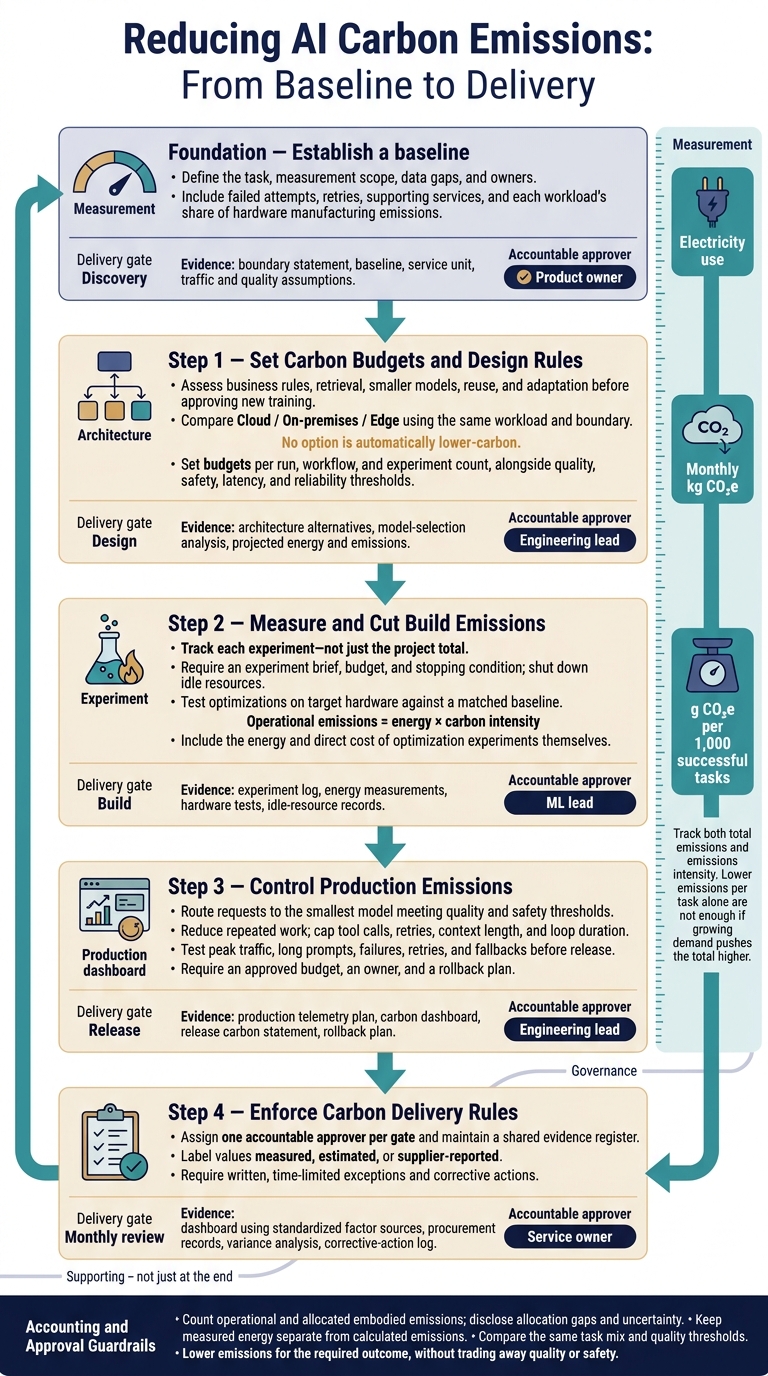
Reducing AI Carbon Emissions: From Baseline to Delivery
How to give AI a BAD Carbon Footprint - Dave Patterson (Turing Award Winner)
sbb-itb-f123e37
Step 1: Set Carbon Budgets and Design Rules
Treat carbon as a nonfunctional requirement alongside security and availability. Use the baseline, business needs, and expected demand to set enforceable budgets per run, workflow, and experiment count for consulting delivery. Pair them with quality, safety, latency, and reliability thresholds. Let these limits guide model choice before building starts.
Match Models and Workflows to the Task
Start with business rules when they can replace the AI use case. Then assess retrieval, smaller models, reuse, and adaptation before approving new training. Cap context size, response length, retries, and tool calls. Allow caching only when data freshness, privacy, and authorization requirements permit it. Compare deployment options using lifecycle estimates - not electricity savings alone.
Use this decision aid in consulting architecture reviews:
| Placement | Boundary | Energy inputs | Embodied emissions | Service constraints |
|---|---|---|---|---|
| Cloud | Model execution, provider overhead, storage, networking, and allocated shared infrastructure | Compute, memory, storage, cooling, networking, and relevant PUE | Allocate provider hardware emissions over expected useful life and workload share | Region selection, data residency, provider transparency, quotas, latency, portability |
| On-premises | Servers, accelerators, networking, storage, cooling, facility overhead, and idle capacity | Measured facility and device electricity, including cooling and power losses | Allocate purchase and manufacturing emissions across hardware life, utilization, and workloads | Capital cost, utilization, staffing, resilience, maintenance, electricity supply |
| Edge | Device inference, local storage, communications, and replacement or charging infrastructure | Device power, battery or charging energy, networking, and any centralized coordination | Allocate device manufacturing and replacement emissions over expected service life and usage | Battery, thermal limits, intermittent connectivity, privacy, updateability, local latency |
Use these comparisons to set the carbon and quality limits you’ll test against.
Check Designs Against Carbon and Quality Limits
Compare cloud, on-premises, and edge options using the same workload and boundary. No option is automatically lower-carbon. Estimate energy use, energy-related emissions, and allocated embodied emissions under normal and peak demand. The budget per successful task must include failed attempts, retries, supporting services, and allocated training and evaluation emissions. Report an uncertainty range rather than a single precise estimate.
Set a draft carbon budget per successful workflow. Before approval, validate it against measured performance.
Require an architecture decision record as a consulting deliverable before design approval. It must document projected demand, energy and emissions estimates, uncertainty, and evidence for every mandatory threshold. It must also explain why larger models are needed instead of rules, retrieval, caching, or smaller models.
Approve a design only when evidence shows it can meet every mandatory limit. Give each measurement gap an owner and a validation plan, then carry the approved limits into build-time measurement and optimization.
Step 2: Measure and Cut Build Emissions
Use the approved carbon budget to guide every experiment, checkpoint, and build run. Track each experiment - not just the project total. Log the run ID, owner, dataset and code versions, model version, hardware, runtime, location, energy use, emissions, and quality scores. Calculate operational emissions as energy × carbon intensity, using the approved boundary method. Keep estimated and measured energy clearly labeled, and include allocated hardware emissions when the approved boundary requires them.
Limit Experiments and Shut Down Idle Resources
No experiment brief, no compute. Each brief needs an owner, hypothesis, expected decision, baseline, target metric, maximum runtime or budget, and stopping condition. Start with stratified subsets that preserve the production distribution and edge cases. Scale up only after the pilot passes. Stop runs when validation quality plateaus, diverges, crosses a safety threshold, or fails to beat the baseline after a predefined number of evaluations. Record which decision each result will support.
Reuse preprocessing outputs, checkpoints, and evaluation results only when inputs and versions still match. Set automatic shutdowns for idle virtual machines, unattached accelerators, notebooks, queues, and development clusters. Add maximum wall-clock times and retry limits.
Before adding accelerators, investigate low utilization. Slow data loading, synchronization barriers, small batches, repeated checkpointing, CPU bottlenecks, and network storage can all waste capacity. Delete duplicate checkpoints, temporary logs, obsolete images, and unused datasets under retention rules that protect the artifacts needed to reproduce results. Track energy or emissions per accepted result, failed-run percentage, and idle accelerator time.
Schedule flexible jobs in lower-carbon windows only when deadlines, security, and residency rules allow it. Record the region, emissions-factor source, forecast window, actual start time, scheduling assumptions, and delay. Compare total emissions, including transfers and any longer runtime - not just the lower grid emissions factor. Keep location-based grid factors separate from market-based procurement figures.
Once waste is under control, test only changes that could lower measured energy use or runtime on the actual stack.
Test Optimization on Target Hardware
Measure the baseline first. Use the methods below only when tests on the target hardware can verify savings.
| Technique | Potential gains | Quality risk | Effort | Measurement method |
|---|---|---|---|---|
| Quantization | Lower memory use and possibly less computation | Accuracy loss or numerical instability | Medium | Compare energy, runtime, and quality by evaluation slice against the full-precision baseline |
| Pruning | Fewer operations when hardware supports sparsity | Lost capability; little actual speedup | Medium–high | Measure target-hardware energy and latency, not parameter count |
| Distillation | Smaller model with lower per-task demand | Weaker capabilities or safety behavior | High | Include teacher-generated data, student training, and per-task energy |
| Parameter-efficient adaptation | Less fine-tuning memory and compute | Reduced adaptation quality or serving compatibility | Low–medium | Compare adaptation energy, quality change, and serving overhead |
| Dataset reduction | Less preprocessing and training | Missing rare cases or subgroup coverage | Medium | Test aggregate, subgroup, and stress-test quality |
| Carbon-aware scheduling | Lower emissions from flexible work | Delays or infrastructure changes affecting reliability | Low–medium | Compare timestamped energy and emissions, including transfers and delays |
Rerun the baseline and optimized versions on the same target hardware and stack. Match batch settings, evaluation data, prompts, scoring code, and seeds. Repeat noisy measurements.
The build-approval record must show budget and threshold compliance, latency, reliability, hardware, duration, location, and emissions assumptions. Include the energy and direct cost of the optimization experiments themselves; a lengthy efficiency search can use more energy than it saves. Approve only changes that reduce measured impact and still meet every mandatory release threshold.
Step 3: Control Production Emissions
Use the approved build budget as a firm limit in production. Set two limits: monthly kg CO₂e and g CO₂e per successful task. Forecast traffic by workflow, model, region, input size, output length, time of day, and expected success rate. Combine those volumes with production energy telemetry and timestamped, region-specific grid factors. Include hosts, idle and failover capacity, storage, and networking - not just accelerators. Review both limits monthly, and take corrective action when forecasts predict an overrun.
Use these limits to guide routing, caching, scaling, and escalation.
Reduce Computation per Successful Task
Route each request to the smallest model that meets quality and safety thresholds. Escalate only when needed. Cut repeated work with prompt and retrieval caching, deduplicated context, response limits, and batching that stays within latency limits. Set cache expiration and access rules so savings don’t come at the cost of stale answers or exposed private data. Tune autoscaling to cut idle capacity while keeping required failover coverage.
For autonomous and voice agents, cap tool calls, retries, context length, and loop duration. Define a clear path for human escalation. Track speech recognition, generation, tool use, and speech synthesis separately, including interrupted turns.
Measure emissions against successful outcomes, not model calls. Include failed attempts, fallbacks, and human rework in workflow emissions before dividing by successful outcomes. Report emissions per request alongside emissions per resolved case or completed call.
Verify Carbon Performance Before Release
Require an approved budget, an owner, and a rollback plan before release. Test actual traffic patterns, including peak concurrency, long prompts, tool failures, retries, and fallbacks. Release evidence must show energy and CO₂e per successful task, success rate, safety, p95 latency, errors, and fallback rates against validated thresholds. Monitor these measures alongside requests, tokens, utilization, region, and grid intensity. Label estimates and uncertainty, and keep sensitive prompt content out of dashboards.
Set alerts for projected budget overruns, declining task efficiency, and spikes in retries or fallbacks. Assign corrective actions, such as tightening context, disabling inefficient features, or queuing nonurgent work.
Assess time shifts and regional routing against their total impact within the approved boundary. Never override privacy, residency, resilience, regulatory, or latency requirements. Report energy reduction and location-based emissions separately. A lower market-based footprint does not prove that a workload used less electricity.
Step 4: Enforce Carbon Delivery Rules
Once design and production controls are set, tie them to approval gates, exceptions, and delivery records. This makes carbon targets enforceable.
Assign one accountable approver per gate. Product owns the service unit and budget; engineering owns design decisions and experiment logs; platform owns telemetry; sustainability owns accounting methods; procurement keeps supplier disclosures and contract records; and risk reviews exceptions and unsupported claims. Together, these owners connect measurement to approval. Link their records in a shared evidence register so every reported figure can be traced to its source and approval.
Set Review, Exception, and Reporting Rules
Require a carbon impact statement at architecture approval, production release, and any material change to models, data, regions, or infrastructure. Record the boundary, configuration, expected volume, measurement method, emissions factor, geography, emissions estimate, intensity per successful task, quality and latency results, and approving owner. Architecture statements compare options. Change statements document the difference from the approved baseline.
Label every value as measured, estimated, or supplier-reported. Include its source, date, period, geography, factor version, allocation method, uncertainty, and reviewer. Keep measured energy separate from calculated emissions. If boundaries or methods change, version the baseline and retain both original and restated comparisons. Report offsets separately from operational reductions.
Require written, time-limited exceptions. Each must record the unmet requirement, variance, reason, alternatives considered, mitigation plan, owner, approver, review date, expiration date, and corrective-action trigger. Set escalation thresholds in advance:
For example, review when projected emissions exceed the budget by more than 10%, or when a model change increases emissions per successful task by more than 20%.
Treat these thresholds as local controls, not universal standards. Expired exceptions should close automatically or require renewed approval.
Add Carbon Requirements to Consulting Deliverables
Include the boundary, baseline, budgets, quality limits, telemetry, reporting schedule, evidence-retention period, owners, and handoff duties in the statement of work and acceptance checklist. Require supporting records - not just recommendations - and prohibit unsupported carbon-neutral claims. Apply these requirements to AI design, autonomous agents, voice agents, AI automation, and business-process automation engagements.
Use the same evidence register at every delivery gate. Each gate is an approval point tied to carbon limits, supporting records, and documented exceptions.
| Delivery gate | Required records | Acceptance criteria | Accountable approver |
|---|---|---|---|
| Discovery | Boundary statement, baseline, service unit, traffic and quality assumptions | Scope, units, data sources, and budget are documented | Product owner |
| Design | Architecture alternatives, model-selection analysis, projected energy and emissions | Selected design meets carbon, quality, latency, privacy, and cost limits, or has an approved exception | Engineering lead |
| Build | Experiment log, energy measurements, hardware tests, idle-resource records | Experiments identify the quality-versus-emissions tradeoff; unused resources are shut down; measurements are reproducible | ML lead |
| Release | Production telemetry plan, carbon dashboard, release carbon statement, rollback plan | Monitoring is live, alerts are set, evidence is stored, and release values stay within limits | Engineering lead |
| Monthly review | Dashboard using standardized factor sources, procurement records, variance analysis, corrective-action log | Review absolute and intensity metrics, document factor or boundary changes, and close or renew exceptions | Service owner |
Conclusion: Put the Framework Into Practice
Lower emissions per task don’t guarantee lower total emissions. Growing demand can cancel out efficiency gains. Track monthly kg CO2e alongside g CO2e per successful task.
Report operational and embodied emissions together. If attribution is incomplete, explain the gap and publish low, central, and high estimates.
For consulting delivery, follow the framework in order: establish baselines, set budgets, apply design rules, add measurement tools during build and production, optimize measured hotspots, verify comparable results, and enforce governance reviews. Compare the same task mix and quality thresholds before claiming improvement. The test is lower impact for the required outcome, not less energy per operation.
FAQs
How do I set a realistic AI carbon budget?
Measure energy use in kWh, then calculate baseline emissions by multiplying total energy use by your electricity grid’s regional carbon intensity. Keep workloads, datasets, and batch sizes consistent so comparisons hold up.
Make carbon goals part of your delivery rules. Budget for validation, scaling, and regular optimization. Use lightweight models for simpler tasks, match hardware to each workload, and choose lower-carbon data centers. Audit energy use and emissions regularly to check that they stay within your thresholds.
How can I estimate emissions with incomplete supplier data?
If supplier data is incomplete, estimate emissions by multiplying energy use (kWh) by the global average carbon intensity of 475 gCO2eq/kWh. Track energy use and multiply it by your data center’s Power Usage Effectiveness (PUE) to account for facility overhead.
When available, use marginal carbon intensity data instead of regional averages. This better reflects the energy sources activated by your workload.
When do optimization savings outweigh their carbon cost?
Optimization savings outweigh their carbon cost when better performance or lower energy use adds enough business value to justify the carbon impact. To assess that trade-off, compare energy use and carbon emissions with performance metrics, such as accuracy or F1 score.
The Scalar Carbon-Aware Score can help make this comparison clearer. If an optimization strategy adds no measurable business value, stop pursuing it.