
AI Ethics Officer Career Path and Certs
AI ethics officers need experience, a governance portfolio, and targeted certs—not just credentials.

You don’t need one required certification to become an AI ethics officer. I recommend starting with a small AI review project that builds on your current work - then choosing training to fill specific gaps.
Here’s the path I’d follow:
- Use your background. Privacy, security, audit, law, policy, data science, and product work can all lead into AI governance.
- Show your work. Build a sanitized portfolio with an AI inventory, risk assessment, vendor review, and monitoring plan.
- Choose training by need. Consider AIGP for AI governance, CIPP/US for U.S. privacy, and CISSP for security. NIST AI RMF has 4 functions to guide risk work; ISO/IEC 42001 addresses AI management systems.
- Learn who decides. Know who approves deployment, accepts remaining risk, pauses a system, and handles incidents through retirement.
My bottom line: credentials support your career; they don’t replace experience. <u>Practice making and documenting risk decisions</u> - and look for roles with clear authority, reporting lines, and support.
Career Paths Into AI Ethics and Governance
Entry Routes by Professional Background
Start with a task your experience prepares you to handle - not company-wide policy ownership. Treat skill gaps as learning priorities, not reasons to rule yourself out. Work on them through a small, defined project, focused coursework, or collaboration with technical and legal specialists.
Choose a path that uses your strengths while helping you close one or two specific gaps.
| Background | Transferable skills | Gaps to close | First assignment | Target roles |
|---|---|---|---|---|
| Privacy | Data governance, impact assessments, regulatory analysis | Model development, AI testing, lifecycle monitoring | Add AI questions to a privacy assessment | AI governance analyst, responsible AI specialist |
| Cybersecurity | Threat modeling, controls, incident response, vendor risk | Fairness, explainability, model performance | Threat-model an AI application | AI risk analyst, AI security governance specialist |
| Audit or compliance | Control design, testing, evidence, remediation | AI system behavior and technical evaluation | Test an AI approval control | AI compliance analyst, model risk specialist |
| Data science | Statistics, experimentation, model evaluation | Policy interpretation, legal risk, stakeholder governance | Produce a model card and evaluation plan | Responsible AI analyst, model risk analyst |
| Product management | Roadmaps, requirements, prioritization, cross-functional delivery | Formal risk frameworks and regulatory obligations | Add governance gates to a product lifecycle | AI product governance manager, responsible AI product lead |
| Law | Contracting, legal research, liability, regulatory interpretation | Technical architecture and model testing | Review AI vendor terms and accountability clauses | AI legal counsel, AI policy lead, governance manager |
| Public policy | Stakeholder analysis, policy design, public-interest assessment | Operational controls and technical implementation | Draft an internal AI policy with enforcement procedures | AI policy analyst, responsible AI program manager |
Qualifications and Career Progression
No single degree is required. Common backgrounds include computer science, statistics, cybersecurity, law, public policy, business, philosophy, and sociology. Advanced technical study helps with independent model evaluation. Legal education helps with complex regulatory and contracting work, while graduate policy study can support strategy roles.
Choose credentials that address a specific gap. The IAPP’s AIGP covers AI foundations, laws and standards, lifecycle governance, and responsible management.
Career growth should bring more decision authority, moving from review support to ownership of how governance works:
- An analyst or specialist carries out reviews and escalates exceptions. A responsible AI lead sets review standards, coordinates technical and legal reviews, and recommends risk treatments.
- A governance manager runs intake, approval, monitoring, training, and issue-remediation processes across teams. A head of AI governance sets the enterprise operating model, assigns accountability, reports material risks to executives or the board, approves exceptions within delegated authority, and measures program effectiveness.
To advance, show that you can run a process, resolve disagreements across teams, and document risk decisions - not just write policy. Evidence matters more than job titles alone.
Building a Governance Portfolio
Build a portfolio of sanitized work or clearly labeled hypothetical projects that shows how you would handle intake and reviews. Include a use-case intake form, risk assessment, vendor checklist, model or system card, human-oversight plan, monitoring dashboard, and incident procedure.
For each artifact, record the owner, required evidence, review frequency, approval conditions, and escalation route. Label its connection to NIST AI RMF functions such as Govern, Map, Measure, and Manage. Also map it to ISO/IEC 42001 responsibilities, documented processes, monitoring, and improvement. Do not present the portfolio as certification.
Where evidence exists, measure review turnaround time, required controls supported by evidence, vendor-documentation completeness, and remediation completed by the due date. State the baseline, measurement period, calculation, and limitations. For hypothetical work, explain the measurement method and label results:
“not measured.”
Show why mitigation was needed, who had authority to approve it, and how you would verify closure. These details demonstrate judgment without invented success claims and provide proof of your approach to intake, review, monitoring, and escalation.
sbb-itb-f123e37
AI Governance Careers: Certifications vs. Real Experience (What Gets You Hired)
Daily Work and Team Accountability
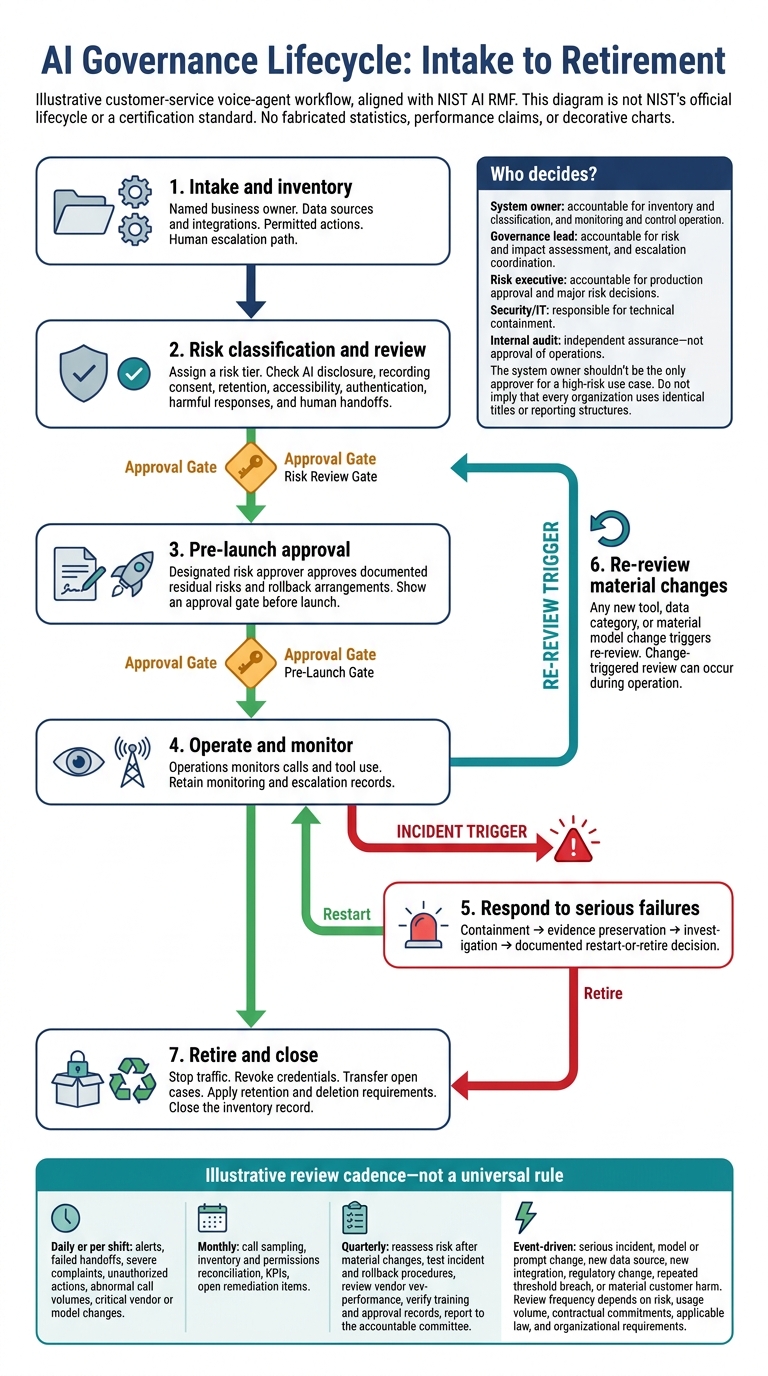
AI Governance Lifecycle: Intake to Retirement
The AI Lifecycle: Intake to Retirement
Once the portfolio is in place, the work shifts to daily review, escalation, and retirement. Governance starts at intake and keeps each use case under control until it’s retired.
A customer-service voice agent enters the inventory with a named business owner, data sources, integrations, permitted actions, and a human escalation path. Reviewers assign a risk tier, then check AI disclosure, recording consent, retention, accessibility, authentication, harmful responses, and human handoffs. Before launch, the designated risk approver approves documented residual risks and rollback arrangements. Operations monitors calls and tool use. Serious failures trigger containment, evidence preservation, investigation, and a documented restart-or-retire decision. Any new tool, data category, or material model change triggers re-review. At retirement, the owner stops traffic, revokes credentials, transfers open cases, applies retention and deletion requirements, and closes the inventory record. This lifecycle aligns with NIST AI RMF.
Review frequency depends on the system, including its risk, usage volume, contractual commitments, applicable law, and organizational requirements. The schedule below is a starting point - not a rule for every business.
| Frequency | Work | Records |
|---|---|---|
| Daily or per shift | Review alerts, failed handoffs, severe complaints, actions taken without permission, abnormal call volumes, and critical vendor or model changes | Monitoring dashboard, alert tickets, escalation log, access log |
| Monthly | Sample calls for quality, safety, privacy, and fair treatment; reconcile inventory and permissions; review KPIs and open remediation items | Sampling results, KPI report, access review, corrective-action tracker |
| Quarterly | Reassess risk after material changes, test incident and rollback procedures, review vendor performance, verify training and approval records, and report status to the accountable committee | Risk assessment update, tabletop results, vendor review, committee minutes |
| Event-driven | Trigger review after a serious incident, model or prompt change, new data source, new integration, regulatory change, repeated threshold breach, or material customer harm | Change record, incident report, root-cause analysis, approval decision, recovery evidence |
Reporting Lines and Approval Rights
Daily procedures work only when everyone knows who can make which decisions. Accountability comes from decision rights, not job titles.
Smaller businesses can divide the work: operations owns the system and business outcome, IT handles access and recovery, a legal or privacy adviser reviews data use, and customer support handles complaints and human handoffs. A designated executive accepts residual risk. One person may fill several roles, but the system owner shouldn’t be the only approver for a high-risk use case.
| Reporting line | Independence benefit | Implementation trade-off |
|---|---|---|
| Legal or compliance | Strong connection to obligations, contracts, privacy, and regulatory interpretation | May give too little weight to engineering feasibility, model performance, or ownership of daily operations |
| Enterprise risk | Clear connection to risk appetite, controls, risk acceptance, and board reporting | Can become process-heavy or distant from product teams |
| Technology or data leadership | Fast access to developers, infrastructure, testing, and deployment data | Potential conflict when the same organization is judged on delivery speed |
| Matrix structure | Combines legal, risk, security, privacy, product, and engineering perspectives | Requires explicit decision rights, escalation rules, and executive sponsorship |
| Independent ethics or assurance office | Strong ability to challenge decisions and see system-wide effects | Usually costs more and may lack authority unless formally connected to approval and escalation processes |
In the RACI below, R = Responsible, A = Accountable, C = Consulted, and I = Informed. Committees may hold delegated approval authority; governance prepares decisions and minutes. Internal audit provides independent assurance - not approval of operations - and shouldn’t audit controls it designed or operates.
| Activity | System owner | Governance lead | Legal/privacy | Security/IT | Risk executive | Internal audit |
|---|---|---|---|---|---|---|
| Inventory and classification | A/R | C | C | C | I | I |
| Risk and impact assessment | R | A | C | C | C | I |
| Production approval | R | C | C | C | A | I |
| Monitoring and control operation | A | C | C | R | I | I |
| Incident response | R | A for escalation coordination | C | R for technical containment | A for major risk decisions | I |
| Periodic audit or assurance | C | C | C | C | I | A/R |
Controls for AI Agents and Automation
AI ethics officers also review agent guardrails. For voice agents and automation, put boundaries in writing: permitted actions, approved data destinations, least-privilege credentials, required human approvals, and transaction limits. Specify tamper-evident logs, model and configuration versions, incident-notification deadlines, and who can disable tools or stop the agent.
Test the boundaries before launch. Tests should cover prohibited requests, prompt injection, identity spoofing, failed handoffs, tool failures, and attempts to bypass approval. Keep the results and retest after material changes. Where appropriate, contain problems in stages - for example, restrict a tool or route calls to humans - and verify recovery before restoring service.
Delivery support isn’t certification or a compliance guarantee. The enterprise still approves use, monitors controls, and accepts residual risk.
AI Governance Certifications and Frameworks
Once you understand the work, choose credentials that fill gaps in your background.
No credential is universally required for an AI ethics officer. Certifications test knowledge and may require experience and renewal. Course certificates confirm completion. Frameworks guide practice, while organizational certifications assess a management system. Personal credentials can help you enter or advance in the field; frameworks help businesses put governance into practice.
Use credentials to support intake reviews, risk decisions, monitoring, and escalation - not replace that work.
AI Governance, Privacy, and Security Credentials
Choose a credential for the skills you need, not its prestige. Being eligible to take an exam doesn’t always mean you’re eligible for certification, especially with CISSP. Check the issuing body’s current requirements before enrolling.
| Credential and provider | Core competencies | Prerequisites and designation requirements | Role fit and limitation |
|---|---|---|---|
| AIGP - IAPP | AI governance, responsible development and deployment, AI management, safety, and trust | Check current exam, maintenance, and designation rules with IAPP. | Supports AI use-case reviews and approval recommendations in governance, responsible AI, policy, and ethics roles; does not show hands-on implementation skills |
| CIPP/US - IAPP | U.S. privacy law and data-protection practices | Check current exam, designation, and renewal rules with IAPP. | Supports privacy reviews and control documentation for privacy counsel, program managers, and AI privacy leads; does not cover the full AI lifecycle, model risk, or AI security |
| CISSP - ISC2 | Security and risk management, asset security, architecture, network security, identity and access management, testing, operations, and software security | Generally requires five years of qualifying experience across at least two domains. An eligible degree or approved credential may waive one year. Candidates who pass without the required experience may become an Associate of ISC2. | Supports security-control reviews and approval evidence in security leadership and AI oversight; not an AI-specific governance designation |
CIPP/US fits U.S. privacy work. For other jurisdictions, consider the relevant jurisdiction-specific CIPP designation. Plan for upkeep, too: CISSP requires 120 continuing professional education credits over three years, plus maintenance fees.
Individual credentials address your skills. Frameworks shape how the organization runs its governance process.
NIST AI RMF and ISO/IEC 42001 Training
NIST AI RMF training should connect Govern, Map, Measure, and Manage to assessments, controls, and records. Knowing the framework is not a NIST-issued professional certification.
ISO/IEC 42001 covers AI management-system policies, responsibilities, risk processes, review, and improvement. Courses may teach foundation, implementation, or audit skills, but completing a course does not certify an organization. Organizational certification requires a separate conformity assessment. ISO itself does not certify organizations.
Choosing a Credential for Your Skill Gaps
| Your background | Main gap to close | Options to consider |
|---|---|---|
| Privacy | AI lifecycle, model risk, and technical controls | AIGP plus NIST AI RMF or ISO/IEC 42001 implementation training |
| Cybersecurity | Stakeholder impacts, privacy, and AI governance | AIGP or CIPP/US; CISSP when experience and role requirements fit |
| Engineering, data science, or product | Policy, risk ownership, and audit evidence | AIGP plus privacy or ISO/IEC 42001 training |
| Legal or compliance | Technical foundations, testing, and assurance | NIST AI RMF and ISO/IEC 42001 implementation or auditor training |
Before paying, compare rigor, prerequisites, employer recognition, renewal rules, and total U.S. cost - including training, retakes, and maintenance. Check credential names, framework editions, and provider requirements against official sources before publication or enrollment.
Prioritize supervised work that produces evidence others can review. Employers should use credentials to gauge readiness, not as substitutes for governance experience.
Conclusion: Career and Hiring Next Steps
From Learning to Leading a Process
Take a defined role in intake, monitoring, or incident response to move from contributor to process owner. Build on what you know, and learn how risk controls change across the AI lifecycle. The goal is to stop just studying the role and start owning the work. Seek targeted training when gaps appear; promotion follows demonstrated governance work.
Build a sanitized work portfolio that records your decision path, assigned risks, controls, approver, and review date. Track overdue reviews, open findings, and closed corrective actions.
Your portfolio should reflect actual decision rights - not just a title.
Readiness Checklist for Candidates and Employers
As roles mature, hiring needs to match authority to risk.
Candidates: Be ready to distinguish inherent risk from residual risk, document control evidence, and explain when to escalate. You should also be able to walk through a disputed risk decision and brief executives without overstating certainty.
Employers: Before hiring, define reporting lines, decision rights, staffing, budget, and escalation routes. Name business and technical owners, specify who can approve or pause work, and set a reporting cadence.
Titles and certifications alone cannot deliver oversight; accountable teams and tested controls can.
FAQs
How can I gain AI governance experience without changing jobs?
Build AI governance experience in your current role by volunteering to document your organization’s AI inventory, maintain its governance committee charter, or coordinate reviews of new AI projects.
You can also document vendor due diligence, map internal controls to NIST AI RMF or ISO/IEC 42001, or track incident response paths and system performance. These repeatable tasks give you hands-on practice in risk management, evidence collection, and audit readiness.
How do I judge whether an AI certification is worth the cost?
Start by checking what the credential proves: Is it a professional certification that requires an exam, or simply a certificate of completion? Look for training that builds practical AI governance skills - not just general awareness.
The program should cover the NIST AI Risk Management Framework, ISO/IEC 42001, ISO/IEC 23894, and ISO/IEC 38507. It should also teach you how to conduct risk assessments, oversee vendors, set approval gates, and keep audit-ready records you can use in your role.
What should I ask employers about AI oversight authority?
Ask whether the ethics board or governance committee has the authority to block, pause, or require changes to AI deployments - not just offer advice. Confirm who owns each model and where risks are escalated when thresholds are breached.
Request documented human-in-the-loop intervention procedures. Who can override AI decisions in high-stakes situations? What training qualifies them to challenge automated outputs?