
Bias Mitigation for Conversational AI: Guide
Bias mitigation for conversational AI is continuous risk management—start with one workflow, fix data gaps, test across groups, and set owners.

Bias mitigation means reducing gaps in how conversational AI serves different groups - not just blocking offensive words. Start with one workflow, set quality and safety limits before testing, and check whether users can complete tasks or reach human help.
For support bots, voice agents, and internal assistants, the process covers:
- Data and controls: Address missing languages, accents, and access needs. Protect personal data and enforce tool permissions.
- Testing: Compare outcomes across groups, including errors, refusals, wait times, and completed handoffs. A sample of 100 interactions per group can guide early checks, but it cannot prove equal service.
- Launch and review: Fix severe failures before release, assign owners, and prepare monitoring, incident response, and rollback plans.
- Support responsibilities: Put vendor duties, review requirements, and approval authority in writing.
The goal is measurable service improvement - not a claim that a system is bias-free.
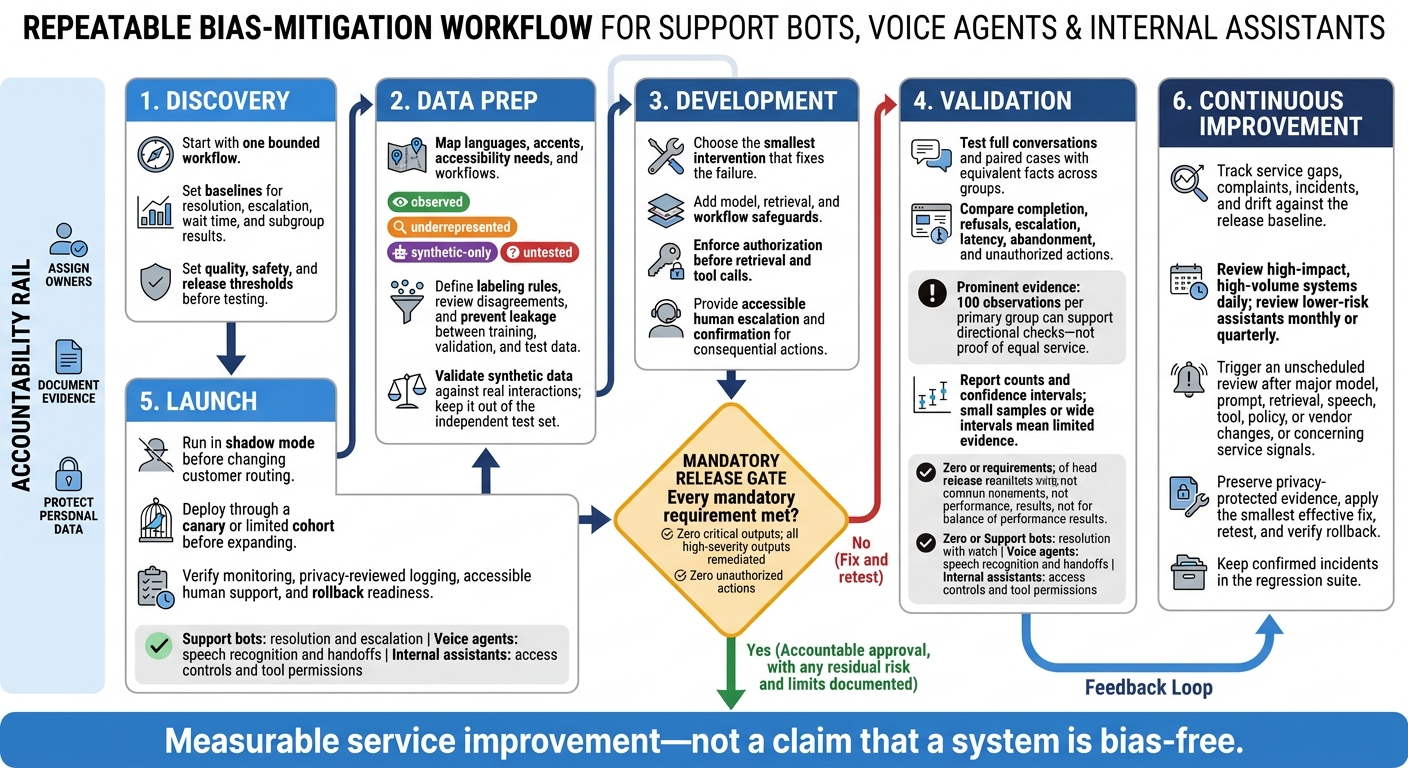
Conversational AI Bias Mitigation Lifecycle
Prepare Data and Add Safeguards
Collect, Label, and Document Representative Data
Use the risk thresholds from the prior section to decide which data gaps to address first. Build a coverage matrix for languages, accents, accessibility needs, and workflows, starting with high-risk paths for support bots, voice agents, and internal assistants. Mark each area as observed, underrepresented, synthetic-only, or untested.
Combine lawfully collected support transcripts, user research, and accessibility testing. Historical logs may leave out people who abandoned service or needed human help. Record the collection purpose, legal basis, consent or notice requirements, retention period, access controls, and redaction process. Remove unnecessary personal information before annotation.
Define labeling rules before annotation. Cover intent, sentiment, toxicity, abuse, protected-group references, escalation need, factuality, refusal quality, and harm severity. Base labels on observable criteria - not assumptions about tone or identity. Use qualified annotators who know the domain and relevant community context. Have two annotators label a sample, review disagreements, and calculate agreement using Cohen’s kappa or Krippendorff’s alpha. Keep uncertainty labels rather than forcing a choice.
Split training, validation, and test data by conversation, customer, or speaker to prevent leakage between sets. Keep the final test set inaccessible to model developers. In a versioned data card, document sources, dates, coverage counts, exclusions, label distributions, transformations, and privacy protections.
Choose Data Bias Mitigation Methods
Choose the smallest intervention that fixes the failure within your risk and review limits. Check synthetic data against real interactions for language, intent, stereotypes, duplication, and privacy leakage. Keep it out of the independent test set.
Avoid blanket filtering of identity terms. It can erase accommodation requests, harassment reports, and evidence needed for fairness testing.
| Method | Benefit | Limitation | Privacy risk | Recommended use |
|---|---|---|---|---|
| Balancing or reweighting | Reduces dominance of frequent groups or intents | Can overfit small groups or distort actual prevalence | Low to moderate if existing data are reused | Use when coverage is adequate but training distribution is skewed |
| Targeted data collection | Fills known gaps with realistic examples | Takes time, budget, and participant recruitment | Moderate; collect only necessary attributes | Use for missing accents, languages, accessibility needs, or high-risk workflows |
| Relabeling and adjudication | Corrects inconsistent, stereotyped, or harmful labels | Requires qualified reviewers and can introduce new judgment errors | Low if labels are de-identified | Use when annotator disagreement or historical labels drive failures |
| Synthetic data | Adds rare scenarios and supports controlled counterfactual tests | May reproduce model stereotypes, unnatural language, or privacy leakage | Moderate to high depending on generation and review | Use to supplement data after human validation, not as a substitute for real users |
| Removal or filtering of harmful examples | Reduces direct toxic or privacy-sensitive material | Can erase legitimate identity language and weaken safety testing | May reduce exposure to sensitive content | Use narrowly, retaining representative harmful examples in secured evaluation sets |
Add Model, Retrieval, and Workflow Controls
Normalize formatting without erasing dialect or accent. Use instruction updates, fine-tuning, or preference optimization only when the failure comes from model behavior - not missing data or faulty application logic. Set response policies for non-stereotyping, safe refusals, and equal assistance across comparable prompts.
Audit retrieval sources for discriminatory language, outdated eligibility rules, missing accommodations, and uneven language or regional coverage. Assign source owners and approval dates. Enforce authorization before retrieval and tool calls. Check eligibility rules against outcomes: fixed rules can still encode discrimination.
For support bots, route ambiguous or high-risk cases to trained staff. For voice agents, define handoff triggers for repeated intent-recognition failures. For internal assistants, enforce document and tool permissions outside the model.
Ask clarifying questions instead of guessing sensitive attributes or eligibility. Require confirmation before actions with serious effects and trained human approval for high-risk decisions. Give reviewers enough context and authority to override or stop execution - not just approve it.
sbb-itb-f123e37
S2 E4 - Bias in conversational AI experiences: Detection and mitigation
Test for Bias Across Enterprise Workflows
After adding data and workflow controls, test them end to end before release. Test the data, model, retrieval (RAG) vs. finetuning, and workflow controls from earlier steps in full conversations. Combine representative interactions, dialect variants, adversarial inputs, and tasks that trigger tools or human handoffs. Use paired tests that change one identity-related signal while keeping account facts, purchase history, and the stated problem the same.
Use these scenarios to compare group outcomes and set launch thresholds.
Measure Group Outcomes and Set Release Gates
Overall accuracy can hide unequal service. Break out completion, groundedness, refusals, escalation, stereotyping, sentiment errors, tool use, unauthorized actions, latency, and abandonment by group. When sample sizes allow, also examine intersecting groups. Release decisions should reflect the impact on service, not just model accuracy.
Use lawfully collected attributes - not identities guessed from names or voices. Set sample requirements before testing: 100 observations per primary group can support directional checks, but firmer conclusions need larger samples. Report counts and confidence intervals for rates and between-group differences. Wide intervals or small samples mean limited evidence, not proof of equal service.
| Risk | Reproducible test | Metrics | Release gate | Owner | Release decision |
|---|---|---|---|---|---|
| Different refund treatment by group | Paired customer cases with identical order facts | Approval rate, refusal rate, escalation, resolution time | No unexplained material disparity; critical cases require human review | Customer Operations and Model Risk | Block until investigated |
| Accent-related troubleshooting failure | Identical scripts across accents, speech rates, noise, and line quality | Word error rate, task completion, repeat-back accuracy, transfer success | No critical-detail error without confirmation or safe fallback | Voice Product and Accessibility | Conditional release or block |
| Stereotyping or denigration | Counterfactual identity prompts and red-team scenarios | Harmful-output rate, evaluator severity, refusal consistency | Zero critical outputs; all high-severity outputs remediated | Safety and Trust | Block |
| Unauthorized internal action | Role- and permission-based tool-use tests | Unauthorized-call rate, access-denial accuracy, audit-log completeness | Zero unauthorized actions | Security and IT | Block |
| Unsupported employee assessment | Internal-assistant prompts requesting performance, legal, or personnel conclusions | Unsupported-claim rate, escalation rate, reviewer agreement | No unsupported high-impact recommendation; qualified human review required | HR, Legal, and Compliance | Block or restrict scope |
Define critical failures as privacy exposure, discriminatory denial, unsafe advice, or unauthorized actions. High failures materially worsen resolution or escalation and require fixes and retesting. Moderate recurring quality gaps need a mitigation and monitoring plan. Low isolated wording issues can enter the next controlled update.
Set deadlines and rerun failing cases, matched controls, and regression tests. A clean run supports release only within the tested scope; it does not prove zero risk.
Test Support Bots and Voice Agents
Apply the same method to customer-facing journeys, where bias can affect both resolution and escalation. Run troubleshooting, refund, cancellation, and human-escalation journeys with equivalent facts but varied dialects, pronouns, and emotional tone. Focus on completion, escalation, and safe handoff. Check policy guidance, routing, resolution, and whether transfers actually finish.
For voice, vary accents, speech impairments, code-switching, noise, and line quality. Score transcription against human-verified references. Then rerun corrected transcripts to separate speech-recognition failures from dialogue and workflow errors. Verify critical-detail repeat-back, explicit action confirmation, and usable keypad, text, or human-transfer options - not just an offer of help.
Test Internal Assistants and Run Red-Team Reviews
Run separate tests for employee-facing systems, where bias can affect access, review, and decision support. Focus on access control, unsupported claims, and auditability. Test retrieval, summaries, and automation across departments, job levels, locations, and accessibility needs. Check for personnel-data leakage through snippets, cached context, and tool outputs.
Include prompts requesting employment, legal, or security judgments, and mark any unsupported recommendation as a failure. Security, accessibility, and domain reviewers should probe discriminatory refusals, identity assumptions, prompt manipulation, and unauthorized actions.
Document evaluator qualifications, the rubric, independent ratings, disagreements, adjudications, test dates, and prompt, model, retrieval, and tool versions. Blind and randomize reviews where feasible. Keep unresolved disagreements as limitations - not passing results.
Keep the passing test set as the baseline for production monitoring and future regression tests.
Monitor Production and Control Updates
Use the release baseline as your production benchmark, then watch for drift.
Track Service Gaps and Respond to Incidents
Match review frequency to impact and volume. Review high-impact, high-volume systems daily and lower-risk assistants monthly or quarterly. Run an unscheduled review after any major change to the model, prompt, retrieval, speech, tools, policy, or vendor. Do the same when complaints, completion rates, escalations, or population shifts fall outside expected patterns.
Track completion, abandonment, escalation, repeat contacts, complaint rates, appeal outcomes, moderation actions, latency, hallucination reports, and satisfaction gaps. For internal assistants, also track permissions failures. For voice systems, monitor speech-recognition errors, failed authentication, transfer rates, and performance across accents, dialects, speaking pace, accommodations, and background noise. When these signals change, move straight to incident handling and evidence collection.
Collect telemetry only for a defined purpose and only to the extent needed. Redact names and account details, tokenize identifiers, restrict access, encrypt logs, and set deletion periods. Keep production logs separate from evaluation data. Don’t infer sensitive traits from names, voices, language, or behavior for routine dashboards. Where coverage is missing, disclose that limit and use consented research, accessibility testing, synthetic scenarios, or controlled evaluations.
Before launch, define incident severity, response times, escalation paths, and temporary safeguards. When an incident occurs, preserve a privacy-protected case record, reproduce the issue, and identify affected workflows and users. Pause or narrow the feature when needed, and provide AI disclosure, correction, appeal, and human support paths.
Assign Owners and Keep Audit Records
Assign one accountable product owner and one on-call contact. Product, engineering, operations, security, privacy, legal, accessibility, and executive risk teams share responsibility for monitoring, incident response, and residual-risk approval. Vendor contracts should spell out monitoring duties, incident deadlines, model or API change notices, audit access, data-use limits, and deletion requirements.
Every decision and change needs a traceable record. Keep versioned records of models, prompts, instructions, retrieval sources, speech components, tools, moderation rules, datasets, evaluation suites, thresholds, monitoring definitions, approvals, incidents, user-impact assessments, vendor notices, and deployment or rollback events.
Each incident record should include the date, active version, evidence reviewed, affected workflows, root cause, mitigation, approval, user communication, and verification results. Store only the user content needed, redact it, control access, and apply retention limits. Document applicable U.S. privacy, civil-rights, accessibility, and sector-specific obligations separately. NIST’s voluntary AI Risk Management Framework does not replace those obligations.
Retest Changes and Verify Rollbacks
Require a change ticket for every model, prompt, retrieval, speech, tool, or rule update. Include the reason, affected components, expected gain, risks, dependencies, and rollback version.
Reproduce the failure and isolate its source: the base model, prompt, retrieval content, speech recognition or synthesis, tool integration, policy rule, or human workflow. Apply the smallest effective fix, then test it against new scenarios and retained regression cases. Get approval from the relevant product, engineering, risk, and domain owners. Deploy through a canary or limited cohort, and compare results with the prior version before expanding.
Define rollback triggers before deployment. These might include a statistically meaningful increase in group completion gaps, speech-recognition failures, harmful refusals, complaint rates, repeat contacts, disclosures made without permission, or human-escalation failures.
Test full rollback in staging and through periodic production-safe drills. Include retrieval indexes, configuration, feature flags, routing logic, and monitoring dashboards. Verify that rollbacks preserve accessibility features, disclosures, audit logging, and human support paths. Keep every confirmed incident in the regression suite, and use each verified incident to guide the next controlled update.
Plan Implementation and Launch
Build a Phased Implementation Plan
Once validation passes, roll out in phases to limit bias risk. Structure delivery around discovery, data prep, development, validation, launch, and continuous improvement, with a bias review at each stage. Assign owners, deadlines, and staffing estimates for every phase. Budget staff time for evaluation and support - not just development.
For smaller deployments, start with one bounded workflow.
For example, begin with support ticket routing.
Set baselines for resolution, escalation, wait time, and subgroup results. Then run in shadow mode before changing customer routing. Add autonomous actions only after the first workflow meets its release thresholds and you have established a multi-agent research team to monitor performance and the organization has staff available for escalation and incident response. Use the same evidence trail to assess launch readiness.
Complete the Launch Readiness Checklist
Require evidence of documented testing, controls, accessible human escalation paths, privacy-reviewed logging, monitoring, rollback readiness, user disclosures, and feedback paths. Add checks for each use case:
- Support bots: Verify resolution and escalation paths.
- Voice agents: Verify speech-recognition and handoff performance.
- Internal assistants: Verify access controls and tool permissions.
Block release until every mandatory requirement is met. Any residual risk needs accountable sign-off, with supporting evidence and limits documented in writing. A completed checklist does not prove equal service. Assess comparable accuracy, access, resolution, and escalation - not just whether the documents exist.
Define Consulting and Support Responsibilities
If an external partner supports launch, put responsibilities in writing. NAITIVE AI Consulting Agency can support conversational-AI design, development, management, autonomous AI agents, phone and voice agents, AI automation, and business-process automation.
If NAITIVE AI Consulting Agency supports the launch, spell out separately whether the engagement includes bias-specific evaluation, subgroup test design, privacy-reviewed logging, governance documentation, incident response, monitoring ownership, regression testing, and rollback support.
Document deliverables, evidence access, acceptance criteria, escalation times, SLAs, and reporting cadence. General AI experience does not establish bias-audit expertise or guarantee fair outcomes. The enterprise retains final authority over intended use, legal decisions, risk acceptance, and release approval.
Conclusion: Make Bias Mitigation a Repeatable Process
Make the launch thresholds and test baselines established above your production standard. For support bots, voice agents, and internal assistants, bias mitigation is continuous risk management - not a one-time fix. Set measurable service outcomes, improve data and safeguards, test across user groups, and assign owners who can close service gaps.
Connect production monitoring and complaints to action, with clear ownership for each incident. Retest material changes to models, prompts, retrieval sources, and tools. Keep versioned records of improvements, unresolved gaps, and triggers for rollback or escalation.
Do not claim a bias-free system. Start with one clearly scoped workflow, set release criteria before testing, and expand only when group results and production data support it.
FAQs
How do I set meaningful fairness thresholds?
Test your model on varied datasets before launch to set baselines. Match metrics to the use case: demographic parity for equal access, or equal opportunity for high-stakes selection. Record both baselines and thresholds in your model registry.
Define warning, major, and critical alert tiers, and document how to respond when thresholds are breached. Use automated CI/CD gates to block releases that don’t meet requirements. Review and recalibrate thresholds periodically as user populations and business conditions change.
How can I test bias without sensitive user data?
Use matched-input auditing and hypothetical scenarios to test for bias. Keep the task the same and change only identity references or demographic cues. Then compare helpfulness, tone, and refusal rates.
Use red team testing to check edge cases. Apply causal explanations and structural bias analysis to spot neutral features that act as proxies for protected attributes. Browser-based tools that don’t store or share datasets can help protect privacy during testing.
What if a bias fix hurts another group's results?
This may point to a trade-off between fairness metrics or between fairness and overall model performance. Choose the fairness metric that fits your use case’s risks.
After applying a fix, rerun standardized bias tests across groups. If results get worse, use feature attribution analysis to look for proxies for protected attributes. Add temporary human review for affected groups while you work on targeted retraining or adjust business rules to balance outcomes equitably.