
OAuth vs mTLS for AI Agent Networks
Use mTLS to verify workloads and OAuth to grant scoped access in AI agent networks; combine them where trust boundaries require.

Use mTLS to verify which workload is connecting. Use OAuth to control what it can access. For example, an invoice-reading agent may connect through mTLS but still need an OAuth token with invoices:read permission.
The choice depends on the trust boundary - not which approach is “stronger”:
- Internal agents: mTLS fits workloads under shared certificate control, with separate permission checks.
- Partner access: OAuth provides scoped, audience-limited access.
- User-directed actions: OAuth delegation carries user authority; client credentials do not prove user consent.
- Combined controls: RFC 8705 certificate-bound tokens require both the token and its matching certificate key.
Quick Comparison
| Criteria | OAuth over TLS | mTLS | Certificate-bound OAuth |
|---|---|---|---|
| Main role | Controls resource access | Verifies connection peers and encrypts traffic | Links resource access to a certificate |
| Identity | Client and token claims | Certificate and private-key proof | Token claims plus certificate binding |
| Permissions | Scopes and API policy checks | Separate policy checks | Scopes and API policy checks |
| Credential theft | Bearer tokens can be reused | Stolen keys can enable impersonation | A stolen token alone is insufficient |
| Best fit | Partners and delegated access | Internal workload connections | Flows needing both controls |
| Upkeep | Token issuance, expiry, and revocation | Certificate issuance, renewal, and trust | Both, plus binding and rotation checks |
| Audit trail | Token identity and access decisions | Certificate identity and connection records | Linked token and certificate records |
Across all three models, APIs must enforce permissions at every agent hop. Before deployment, assign owners for credentials, revocation, TLS termination, outage recovery, and audit records - without logging tokens or private keys.
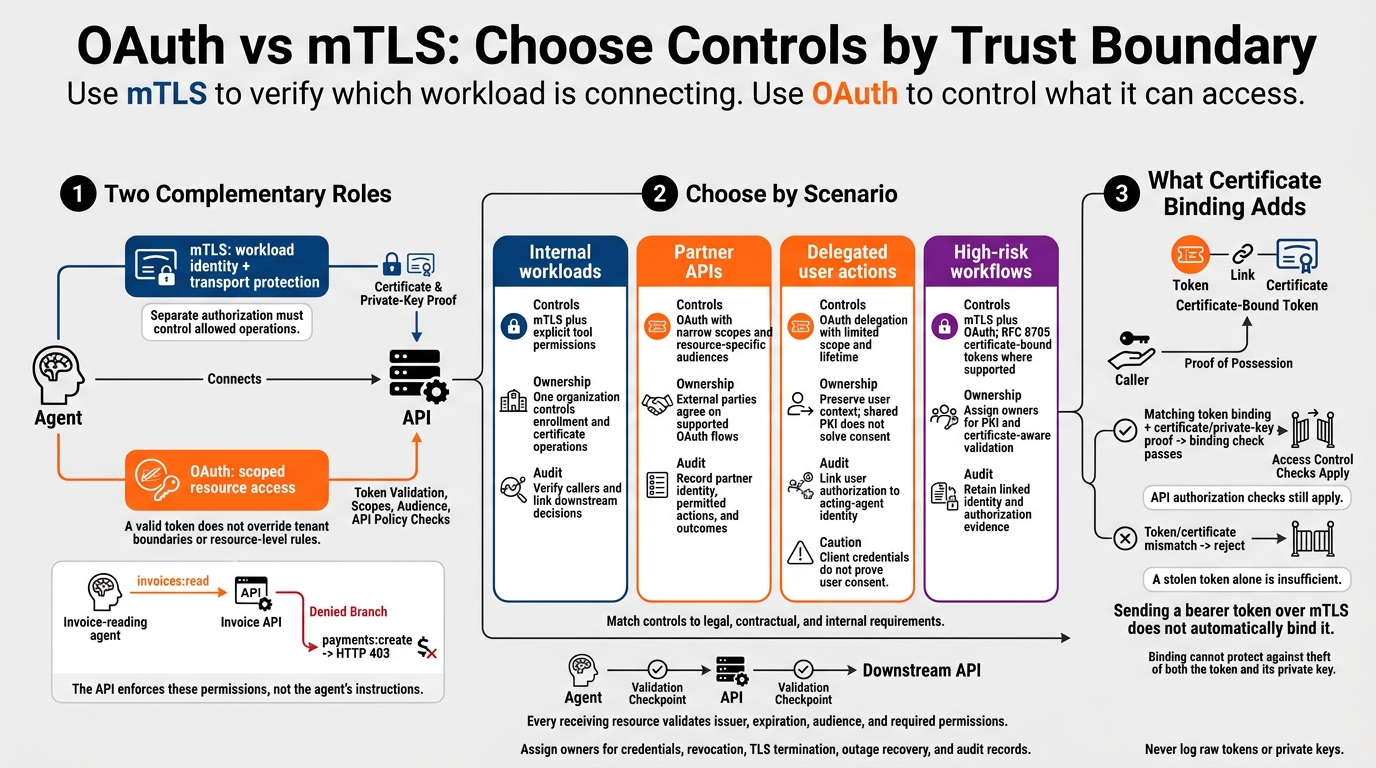
OAuth vs mTLS: Choose Controls by Trust Boundary
OAuth 2.0 mutual client authentication (mTLS)
sbb-itb-f123e37
OAuth for Agent Access to Services
The OAuth 2.0 client credentials grant lets a confidential agent workload get access without a user authorization step. The agent authenticates to the token endpoint, requests grant_type=client_credentials with approved scopes, and receives an access token. Use this grant only for agent-owned or preauthorized access. It does not prove user consent.
Issuing Tokens and Enforcing Scopes
Before issuing a token, the authorization server must authenticate the client and check its registration, status, audience, and scopes. Protect client secrets or use private-key client authentication.
At the API, validate signed tokens or use introspection for opaque tokens. Use the validated token or introspection response to check the trusted issuer, intended audience, expiration, not-before time where applicable, client identity, and permissions.
Enforce permissions at the API, not in the agent’s instructions.
For an invoice-reading workload, grant
invoices:read, notpayments:create. Allow invoice access only within the assigned business unit, and return HTTP 403 for payment creation.
A valid token does not override tenant boundaries or resource-level rules.
Token Theft, Revocation, and Logging
Once scopes are enforced, token handling becomes the main operational risk. Anyone holding a bearer token can generally use it. Limit scopes, use short-lived tokens, and forward tokens only to explicitly trusted audiences. Store credentials in managed secret storage. Keep tokens out of prompts, URLs, logs, and traces.
Centralized issuance lets administrators disable clients, rotate credentials, and block new token issuance. But self-contained tokens may remain usable until they expire. Introspection can detect revocation sooner, depending on caching.
Link issuance and access records through non-secret identifiers and correlation IDs. Record client identity, audience, scopes, timestamps, resource, action, and outcome - never raw tokens or secrets.
Partner Access and User Delegation
Partner access needs the same controls, with tighter onboarding and offboarding. Register each partner as a distinct client. Issue scoped, time-limited tokens for a specific API audience. You still need secure onboarding, issuer trust, agreed permissions, rate limits, incident contacts, and offboarding procedures.
For actions on behalf of a person, use a delegated flow, such as authorization code with user consent, or a documented token-exchange design that preserves delegation context. Client credentials do not automatically retain the initiating user’s permissions. Audit records must distinguish the workload from the user it represents.
mTLS for Internal Agent Identity
OAuth controls access. mTLS verifies internal workload identity and protects transport - not permissions. Use it for internal agent traffic when your organization controls enrollment and certificate trust. During the TLS handshake, both endpoints present X.509 certificates and prove they hold the matching private keys. A copied public certificate alone cannot impersonate an agent.
Checking Certificates and Protecting Connections
Each endpoint must validate the certificate chain against a trusted anchor, check the expiration and validity start time, and match the SAN to the expected peer identity. It must also check the correct serverAuth or clientAuth usage, acceptable algorithms, and revocation status where required. Trusting the issuer isn't enough: authorize only verified peer identities.
Certificate validation proves the peer's identity, not its permission to act. Separate authorization must control allowed operations. mTLS does not pass user authority across agent hops.
If a proxy terminates TLS, the next connection authenticates that proxy or its configured identity - not automatically the original caller. Document where TLS terminates and re-authenticate downstream connections.
Managing PKI, Keys, and Certificate Rotation
Assign owners for root and issuing CAs, enrollment rules, key storage, and compromise response. Keep private keys out of source repositories and images. Limit which workloads can obtain each identity, and keep production trust separate from development trust. Automate short-lived certificate issuance, renewal before expiration, certificate reloads, and CA bundle updates.
Service meshes and workload-identity systems can automate these controls, but monitoring and recovery still need owners. Set alerts for renewal failures and stale trust bundles. Test expired certificates, clock skew, and CA outages.
Define how revocation is enforced; don't assume every TLS client checks it. After a key compromise, replace credentials and block the compromised identity through supported controls. Test that certificate validation failures cause connections from untrusted peers to be rejected.
For agents that need scoped access or delegated authority, pair mTLS with OAuth. That leads to the next question: whether this identity layer is enough on its own, or whether authorization must travel with the request.
Comparing OAuth, mTLS, and Combined Controls
Compare them by trust boundary, not by feature list. The question isn’t which control is stronger. It’s which one fits the trust boundary.
| Model | Advantages | Limitations |
|---|---|---|
| OAuth client credentials over TLS with server authentication | Scoped, audience-limited access with resource policy checks; often simpler partner onboarding. | Requires agreement on issuer trust, client registration, and permissions. |
| mTLS alone | Fits internal workloads that share certificate trust. | Needs separate authorization and delegation controls; partners must agree on enrollment and trust. |
| OAuth with certificate-bound tokens | Adds a sender constraint to scoped, audience-restricted access; stealing the token alone isn’t enough. | Needs compatible servers and coordinated rotation; delegation still requires a separate authorization flow. |
The fit also depends on who owns issuance, validation, and recovery.
Setup, Maintenance, and Team Responsibilities
Assign ownership by control plane. OAuth needs client authentication, scope design, and token handling. mTLS needs enrollment, issuance, and trust distribution.
| Operational concern | OAuth client credentials | mTLS alone | Certificate-bound OAuth |
|---|---|---|---|
| Staffing and setup | IAM owns issuance; application teams own scopes and enforcement. | PKI/platform teams own trust; service teams integrate certificates. | Both teams own binding tests and gateway integration. |
| Credential rotation | IAM rotates credentials and signing keys; applications maintain validation. | PKI/platform teams rotate certificates, keys, and trust bundles. | Both teams coordinate new certificates and newly bound tokens. |
| Revocation | IAM and API teams enforce token lifetimes or active checks. | PKI and service teams enforce certificate revocation or identity disablement. | Both teams test token invalidation and certificate blocking. |
| Outage recovery | IAM restores issuance; API teams fix validation failures. | PKI/platform teams restore renewal, trust, and key access. | Both teams address failures in either layer and binding mismatches. |
| Audit evidence | Application teams log authorization decisions. | Platform teams log connection identity. | Both teams link authorization and certificate records. |
Don’t bypass audience or certificate checks to restore traffic. Queue noncritical work instead.
Certificate-Bound Tokens Under RFC 8705
When OAuth and mTLS need to work together, RFC 8705 binds token use to the certificate presented. It separates two checks: mTLS client authentication at the authorization server and certificate binding at the resource server. Sending a bearer token over mTLS does not automatically bind it. Deployment requires coordinated issuance and certificate-aware validation at the resource server. A mismatch must fail.
During rotation, obtain new tokens bound to the new certificate and set a controlled overlap period for old credentials. At TLS termination points, accept certificate metadata only from a trusted, authenticated gateway that strips spoofed incoming headers. Backend mTLS authenticates the gateway - not the original caller’s token binding. Binding also cannot protect against theft of both the token and its private key.
Downstream services must preserve that same identity chain for the binding to help.
Permissions and Audit Trails Across Agent Chains
Every receiving resource must validate the token’s issuer, expiration, audience, and required permissions. This is especially critical when building multi-agent research teams where trust must be maintained across several autonomous nodes. An upstream agent’s approval isn’t enough. Obtain explicitly authorized downstream tokens through token exchange or another approved mechanism, rather than forwarding broad tokens indiscriminately.
Keep the calling workload, initiating agent, and delegated user separate in audit records. Record UTC timestamps, correlation IDs, verified identities, resource actions, policy versions, and allow-or-deny results. Exclude raw tokens and private keys. Even validated credentials need downstream policy checks.
Conclusion: Choose Controls by Trust Boundary
Use mTLS to verify workload identity at the transport layer and OAuth to grant scoped access to specific resources. Combine them only when the trust boundary calls for both.
Base that choice on who controls issuance, revocation, and audit evidence at each boundary.
Choosing Controls for Internal, Partner, and Regulated Systems
For regulated workflows, match controls to legal, contractual, and internal requirements.
| Scenario | Controls | Ownership and interoperability | Audit needs |
|---|---|---|---|
| Internal workloads | mTLS plus explicit tool permissions | One organization controls enrollment and certificate operations | Verify callers and link downstream decisions |
| Partner APIs | OAuth with narrow scopes and resource-specific audiences | External parties agree on supported OAuth flows | Record partner identity, permitted actions, and outcomes |
| Delegated user actions | OAuth delegation with limited scope and lifetime | Preserve user context; shared PKI does not solve consent | Link user authorization to acting-agent identity |
| High-risk workflows | mTLS plus OAuth; RFC 8705 certificate-bound tokens where supported | Assign owners for PKI and certificate-aware validation | Retain linked identity and authorization evidence |
For user-directed actions, use the authorization-code flow with PKCE. Require step-up approval for irreversible actions.
Implementation Checklist and Consulting Support
Put the policy choice into practice with a clear operating model.
Before deployment, inventory identities, permissions, trust boundaries, TLS termination points, and owners. Test expiration, revocation, clock skew, and partial outages. Check that audit events link the full agent chain.
NAITIVE AI Consulting Agency can help define the project’s identity, authorization, key management, and audit requirements.
FAQs
How can I add OAuth to an existing mTLS agent network?
Use certificate-bound access tokens, as specified in RFC 8705, to bind OAuth tokens to your existing mTLS client certificates. An intercepted token can't be used without the matching private key.
Keep mTLS for service-to-service transport-layer authentication. Add OAuth 2.0 client credentials for granular, scoped access and authorization roles. Store all credentials and cryptographic keys in secure vaults - not in configuration files or code.
How granular should my AI agent scopes be?
Use a default-deny model: grant each agent only the permissions its role requires. Allow access to specific functions, such as github/issues/list, instead of entire APIs.
Use namespace-scoped roles to limit each agent’s potential impact. Apply capability-based security so sub-agents receive only the authority needed for their tasks. Audit permission scopes regularly and remove inactive permissions every 30 days to prevent credential sprawl.
How can I test authorization across multiple agent hops?
Run controlled tests that mirror actual workflows. To address the Confused Deputy Problem, trace the full delegation chain and check that permissions decrease at every hop.
Cap delegation at three hops so the chain is easier to audit. Use capability-based security tools or distinct X.509 certificates to verify each step and ensure sub-agents never exceed their parent’s authority. Record interactions in append-only logs so you can audit the full authorization sequence for every request.