
AI Agents and Data Sovereignty: 7 Cross-Border Risks
Seven cross-border risks for AI agents—from routing and fallbacks to vendor access, logs, transfer safeguards, and policy drift.

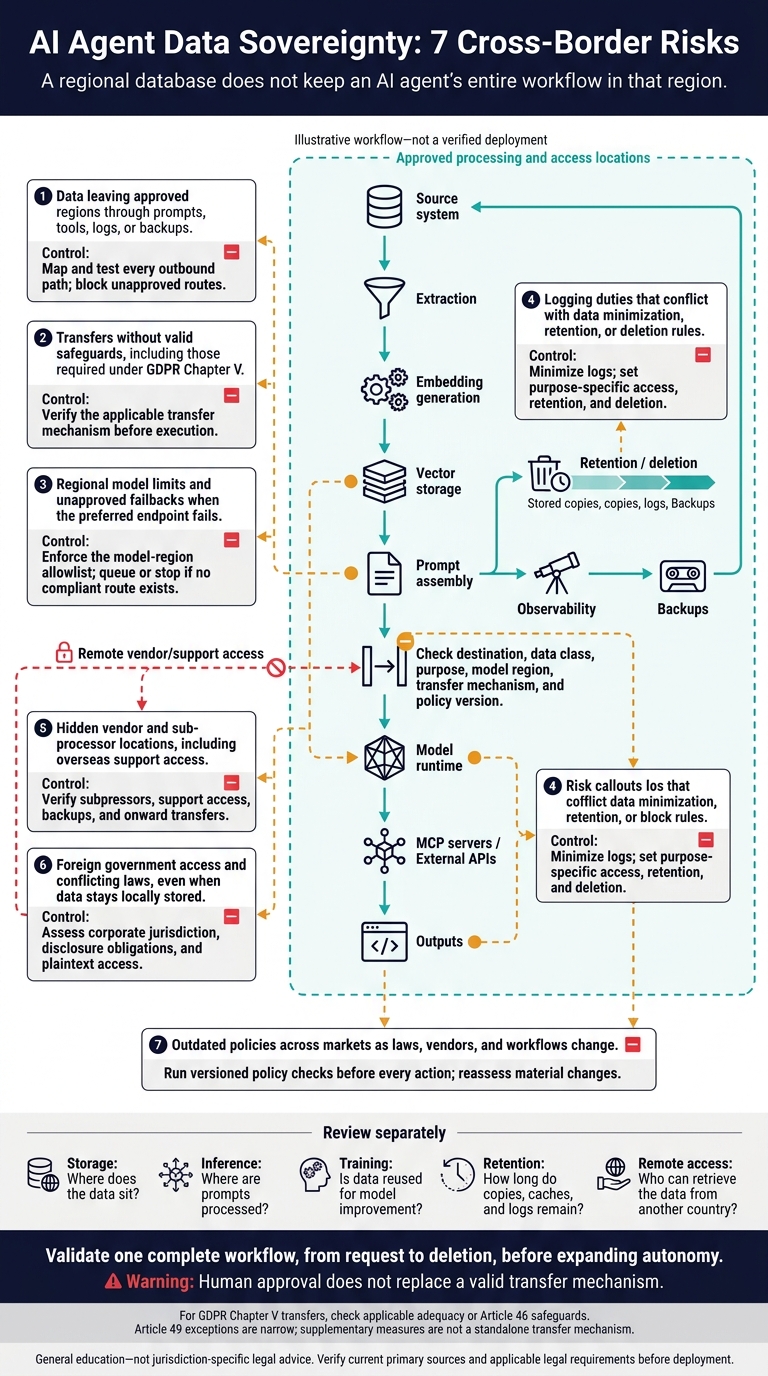
A regional database does not keep an AI agent’s entire workflow in that region. Before launch, check every destination - from model calls to logs - and block any route without approved locations and required legal safeguards.
For U.S. teams, the review covers 7 cross-border risks:
- Data leaving approved regions through prompts, tools, logs, or backups.
- Transfers without valid safeguards, including those required under GDPR Chapter V.
- Regional model limits and unapproved fallbacks when the preferred endpoint fails.
- Logging duties that conflict with data minimization, retention, or deletion rules.
- Hidden vendor and subprocessor locations, including overseas support access.
- Foreign government access and conflicting laws, even when data stays locally stored.
- Outdated policies across markets as laws, vendors, and workflows change.
The starting point: map one workflow from request to deletion, such as building a multi-agent research team, assign owners, and test failures before expanding. Human approval does not replace a valid transfer mechanism. Legal requirements and application dates should be checked against current primary sources as of November 23, 2026, and again before deployment.
AI Agent Data Sovereignty: 7 Cross-Border Risks
Data Sovereignty, Residency, and Agent Workflows
Data sovereignty determines which laws and authorities apply. Data residency describes where data is stored. Data localization requires specified data or processing to stay within a country or region.
For retrieval-augmented generation (RAG), trace the full data path: source system, extraction, embedding generation, vector storage, prompt assembly, model runtime, Model Context Protocol (MCP) servers, external APIs, outputs, observability, and backups. Record both processing and access locations, including those for embeddings, document IDs, and diagnostic traces. This map shows where data could leave approved regions.
Review storage, inference, training, retention, and remote access separately. Each answers a different question:
- Storage: Where does the data sit?
- Inference: Where are prompts processed?
- Training: Is data reused for model improvement?
- Retention: How long do copies, caches, and logs remain?
- Remote access: Who can retrieve the data from another country?
Verify each point through contracts and settings. A regional hosting label alone doesn’t answer these questions.
MCP adds another cross-border path. Even an approved model can send data to an unapproved tool server. Allowlist servers, restrict fields and actions, enforce tenant and region boundaries, and require approval for high-risk actions. Log tool calls without copying sensitive content into those logs.
Transfer rules also apply beyond tool access. Under GDPR Chapter V, identify the exporter, importer, destination, data categories, transfer purpose, and destination-country access risks. A transfer can occur when an exporter subject to GDPR makes personal data available to another controller or processor in a third country - including through remote access. Use Article 45 adequacy or Article 46 safeguards. Reserve Article 49 for narrow exceptions, not routine agent traffic.
sbb-itb-f123e37
1. Data Leaving Approved Regions
Hypothetical workflow: U.S. customer-support agent. A customer submits their name, account number, and medical-device issue. The orchestration layer sends the prompt to a model endpoint selected by the default route. After a timeout, a fallback model in another country processes it alongside retrieved support records from a U.S. database. Tool calls send details to a translation API in another country; the answer enters centralized logs and a vendor’s debugging system. A supervisor approves the answer after the transfers have already occurred.
Every outbound step creates a transfer risk - including fallback routes, logging, and vendor support. Test every outbound path in the live workflow, not just the policy diagram.
Prelaunch: map outbound data. Engineering should check network and access logs, deployment settings, and provider evidence to verify runtime routing and failover paths. Include caches, backups, telemetry, and human-review queues. Privacy owners should classify complete outbound payloads and remove unnecessary identifiers before transmission.
Approve and verify: Procurement should maintain approved-region and subprocessor registers that cover processing, vendor support access, retention, and onward transfers. Get vendor evidence confirming that runtime destinations match those registers.
Enforce and detect: Once destinations are verified, block data from leaving through unapproved routes. Use region-aware routing and network/API geofencing to block unapproved destinations. Keep retrieval, redaction, embeddings, and sensitive processing local. Inspect outbound payloads. Log every block, redaction, or escalation, including the workflow, data category, destination, vendor, and policy triggered.
Escalate before sending: If the route is unclear, stop before transmission. Preserve the routing decision and policy version. Human approval cannot legalize a transfer that the law prohibits or that lacks required safeguards. If the approved endpoint is unavailable, do not silently fail over to another country. Engineering should pause the workflow until the designated privacy, security, or legal owner resolves uncertainty about classification, destination, or safeguards.
2. Transfers Without Valid Legal Safeguards
Once you’ve mapped the route, check the legal mechanism for every transfer. An approved destination still needs a valid transfer mechanism. For GDPR Chapter V transfers, legal and privacy owners should identify the exporter, importer, destination, purpose, data types, recipients, and frequency. Document the mechanism before the transfer runs.
Choose the mechanism that fits the destination and transfer pattern.
| Mechanism | Typical use | Strength | Limitation |
|---|---|---|---|
| Adequacy decision | Transfers covered by European Commission adequacy decisions | No additional transfer safeguard needed within scope | Check the recipient and current country, sector, or scope coverage. |
| Standard Contractual Clauses (SCCs) | Organization-to-organization transfers under Article 46 | Standardized contractual protection | Requires the correct module, completed annexes, a transfer impact assessment, and controls on onward transfers. |
| Binding Corporate Rules (BCRs) | Transfers within an approved multinational group | Group-wide transfer framework | Requires regulatory approval; does not automatically cover external vendors. |
| Article 49 derogation | Narrowly defined transfers that qualify for an exception | Permits qualifying exceptions | Requires strict justification; routine agent traffic is not automatically occasional. |
| Supplementary measures | Added protection alongside SCCs or BCRs | Addresses protection gaps | Not a standalone mechanism; must address the identified risk. |
Test whether the safeguards work in practice. For execution paths that rely on SCCs or BCRs, document destination-country laws, government access, remedies, and the importer’s ability to comply. Contracts alone don’t control vendor access or onward transfers. Check the recipient chain and add effective protections, such as pseudonymization or encryption with exporter-controlled keys. If protection gaps remain unresolved, block the transfer.
Before the tool call, define permitted fields, recipients, retention, and deletion triggers. Don’t allow secondary use, including model training, unless separately authorized. In Article 30 records, document the data category, purpose, destination, recipient, mechanism, safeguards, retention, and subprocessors.
Agent routing can change at execution time, so validate the mechanism for each call. Require a transfer decision before each execution path, rather than relying only on static vendor approval. Keep a minimized record of the actual endpoint, tool, purpose, data classification, mechanism and assessment references, policy version, UTC timestamp, and decision. Use controlled records as evidence - not full prompts or customer data.
3. Regional Model Limits and Unapproved Fallbacks
Valid transfer safeguards don’t mean a model is approved for every region or data class. Country availability does not authorize every workflow. Track inference, training, fine-tuning, support, admin access, and retention separately by region. Provider documentation already distinguishes data residency from inference residency, and regional processing can vary by model. Sanctions, export controls, sector rules, and contractual limits can also differ by model, destination, access type, and intended use.
These differences matter when the preferred endpoint fails and the agent selects a fallback.
If an approved U.S. model fails and the agent silently switches to an unapproved European model, prompts, retrieved records, and conversation memory can cross borders.
Maintain an up-to-date allowlisted model-region registry that controls runtime routing - not just procurement approval. Record the model version, endpoint, allowed regions for inference, training, retention, support, and admin access, permitted data classes, approved uses, fallback rules, owner, and expiration date.
The gateway must check and enforce the registry before any fallback. A route approved for public summaries must not handle SSNs or PHI. If you use redaction, verify that it worked before transmitting the data.
If no compliant route exists, queue the task or return service unavailable. Test outages, retries, and vendor rerouting. Never silently switch to a global endpoint.
4. Logging Duties and Data Minimization
Logs can cross borders just as routing does. Prompts, tool calls, and model responses can reach monitoring tools, backups, and support exports. Inventory every logging destination, subprocessor, storage region, administrator, and deletion process. Keep raw payloads out of logs by default. Redact secrets, tokens, cookies, private keys, authentication answers, and full card numbers before ingestion, and test filters with synthetic secrets.
For actions that need an audit trail, keep only the proof needed to reconstruct an agent’s decision: agent and version, model and version, tool or API used, UTC event timestamp, relevant jurisdictions, data category, policy version, policy decision, outcome, and whether a human reviewed, approved, changed, or overrode the action. Use pseudonymous identifiers when records need to be linked, and control re-identification keys separately. Pseudonymized data can still be personal data. Apply the same regional storage controls to indexes, replicas, backups, and support access.
Keep security telemetry separate from business and audit logs. Link them through event IDs instead of copying payloads. Use role-based access: security teams investigate threats, compliance teams review decisions, business leads see aggregates, and developers get sanitized samples. Require multifactor authentication, time-limited elevated access, export restrictions, and records of searches and exports. Give each retention schedule an owner. Retention limits mean little unless teams can prove who has access to each log stream.
| Log purpose | Minimum content | Example retention | Permitted access | Regional and deletion control |
|---|---|---|---|---|
| Security detection | Event ID, timestamp, actor, agent, tool, threat signal, tokenized subject | 12 months, or a documented incident-response period | Security operations and incident responders | Approved security region; purge or anonymize after the period |
| Compliance and audit | Agent, model, policy version, jurisdiction, data category, outcome, human intervention | At least 6 months where EU AI Act Article 19 or Article 26(6) applies, unless Union or national law provides otherwise | Compliance, internal audit, designated legal personnel | Append-only integrity controls; delete linked payloads separately |
| Business operations | Action ID, outcome, status, aggregate metrics, minimal subject token | 30–90 days | Process owner and approved analysts | No raw prompts by default; automatic expiration |
| Support and debugging | Error class, trace ID, sanitized input/output excerpts | 7–30 days | Restricted engineering and vendor support | Redact before ingestion; delete exports and vendor copies |
| Legal hold | Relevant event and preservation rationale | Until hold release | Legal and specifically approved custodians | Isolate held records; document review and release |
Check the six-month rule by role, log type, and application date - not simply because AI is involved. Article 19 covers provider-controlled, automatically generated high-risk-system logs. Article 26(6) covers deployer-controlled, system-generated logs. Check the applicable phase-in date before relying on this rule. Document the category, provider/deployer role, deployment date, log control, and legal basis.
Preserve evidence without keeping personal content forever. Separate deletable payloads from minimal, tamper-evident event records. Use append-only controls, signed timestamps, sequence numbers, hashes, and access monitoring. Document how deletions and corrections affect integrity checks. Remove copies from vendor systems and exports, and pause deletion only for records under legal hold.
5. Hidden Vendor and Subprocessor Locations
A compliant regional deployment can still involve other jurisdictions through its vendor chain. A regional hosting label does not tell you where all processing happens, which is why AI consulting services emphasize mapping the entire vendor chain. Check the provider’s legal name, headquarters, contracting entity, country of incorporation, parent-company structure, governing law, and locations where personnel can access data. Map support access, backups, and disaster-recovery copies, too. Local storage does not remove the risk of foreign access.
Require a current subprocessor register that lists each entity, service, purpose, country, access type, and data category. It should cover cloud hosting, model providers, speech services, tool integrations, support systems, and backup or disaster-recovery providers. Where GDPR applies, require prior specific or general written approval. General approval must include notice of planned changes and an opportunity to object. Pass the same obligations down to every subprocessor.
Put location limits in the contract. Define permitted purposes, data categories, processing locations, and retention periods. Ban region changes without approval, including failover and disaster-recovery shifts. Require advance notice of material infrastructure or support changes, along with objection and exit rights.
Restrict training or product-improvement use unless expressly authorized. That restriction should cover prompts, outputs, metadata, and derived artifacts - not just customer content. Require breach notification without undue delay, cooperation with audits, and written proof of deletion covering backups, archives, and replicas. For government requests, require legal review, limited disclosure, challenges where permitted, and customer notice unless prohibited.
Require dated evidence tied to the actual service and account. A generic security certification does not prove where processing takes place. These contract controls reduce vendor risk, but they do not address government access.
6. Foreign Government Access and Conflicting Laws
Vendor location is only part of the risk. The next question is which governments can compel disclosure. Map five separate fields: storage and processing location, corporate jurisdiction, admin access, remote support location, and government disclosure obligations. A U.S.-hosted model may still be operated abroad or face foreign legal demands. The U.S. CLOUD Act can require providers subject to U.S. jurisdiction to produce data under valid legal process, regardless of where it is stored. An order may conflict with localization rules, privacy rights, or secrecy restrictions.
Bring in counsel familiar with both jurisdictions immediately. Then check the demand’s validity, legal authority, target account, data categories, date range, preservation requirements, and deadline. Counsel should assess conflicting obligations and decide whether to challenge, narrow, delay, or comply. Disclose only the records the order requires.
If secrecy rules prevent notice, document the restriction and revisit notice when permitted. Handle suspected unauthorized access separately. Under GDPR Article 33, a qualifying personal-data breach generally requires notice to the supervisory authority without undue delay and, where feasible, within 72 hours of awareness.
Customer-held keys do not prevent plaintext exposure during inference. If provider systems decrypt prompts, retrieved documents, or tool results, regional hosting and encryption at rest cannot, by themselves, prevent access during processing. Check exposure across inference, monitoring, and logs - including memory and debugging - not just stored files.
Use time-limited privileged access, phishing-resistant multifactor authentication, second-person approval, and automatic revocation. Keep access logs that show who accessed which tenant, when, from where, and under which support case, without routinely copying sensitive prompts. Test a jurisdiction-specific playbook with named legal, privacy, and security owners. The test should cover a foreign order, a secrecy restriction, and a simultaneous breach-reporting deadline. Keep these controls aligned with each market’s current policies, notices, and retention rules.
7. Outdated Policies Across Markets
Approval can expire even when a workflow stays the same. Changes in law, technology, or business practices can make a previously approved agent noncompliant. An agent may comply in one market but not another, and a policy change in one market can invalidate its workflow elsewhere.
Run versioned policy-as-code checks before every action. Check jurisdiction, data class, parties, locations, vendor, tool, model version, requested action, destination, safeguards, retention, sector rules, sanctions, export controls, and risk tier. User location alone does not determine which law applies. Establishment, recipients, and processing locations also matter. Each check must return a clear decision: allow, allow with safeguards, require human approval, or block.
Monitor regulatory and vendor changes monthly, and review material changes immediately. Record the source, effective date, affected workflows, owner, and update deadline. Version models, tools, routing rules, prompts, and policies together. After changes, run regional regression tests. Failed tests must stop deployment or disable affected routes.
Set reassessment deadlines by risk: quarterly for high-risk workflows and annually for lower-risk workflows, with continuous monitoring. Update transfer assessments whenever destinations, subprocessors, access arrangements, or safeguards change. Establish a 24-hour critical-issue escalation path. Block execution when policy status is unknown, conflicting, or expired. Emergency updates must pass regional tests before affected actions resume.
Assign clear ownership:
- Legal and privacy own legal interpretations and transfer approvals; trade compliance owns sanctions and export controls; procurement tracks vendor changes.
- Security and engineering enforce routing and blocks; AI governance approves model, prompt, and test changes; business owners fund fixes and accept only permissible residual risk.
Track overdue assessments, time from a change to its policy update, failed tests, expired exceptions, and actions without traceable model or policy versions. When a policy change affects a transfer, revalidate the transfer mechanism before the next run.
Transfer Mechanisms: Uses and Limits
Transfer rules are separate from lawful basis. Match each outbound path to a valid transfer mechanism before it runs.
For autonomous agents, that match must work in practice - not just on paper. Check every outbound path, including prompts, retrieved records, tool outputs, telemetry, backups, and support access. Use the European Commission’s current adequacy decisions and the EDPB’s transfer guidance rather than relying on a vendor’s broad “GDPR compliant” claim.
Choose the mechanism that fits the actual exporter-importer relationship and how data is accessed.
- Adequacy: Check the decision’s current scope: country, sector, recipient, and data type. Confirm that it covers support access and onward disclosures.
- BCRs: Check that the entities and access paths are covered. Approval does not automatically cover unrelated vendors or subprocessors.
- SCCs: Select the correct module and document the transfer impact assessment. Add supplementary measures only when they address the actual access risk.
If destination-law risk cannot be controlled, stop the transfer. Contract language alone is not enough. Encryption at rest does not prevent an overseas recipient from reading prompts it must access during inference.
Treat Article 49 as a narrow exception - not the default route for recurring agent traffic.
Log Retention and Access Rules
Logs are cross-border records, too. Retention and access controls determine where agent evidence can travel.
Classify each log before storing it. Define its purpose, owner, sensitivity, retention period, and access policy. Keep full prompts, raw documents, voice recordings, and credentials out of shared logs unless a defined control or investigation requires them. Use redacted fields or pointers to protected records instead.
Control access - not just storage. Set approved regions for log storage, replicas, backups, and remote access. Require least privilege, multifactor authentication, and separate approval for exports outside approved regions. Record and review access. Contracts must specify who controls the logs and how customers can export and preserve them.
Apply EU AI Act logging duties only when they cover the system and role. For some deployer-controlled logs, six months is the minimum - not the default retention period for every agent.
Use one purpose-specific control matrix across log purposes, rather than one blanket retention rule. Set fields, regions, access, and deletion rules together. Don't assign a single retention period to the entire pipeline.
| Log purpose | Minimum necessary fields | Permitted storage regions | Authorized roles | Retention basis | Deletion or hold handling |
|---|---|---|---|---|---|
| Reliability | Pseudonymous request ID, timestamp, agent/model version, workflow step, tool status, latency, error code, retry outcome | Approved operational regions, including backups | SRE and approved support; redacted access | Troubleshooting need and privacy limits | Delete or aggregate when diagnostic need ends; preserve scoped evidence when required |
| Security | Actor/service ID, authentication result, source region, privilege changes, policy violations, suspicious-event indicators | Approved security regions; assess overseas access separately | Security operations and incident response | Security monitoring and incident response | Preserve relevant incident evidence; restrict access and review continued need |
| Legal | Transaction reference, action summary, approvals, policy version, integrity evidence | Counsel-approved jurisdictions | Legal and designated investigators | Disputes, investigations, contracts, legal holds | Suspend deletion only for scoped records; document hold release |
| Regulatory | System/version, use period, outcome references, human review, escalation events | Approved jurisdictions | Compliance, audit, designated response staff | Applicable regulatory duties | Preserve required records; delete or anonymize when obligations end |
Apply rules at the record or field level, not to the whole dataset. Use the strictest necessary rule only for the fields that need it. Preserve records covered by a hold while continuing scheduled deletion for everything else. When the hold ends, restore the normal schedule and verify deletion across replicas, indexes, exports, and backups.
Implementation Steps and Accountable Owners
Once policy rules are set, assign owners and turn those rules into release gates.
Assign one owner and one backup to each control. Legal owns jurisdiction and transfer rules; privacy owns data classification; security owns access controls; procurement owns vendor and subprocessor reviews; engineering owns routing and failover. Name an executive sponsor to handle resources and risk decisions. Document approval limits, escalation contacts, and review dates, then build a control register that each owner keeps up to date.
The controlled register should cover every agent, model, tool, vendor, and subprocessor. Tie each data route to its owner, region, purpose, and approval status. Attach field-level data classifications and transfer approvals so owners can track residency, transfer, and vendor-chain risks in one place. Unknown destinations should block production approval.
Check transfers before execution. Engineering should block any external call missing an approved destination, data class, purpose, model region, or transfer metadata. Apply the same gate to fallback routes. Store only the decision evidence needed, alongside the route and policy version. Carry these controls into vendor change management, too.
Procurement should require advance notice of changes to subprocessors, locations, support access, and data use. Review material changes before deployment. Engineering should set fixed dates for route tests, procurement for vendor reviews, and legal/privacy for reassessments. Review immediately after material changes.
Treat denied transfers, undocumented routes, and unapproved fallbacks as control signals. Open a ticket, assign an owner, investigate the cause, and suspend affected workflows when warranted.
Conclusion: Validate Workflows Before Expanding
These seven risks point to the same issue: Data sovereignty is an end-to-end workflow control, not a cloud-region setting. It depends on where prompts, personal data, outputs, backups, telemetry, and logs travel and remain. It also depends on which vendors and authorities can access them - and whether technical and contractual controls stay current.
The safest path is to validate one complete workflow, from request to deletion, before expanding autonomy. Check routing, transfers, fallbacks, logs, vendor access, government requests, and policy updates. Keep a signed test record showing zero unapproved cross-border transfers, documented retention enforcement, and corrected failures. Begin with one low-risk workflow in a limited set of jurisdictions, monitor it in production, and expand only after the accountable owner approves.
Before publication - and again before implementation - check primary sources for current GDPR Chapter V requirements, relevant EDPB guidance, EU AI Act provisions and application dates, and U.S. sanctions and export controls. Check sanctions and export controls against the parties, destinations, technology, and services involved. Confirm the legal position as of November 23, 2026, and recheck before implementation. An old checklist is not current authorization.
NAITIVE AI Consulting Agency can help design, build, and manage autonomous-agent workflows, but it does not replace legal review or internal governance. Get qualified counsel in each relevant jurisdiction before deployment. This article is general education, not jurisdiction-specific legal advice.
FAQs
How do I prioritize cross-border risks for my AI agent?
Inventory and assess each AI system by use case and risk level - not by vendor or model to identify which regulatory obligations apply. Map where data comes from, where it’s processed, and where it’s stored. Focus first on data handling, algorithmic bias, and compliance gaps.
For high-risk systems, keep thorough technical documentation and operational logs. Align system architecture with regional requirements through local data residency controls and suitable data transfer mechanisms, such as Standard Contractual Clauses or Binding Corporate Rules.
What evidence should I request to verify vendor data locations?
Ask for documentation showing where the platform stores and processes data. Get specific infrastructure details - not vague claims about data residency.
Request the following:
- A current SOC 2 Type II report and a signed Business Associate Agreement (BAA) when handling sensitive data, such as healthcare data.
- Detailed API and data-access audit logs so you can verify processing paths.
- Documentation confirming TLS 1.3 in transit, AES-256 at rest, and who owns the encryption keys.
What should I do after an unauthorized cross-border transfer?
Activate your incident response plan immediately. Make incident response part of your AI systems, and set up monitoring to flag exports of training or inference data made without permission.
U.S.-based teams must check whether EU notification duties apply and promptly coordinate with the EU Data Protection Officer. Build your response playbook around the strictest reporting deadline that applies, such as GDPR’s 72-hour requirement or NIS2’s 24-hour deadline.