5 AI Workflow Success Stories in Enterprise
Five enterprise case studies showing AI workflows cutting costs, speeding processes, and improving KPIs across key functions.
AI is transforming enterprise workflows, cutting costs, saving time, and improving results across industries. Here’s a quick look at five success stories where AI delivered measurable outcomes:
- IT Support: A Fortune 500 SaaS company reduced ticket deflection costs by $2.1M annually, increasing first-contact resolution rates from 38% to 80%.
- Order-to-Cash in Manufacturing: U.S. manufacturers like Zochem cut order processing time from 24–48 hours to 2 hours, saving up to $850,000 annually.
- Customer Service in Telecom: Companies like Centracom lowered support costs by 80% and boosted customer satisfaction scores significantly.
- Predictive Maintenance in Energy: A U.S. power plant reduced maintenance costs by 33% and avoided $420,000 in downtime per incident.
- Retail Marketing and Sales: Retailers like Bestseller improved ad spend efficiency by 50% and reduced manual marketing tasks by 37%.
These examples show how AI improves efficiency, reduces errors, and saves millions by automating repetitive tasks and optimizing complex workflows.
Quick Comparison of Results
| Sector | Key Metric Improved | Before AI | After AI | Savings/Impact |
|---|---|---|---|---|
| IT Support | Ticket Deflection Rate | 12% | 75% | $2.1M saved annually |
| Manufacturing | Order Processing Time | 24–48 hours | 2 hours | $750K–$850K saved |
| Telecom | Annual Support Costs | $500,000 | $80,000 | 80% cost reduction |
| Energy | Maintenance Costs | $5.8M annually | $3.9M annually | 33% cost reduction |
| Retail Marketing | Return on Ad Spend (ROAS) | Baseline | +50% | 37% fewer manual steps |
AI is helping enterprises achieve faster results, reduce costs, and improve productivity across diverse functions.
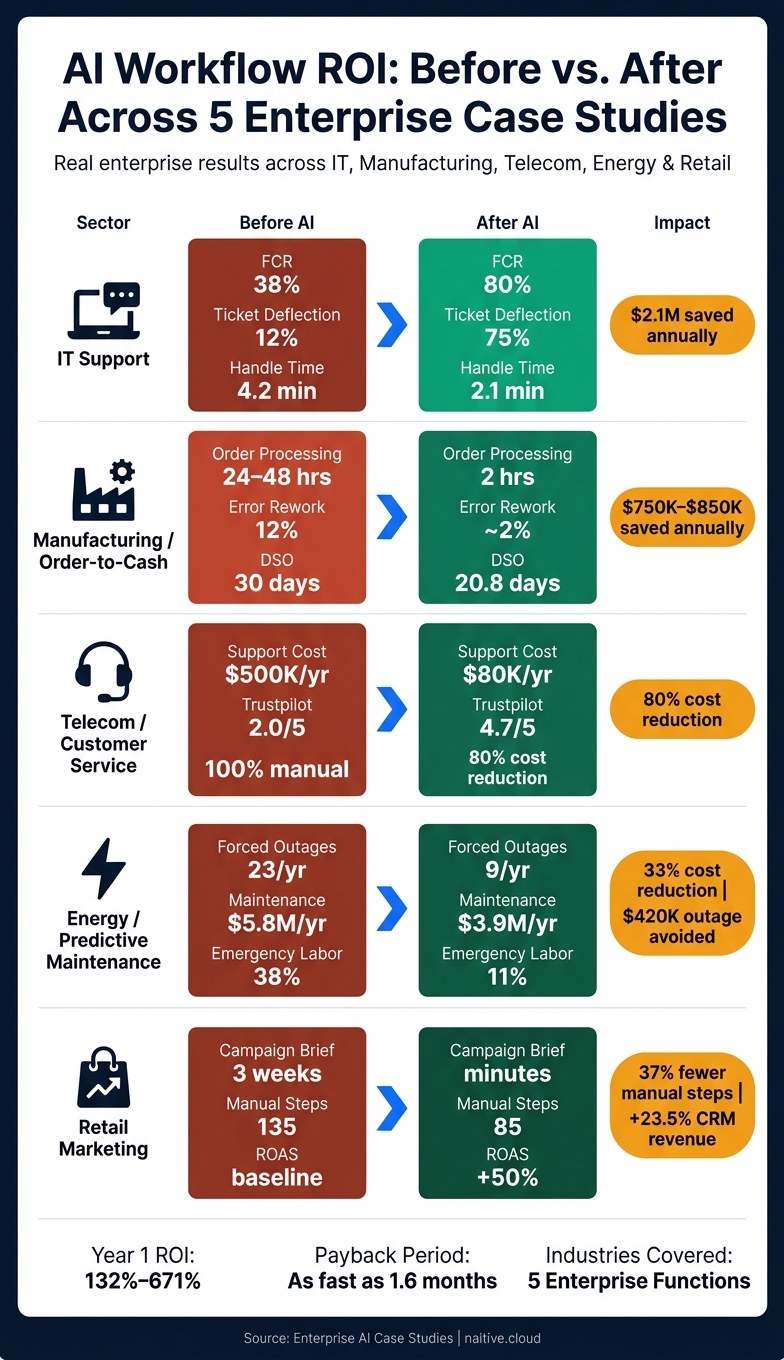
AI Workflow ROI: Before vs. After Across 5 Enterprise Case Studies
How These Case Studies Were Selected
The projects featured here were chosen based on strict criteria: measurable results, clear starting points, and well-documented outcomes.
The first criterion was scale. Each case study highlights large-scale implementations involving global operations or multiple departments.
The second was baseline data. All examples include clear starting metrics, such as 14-day turnaround times, 8–10 hours spent preparing sales reports, or a 9% rate of call misrouting.
The third was defined KPIs. Each case tracks measurable outcomes tied directly to business value, like hours saved, cost reductions, or improved productivity. Here's a breakdown of key enterprise functions and their results:
| Function | Primary KPI | Before AI | After AI |
|---|---|---|---|
| IT Support | Ticket deflection rate | Baseline | 75% deflection |
| Finance | Month-end close cycle | 11 working days | 3 working days |
| Customer Service | Cost per contact | $25.96 | Under $12.00 |
| Sales/GTM | QBR preparation time | 8–10 hours | 20 minutes |
| Treasury | Annual hours saved | Baseline | 60,000+ hours |
These results highlight how AI can optimize a wide range of enterprise functions. The selected cases span IT, finance, customer service, operations, and sales, showcasing the extensive reach of AI-driven improvements across industries.
Case Study 1: IT Support Automation in a Global Enterprise
Managing IT support in large enterprises can feel like an uphill battle. With repetitive tickets piling up, agents often face burnout, and customers endure long wait times. This case study delves into how a Fortune 500 cloud-collaboration SaaS company revolutionized its IT support system using a cutting-edge multi-agent AI solution.
Baseline Challenges
The company, with its 12,000 employees and 80,000 customers, was drowning in over 140,000 support tickets per month. A staggering 68% of these tickets were repetitive, yet their First-Contact Resolution (FCR) rate was just 38%. Most issues required multiple interactions to resolve. A chatbot pilot launched in 2023 achieved only 12% containment, leaving the majority of users dependent on human agents. To make matters worse, critical support information was scattered across multiple platforms, including Confluence, Salesforce, Slack, and SharePoint.
AI Workflow Solution
To tackle these inefficiencies, the company replaced its underperforming chatbot with a multi-agent AI system powered by LangGraph and Claude 3.5 Sonnet. This advanced system streamlined ticket management by classifying and routing incoming requests in real time. Leveraging historical data, it ranked resolution suggestions and provided accurate answers directly through existing tools, bypassing the need for formal ticketing in many cases. Retrieval-Augmented Generation technology consolidated knowledge bases, ensuring consistent and accurate responses. This "shift-left" strategy empowered users to resolve many issues on their own, reducing the need for human intervention.
Measurable Outcomes and ROI
The results were transformative. Within a year, the company achieved:
- A jump in ticket deflection from 12% (legacy bot) to 75%.
- An increase in FCR from 38% to 80%.
- A reduction in average handle time from 4.2 minutes to 2.1 minutes.
These improvements translated into annual savings of approximately $2.1 million.
| Metric | Before AI | After AI |
|---|---|---|
| First‑Contact Resolution (FCR) | 38% | 80% |
| Ticket Deflection Rate | 12% (legacy bot) | 75% |
| Average Handle Time | 4.2 minutes | 2.1 minutes |
| Annual Cost Savings | Baseline | $2.1M |
This success story not only optimized IT support but also paved the way for broader AI-driven advancements across the enterprise.
Case Study 2: Order-to-Cash Optimization in Manufacturing
Manufacturers, like IT support teams, have turned to AI to simplify and improve their operations. For many, the order-to-cash (O2C) cycle is a critical process - one that can either keep revenue flowing smoothly or create frustrating bottlenecks. The challenge? Orders often arrive in various formats - PDFs, emails, faxes, and Excel sheets - making manual processing both time-consuming and error-prone. This case study looks at how U.S.-based manufacturers tackled these issues using AI-powered workflow automation.
Baseline Challenges
Before AI, staff manually entered order data into ERP systems like NetSuite or SAP. This manual approach had some glaring issues:
- Error Rates: Around 10–15% of line-item entries contained errors.
- Rework: Approximately 12% of orders needed to be corrected due to mismatched data.
- Delays: These errors caused shipment delays, strained customer relationships, and increased the volume of support tickets.
Take Zochem, North America’s largest zinc oxide producer, as an example. The company dealt with orders from nearly 500 customers, each submitting purchase orders in different formats. Skilled employees spent their time processing these orders, leading to weekend backlogs that delayed fulfillment by 24–48 hours. Additionally, Days Sales Outstanding (DSO) often stretched to 30 days, creating a ripple effect on cash flow.
AI Workflow Solution
To address these inefficiencies, Zochem teamed up with Initus Technologies to implement the InitusIDP AI engine alongside their NetSuite system. Acting as a "universal translator", this AI engine could process PDFs and emails, extract critical data, and feed it directly into the ERP - completely removing the need for manual data entry. Marcelo Roldán, Practice Lead at Initus, described the impact:
"The AI's ability to read all the different PO formats made the most frustrating part of the job 'disappear,' allowing orders to be processed faster."
Other manufacturers, like Bishop Lifting and EZG Manufacturing, adopted AI for their collections processes. These systems automated outbound communication, segmented customers by payment risk, and prioritized follow-ups. This shift replaced manual collection efforts with intelligent automation, significantly boosting efficiency.
Measurable Outcomes and ROI
The results of these AI implementations were striking:
| Metric | Before AI | After AI |
|---|---|---|
| Order Processing Time | 24–48 hours (weekend backlog) | 2 hours |
| Data Entry Error Rate | 12% rework rate | ~2% |
| Invoice Cycle Time | 14 days | 4 days |
| Days Sales Outstanding (DSO) | 30 days | 20.8 days |
| Annual Labor/Cost Savings | High operational cost | $750,000–$850,000 |
At Zochem, automation reduced data entry errors by over 90% within just 12 weeks of implementation. CFO Ken Williams praised the achievement:
"To deliver a transformation of this magnitude in just 12 weeks is a testament to the focus and collaboration... It sets a new standard for what we can achieve."
EZG Manufacturing also saw impressive results. Their two-person accounts receivable team used AI automation to collect $11.67M, cut DSO by 5 days, and save 20 hours of manual work each week - all without adding staff.
Case Study 3: Customer Service Automation in Telecommunications
Telecommunications companies face significant challenges when their call centers struggle to keep up with demand. The result? Longer wait times, frustrated customers, and higher churn rates. This case study explores how three telecom providers tackled these issues head-on using AI-driven workflow automation.
Baseline Challenges
The main hurdles revolved around high call volumes, rising costs, and inconsistent service quality. For instance, Centracom, a telecom provider based in Utah serving 30,000 households, spent approximately $500,000 annually on an outsourced call center in Georgia. According to Kenyon Anderson, who spearheaded the transition:
"People felt like they were being outsourced. Call times were long. Customers were frustrated. We knew something had to change."
Outsourcing often led to inefficiencies and dissatisfaction. Similarly, Telefónica Spain's B2C division managed 100,000 daily inquiries with 6,000 employees, many of whom were bogged down with repetitive tasks like billing and resetting connectivity. Meanwhile, Openreach (part of BT Group) struggled with a 2.0 out of 5 Trustpilot rating, reflecting widespread customer dissatisfaction.
Faced with these challenges, each company turned to AI solutions tailored to their specific needs.
AI Workflow Solution
To address these issues, the companies implemented AI systems to handle Tier-1 inquiries, allowing human agents to focus on more complex problems.
- Centracom introduced Thoughtly AI voice agents, which specialize in ISP troubleshooting. These agents integrate directly with the company's ticketing system, automatically logging and escalating issues without human input.
-
Telefónica Spain, in partnership with SS&C Blue Prism, rolled out over 1,000 digital workers between 2018 and 2020 to streamline manual workflows. As Javier Magdalena Pinilla, Director of Automation & Process Simplification, noted:
"We need to put complexity out of the relationship with our customers. This is the main driver."
- Openreach deployed NiCE Cognigy AI agents in April 2026 to manage 15 million customer journeys. These agents proactively engaged with customers via text and voice to resolve issues before they escalated.
These customized AI solutions paved the way for measurable improvements in efficiency and customer satisfaction.
Measurable Outcomes and ROI
The results from these AI implementations were striking:
- Centracom's AI system now handles 3,000 inbound calls per month - about 12% of its total call traffic - at 80% lower costs compared to outsourcing, saving the company approximately $420,000 annually.
- Telefónica Spain reduced call handling times by up to 50% and automated 70% of manual tasks in its B2B operations.
- Openreach saw a one-third reduction in inbound contact volumes and boosted its Trustpilot rating from 2.0 to 4.7 out of 5.
| Metric | Legacy / Human-Only | AI-Hybrid / Automated |
|---|---|---|
| Annual Support Costs | ~$500,000 (Centracom) | ~$80,000 (80% reduction) |
| Call Handling Time | Long due to manual processing | Up to 50% reduction per call |
| Inbound Contact Volume | 100% manual or outsourced | 12–33% reduction in inbound load |
| Customer Satisfaction | 2.0/5 Trustpilot (Openreach) | 4.7/5 Trustpilot |
| Service Availability | Limited to shift hours | 24/7 natural voice-based support |
Chris Herbert, Director of Customer Service at Openreach, captured the transformation perfectly:
"By moving to proactive, AI-driven engagement, we've improved appointment success, optimized operations, and given customers greater clarity during a complex national upgrade."
sbb-itb-f123e37
Case Study 4: Predictive Maintenance in Energy and Utilities
Energy and utility companies often face steep expenses due to equipment failures. These costs - spanning unplanned outages, emergency repairs, and idle technicians - become glaringly obvious when tracked closely.
Baseline Challenges
A 1,200MW coal-fired power station in the U.S. Midwest decided to assess the full costs of its reactive maintenance approach. Before implementing any AI solution, the plant experienced 23 forced outages annually, with 14 of those caused by boiler tube failures. Each outage carried a price tag of $180,000 to $400,000, factoring in lost generation, emergency repairs, and penalties. Technicians spent 38% of their labor hours responding to emergencies, and 22% of parts were ordered at emergency premiums. On top of that, the plant’s annual maintenance costs reached $5.8 million - 34% higher than the fleet benchmark. Its Weighted Equivalent Forced Outage Rate (WEFOR) stood at 11.7%, which was 46% above the target.
A proactive solution was clearly needed. Reflecting on the shift, the VP of Generation Operations noted:
"What changed our thinking was not any single save - it was seeing our maintenance team shift from firefighting to planned work."
AI Workflow Solution
To address these challenges, the plant transitioned from reactive maintenance to a predictive approach. Using the iFactory AI platform, the team completed a 16-week rollout, monitoring 147 assets such as steam turbines and boiler feed pumps. The platform integrated real-time data from existing Distributed Control Systems (DCS) and IoT sensors, analyzing vibration, temperature, acoustic signals, and pressure to establish performance baselines for each asset. Machine learning models identified anomalies 14 to 60 days before a critical failure, giving the team enough time to order parts and schedule repairs without emergency premiums.
To ensure a smooth transition, a 30-day "shadow period" was implemented before connecting the AI system to live work orders. This allowed engineers to fine-tune alert thresholds and avoid unnecessary disruptions.
Measurable Outcomes and ROI
After 14 months, the results were striking. Forced outages dropped from 23 to 9 per year - a 61% reduction. The mean time to repair shrank from 14.3 hours to 5.8 hours. Emergency labor hours for technicians fell from 38% to just 11%, enabling the team to focus more on planned, value-added work. Maintenance costs decreased to $3.9 million annually, a 33% reduction.
One standout example involved the system detecting a turbine bearing defect 52 days before failure, avoiding a $420,000 loss - enough to cover the platform’s entire annual subscription cost.
| Metric | Before AI | After AI (14 Months) | Change |
|---|---|---|---|
| Forced Outages per Year | 23 | 9 | 61% decrease |
| Mean Time to Repair | 14.3 hours | 5.8 hours | 59% faster |
| Technician Emergency Hours | 38% of labor | 11% of labor | 71% reduction |
| Total Maintenance Spend | $5.8M/year | $3.9M/year | 33% lower |
| Failure Detection Lead Time | 0 days | 47 days average | Full advance warning |
This shift propelled the plant from bottom-quartile to top-decile fleet performance. It highlights how AI-powered workflows can slash costs and dramatically improve operational efficiency.
Case Study 5: Marketing and Sales Automation in Retail
The retail sector offers a clear example of how AI can transform workflows, especially in marketing and sales. Retail marketing teams have traditionally faced challenges with manual processes that slowed down campaign execution. Before AI solutions came into play, running a single campaign often required a time-consuming and inefficient effort across multiple channels. Let’s take a closer look at the obstacles retail teams faced and how AI helped tackle them.
Baseline Challenges
The sheer amount of manual work involved in retail marketing becomes evident when you break it down. For example, Accenture’s global marketing team - comprising nearly 2,000 employees - had to complete 135 manual steps to execute just one campaign. Creating a strategy brief alone could take up to three weeks, as it required extensive research from both internal and external data sources.
Natura Cosméticos’ CRM teams dealt with an equally cumbersome process. They had to manually query multiple legacy systems and merge data in Excel to create performance reports.
"To consolidate the numbers, we used to query different sources and merge everything manually in Excel. It took several working days to deliver reports - a huge lag for planning teams." - Julia Formentin, CRM Analytics Manager, Natura Cosméticos
Meanwhile, Bestseller, a Danish fashion group that owns brands like Jack & Jones and Vero Moda, faced delays in its advertising system. Their system couldn’t sync with real-time sales data, running 24 hours behind. This delay made real-time bid adjustments in digital advertising virtually impossible.
AI Workflow Solution
Retailers turned to AI to replace these outdated workflows with automated systems that could act on live data. Accenture introduced "AI Refinery" agents to handle tasks like research, segmentation, and content drafting. This reduced the time needed to produce an initial strategy brief from weeks to just minutes.
Natura Cosméticos implemented the Databricks Data Intelligence Platform to automate CRM reporting across six countries. This eliminated the need for manual SQL queries and provided daily insights for campaign planners. Bestseller partnered with agency Refyne and used Google Cloud’s Vertex AI to create a return-prediction model. This model evaluated shopping carts in real time, calculating the true value of each sale and enabling immediate adjustments to Google Ads bids.
"In an era of rising costs, the winner isn't the one who bids the most, but the one who knows exactly what a customer is worth before the bid is even placed." - Jens Castenskjold Viborg, Digital & Media Manager, Bestseller
Measurable Outcomes and ROI
The results of these AI-driven changes were impressive, going far beyond just operational improvements. Bestseller’s return-prediction model achieved 93% accuracy and delivered a 50% increase in Return on Ad Spend (ROAS) in the Netherlands, while reducing cost-per-click (CPC) by 24.5%.
Natura Cosméticos saw its reporting cycle time drop by 64%, which contributed to a 23.5% increase in CRM-driven revenue. This allowed planners to adjust campaigns almost in real time. Accenture managed to cut manual campaign steps from 135 to 85 - a 37% reduction - giving marketers more time to focus on strategy.
| Metric | Before AI | After AI |
|---|---|---|
| Campaign Strategy Brief Time | Up to 3 weeks | Minutes (initial draft) |
| Manual Campaign Steps | 135 steps | 85 steps |
| Reporting Cycle Time | Several working days | 64% faster |
| Return on Ad Spend (ROAS) | Baseline | +50% |
| Cost Per Click (CPC) | Baseline | −24.5% |
| CRM-Driven Revenue | Baseline | +23.5% |
These examples highlight how AI not only streamlines processes but also drives better business outcomes. From boosting revenue to cutting costs, the results align with the overall trends observed in this series of case studies.
Patterns Across All Five Case Studies
When examining all five implementations - IT support, order-to-cash, customer service, predictive maintenance, and retail marketing - three recurring themes stand out: seamless data integration, clear KPIs from the start, and human-in-the-loop governance.
In every instance, AI agents were directly integrated into the systems where work happens - platforms like Salesforce, SAP, Oracle, NetSuite, Slack, and Microsoft Teams. Instead of overhauling existing infrastructure, integration layers were used to provide AI with direct, live access to operational data. This eliminated redundant manual tasks and enabled real-time data interaction. For example, SnapLogic's "Jean-Paul" agent connected Salesforce, Zendesk, and BigQuery simultaneously, saving 2,141 hours in just 30 days - equivalent to 12.5 full-time employees.
Governance was another consistent element. High-stakes workflows relied on automated systems paired with human oversight. Routine, high-probability tasks were handled automatically by AI, while more complex or ambiguous tasks were escalated to humans for review. A $1.2 billion specialty chemicals company illustrates this approach: 85% of monthly journal entries were auto-posted, with lower-confidence entries reviewed by human controllers. This setup led to $850,000 in annual savings with zero SOX 404 findings. Additionally, human overrides were fed back into the system for weekly retraining, continuously improving the AI’s performance. This combination of seamless integration and robust governance delivered impressive financial outcomes.
The first-year returns across industries ranged between 132% and 671%, with payback periods as short as 1.6 months. Here’s a snapshot of the results across different sectors:
| Sector | Year 1 ROI | Payback Period | Key Improvement |
|---|---|---|---|
| Manufacturing | 384% | 2.5 months | 79% reduction in downtime |
| Law Firm | 671% | 1.6 months | 67% reduction in research time |
| Healthcare | 340% | < 4 months | 99% faster prior authorization |
| Fashion E-commerce | 132% | 5.2 months | 99% faster response time |
| B2B Consulting | 181% | 4.3 months | 87% increase in lead conversion |
The Role of Specialized Partners
Beyond the technical groundwork, specialized partners played a pivotal role in these successes. These partners bridged the gap between technology and business needs by mapping out processes and tailoring integrations to fit specific requirements. They also ensured security measures were in place and delivered functional MVPs in weeks, sometimes even days. For example, some AI agents built on existing integration layers went live in as little as 1–3 days, compared to the typical industry timeline of 8 months.
This is where firms like NAITIVE AI Consulting Agency make a difference. Rather than offering a generic solution, these partners focus on designing systems tailored to each business’s workflows, compliance needs, and data environments. The success of a project often hinges on whether the implementation team has the depth of understanding to define the right KPIs, build effective integrations, and establish governance that can withstand real-world challenges.
"Strategy before technology. The client already had the technology - what was missing was the systematic framework." - Lunatec Case Study
This quote highlights a key insight: technology itself is rarely the limiting factor. The real differentiator between success and failure lies in having a clear, well-thought-out strategy to guide the implementation.
Conclusion
The five case studies discussed here highlight one clear trend: tangible, quick results. For instance, a global retail bank automated the resolution of 18,000 Level 1 tickets each month, saving $1.8 million in costs. A mid-sized health system slashed prior authorization turnaround time from 14 days to just 2.8 hours, saving $1.44 million annually. Meanwhile, Medtronic reduced their cost per contact from $25.96 to under $12, freeing up 36,000 agent hours in the process. These examples underscore how AI can transform enterprise workflows in a measurable way.
The success of these projects rests on two key practices:
- Target high-volume, structured workflows. Processes like Level 1 support tickets, financial journal entries, and standard authorization requests offer immediate and measurable returns. Once the system demonstrates its value, scaling it across the organization becomes much easier.
- Adopt strategic operational habits. Successful teams started by running AI in shadow mode to build trust and refine processes before full deployment. They also treated AI as an ongoing operational tool, assigning dedicated staff to monitor accuracy, update rules, and retrain models as needed.
As one case study put it:
"AI didn't replace the finance team - it gave them their evenings back. That's the difference between an automation tool and an AI finance agent." - DreamzTech Case Study
These examples illustrate how AI, when implemented thoughtfully, can serve as a powerful ally in optimizing workflows and freeing up valuable human resources.
FAQs
Which enterprise workflows are best to automate first with AI?
When introducing AI into your workflows, start with high-volume, repetitive tasks that rely on clear business rules and deliver measurable returns. These are the processes where automation can make the biggest impact, whether by saving time, cutting costs, or improving overall quality.
Examples of strong candidates for AI implementation include document-heavy tasks like invoice processing, account verification, financial month-end close activities, or even routing customer support tickets. The key is to strike the right balance: let AI handle the routine, repetitive work, while leaving complex decisions to human expertise. This approach ensures efficiency without compromising on quality or oversight.
What data and systems should we integrate for AI workflow ROI?
To see tangible ROI, it's essential to connect AI with your main systems, such as ERPs like SAP, Oracle, or NetSuite, and CRMs such as Salesforce. Integrating with tools like Zendesk for ticketing and communication platforms like Slack helps create a seamless workflow.
A unified data layer plays a crucial role here, breaking down data silos so AI can analyze and combine information from different sources effectively. You can also boost AI capabilities by incorporating vector databases for better knowledge management and IoT sensors for real-time operational monitoring. These additions strengthen predictive analytics and support smarter decision-making.
How do you govern AI agents to keep accuracy and compliance high?
To build accurate and compliant AI systems, AI governance needs to be woven into the design process from the start. NAITIVE AI Consulting Agency emphasizes the concept of bounded autonomy, which ensures AI agents function strictly within clearly defined policies, permissions, and audit guidelines.
This involves implementing automated safeguards, such as:
- Policy checks to ensure adherence to established rules.
- Access controls to limit unauthorized use.
- Escalation triggers for tasks deemed high-risk.
These measures create a framework where audit trails are maintained, and human oversight is applied when necessary. The result is a scalable approach to integrating AI systems while staying compliant with regulations.