AI Agents for Predictive Maintenance: Case Studies
AI agents link sensor data to CMMS, triage alerts, and trigger work orders to cut downtime and maintenance costs.
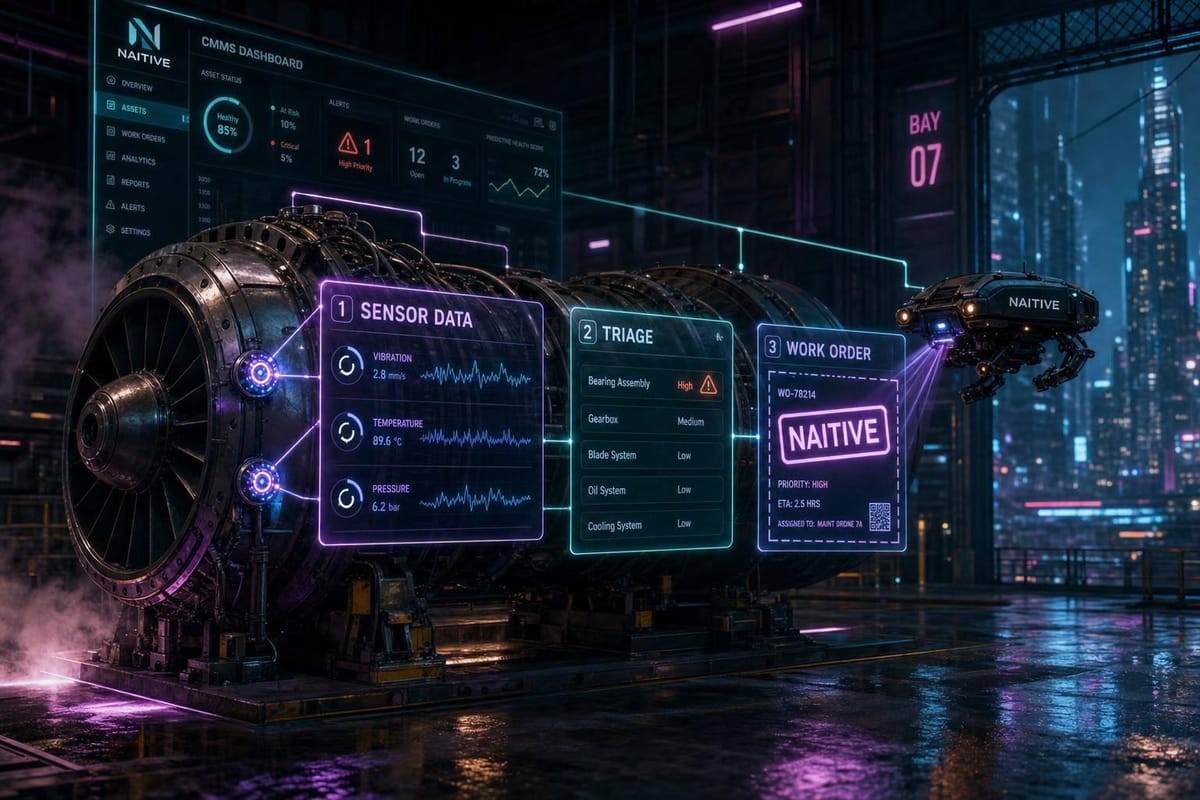
AI agents help maintenance teams move from "we see a risk" to "here’s the next step." In these case studies, I see the same pattern again and again: when prediction is tied to work-order flow, parts checks, and human approval, teams cut downtime and trim maintenance costs.
Here’s the short version:
- Siemens / Senseye focused on early fault detection and alert ranking
- IBM Maximo Predict tied asset health scores to scheduling and work-order triggers
- Azure-based agent workflows added a rule layer between ML alerts and CMMS actions
And the results were clear:
- Up to 50% lower unplanned downtime with Siemens / Senseye
- $1.31 million in annual savings and 154% first-year ROI with IBM Maximo
- Up to 40% lower unexpected downtime with Azure-based setups
What matters most is not just the model. It’s the full workflow:
- Sensor and machine data
- CMMS/EAM and ERP links
- Risk scoring
- Approval rules
- Work-order creation
If I had to boil the article down to one idea, it would be this: the best agent setups automate triage, while people still approve higher-risk work.
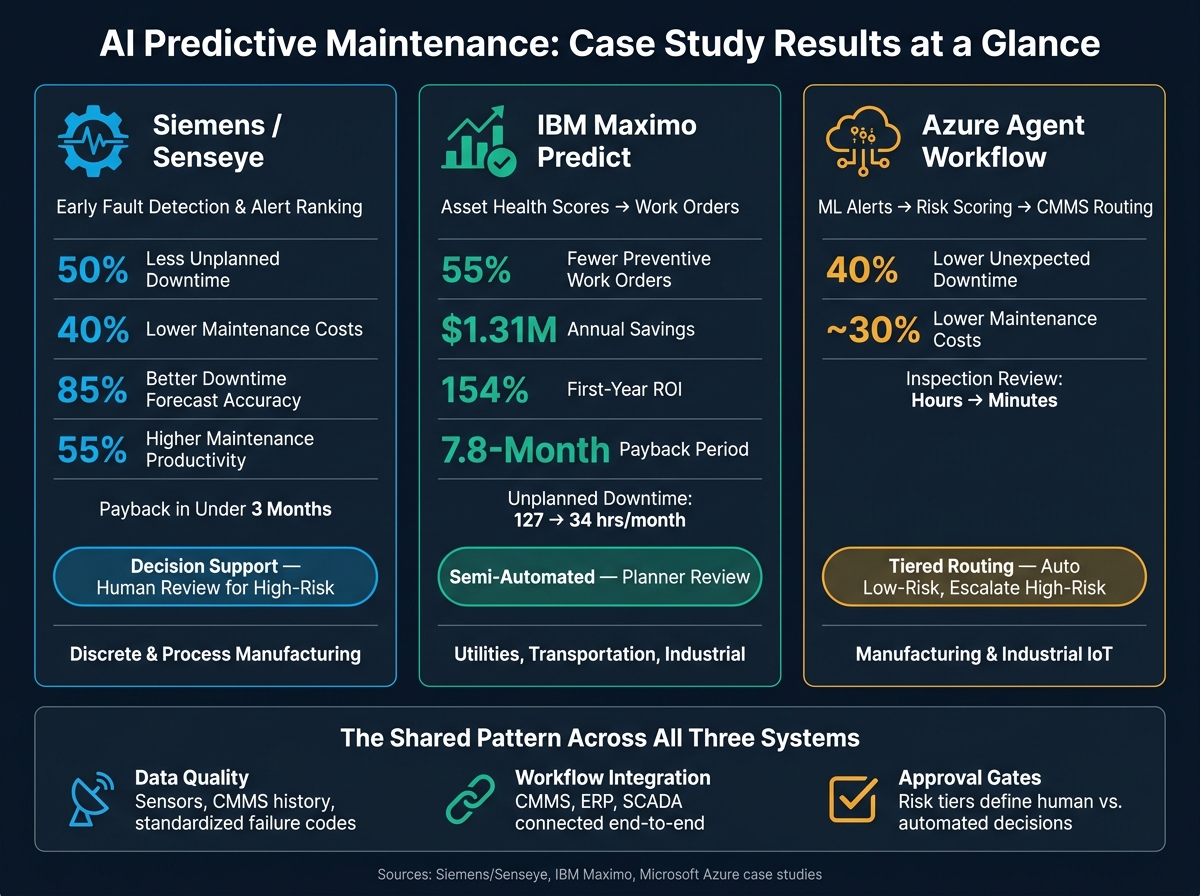
AI Predictive Maintenance Systems: Results Compared
How to Architect an Agentic AI-Powered Predictive Maintenance Solution
sbb-itb-f123e37
Quick Comparison
| System | Main role | Data used | Autonomy level | Reported results |
|---|---|---|---|---|
| Siemens / Senseye | Detects faults early and ranks alerts | Sensors, PLC/SCADA, maintenance logs | Decision support with human review for higher-risk cases | Up to 50% less unplanned downtime, 40% lower maintenance costs, payback in under 3 months |
| IBM Maximo Predict | Turns health scores into schedules and work orders | IoT data, inspections, asset history, failure records | Semi-automated work-order triggering with planner review | 55% fewer preventive work orders, $1.31 million annual savings, 154% ROI |
| Azure agent layer | Checks ML alerts, scores risk, and routes action | IoT telemetry, logs, error codes, CMMS/ERP history | Tiered automation by risk level | Up to 40% lower unexpected downtime, about 30% lower maintenance costs |
Bottom line: if you want better results from predictive maintenance, don’t stop at detection. Working with an AI consulting agency can help you bridge the gap between data and action. Connect alerts to work-order flow, set risk tiers, and keep people in the loop for safety-critical decisions.
Case Study: Siemens and Senseye Predictive Maintenance
Siemens' Senseye Predictive Maintenance is built to spot trouble before a machine fails. It keeps a running score of machine health, flags risk early, and ranks alerts so maintenance teams can go after the assets most likely to fail first. The loop is simple: detect risk, rank alerts, guide response.
The Operational Problem and Agent Workflow
Fixed maintenance schedules often miss the small warning signs that show up before a breakdown. A motor may run hotter than usual. A pump may pull more current than normal. A conveyor may start vibrating just a little off-pattern. On their own, those signals can look minor. Together, they can point to trouble ahead.
Senseye takes in telemetry, compares it against past failure patterns, and ranks anomalies by failure risk. When something looks off, the system pushes that issue up or down the queue based on how likely it is to turn into a failure. That triage step matters because it helps teams focus on the machines that need attention NOW, not just the ones next on a calendar.
That’s where the day-to-day value shows up: faster prioritization and fewer missed failure windows.
Data Inputs, Deployment, and Reported Outcomes
The system pulls from a mix of plant data, including:
- Electrical measurements such as current draw and power consumption
- Mechanical signals like vibration and temperature
- Control-system tags from PLCs
- Process metrics such as throughput and pressure
Many deployments rely on data plants already collect, which helps limit retrofit work.
Siemens reports 85% better downtime forecasting accuracy, 50% less unplanned downtime, 55% higher maintenance productivity, and about 40% lower maintenance costs, with payback in under 3 months in some cases.
One global automotive manufacturer rolled the system out across 10,000+ machines and 100 machine types. More than 500 users acted on the system’s insights, and the company saw up to 6 months of lead time before failure, leading to tens of millions of dollars in downtime savings.
BlueScope Steel saved about 2,000 hours of unplanned downtime since 2022 and prevented 53 full process shutdowns. That total included 1,200+ hours in Australia and 750+ hours across New Zealand and Southeast Asia.
In another case, a hydraulic leak on a metal coating line was caught early enough to avoid at least 24 hours of stoppage and a low six-figure cost impact.
The next case shows how asset-health scoring moves from detection into maintenance scheduling.
Case Study: IBM Maximo Predict and Asset Health Management
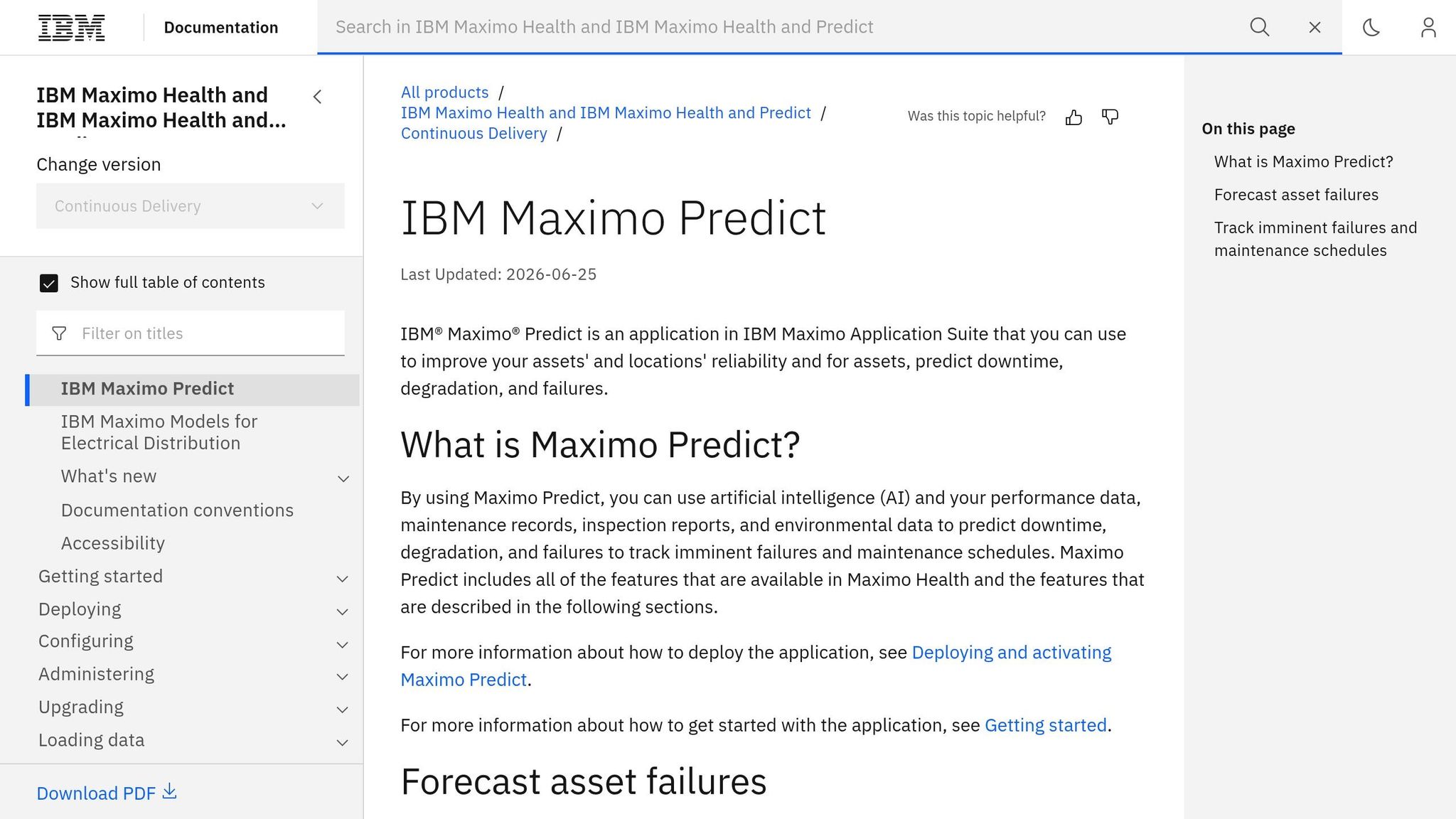
IBM Maximo Predict builds a continuous health score for each asset by pulling together condition data, inspection reports, maintenance records, failure history, and sensor data. That score doesn’t just sit on a dashboard. It shapes predictions and gives planners a clear signal on what to do next. From there, the score flows straight into maintenance planning.
How Failure Prediction Connects to Maintenance Scheduling
Maximo links failure probability, predicted failure date, RUL, and anomaly flags to work-order triggers. When failure probability passes a set threshold, Maximo can automatically create an inspection or corrective work order, or send the result to a planner for review.
If the predicted failure date lands inside a set planning window - often 30 to 90 days - teams can line up the work during planned downtime or off-peak hours, with labor and parts ready to go. That’s the practical side of prediction: not just knowing what might fail, but fitting the repair into a schedule that makes sense.
Assets with the weakest health scores move to the top of the queue. Lower-risk assets can wait longer between service cycles, which frees up crew time for jobs that need attention now. Maximo Manage connects those scores straight to daily schedules and work orders.
The same setup shows up in cloud-native deployments too, where the agent layer handles the handoff from telemetry to work order.
Business Impact and Lessons Learned
One detailed case study showed preventive maintenance work orders drop from 847 to 380 per month, a 55% reduction. Unplanned downtime fell from 127 to 34 hours per month, and inspection time dropped from 450 to 85 hours per month. The total impact came to $1.31 million in annual savings, a 154% first-year ROI, and a 7.8-month payback period.
A power transmission operator using Maximo-based AI asset management improved asset availability from 87% to 92%, reported no surprise failures in critical corridors, cut penalties by 78%, reduced emergency repairs by 70%, and lowered maintenance costs by about 35%.
Two lessons stand out here.
- Data quality matters. A documented pump bearing model started at 75% precision but slipped after a plant changed its cooling water treatment, which caused data drift. Getting trust back meant retraining the model, adjusting thresholds, and adding a technician feedback mechanism directly in work orders.
- Put health scores where people work. Maximo teams saw more value when health scores appeared inside work-order screens instead of living in separate dashboards.
The next case shows how a cloud agent layer turns that same workflow into an end-to-end automation path.
Case Study: Azure-Based Predictive Maintenance with an Agent Layer
Where Maximo connects predictions to scheduling, Azure pushes the same idea into a cloud-native agent workflow. The Azure setup ties telemetry, analytics, ML, and an agent layer into a single maintenance process.
End-to-End Architecture: From Telemetry to Work Order
Sensors that track vibration, temperature, pressure, and electrical load send data into Azure IoT Hub, which manages secure ingestion for connected equipment. From there, Azure Stream Analytics or Azure Databricks blends live telemetry with maintenance logs and error codes. Those enriched datasets then feed Azure Machine Learning models trained to estimate remaining useful life (RUL) or detect anomalies before a failure hits.
The agent sits between the ML output and the maintenance system. That matters because the model does not send every alert straight into a work order. Instead, the agent runs a few checks first: it verifies that the alert holds over a set time window, checks whether multiple signals point to the same issue, and compares the pattern with past cases that led to real failures.
Once an alert clears those checks, the agent assigns a risk score based on failure likelihood, estimated time to failure, safety impact, and expected downtime cost. Then it routes the event by severity:
- Low-risk alerts are logged for monitoring.
- Medium-risk events trigger a planned work order for the next open maintenance window, along with a recommended checks-and-parts list.
- High-risk events create an urgent work order, notify supervisors, and can include a controlled shutdown recommendation if needed.
You can see the flow more clearly in a pump-failure example. A pump at Plant B starts showing abnormal vibration and rising temperature. The model assigns a high risk score and estimates a failure window of 3–5 days. The agent then checks that signal against past patterns, reviews the production schedule and planned outages, and confirms that the pump is critical to output.
After that, it creates a CMMS work order for a planned shutdown and replacement within the next 48 hours. It also attaches diagnostic steps and a parts list based on past repairs and equipment manuals, then notifies the assigned technicians with the reason behind the risk score.
Scalability, Integration, and Measured Outcomes
At larger scale, the same pattern helps cut downtime and shortens the path from alert to action. Since telemetry and maintenance history sit in Azure, teams can apply the same decision logic across sites while tuning thresholds by asset type, criticality, and operating conditions.
The main handoff points are the connectors between the agent and business systems such as CMMS, ERP, and Dynamics 365 Field Service. Those links let work orders, parts reservations, and technician notifications move through the system automatically, without manual re-entry.
Reported results for Azure AI-powered predictive maintenance include up to 40% lower unexpected downtime and around 30% lower maintenance costs. When teams add an agentic workflow layer on top of standard ML pipelines, inspection review time has also dropped from hours to minutes. To measure performance, teams track unplanned downtime, alert precision, MTBF, MTTR, and lead time to work-order creation.
Cross-Case Comparison and Conclusion
What These Cases Show About Successful AI Agent Deployments
Across all three cases, one thing stands out: results get better when sensor data, CMMS/ERP integration, and approval rules work together. BlueScope Steel saved about 2,000 hours of unplanned downtime and prevented 53 process shutdowns since 2022. That’s what happens when a prediction doesn’t just sit on a dashboard, but kicks off action through a work order.
The table below shows how these cases differ in the areas decision-makers usually care about most:
| Siemens / Senseye | IBM Maximo Predict | Azure-Based Agent Layer | |
|---|---|---|---|
| Industry focus | Discrete and process manufacturing | Utilities, transportation, industrial facilities | Manufacturing and industrial IoT |
| Primary data sources | Existing sensors, PLC/SCADA, maintenance logs | IoT telemetry, inspection records, asset histories | Azure IoT Hub telemetry, CMMS/ERP history |
| Agent autonomy level | Decision support; humans approve high-risk interventions | Augmented decision support; semi-autonomous scheduling for routine work orders | Tiered routing; low-risk cases automated, higher-risk cases escalated |
| Integration points | CMMS/EAM, production control, condition monitoring | Maximo EAM, ERP, scheduling modules | CMMS, ERP, SCADA, IoT and analytics services |
| Reported outcomes | Up to 50% reduction in unplanned downtime; 40% lower maintenance costs; payback under 3 months. | 55% fewer preventive work orders; $1.31 million annual savings; 154% first-year ROI. | Up to 40% lower unexpected downtime; ~30% lower maintenance costs. |
The shared pattern is simple: the best systems automate triage, not final judgment.
Human oversight is still non-negotiable, especially for safety-critical assets. The strongest deployments set risk tiers up front - low, medium, and high - and tie each one to a required approval level. That setup lets agents handle routine pattern detection while engineers spend their time on harder trade-offs and regulatory issues.
How to Scope a Predictive Maintenance Program
Once the operating model is set, the next step is deciding where to begin. A smart starting point is one high-value asset class where sensor data already exists and downtime costs are easy to measure. Before building any agent logic, check the basics:
- Confirm sensor coverage
- Review at least 12–24 months of maintenance history in your CMMS
- Verify that failure codes are standardized
- Test connectivity from PLC/SCADA into a central data platform
For autonomy design, decide early which asset types or risk levels can allow automatic work order creation. Then build those rules into your workflows before you scale.
Across every case, the same three factors keep showing up: data quality, workflow integration, and approval gates. NAITIVE AI Consulting Agency can scope the first asset class, assess data readiness, and integrate agent workflows with CMMS and ERP.
FAQs
How do AI agents differ from predictive maintenance models?
Predictive maintenance models look at equipment data to spot signs of trouble before a machine fails. They then surface those findings as insights or alerts for a person to review.
AI agents take the next step. Instead of just flagging an issue, they can act on it by managing maintenance workflows, adjusting schedules, and handling troubleshooting or optimization with less human input.
What data is needed to start predictive maintenance?
To get started with predictive maintenance, you need baseline data. That gives you a starting point to measure performance and see whether things are getting better, worse, or holding steady.
You also need a steady stream of data from IoT sensors attached to key equipment. These sensors track conditions like temperature and vibration, which often show early signs of wear or trouble.
Historical data matters too. Without it, the AI has no past patterns to learn from. With that history in place, it can spot unusual behavior, flag anomalies, and predict when a piece of equipment may fail.
When should work orders be created automatically?
Work orders should be created automatically when AI-driven monitoring systems spot unusual shifts in equipment performance, like changes in temperature or vibration.
That gives maintenance teams a head start. Instead of scrambling after an unexpected breakdown, they can catch likely failures early and plan repairs during scheduled downtime.