
AI in Smart Grids: Multi-Agent Systems
Compare hierarchical, decentralized, and hybrid MAS plus rising MARL for smart grids—trade-offs in speed, privacy, peak shaving, and deployment risk.
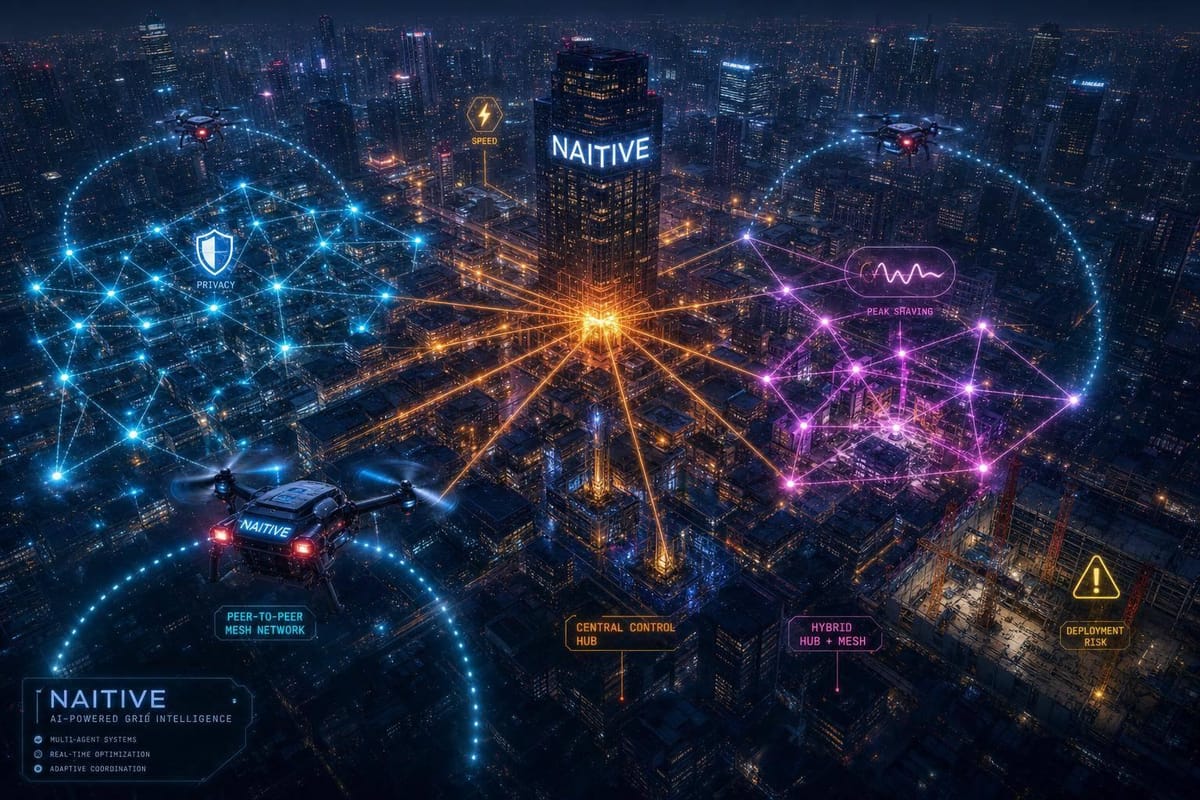
Multi-agent systems help smart grids make local decisions faster, cut peaks, and keep more control close to the edge. From the studies in this article, I’d boil it down like this: hybrid and decentralized agent setups often handle scale, faults, and privacy better than fully central control, while MARL is gaining ground for demand response, EV charging, and power-flow control.
If you just want the main takeaways, here they are:
- I see three main MAS designs: hierarchical, decentralized, and hybrid
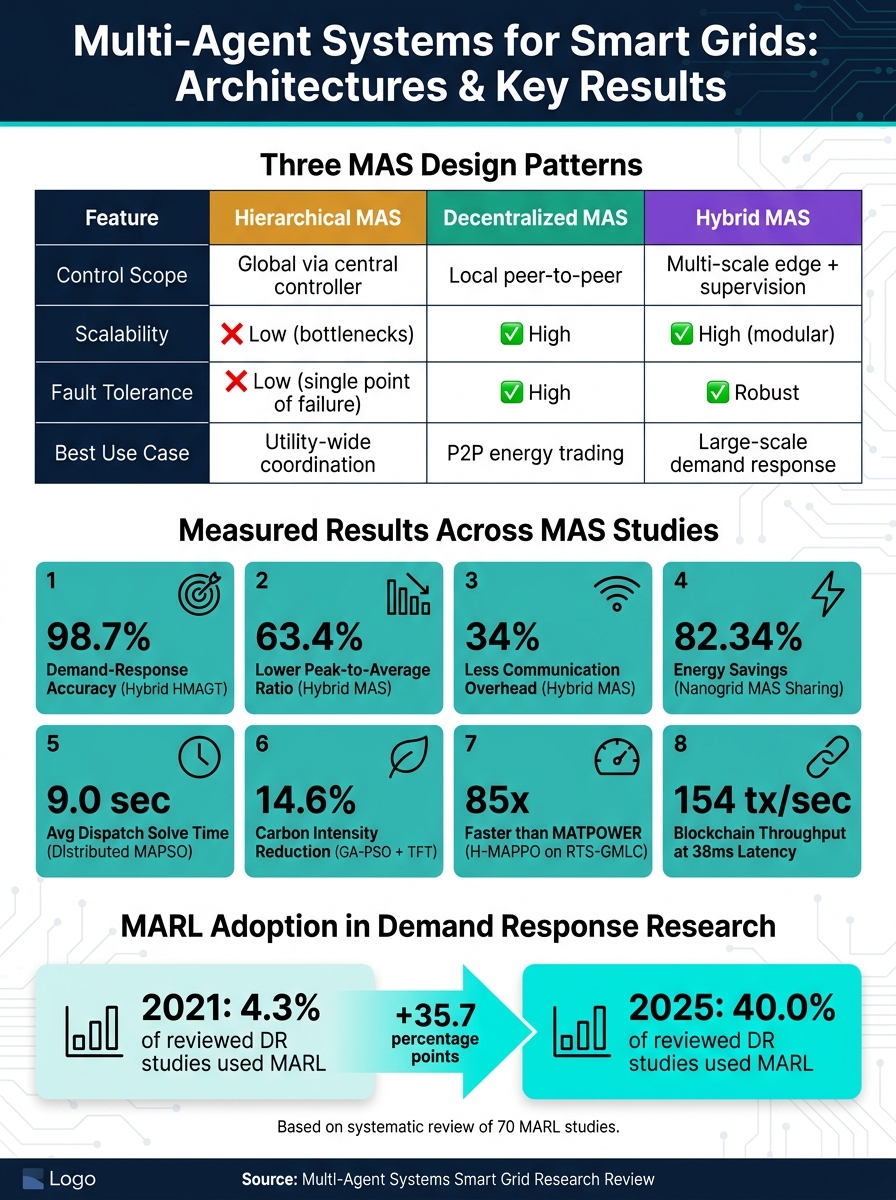
- Hybrid systems stood out in several results, including 98.7% demand-response accuracy, 63.4% lower peak-to-average ratio, and 34% less communication overhead
- In microgrid and nanogrid work, MAS showed 82.34% energy savings in one energy-sharing case
- For short dispatch, distributed MAPSO reached a 9.0-second average solve time with 15.6% variability
- In one forecast-plus-optimization setup, researchers reported 14.6% lower carbon intensity and 12.3% higher renewable use
- MARL use in reviewed demand-response studies grew from 4.3% in 2021 to 40.0% in 2025
- On the RTS-GMLC benchmark, H-MAPPO reached 100% feasible convergence across 50%–150% load uncertainty and ran 85x faster than MATPOWER
- For peer-to-peer trading, a blockchain layer handled 154 transactions per second with just 38 ms added latency
This means if you run or study grid control, you’re not just choosing an AI method. You’re choosing a trade-off between global control, fault tolerance, privacy, communication load, and human oversight.
Quick comparison
| Approach | Best fit | Main upside | Main downside |
|---|---|---|---|
| Hierarchical MAS | Utility-wide coordination, centralized microgrid control | Strong top-level visibility | Bottlenecks and single-point failure risk |
| Decentralized MAS | Peer-to-peer energy trading, local DER control | Better fault tolerance and local privacy | Harder to reach system-wide optimum |
| Hybrid MAS | Large demand response programs, linked microgrids | Mix of local action and top-level coordination | More design complexity |
| MARL-based MAS | Fast-changing grid tasks like DR, EVs, voltage control | Fast online decisions after training | Low explainability and training instability |
So if I had to sum up the article in one line: MAS works best when the control design matches the grid task, and the current research points toward hybrid systems and MARL for many high-change grid problems.
Multi-Agent Systems for Smart Grids: Architecture Comparison & Key Performance Stats
[MERL Seminar Series Spring 2023] Investigating Multi-Agent Reinforcement Learning for Grid-Inter...

sbb-itb-f123e37
Multi-Agent Architectures for Smart Grid Control
Smart-grid MAS usually fall into three patterns, often optimized by specialized AI consulting: hierarchical, decentralized, and hybrid. Each one makes a different trade-off between control, fault tolerance, and communication load. Those trade-offs don't stay on paper. They directly affect energy distribution, optimization, and demand response.
Hierarchical vs. Decentralized Agent Designs
Hierarchical MAS usually has three layers. At the top sits a microgrid energy management system (µEMS), which handles global optimization. In the middle, local agents (LA) or local controllers (LC) gather data and make local decisions. At the bottom are the physical assets and grid components.
That setup gives operators a full-system view, which is useful when you want one place making the big calls. The catch is the bottleneck. When too much depends on the top layer, failure there can expose the whole system. That changes dispatch speed, fault tolerance, and communication load.
Decentralized designs work the other way. Agents act on their own, using local data, activity history, and interactions with neighboring agents instead of waiting for a central authority. This makes the system more resilient and helps protect privacy because load data stays local. The trade-off is that global optimization gets tougher.
Hybrid architectures aim for a middle ground. Lower-layer edge agents handle local forecasting and demand, while a supervisory layer coordinates across the larger community. A June 2026 study of the Energy-Efficient Hierarchical Multi-Agent Graph Transformer reported 98.7% demand-response accuracy, a 63.4% lower peak-to-average ratio, and 34% less communication overhead.
Agent Roles, Coordination, and Communication
In practice, MAS agents don't all do the same job. Some manage assets. Some watch the grid. Others coordinate actions across many participants.
- Prosumer agents manage local generation, storage, and consumption.
- Aggregator agents combine small-scale assets, usually under 100 kW, so they can take part in wholesale markets or redispatch processes.
- Monitoring agents gather data from DERs through smart meters and sensors.
- Control agents manage energy balance and shape prosumer behavior through policy interventions.
There are also more specialized roles, including Energy Efficiency Agents (EEA), Time-of-Use Agents (TOUA), and Demand Response Agents (DRA).
Coordination depends on the architecture. Hierarchical systems push large volumes of data to a central controller. Decentralized systems lean on local message passing, distributed consensus protocols, and negotiation algorithms. For peer-to-peer trading, blockchain smart contracts can handle the exchange layer; one implementation supported 154 transactions per second with a latency increase of only 38 ms. On the device side, messaging often uses MQTT, LoRaWAN, or ZigBee. Interoperability usually relies on IEC 61850 and ISO/IEC 15118.
Comparison Table: Common MAS Architecture Patterns
| Feature | Hierarchical MAS | Decentralized MAS | Hybrid MAS |
|---|---|---|---|
| Control Scope | Global optimization via central controller | Local optimization via peer-to-peer interaction | Multi-scale: local edge control with community-wide supervision |
| Scalability | Limited by central processor bottlenecks and communication overhead | High; easily integrates new resources and nodes | High; uses modular intelligence stacks to manage dense environments |
| Fault Tolerance | Low; prone to single points of failure at the central level | High; outages in one component do not affect the entire system | Robust; maintains local functionality if supervisory layers fail |
| Communication Needs | High-volume data flow to central controller | Localized message passing between neighbors | Optimized; uses compressed edge-cloud coordination |
| Operator Oversight | High; central authority makes final calls | Low; autonomous agent interactions | Balanced; oversight at key nodes |
| Common Use Cases | Microgrid balancing, centralized reactive power control | Peer-to-peer energy trading, transactive energy | Large-scale demand response, interconnected microgrids |
These architecture choices shape how well MAS can handle dispatch, demand response, and EV charging.
Research Findings on Energy Distribution, Optimization, and Demand Response
These studies show what happens when multi-agent systems move from theory into day-to-day grid decisions. Some focus on local dispatch inside microgrids and nanogrids. Others look at demand response across the grid, where many devices react to price signals at the same time.
Microgrid Energy Management and Distributed Dispatch
Nanogrid energy sharing makes the pattern easy to see. When individual buildings with their own renewable energy sources (RES) share energy through a multi-agent system, studies report more than 82.34% energy savings. In some cases, this setup also removes the need for local storage.
Speed matters too, especially when renewable output changes every few minutes. A co-simulation study published in August 2025 used the Python Agent Development (PADE) platform with the Mosaik co-simulation framework to test distributed Multi-Agent Particle Swarm Optimization (MAPSO) for 5-minute dispatch under renewable variability. Distributed MAPSO produced lower objective values and lower variability than distributed PSO. It reached an average solution time of 9.0 seconds and 15.6% performance variability, compared with 33.9% for standard distributed PSO.
A November 2025 study in MDPI Computation paired Temporal Fusion Transformers (TFT) for multi-horizon forecasting with a hybrid Genetic Algorithm–Particle Swarm Optimization (GA-PSO) method. TFT outperformed LSTM and GRU by 11% and 8%, with 0.041 kWh RMSE. The full framework brought together forecasting, optimization, and blockchain coordination, leading to a 14.6% reduction in carbon intensity and a 12.3% increase in renewable utilization compared with baseline models. That link matters: better local control can also cut emissions and make better use of clean power.
Demand Response, Transactive Energy, and EV Charging
Demand-response studies look at a different problem. It’s not just about dispatching supply well. It’s about getting many loads to respond to price signals without everyone moving at once and causing a new spike.
A systematic review of 70 MARL studies found that 91.4% used cost-based metrics as their main evaluation criteria, while 78.6% reported peak reduction. That tells you where the field is putting its attention: lower cost first, peak control close behind.
One issue keeps coming up: the rebound effect. This happens when many agents respond to the same price signal and create a new peak instead of easing the original one. Researchers now track this directly as part of multi-KPI reporting, along with economic dispatch and peak shaving. In that setting, HMAGT improved demand allocation accuracy, and its blockchain layer supported 154 transactions per second with 38 ms added latency.
The table below separates local dispatch results from grid-level demand-response outcomes.
Comparison Table: MAS Optimization Use Cases and Results
| Use Case | Optimization Objective | Environment / Method | Key Performance Results |
|---|---|---|---|
| Nanogrid Energy Sharing | Minimize energy costs; reduce storage needs | Multi-agent energy sharing between buildings with RES | 82.34% energy savings; local storage removed in some cases |
| Short-Term Microgrid Dispatch | Economic dispatch at 5-minute intervals | PADE + Mosaik co-simulation; distributed MAPSO | 9.0-second average solution time; 15.6% variability vs. 33.9% for distributed PSO |
| Hybrid GA-PSO Microgrid EMS | Carbon intensity reduction; renewable utilization | TFT forecasting + GA-PSO optimization with blockchain | 14.6% carbon intensity reduction; 12.3% renewable utilization increase |
| HMAGT Demand Response | Peak shaving; demand allocation accuracy | Hierarchical Multi-Agent Graph Transformer | 98.7% DR efficiency; 63.4% peak-to-average ratio reduction |
| Blockchain Transactive Energy | Secure peer-to-peer trading throughput | Hyperledger Fabric blockchain with HMAGT | 154 transactions/second; 38 ms added latency |
Multi-Agent Reinforcement Learning and Advanced Control Methods
Multi-agent reinforcement learning, or MARL, pushes smart-grid control into situations that change fast and don't play nicely with fixed rules or heavy solver-based setups. Older optimization methods depend on accurate physics-based models, and they can run into trouble with non-convex or NP-hard problems at scale. MARL takes a different route: it learns control policies offline, then uses them online when decisions need to happen fast. That shift cuts real-time compute and makes MARL a strong fit for grid control under uncertainty.
Where MARL Fits in Smart Grid Research
Interest in MARL for demand response has climbed fast. It grew from 4.3% of reviewed studies in 2021 to 40.0% by 2025.
A lot of this work uses centralized training and decentralized execution (CTDE). In plain English, agents train with shared data, but once deployed, each one acts on its own local view. That setup helps cut latency and keeps local energy data private. More recent frameworks also combine MARL with graph-based learning so models can reflect grid topology and changing renewable output more closely.
The big question, of course, is scale. Can this setup still hold together when the grid gets large and messy? On the RTS-GMLC benchmark, researchers tested a Heterogeneous Multi-Agent Proximal Policy Optimization (H-MAPPO) model and reached 100% feasible convergence across 50%–150% load uncertainty, while running 85 times faster than MATPOWER. For real-time optimal power flow, or OPF, that kind of speed matters.
Research is also moving past theory and into grid tasks that operators care about day to day. MARL is now being used for secondary voltage control, peer-to-peer trading, and DER coordination. In one case, a Spatio-Temporal Transformer (STT) paired with MARL cut 99th percentile voltage deviation violations by 31% to 56% across three feeder types.
Scalability, Privacy, and Robustness Trade-Offs
As MARL scales up, the hard part shifts from designing the controller to making sure it works reliably in the field. One reason is that agents learn at the same time, which creates non-stationary environments and makes scaling hard. That concern shows up in the research: only 22.9% of MARL studies included robustness testing, and only 15.7% dealt with deployment realism such as communication delays or faults. In practice, the main risks are unstable training, communication failures, and voltage control errors.
Sending raw telemetry to a central hub can also create network congestion and more exposure risk. Federated learning and edge-cloud coordination help by keeping raw data local and sharing only model updates. That matters when operators need tighter control over sensitive energy data. They also need outputs they can explain, especially for load shedding and other high-stakes actions. Keeping data local can also help MARL scale in residential and community energy systems, while supporting adoption and sustainability goals.
Comparison Table: Rule-Based MAS vs. Optimization-Based MAS vs. MARL-Based MAS
| Feature | Rule-Based MAS | Optimization-Based MAS | MARL-Based MAS |
|---|---|---|---|
| Data Requirements | Low; relies on predefined logic | High; requires accurate physics-based models | High; learns from historical or simulated interaction data |
| Training Needs | None; rules are hard-coded | None; relies on iterative solvers | Intensive offline training required |
| Interpretability | High; logic is explicit | Moderate; based on mathematical constraints | Low ("black box"); requires XAI for transparency |
| Convergence | Guaranteed by logic | Can be slow or fail in non-convex or NP-hard problems | High real-time convergence once trained; can be unstable during learning |
| Scalability | Limited by rule complexity | Poor; suffers from the "curse of dimensionality" | High; supports decentralized execution |
| Typical Applications | Simple thermostat control, basic load shedding | Large-scale transmission planning, steady-state OPF | Real-time DR, EV coordination, microgrid voltage control |
Reliability, Sustainability, and Practical Design Considerations
Reliability and Sustainability Outcomes Reported in Studies
Beyond control performance, studies also look at a simpler question: do MAS help the grid stay up, recover faster, and operate with lower emissions in day-to-day conditions?
The research says yes, in several areas.
Reviews report that MAS can cut delays in analysis, relaying, protection, transmission switching, and plant control. That matters because in power systems, small delays can turn into bigger problems fast. Decentralized setups also improve resilience. If one part of the system fails, nearby agents can step in, handle local issues, and support recovery after faults or cyberattacks.
Across the studies, MAS also improves energy efficiency, demand-response results, and emissions outcomes for utilities and community energy systems. The main reason is pretty direct: tighter local control reduces the need to lean on conventional redispatch as often.
Comparison Table: MAS Impact on Reliability, Resilience, and Emissions
| Study Category | Reliability & Resilience Impact | Sustainability & Efficiency Impact |
|---|---|---|
| Microgrid EMS | Faster fault response; enhanced transient stability | >82.34% energy savings; reduced storage needs |
| Demand Response | 98.7% DR efficiency; 63.4% peak-to-average ratio reduction | Lower emissions; optimized load shifting |
| EV Coordination | Mitigation of local demand spikes; grid capacity management | Improved renewable penetration; V2G flexibility |
| MARL Control | Robustness to non-stationary conditions; low-latency edge response | 34% reduction in communication overhead |
Taken together, these findings show a basic design trade-off. As control becomes more distributed, coordination gets harder. That makes transparency and operator oversight much more important.
Conclusion: What the Research Means for Smart Grid AI Strategy
MAS delivers measurable gains across microgrids, demand response, EV coordination, and grid stability. But one size doesn't fit all.
Hierarchical designs work well for large-scale utility operations, where local autonomy has to exist alongside system-wide coordination. MARL can support grid stability when conditions are uncertain, but it needs careful reward design and clear physical constraints to avoid unstable behavior.
The trade-offs are real. Edge-based control improves response times and helps protect data privacy. Privacy-preserving data-sharing methods can keep sensitive information local while still allowing verifiable coordination. Explainability also matters when agents make safety-critical decisions such as load shedding or battery dispatch. Human override still needs to stay in the loop for those same actions.
For utilities, the most practical path is modular, interoperable control backed by strong data governance and explainable decisions.
FAQs
Which MAS architecture is best for my grid?
The best multi-agent system architecture comes down to your grid’s day-to-day needs and how much complexity you’re dealing with.
Hierarchical frameworks tend to fit large-scale systems well because they give you more control and a clearer chain of coordination. Decentralized structures, on the other hand, make more sense when bandwidth is limited and agents need to act with less back-and-forth communication.
If you’re dealing with high uncertainty and real-time dispatch, adaptive architectures can help the system respond faster as conditions shift. In practice, the right setup depends on a few core factors: communication latency, fault handling, and how much renewable integration the grid needs to support.
Why is MARL becoming more important in smart grids?
Multi-Agent Reinforcement Learning (MARL) is becoming more important in smart grids because centralized control just can’t keep up with how modern grids now work.
Today’s grids are more dynamic and more distributed than before. As more renewable energy sources and distributed resources come online, MARL gives autonomous agents a way to learn from interaction and coordinate with each other in practice. That makes decentralized execution far more workable at scale.
The payoff is clear: better scalability, better fault tolerance, and faster response when conditions change. At the same time, MARL helps balance a few competing goals that grid operators deal with every day, including energy costs, asset health, and grid stability.
What are the biggest risks of using MAS in grid control?
The biggest risks come down to weak agent coordination, security issues, and poor work distribution. If the agents don’t stay aligned, the whole system can start to drift. One part may overreact while another lags behind, and that can hurt performance fast.
MAS can also be sensitive to measurement noise, which can make results less reliable. In plain terms, if the system reads bad or messy data, agents may act on the wrong signal.
In multi-agent reinforcement learning, black-box models may produce unsafe or physically infeasible actions. That’s a serious problem in settings where decisions affect machines, power flow, or safety-critical operations.
Decentralized grid control brings another layer of risk. It can face cyber threats and communication bottlenecks, both of which can disrupt coordination between agents and weaken system performance.