Generative AI in Voice AI: ROI for Enterprises
For enterprises handling high call volumes, generative voice AI is a finance decision that cuts costs, recovers revenue, and reduces compliance risk.

If you handle more than 50,000 calls a month, voice AI is a finance decision, not just a support tool.
I’d boil the article down like this: the ROI case usually comes from three places - lower call costs, more recovered revenue, and less compliance or service risk. The numbers are the reason many AI consulting teams are looking now: human-handled calls often cost $4 to $12 each, while AI-resolved calls often land around $0.40 to $1.20. Large rollouts can pay back in 4 to 8 months if the setup is tied to clear workflows, strong system links, and tight controls.
If I were reviewing this for a U.S. enterprise, I’d focus on these points first:
- Best-fit use cases: appointment booking, payment reminders, KYC, address changes, order status, and password resets
- Main ROI levers: contained calls, shorter agent handle time, after-hours coverage, fewer missed leads, and lower DSO
- Core metrics: call volume, AHT, containment, transfer rate, FCR, abandonment, gross profit per deal, and DSO
- Main cost buckets: build, model usage, integration, tuning, monitoring, and compliance review
- Typical performance ranges: 60% to 75% containment, 30% to 50% AHT reduction, 85%+ FCR in mature setups
- Risk checks: consent, audit trails, data rules, warm transfer logic, and savings discounts of 20% to 35% before CFO review
A fast way to think about it: if the agent can only answer simple questions, savings stay limited. If it can verify identity, pull records, update systems, take payments, book appointments, and hand off cleanly, the business case gets much stronger.
Generative Voice AI vs. Rules-Based Automation: Enterprise ROI Breakdown
Measuring the ROI of Voice AI: Key KPIs for Success with PolyAI's Steven Fine
sbb-itb-f123e37
Quick comparison
| Area | Rules-based phone automation | Generative voice AI |
|---|---|---|
| Conversation | Fixed menu paths | Multi-turn back-and-forth |
| System access | Light | Deep links to CRM, ERP, billing, and calendars |
| Resolution | Often ends in transfer | Can finish full tasks |
| ROI source | Call deflection | Cost cuts, revenue recovery, and risk control |
| Best use | Narrow scripted flows | High-volume workflows with system actions |
| Main limit | Breaks outside script | Needs testing, controls, and tuning |
What stands out most to me is simple: the model works best when leaders set the baseline before launch, use conservative math, and track results week by week after go-live.
How to Define ROI for Generative Voice AI
The Core ROI Formula and Key Metrics
The math is simple: ROI = (Net Gain ÷ Total Investment) × 100. The hard part is deciding what counts as gain and what counts as cost. For enterprise teams, that model needs to line up with finance reporting, not just ops dashboards.
For a hard financial case, use metrics a CFO can put on the P&L: headcount avoided, SLA attainment, margin recovered on closed deals, and Days Sales Outstanding (DSO) improvement, which frees up working capital. Then use call volume, average handle time, containment rate, transfer rate, and revenue uplift as support for the case.
Keep softer measures like NPS improvement, perceived brand benefit, and broad agent productivity gains in the story around the project, not inside the financial model. They matter. But if they can't be booked cleanly, they shouldn't carry the ROI case.
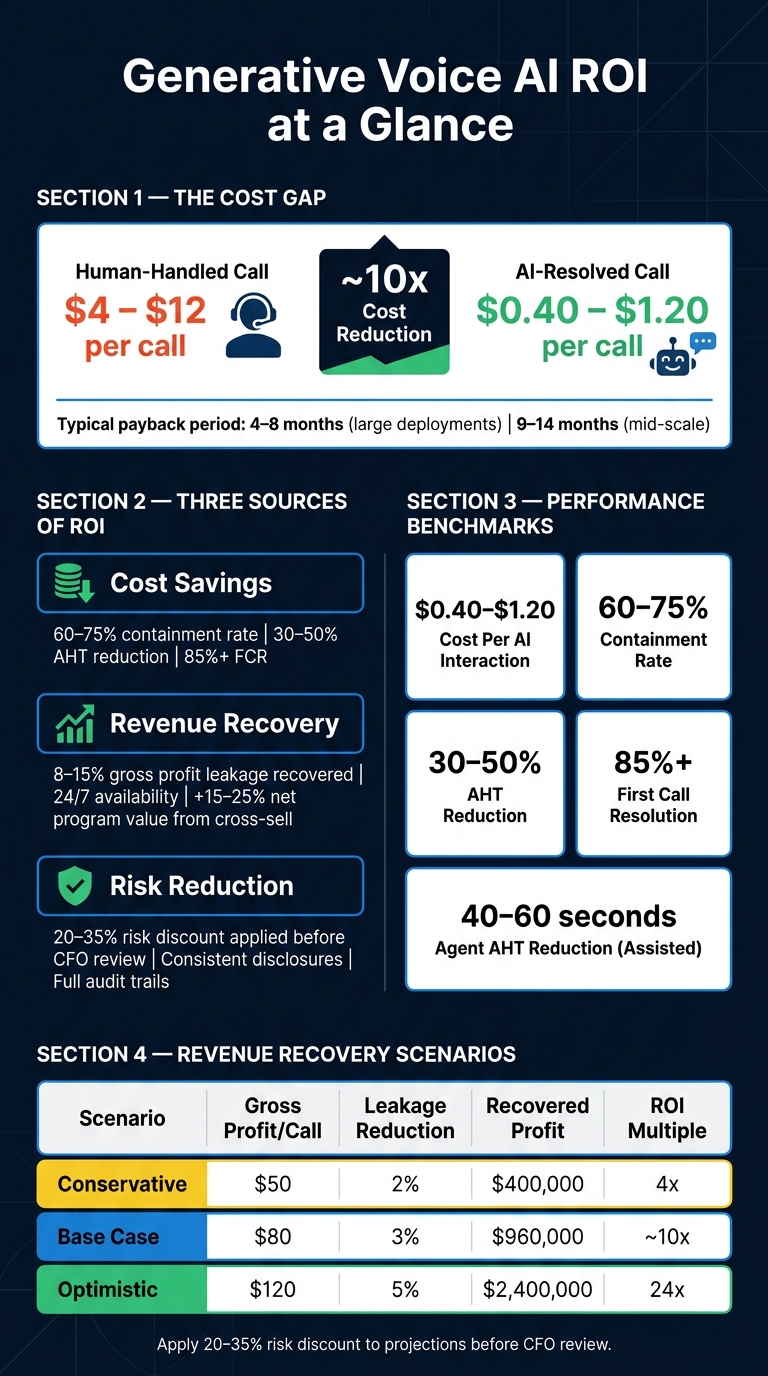
The cost gap is what makes the business case work. A human-handled call costs about $4 to $12, while an AI-resolved call usually lands around $0.40 to $1.20.
That said, the formula only holds up if your baseline and cost assumptions are set before launch.
Baseline Data Enterprises Need Before Deployment
You can’t measure improvement if the starting line keeps moving. Before deployment, finance and operations need to agree on a written baseline and capture it in the same system that will be used for post-launch reporting. That cuts off the apples-to-oranges debates that tend to wreck ROI reviews later.
These baselines help leaders separate the effect of generative voice AI from normal call-center swings.
| Baseline Category | Specific Metrics to Document |
|---|---|
| Call Volume | Total monthly volume; top 15 call intents; after-hours volume |
| Efficiency | Average Handle Time (AHT) per intent; hold times; transfer rates |
| Resolution | First Call Resolution (FCR); abandonment rate; escalation rate by category |
| Financials | Fully loaded agent cost (salary, benefits, management overhead, and attrition replacement); BPO surge costs; gross profit per closed deal |
| Revenue/Sales | Lead qualification rate; close rate; reach rate for outbound |
| Experience | CSAT; NPS; Customer Effort Score (CES) |
| Collections | Days Sales Outstanding (DSO); recovery rate on overdue accounts |
Once the baseline is in place, the next job is to separate build costs from operating costs.
Cost Categories in a Voice AI Business Case
Break costs into one-time build costs and recurring operating costs. Also, treat the first 30 to 60 days as a ramp period at 70% to 80% of target performance. If you skip that step, the model can look better on paper than it does in practice.
Implementation often comes out to 80% to 120% of year-one platform cost. After launch, budget 15% to 20% of the year-one platform cost each year for optimization, plus another 8% to 12% for governance, including compliance monitoring, model risk review, and escalation reviews.
| Cost Category | Traditional Voice Operations | Generative Voice AI |
|---|---|---|
| Labor/Usage | Fully loaded salary, benefits, and attrition replacement costs | Platform fees + per-minute model inference |
| Training/Design | Continuous agent training (weeks per new hire) | One-time conversation design and prompt engineering |
| Infrastructure | Premises, desks, hardware | Cloud hosting and API integration fees |
| Turnover | Attrition replacement (20% to 30% of salary) | N/A - digital agents don't quit |
| Management | Supervisor and QA overhead | Governance, model monitoring, and tuning |
Payback periods vary by deployment size. Large deployments usually pay back in 4 to 8 months, while mid-scale deployments tend to take 9 to 14 months.
It also helps to model three cases instead of betting on one rosy number:
- Base case
- Upside case at +15%
- Downside case at 70% to 80% of base
That gives the board a range it can work with, not just a best-case guess.
Those assumptions shape where ROI shows up: cost reduction, revenue lift, or risk control. Once the model is in place, the next step is figuring out where the return actually comes from.
Where Enterprise ROI Comes From in Practice
Enterprise ROI from voice AI usually comes from three places: lower cost, more revenue, and less risk.
Cost Savings From Containment, Deflection, and Reduced After-Call Work
The first driver is labor savings. But finance teams don’t give much weight to savings unless they hold up at scale.
Once volume climbs, the cost gap between a human-handled call and an AI-resolved interaction adds up fast. What matters to finance is the savings from contained calls, not a blended average call cost. It also helps to separate deflection from resolved self-service, because ROI shows up in outcome metrics like First Call Resolution rather than activity metrics like sessions handled.
That’s why savings models should focus on contained calls, not on the idea that everything will be fully automated. Mature deployments usually contain 60% to 75% of eligible calls. You also need to model both contained calls and escalated calls.
Hybrid flows can cut agent time too. If AI handles authentication and intent capture before a transfer, eligible call types often see 40 to 60 seconds of AHT reduction per assisted call. On top of that, AI can trim after-call work. The main KPIs to track are below:
| KPI | AI-Handled / Assisted |
|---|---|
| Cost Per Interaction | $0.40 – $1.20 |
| Average Handle Time | 30% – 50% reduction |
| Agent AHT (Assisted) | 40 – 60 second reduction |
| Containment Rate | 60% – 75% |
| First Call Resolution | 85%+ |
Cost reduction sets the floor. Revenue recovery sets the ceiling.
Revenue and Retention Gains From Better Voice Experiences
The next source of ROI is recovered revenue from calls that would have been missed or abandoned.
A caller who drops out of a human queue, an after-hours lead that never gets answered, or a buyer who gives up after sitting on hold all create revenue leakage. For mid-market contact centers, that leakage is often 8% to 15% of potential gross profit. Generative voice AI helps recover that missed value by being available 24/7.
To estimate the dollar impact, use this formula: qualification rate × close rate × gross profit per closed deal. Then apply it to the volume of calls that were previously abandoned or missed.
"Voice AI is therefore not primarily a labor substitution tool. It is a mechanism for protecting and expanding the economic value already present in inbound traffic." - David Casem, Chief Product Officer, Telnyx
The numbers can move fast, even with small gains in leakage recovery. Based on 400,000 annual calls and $100,000 in annual AI cost, the table below shows the scale:
| Scenario | Gross Profit / Call | Leakage Reduction | Recovered Gross Profit | ROI Multiple |
|---|---|---|---|---|
| Conservative | $50 | 2% | $400,000 | 4x |
| Base Case | $80 | 3% | $960,000 | ~10x |
| Optimistic | $120 | 5% | $2,400,000 | 24x |
Cross-sell prompts and outbound coverage can add 15% to 25% of year-one net program value.
Quality, Compliance, and Risk Reduction
The third source of return comes from lower operational and regulatory risk.
This part is a bit harder to model, but it can still be measured. Generative voice AI can improve policy adherence and documentation by delivering the same disclosure language each time, logging intent with more consistency, and keeping searchable transcripts for audit trails.
For FCR, use a 72-hour repeat-contact window. If the same caller reaches out again within three days about the same issue, the first interaction didn’t solve it. Mature AI deployments push FCR above 85%, while a common human baseline sits at 70% to 80%.
A rising escalation rate is usually a warning sign. It often points to an intent gap or a policy gap, and both can be fixed before they start dragging down CSAT.
Before a CFO review, apply a 20% to 35% risk discount to projected savings.
Implementation Choices That Determine ROI Outcomes
Once ROI is clear, the next part is execution. This is where a lot of projects either pay off or stall out. In practice, ROI comes down to three things: architecture, integration depth, and governance.
Architecture, Integrations, and Automation Depth
A shallow deployment sounds nice on paper, but it hits a ceiling fast. If the system only connects to a dialer and answers basic FAQs, it can't finish actual transactions. So when a caller has anything more than a simple question, the call still goes to a human. That keeps containment low and limits savings.
Deep integration changes the math. When the agent connects into CRM, ERP, ticketing, and accounts receivable systems, it can authenticate callers, update records, and complete transactions without a transfer. That matters. Accounts receivable integration can cut DSO by 2 to 6 days, which creates a working-capital gain Treasury can book directly.
That kind of setup does more than trim call volume. It increases containment, cuts handoffs, and adds working-capital gains at the same time.
For architecture, a simple rule works well: 70/30 split. Put the reusable foundation first, then build custom workflows on top. That helps the system scale without turning every process into a one-off build.
The deeper the integration, the more the agent moves from simple deflection to full transaction completion.
Security, Privacy, and Governance for U.S. Enterprises
As integration gets deeper, governance stops being a side task. It becomes part of the ROI model itself.
Governance is a recurring operating cost, usually budgeted at 8% to 12% of platform spend each year. In regulated sectors like healthcare under HIPAA, costs run higher. On top of that, compliance paperwork tied to data residency and recording consent often becomes a hard gate before budget approval.
So this isn't just legal fine print. It affects timing, cost, and whether the project gets approved at all.
Before go-live, teams usually need to put a few controls in place:
- Recording consent controls
- Data residency rules
- Audit trails
Warm transfers for complex or sensitive calls also help protect retention ROI. And it's smart to budget for evals, monitoring, and rollback. Generative models can return incorrect answers, and in a regulated setting, that creates compliance and liability risk.
These controls - consent, residency, and rollback - help protect compliance and preserve enterprise trust. That directly supports the risk-reduction ROI bucket.
Working With a Specialized AI Consulting Partner
When a workflow touches several systems or runs into compliance limits, speed starts to matter a lot. Not just for convenience, but for ROI.
DIY builds can work. But they usually push ROI further out. Internal engineering teams often add 8 to 16 weeks compared with a specialized partner, which delays ROI by at least one quarter.
The more systems, reviews, and controls involved, the more partner choice affects the outcome. Firms like NAITIVE AI Consulting Agency focus on this exact type of work. They can shorten implementation timelines and bring ROI forward through faster delivery and built-in governance expertise.
The table below shows how implementation depth changes ROI, risk, and time-to-value:
| Implementation Choice | ROI Impact | Time-to-Value | Risk Level |
|---|---|---|---|
| Low integration (dialer only) | Low; limited to simple deflection | Fast (weeks) | Low technical risk; high business irrelevance risk |
| Deep integration (CRM/ERP/AR) | High; enables transaction completion and DSO gains | Moderate (60–90 days) | Moderate; requires data mapping and security review |
| Advisory agents (L1–L2) | Moderate; improves human productivity | Very fast | Very low; human remains the final decision gate |
| High-autonomy agents | Maximum; eliminates manual handoffs between systems | Slow; requires evidence-based trust building | High; requires kill switches and full audit trails |
Deeper integration and higher autonomy increase ROI upside, but they also add implementation time and governance work.
How to Measure and Improve Voice AI ROI Over Time
ROI from generative voice AI isn't something you calculate once at launch and forget about. It works better as a managed program. The teams that get the best returns treat the voice agent like a product, often supported by AI cloud consulting to ensure a clear owner and steady iteration. At that point, the baseline stops being just a launch document and starts becoming a day-to-day management tool.
A KPI Scorecard for the First 90 Days and Beyond
The first 90 days after launch matter a lot. This is the window where teams need to learn fast, fix issues early, and avoid waiting until financial reports show that something's off.
| Phase | Focus Metrics | Objective |
|---|---|---|
| Days 0–30 | Intent split, escalation logic, conversation completion rate, initial containment | Validate technical accuracy and find prompt and policy gaps right away |
| Days 31–60 | Cost-per-call delta, AHT reduction (AI vs. human), revenue recovery rate | Measure early financial impact and efficiency gains on assisted calls |
| Days 61–90 | FCR (72-hour window), CSAT/NPS lift, repeat contact rate, outbound conversion | Evaluate resolution quality and customer experience impact |
Use this scorecard to compare live performance against the pre-launch baseline. It gives you an early read on whether results are moving toward steady-state targets.
Track assisted-call AHT separately from full containment. In a high-volume contact center, that difference can turn into a big dollar impact fast.
Continuous Improvement Through Analytics and Testing
Once the baseline is steady, transcript analysis should help explain performance swings. Run it all the time, with a close eye on two failure patterns: intent gaps and policy gaps.
Those gaps can be fixed, but only if the team is looking for them. This is where A/B testing conversation designs and refining prompts based on live call data matters. That's how containment rates improve over time. Two of the best leading indicators are conversation completion rates and escalation rates by topic. If escalations jump for one call driver, that's often a sign of an intent gap or a policy gap.
Treat optimization and governance as recurring operating costs. That's the difference between a deployment that stalls out and one that keeps getting better.
Conclusion: What Enterprise Leaders Should Evaluate Before Investing
The business case for generative voice AI is real, but it doesn't run on autopilot. The best ROI tends to come from deployments that begin with a documented baseline, model returns by use case, account honestly for implementation and governance costs, and treat measurement as an ongoing discipline instead of a one-time launch task.
Start narrow with high-volume, low-complexity intents like order status or password resets, then expand as containment rates stabilize. Build the ROI model for the CFO using conservative assumptions, and discount aggressive savings projections by 20–35% for execution risk. Give each metric a clear owner: the COO owns headcount avoided, and the CRO owns revenue uplift.
Generative voice AI tends to pay off most when it's tied to measurable workflows, governed with care, and improved over time. The technology is ready. The real issue is whether the operating model around it is ready too.
FAQs
How do we know if voice AI will pay off for us?
Look past cost per call and focus on total economic return. In many companies, voice AI leads to lower operating costs, short payback periods, and strong ROI over multiple years.
Focus on three areas:
- Current staffing costs vs. voice AI costs: Compare what you spend today on agents, scheduling, training, and coverage against the cost of the voice AI program.
- Revenue lost from missed or abandoned calls: If calls go unanswered, money walks out the door. That lost revenue should be part of the math.
- Total program costs: Include implementation, change management, and any impact from cross-selling, whether that impact adds to revenue or limits it.
That gives you a much clearer view than cost per call alone.
Which workflows should we automate first?
To get fast wins and see ROI sooner, start with high-volume, repeatable work that doesn't take much judgment, such as:
- answering FAQs
- order tracking
- appointment scheduling
- outbound outreach
- L1–L2 support
Lead qualification and follow-ups are also strong places to start. NAITIVE AI Consulting Agency can help you spot the workflows with the most upside and connect them to your current CRM and support tools.
What can delay or reduce ROI?
ROI can take longer to show up - or end up smaller than expected - when teams miss the full financial picture and the day-to-day realities of rollout.
That usually includes:
- Implementation costs that were estimated too low, often 80–120% of first-year platform fees
- A 30–60 day transition period with lower completion rates and more escalations
- Change management costs tied to redeploying, retraining, or restructuring staff
- Ongoing optimization work, which typically adds 15–20% of initial costs per year