AI Certification for Cross-Border Operations: Checklist
Step-by-step checklist to map regulations, secure cross-border data flows, document AI systems, and maintain EU AI Act compliance.

In today's global market, AI certification is no longer optional - it's a requirement. Regulations like the EU AI Act apply even if your company is based outside the EU, creating legal and financial risks if compliance is ignored. Fines can reach up to €35 million or 7% of global revenue. Certification not only ensures compliance but also builds trust with clients, investors, and regulators.
Key Takeaways:
- Why It Matters: Non-compliance can lead to severe penalties and lost business opportunities.
- Challenges: Regulatory fragmentation, data privacy laws, and technical risks complicate cross-border AI operations.
- Steps to Certification:
- Map regulations and assess risks.
- Manage data governance and cross-border flows.
- Prepare documentation and align with standards like ISO 42001 or the EU AI Act.
- Implement technical controls and human oversight.
- Stay updated with evolving regulations and maintain certifications.
Certified AI Practitioner: Cross Border AI Compliance Management: The Expert Guide for Ai Pros
sbb-itb-f123e37
Step 1: Regulatory Mapping and Risk Assessment
Start by identifying all the rules that apply to your AI systems. Many organizations are surprised to find they fall under more regulations than they initially thought.
Identify Applicable AI Regulations and Standards
The jurisdiction is determined by where your AI's output is used, not where your office is located.
"The scope trigger follows the output, not your office address. If your AI system produces results that are used by, or affect, anyone located in the EU, you are likely in scope." - Constantin Razvan Gospodin, Legal AI Risk Manager, Lexara
In addition to the EU AI Act, your regulatory landscape may include laws like the GDPR for handling personal data, sector-specific rules such as DORA for financial services, and U.S. federal or state-level AI requirements. While the U.S. has leaned toward a more innovation-friendly approach since early 2025, the EU has implemented a stricter, risk-based framework.
Voluntary standards like the NIST AI Risk Management Framework (RMF) and ISO/IEC 42001 can help you align controls across jurisdictions. These frameworks can bridge the gap between U.S. voluntary compliance and EU regulatory obligations.
Map AI Use Cases by Region and Risk Level
Classify your AI systems individually rather than grouping them by vendor or model. A single model can serve vastly different purposes, from low-risk spam filtering to high-risk employment screening.
"The classification is per-system, not per-vendor... The same model can power a tier-4 spam summariser and a tier-2 employment screening tool - the system, not the model, is classified." - Digital Applied
For each AI system, follow a structured decision-making process. Begin by checking for prohibited practices, then review Annex I (safety components in regulated products), Annex III (high-impact use cases), and transparency requirements. The table below outlines the risk tiers and their corresponding obligations:
| Risk Tier | Examples | Key Obligation |
|---|---|---|
| Unacceptable | Social scoring, subliminal manipulation | Absolute ban (effective since February 2025) |
| High-Risk | Recruitment tools, credit scoring, biometrics | Conformity assessment, QMS, human oversight |
| Limited Risk | Chatbots, deepfakes, AI-generated content | Transparency disclosure to users |
| Minimal Risk | Spam filters, recommendation engines | Voluntary codes of conduct only |
These classifications are critical for guiding risk assessments and preparing for audits.
Determine your role in each deployment - whether you are a Provider, Deployer, Importer, or Distributor. It's possible for one organization to take on multiple roles depending on the situation. Detailed role-specific obligations will be addressed in later steps.
Run an Initial Risk Assessment
Conduct a "Shadow AI" audit to identify all AI systems in use, including any unauthorized tools. A full inventory is essential before moving forward.
Once you’ve cataloged all systems, evaluate each one for data handling practices, algorithmic bias, and compliance gaps. For systems classified as High-Risk, you must retain technical documentation for 10 years after market deployment and keep operational logs for at least six months.
Document all classifications with a signed one-page memo. This provides a clear, defensible record in case regulators or auditors challenge your decisions.
With your risks clearly outlined and documented, the next step is to address data governance and manage cross-border data flows.
Step 2: Data Governance and Cross-Border Data Flow Management
Once you've classified your AI systems and documented the associated risks, the next step is managing how data moves across borders. This is no small task - while 85% of global businesses transfer personal data internationally, only 34% have documented effective mechanisms for these transfers. To get started, you'll need to build a detailed data inventory. Working with an AI consulting agency can help streamline this mapping process.
Build a Data Inventory
Creating a thorough inventory of your AI systems and their data flows is the foundation of effective governance.
"You cannot classify what you cannot see. The first phase establishes a complete, centralized inventory of every AI system your organization develops, deploys, imports, or distributes." - Saravanan G, Vice President - Cyber Assurance, Glocert International
To do this, survey all departments, including those using unsanctioned tools, to identify every AI system in use. Then, map out the complete data lifecycle for each system. This includes where the data originates, how it’s processed, who has access, whether it crosses borders, and when it’s deleted. Adding geolocation identifiers, like IP addresses or billing addresses, to each data record ensures that regional laws are automatically applied.
"If you can't identify where a user is located, you can't ensure their rights are being respected, or that your obligations are being met." - Robert Blackburn, Legal Writer, TermsFeed
It’s also critical to assign a specific individual as the owner of each inventory entry. This ensures accuracy, especially as systems evolve. If you’re already maintaining GDPR Records of Processing Activities (RoPA) or an ISO 27001 asset register, you can extend those systems rather than starting from scratch.
Apply Data Localization and Transfer Mechanisms
Different jurisdictions have different rules for data transfers. For example, the EU allows conditional transfers with safeguards, while countries like China and Russia require data to remain within their borders. India and Brazil fall somewhere in between. Understanding these rules for each region you operate in is essential.
Standard Contractual Clauses (SCCs) are the most common tool for cross-border transfers, with 88% of companies relying on them. However, SCCs alone may not be enough. After the Schrems II ruling, organizations must also complete a Transfer Impact Assessment (TIA) to ensure that the destination country’s laws don’t compromise SCC protections. For instance, in May 2023, Meta was fined €1.2 billion by the Irish Data Protection Commission because its TIA failed to address risks from FISA Section 702 surveillance, rendering SCCs insufficient without additional safeguards.
For large multinational companies, Binding Corporate Rules (BCRs) are another option. However, these are costly - ranging from $550,000 to $2.2 million in legal and compliance fees - and can take 12 to 24 months to secure approval. For transfers to the US, the EU-US Data Privacy Framework (DPF) is a practical choice, with SCCs and a current TIA serving as a backup in case the adequacy decision is challenged.
Legal measures alone are not enough. They must be paired with strong technical controls to ensure data security during transfer and storage.
Put Privacy and Security Controls in Place
To secure data, legal mechanisms must be supported by technical protections.
Pseudonymize data before it crosses borders. Replace direct identifiers, like names or Social Security numbers, with reversible tokens at the source. This ensures that even if data is intercepted, it cannot be linked to an individual without the decryption key, which is stored separately. Use TLS 1.3 encryption in transit and AES-256 encryption at rest to protect data during transfer and storage.
For transfers involving countries with strict surveillance laws, consider EU-managed encryption keys (also known as Bring Your Own Key, or BYOK). With this approach, decryption keys remain within the EU, so even if a foreign authority demands access, the data remains unreadable. Additionally, implement Role-Based Access Control (RBAC) to ensure only authorized personnel in the destination country can access sensitive data. Maintain detailed audit logs of all cross-border transfers to support compliance reviews and incident responses.
| Technical Measure | Standard | Purpose |
|---|---|---|
| Encryption in Transit | TLS 1.3 | Protects data moving between jurisdictions |
| Encryption at Rest | AES-256 | Keeps stored data unreadable if breached |
| Pseudonymization | Tokenization | Removes identifiers before data crosses borders |
| Access Controls | RBAC | Limits data visibility by role and location |
| Audit Logging | Comprehensive transfer logs | Supports compliance reviews and incident response |
Step 3: Preparing for Certification and External Audits
Once your data governance controls are in place, it’s time to focus on preparing your AI systems for formal certification and external audits. This step often trips up organizations - not because their systems fail to comply, but because they lack the documentation to prove it.
Document Your AI System Design and Operations
Auditors need solid proof, and that means detailed documentation. For high-risk AI systems, Annex IV requires records that cover system architecture, algorithmic logic, training methods, and computational resources. Beyond the technical details, you’ll also need a risk record that tracks identified risks, mitigation efforts, and residual risks over the system’s lifecycle.
Data governance documentation is equally important. This involves detailing your training, validation, and testing datasets, including their origins, labeling methods, bias mitigation strategies, and limitations. Operational logs must also be retained for at least six months and must be automated and tamper-proof to ensure traceability.
Legacy systems can be particularly challenging. Retrofitting documentation for older systems often requires extra effort, as highlighted by Saravanan G, Vice President of Cyber Assurance at Glocert International:
"A readiness assessment performed now - prior to the August 2026 deadline - gives your organization the time to remediate gaps methodically rather than reactively."
Thorough documentation is the foundation for the next step: selecting the right certification frameworks to validate your compliance.
Align with the Right Certification Frameworks
Choosing the right certification frameworks helps solidify your compliance strategy. Here are some of the most relevant options:
- ISO/IEC 42001: The first certifiable international standard for AI Management Systems, offering a repeatable governance structure that works globally.
- EU AI Act: Binding legislation that applies if your AI outputs are used in the EU or impact EU residents, regardless of your company’s location.
- NIST AI RMF: A voluntary framework from the U.S. that provides a structured approach to risk management, though it isn’t certifiable.
Each of these frameworks serves a unique purpose. As Radhika Sarraf, Senior Content Marketer at Sprinto, explains:
"ISO 42001 gives you the governance management system. The EU AI Act is the law. They are complementary, not interchangeable."
Here’s a quick comparison of these frameworks:
| Framework | Type | Certifiable | Best For |
|---|---|---|---|
| ISO/IEC 42001 | International Standard | Yes | Global governance backbone |
| EU AI Act | Binding Legislation | Conformity Assessment | Legal market access in the EU |
| NIST AI RMF | Voluntary Framework | No | Practical risk methodology (US) |
ISO 42001 provides a global governance structure but must be paired with region-specific measures to ensure full compliance.
Build an Audit-Ready Governance Framework
Once your documentation aligns with these frameworks, the next step is to establish governance practices that keep your records accurate and up to date. Start by assigning AI System Owners for each system in your inventory. These individuals will be responsible for maintaining current records as systems evolve. Additionally, create an AI Review Board with the authority to approve or halt deployments.
The focus should be on creating a scalable governance system. Gabriel Few-Wiegratz of SureCloud emphasizes:
"The goal is not to certify a single AI model. The goal is to create a repeatable system of AI governance... that covers oversight, documentation, monitoring, and continual improvement."
One key habit is documenting the reasoning behind system classifications, not just the classifications themselves. The Digital Applied team notes:
"The single highest-leverage compliance habit is documenting why a system landed in its tier, not just the tier itself. The label without the reasoning is not evidence."
This means creating a classification memo for each system, citing the specific articles or annexes that justify your decisions. This small but critical step can make a big difference when auditors review your risk tier assignments.
While compliance efforts require a significant investment, they pale in comparison to the potential penalties for non-compliance. Under the EU AI Act, violations of prohibited AI practices can result in fines of up to $35 million or 7% of global annual turnover, whichever is higher.
Step 4: Technical and Operational Controls for Cross-Border AI Systems
Now that you've established a governance framework and audit documentation with the help of AI consulting services, the next step is ensuring your AI systems are technically equipped to function across borders without running into compliance issues.
Design Your AI Architecture for Cross-Border Use
When building AI systems for cross-border operations, compliance needs to be baked in from the start. Incorporate measures like data minimization through tokenization and pseudonymization to limit the exposure of sensitive information as it moves between regions. Techniques such as federated learning or edge processing can also help keep sensitive data localized.
A modular architecture is key. For instance, systems that can deliver geo-targeted disclosures - like showing EU-specific transparency notices only to users in the EU - allow you to meet regional requirements without overhauling the entire system. Similarly, embedding features like disclosure labels and "AI assistant" markers during the design phase is far more efficient than trying to add them later.
"A vendor contract that ignores support access and subcontractors is not a control. It is a hope." - ITU Online Editorial Team
Remember, your architecture isn’t just your core AI model. It also includes every subcontractor, monitoring tool, and remote support channel that interacts with your data. A well-thought-out design lays the groundwork for effective monitoring and controls down the line.
Set Up Monitoring and Incident Management
With a compliant architecture in place, the next step is ensuring continuous oversight through integrated monitoring. Automatic event logging is a must for high-risk AI systems, and logs should be retained according to regulatory requirements. These logs - capturing prompts, outputs, and interventions - are particularly sensitive when data crosses borders, such as EU data processed in the US and reviewed elsewhere.
One of the toughest challenges is managing overlapping incident reporting deadlines. If a significant incident triggers multiple regulatory obligations at once, your team needs workflows ready to meet each deadline:
| Regulation | Incident Reporting Deadline |
|---|---|
| NIS2 | 24 hours |
| GDPR | 72 hours |
| EU AI Act | 15 days |
Develop a response playbook based on the shortest deadline and ensure monitoring is active before launching your system.
Add Human Oversight and Explainability
Technical controls and monitoring are essential, but they must be paired with strong human oversight to counteract automation bias. For high-risk AI systems, human oversight isn’t optional. The individuals responsible should have the technical skills and authority to intervene, override, or even shut down the system if necessary. This requires building explicit "stop" or "interrupt" functions into the system interface.
A common pitfall is automation bias, where users may place too much trust in AI outputs. Addressing this goes beyond training - it requires system designs that actively encourage human judgment at critical decision points.
"The supervisor must understand the system well enough to judge it critically, be able to disregard outputs or fully stop the system, and be aware of limitations and possible errors." - Cloud Captains
For systems generating synthetic content, transparency is equally important. The C2PA standard is emerging as a practical solution for marking synthetic audio, video, and images in a way that works across borders. Implementing machine-readable provenance markers now can give you a head start as regulatory expectations evolve.
Step 5: Keeping Your Certification Current
EU AI Act Compliance Deadlines: Key Dates for Cross-Border AI Certification
Getting certified is just the start - keeping it up-to-date is where the real challenge begins, especially with regulations constantly evolving.
Track Regulatory Changes and Update Your Policies
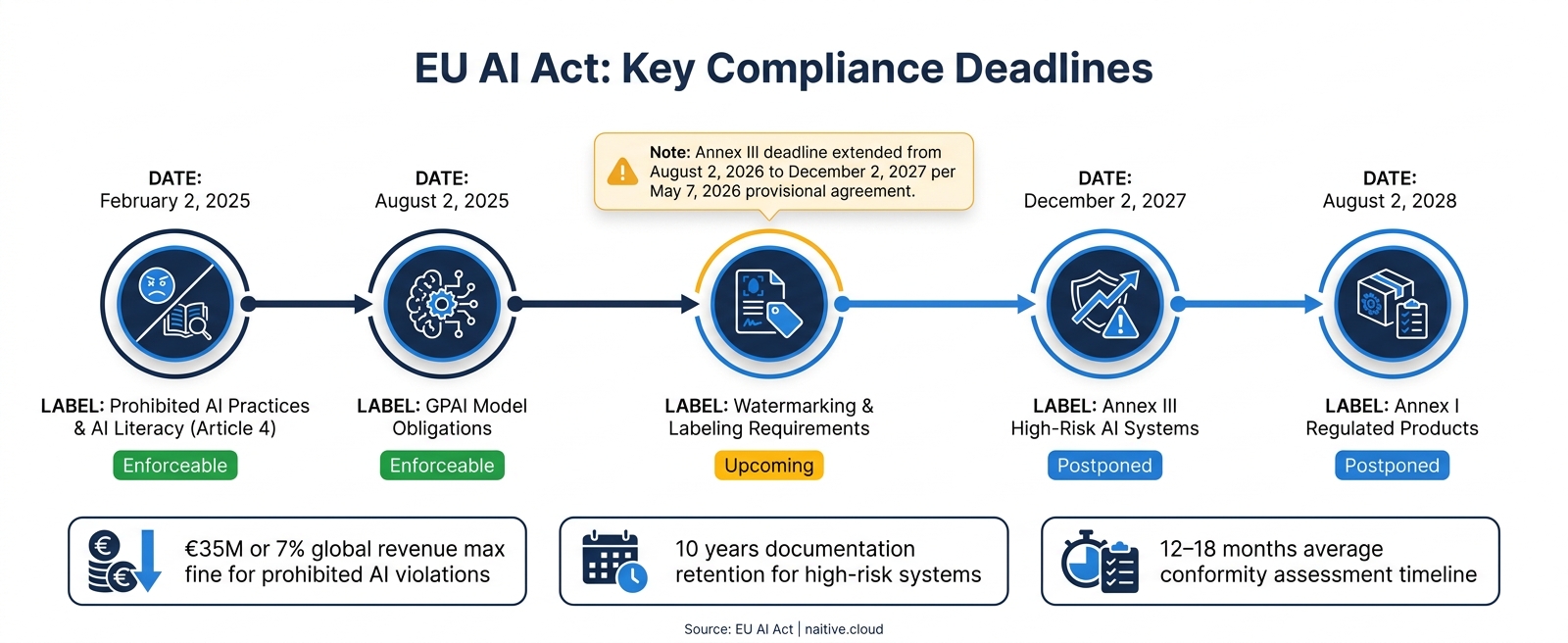
On May 7, 2026, a provisional agreement extended the deadline for Annex III high-risk AI obligations from August 2, 2026, to December 2, 2027. Meanwhile, other requirements have already taken effect. For example, prohibited practices (Article 5) and AI literacy mandates (Article 4) have been enforceable since February 2, 2025, while GPAI obligations went live on August 2, 2025.
| Requirement | Deadline | Status |
|---|---|---|
| Prohibited AI Practices | February 2, 2025 | Enforceable |
| AI Literacy (Article 4) | February 2, 2025 | Enforceable |
| GPAI Obligations | August 2, 2025 | Enforceable |
| Watermarking/Labeling | December 2, 2026 | Upcoming |
| Annex III High-Risk AI | December 2, 2027 | Postponed |
| Annex I (Regulated Products) | August 2, 2028 | Postponed |
These shifting timelines mean you’ll need to stay proactive about updating your policies to align with the latest standards.
Regulatory landscapes are also diverging. For instance, in January 2025, the US replaced the Biden-era AI Executive Order with a framework focused on innovation. On the other hand, the EU AI Act is increasingly setting the tone globally, even influencing state-level legislation in Texas (TRAIGA) and Colorado. If your business operates in both regions, aligning your governance program with EU standards will generally meet federal requirements in the US as well.
Run Regular Compliance Reviews
Maintaining certification means committing to regular compliance checks. A structured review schedule can make this manageable. Consider the following approach:
- Weekly: Anomaly detection reviews
- Monthly: Performance drift reports
- Quarterly: Bias and fairness assessments
Every AI system in your inventory should undergo a quarterly review to ensure its risk classification remains accurate. This includes informal tools, often referred to as "Shadow AI".
To avoid surprises, lock model versions and skip auto-upgrades in production. Use version-tagged artifacts and maintain detailed logs for each version. For high-risk systems, retain technical documentation for at least 10 years after market release. Keep in mind, any major change to a high-risk AI system’s purpose or architecture might require a fresh conformity assessment. This could even reclassify you as a "provider", making you legally responsible for the system.
"AI compliance is the architecture decisions made on Day 1 that determine whether your first audit takes two weeks or six months." - Shishir Mishra, Founder, KORIX
For businesses managing complex, cross-border AI systems, bringing in external expertise can be a game-changer.
Work with Expert Consulting Support
Expert consulting can help you navigate the maze of compliance requirements. For example, the cost of a conformity assessment for a single high-risk AI product can climb to $80,000, with annual monitoring costs for small and medium enterprises (SMEs) averaging 17%.
Specialists like NAITIVE AI Consulting Agency can simplify this process. They offer services like mapping your AI systems to relevant regulations and designing governance frameworks that can withstand scrutiny. Their expertise in AI architecture and automation ensures compliance is built into your systems from the start.
"Organisations that embrace the AI Act as an opportunity to improve their governance will, in the long run, score better on trust, quality and customer loyalty than those who wait until the supervisor is at the door." - Cloud Captains
Staying certified isn’t just about avoiding penalties. It’s about building trust and ensuring your AI systems remain viable in global markets for years to come.
Conclusion: What It Takes to Succeed at Cross-Border AI Certification
Cross-border AI certification demands an ongoing commitment. The five-step checklist outlined earlier offers a clear path - from understanding regulatory requirements to maintaining certifications over time. This includes managing data governance, creating thorough documentation, implementing technical controls, and staying updated as regulations evolve.
The key to success lies in starting early. Conformity assessments and audits can take anywhere from 12 to 18 months, requiring collaboration across legal, IT, data governance, and product teams. Additionally, maintaining up-to-date documentation is essential for staying ahead of compliance requirements. This proactive mindset not only reduces risks but also helps avoid financial and operational disruptions.
The financial stakes are high, making this a priority for executive leadership.
"The penalty structure... is what moves this from compliance theater to a CFO-level matter." - Promise Legal
Non-compliance comes with steep penalties, and the cost of establishing a full compliance program for managing 3 to 5 high-risk AI systems can range between €100,000 and €300,000. These figures highlight the importance of taking certification seriously.
Forward-thinking organizations view certification as more than just a regulatory box to check. They see it as a cornerstone for building trust. As the EU AI Act sets the stage for global standards - similar to the impact GDPR had on privacy - strong governance programs will increasingly become a competitive edge in international markets.
FAQs
Does the EU AI Act apply to my U.S. company?
The EU AI Act applies to your activities if they have an impact within the European Union. This includes situations where you place AI systems or general-purpose models on the EU market or if the output of your AI systems is used within the EU. The regulation doesn’t care whether your headquarters or servers are based in the U.S. What matters is where the effects of your AI system are felt. Depending on your role, you may have obligations as a provider, deployer, importer, or distributor.
How can I determine if my AI system is high-risk?
To determine whether your AI system falls under the "high-risk" category, you need to evaluate its purpose and the context in which it operates. According to the EU AI Act, an AI system is considered high-risk if it:
- Functions as a safety component or is part of a product that requires third-party conformity assessments.
- Is deployed in fields such as hiring processes, credit scoring, biometric identification, critical infrastructure, or law enforcement.
If you're unsure about navigating compliance, NAITIVE AI Consulting Agency offers support with processes like proper documentation and establishing oversight mechanisms.
What’s the fastest way to get audit-ready for certification?
If you're aiming to be audit-ready in a short timeframe, the first step is conducting a structured gap analysis. This helps pinpoint any missing documentation or controls required by frameworks like the EU AI Act or the NIST AI Risk Management Framework (AI RMF).
Next, build a detailed inventory of your AI systems. For each system, document its purpose, risk level, and the responsible owner. This inventory provides a clear overview of your AI operations and their compliance status.
To streamline this process, governance tools can be incredibly helpful. These tools can automate documentation and ensure everything is organized and accessible. Additionally, schedule a mock audit about 4–6 weeks before your actual audit date. This gives you time to identify and fix any vulnerabilities or gaps.
If you need expert guidance, NAITIVE AI Consulting Agency offers support to navigate this process effectively.