
https://www.reddit.com/user/NAITIVEAI/trends/
Agent-driven enterprise AI: autonomous agents, voice AI, and low-code orchestration reshape workflows, boost efficiency, and require strong governance.

Enterprise AI is evolving fast. Businesses are leveraging advanced AI systems to boost efficiency, cut costs, and solve complex challenges. Key trends include autonomous AI agents, voice AI for customer interactions, and low-code tools like Dify and n8n that simplify AI deployment. These tools enable faster workflows, reduce errors, and deliver measurable ROI in months.
- Autonomous AI Agents: Handle multi-step tasks independently, cutting low-value work by 25–40%.
- Voice AI: Automates customer interactions, enhancing efficiency and accessibility.
- Low-Code Platforms: Make AI adoption easier for non-developers, bridging the gap between experiments and production-ready solutions.
Industries like manufacturing, finance, and healthcare are already reaping the benefits, with examples like predictive maintenance saving millions or AI-driven compliance reducing workloads by thousands of hours. To succeed, businesses must assess readiness, adopt phased integration, and establish strong governance frameworks.
Quick Tip: Start small with pilot projects targeting high-impact workflows, measure success with clear KPIs, and scale responsibly with human oversight.
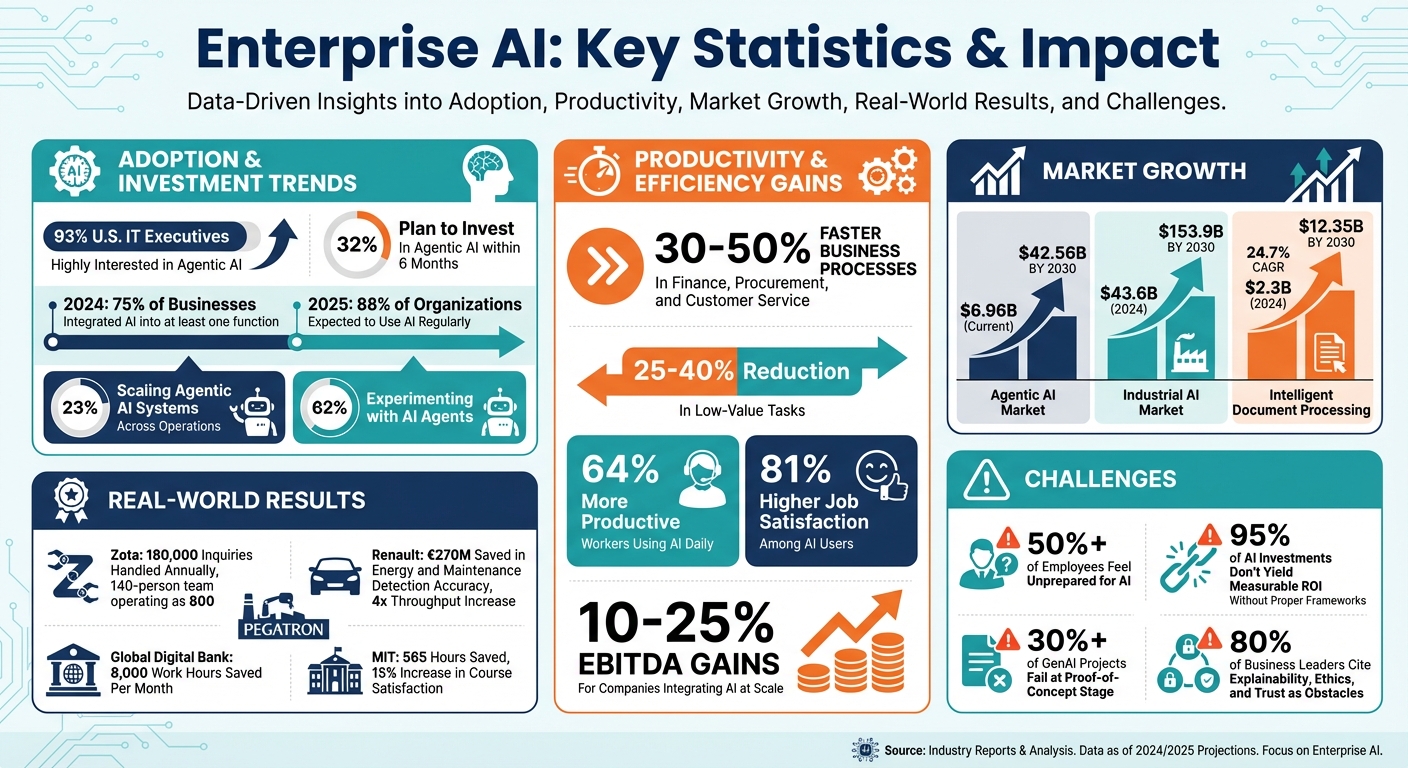
Enterprise AI Adoption Statistics and ROI Impact 2024-2030
The enterprise AI playbook: Five must-have strategies
Top NAITIVEAI Trends in Enterprise AI Consulting
The world of enterprise AI is changing fast, and NAITIVEAI's community discussions highlight three major trends shaping the future: agentic AI systems that handle complex tasks independently, voice AI agents that manage real-time customer interactions, and low-code orchestration platforms that make AI development more accessible. These innovations are already delivering tangible results for businesses. Let’s break down each trend and its impact.
Agentic AI and Autonomous Agents
Agentic AI has moved far beyond traditional chatbots. These systems can now plan, reason, and execute multi-step tasks on their own. They figure out the best approach to meet business goals, tapping into APIs, using web search, and adjusting strategies based on feedback.
Here’s the scope: 93% of U.S. IT executives are highly interested in agentic AI, and 32% plan to invest in it within six months. These agents can speed up business processes by 30% to 50% in areas like finance, procurement, and customer service, while cutting down low-value tasks by 25% to 40%.
"Agentic AI is about delegating outcomes, not just prompts; systems that can plan, act, verify, and report back, while remaining governable."
– Svitla Team
What makes agentic AI stand out is its ability to handle complex, non-linear workflows that traditional automation tools can’t manage. Companies are deploying specialized teams of AI agents - planners, executors, and reviewers - that work together to complete tasks. By 2030, the market for agentic AI is expected to grow from $6.96 billion to $42.56 billion.
A standout example is Zota, a global payments marketplace. In 2025, under CEO Avner Ziv, Zota adopted an AI-first strategy using Salesforce Platform and Data Cloud. In just five weeks, they launched a merchant FAQ agent capable of handling 180,000 inquiries annually and supporting 500,000 merchants 24/7. This allowed their 140-person team to operate as efficiently as a team of 800, doubling merchant support without adding staff.
To ensure critical tasks like financial transactions are handled responsibly, agentic workflows often include Human-in-the-Loop (HITL) frameworks for oversight. Voice technology is also playing a transformative role in automating real-time customer interactions.
Voice AI Agents for Business Operations
Voice AI has evolved into a powerful tool for managing entire customer interactions - from handling after-hours inquiries to booking appointments - all without human involvement. These agents don’t just follow scripts; they understand context, adapt to customer needs, and can even help boost revenue.
Unlike generative AI that waits for input, voice AI agents are proactive. They plan conversations, access live business systems, and execute tasks across multiple channels. In healthcare, for instance, they manage sensitive patient communications while ensuring compliance, acting as "empathy engines" for enterprise operations.
Voice AI is increasingly integrated with platforms like Salesforce and SAP. This allows agents to pull up customer data, update records, and trigger workflows - all during a single interaction. This integration has turned voice AI into a key operational tool.
Workflow Orchestration and Low-Code Tools
Low-code orchestration platforms are making it easier for businesses to deploy AI quickly and effectively. Platforms like n8n and Langflow let users build advanced AI workflows through visual interfaces that work seamlessly with existing systems.
These platforms use tools like "nodes-as-tools" or HTTP Request tools, enabling AI agents to interact with almost any API. This allows businesses to create workflows where large language models handle decision-making, not just text generation. Emerging design patterns, such as "Chained Requests" for sequential tasks and "Multi-Agent Teams" for collaborative problem-solving, make it easier to prototype and scale solutions.
Speed is a major advantage. Companies can quickly prototype workflows, test them alongside existing systems, and scale the successful ones. While low-code platforms are great for many use cases, custom coding is still needed for highly complex operations to avoid inefficiencies like "node bloat".
A practical tip from NAITIVEAI discussions is to identify bottlenecks using the "Fairy Godmother" test - ask yourself, if your workload doubled overnight, where would things break? Start with a pilot project focused on a high-impact workflow, like lead grading or vendor onboarding. Define 2–3 success metrics, and always include safeguards like a "kill switch" to prevent cascading errors.
How to Apply These Trends to Your Business
Turning ideas into action starts with evaluating where your business stands today. While 75% of businesses have integrated AI into at least one function by 2024, more than 50% of employees feel unprepared to work with these technologies. This disconnect highlights the importance of bridging the gap between adoption and readiness, which begins with a clear and honest assessment.
Evaluating Your AI Readiness
Before implementing AI, it's essential to understand your starting point in five key areas: leadership commitment, data quality, technological infrastructure, workforce skills, and financial planning. Identifying areas where investments can make the most impact is crucial.
Start with a detailed audit of your data and workflows to uncover gaps in quality and efficiency. Assess your data for accuracy, completeness, consistency, timeliness, and accessibility.
"Data quality isn't just an IT concern, it's the foundation upon which your entire AI strategy stands or falls."
Next, evaluate your processes by scoring bottlenecks, manual tasks, and error rates on a scale of 1–5. This will help pinpoint tasks ripe for automation. Focus on eliminating what Smith calls "robot work" - those repetitive, rules-based tasks that sap productivity. Companies that have taken this approach report a 40% reduction in costs and a 60% increase in revenue.
Your infrastructure assessment should compare your current hardware and software capabilities with your AI goals. For example, advanced AI models like Llama-3.1-70b, which have 70 billion parameters, need around 168GB of GPU memory to run smoothly. Many organizations are opting for self-hosted AI environments using tools like Ollama and Docker to ensure data privacy and reduce network latency.
| Readiness Pillar | Focus Areas |
|---|---|
| Leadership | Strategic vision, resource allocation, and promoting AI benefits. |
| Data Quality | Accuracy, completeness, consistency, timeliness, and accessibility. |
| Infrastructure | Compatibility of legacy systems, hardware/software capabilities, and performance. |
| Workforce | Digital literacy, technical skills gaps, and change management. |
| Financials | ROI analysis, talent acquisition costs, and maintenance budgets. |
This readiness evaluation sets the stage for selecting the best tools to build your AI systems.
Building AI Systems with Modern Tools
Once your readiness is clear, the next step is choosing tools that align with your technical capabilities and use case complexity.
For automation and integration-heavy workflows, n8n is a versatile option. It offers over 1,700 templates and numerous SaaS connectors, making it ideal for connecting AI agents to existing systems. The cloud version starts at €24/month ($26), while the self-hosted version is free.
If you're looking for a user-friendly, visual approach, Langflow is a great choice. It features a node-based editor where components are customizable Python classes, and flows can be exported as JSON. This tool is perfect for rapid prototyping without needing extensive coding skills.
For more advanced multi-agent systems, consider frameworks like LangChain or LangGraph.
| Framework | Best Use Case | Complexity |
|---|---|---|
| Flowise / Langflow | Quick prototyping and visual LangChain design | Low (No-code) |
| n8n | Production-ready orchestration and business integration | Medium (Low-code) |
| CrewAI | Role-based collaboration with specialized agent teams | Medium (Low-code) |
| AutoGen / LangGraph | Complex multi-agent systems and structured reasoning | High (Code-first) |
Start small with pilot projects targeting high-impact workflows like lead scoring or vendor onboarding. Define 2–3 success metrics upfront to measure progress. While low-code platforms can handle many tasks, custom coding may be necessary for more complex operations.
Deploying AI Agents in Your Workflows
With tools in place, the focus shifts to gradually introducing AI agents into your workflows. A phased approach is key to ensuring smooth integration. High-performing organizations are three times more likely to redesign workflows to be "AI-first" rather than retrofitting AI into existing processes.
Follow the 80/20 rule: spend most of your effort redesigning workflows and less on technical implementation. Let AI handle routine tasks, freeing your team to focus on strategic decisions.
Adopt a phased oversight model to validate AI outputs. Break tasks into smaller steps, require AI to explain its reasoning, and include human validation for high-risk outputs. For critical tasks like financial transactions, use Human-in-the-Loop (HITL) frameworks. Tools like n8n's "Wait for Response" nodes can help ensure reliability.
Start with chained requests (structured logic) before moving to fully autonomous agents or multi-agent systems. This approach allows you to address potential issues early and build confidence before scaling.
Establish governance early. Define clear ownership, access protocols, and ethical guidelines to avoid legal and security risks during scaling. Align IT, risk, and AI teams to create a Responsible AI (RAI) framework. Include safeguards like automated red teaming and deepfake detection. With 62% of organizations already experimenting with AI agents, having these guardrails in place is critical.
| Integration Step | Key Actions |
|---|---|
| 1. Data Ingestion | Use Retrieval-Augmented Generation (RAG) to input organization-specific data. |
| 2. Prompt Engineering | Create 5–10 precise prompts tailored to specific scenarios (e.g., risk evaluation). |
| 3. Validation | Dedicate time for human review to ensure accuracy and reduce bias. |
| 4. Workflow Connectivity | Connect systems via APIs (e.g., LangChain) for 95%+ reliability. |
Industry-Specific Uses of NAITIVEAI Trends
AI agents and workflow orchestration are being tailored to meet the unique challenges of various industries. The rise of Agentic Process Automation (APA) has enabled AI to tackle complex, non-linear processes. With 88% of organizations expected to use AI regularly in at least one business function by 2025, and 23% already scaling agentic AI systems across their operations, the focus has shifted from "if" to "how" businesses can apply these advancements to solve industry-specific challenges. Here's how sectors like manufacturing, financial services, and healthcare are leveraging these AI-powered innovations.
Manufacturing and Supply Chain
In manufacturing, AI is driving improvements in productivity and quality control. One standout application is predictive maintenance, where AI analyzes sensor data to anticipate equipment failures before they occur. For example, Renault SA saved €270 million ($291 million) in energy and maintenance costs in just one year by implementing predictive maintenance tools, as reported by CEO Luca de Meo in February 2024.
Another game-changer is automated optical inspection, which is transforming quality control. Pegatron, an electronics manufacturer, deployed an AI system called PEGA AI using NVIDIA's Omniverse, achieving a 99.8% defect detection accuracy and a 4x increase in throughput. This level of precision is invaluable in high-volume manufacturing, where even minor defect rates can result in significant financial losses.
"Agents [can autonomously] reschedule tasks, adapt to disruptions, and optimize production on the fly." - Francisco Lobo, CEO, Critical Manufacturing
Voice AI agents are also making waves by providing hands-free access to operational data for factory workers. These systems enable operators to check production schedules, report issues, or access maintenance procedures directly from their workstations. The industrial AI market hit $43.6 billion in 2024 and is projected to grow to $153.9 billion by 2030, with automated optical inspection leading the way, holding an 11% market share.
Supply chain operations are benefiting as well. AI is being used to predict delivery times, detect shipment damage, and optimize warehouse slotting. By 2028, 25% of KPI reporting in supply chains will rely on GenAI models, and smart robots are expected to outnumber frontline workers in industries like manufacturing, retail, and logistics. Tools such as n8n stand out for their ability to integrate seamlessly with legacy ERP and logistics systems, thanks to over 400 pre-built connectors.
Financial Services and Compliance
The financial services sector is leveraging AI to streamline document-heavy processes and enhance compliance. With institutions handling vast amounts of paperwork daily - from loan applications to regulatory reports - AI-driven intelligent document processing (IDP) has become indispensable. This market was valued at $2.3 billion in 2024 and is expected to grow to $12.35 billion by 2030, with a 24.7% CAGR.
For instance, ABBYY's document processing technology reduced loan processing times by 60% in just 12 months by automating the extraction of key terms from unstructured contracts. AI is also transforming underwriting by analyzing financial statements, credit histories, and market conditions in real time to assess credit risk more efficiently.
Fraud detection has become more advanced, with AI systems capable of identifying patterns across millions of transactions. These systems can flag unauthorized activities in seconds, minimizing losses and boosting customer trust. Compliance monitoring has also improved, as AI agents continuously scan transactions and communications to ensure adherence to regulations like FINRA guidelines and SOC 2 Type II standards.
For industries with strict data privacy requirements, platforms like Vellum and Stack-AI are preferred. These self-hosted frameworks offer features like built-in evaluation tools, test-case libraries, and HIPAA compliance, enabling financial institutions to maintain data residency while leveraging AI capabilities. By 2026, 95% of data-driven decisions are predicted to involve some level of automation, making these tools essential for staying competitive.
Healthcare and Patient Engagement
In healthcare, AI is reshaping patient care and administrative workflows. From patient engagement to clinical documentation, AI agents are addressing some of the industry's most pressing challenges. Tools like Dify.ai are particularly popular for building healthcare knowledge bases. Its RAG (Retrieval-Augmented Generation) engine can transform corporate document sets into AI assistants in just minutes.
One major area of impact is clinical documentation. AI agents can transcribe patient encounters, extract relevant details, and automatically update electronic health records, freeing up physicians to focus on patient care. AI-powered triage systems are also improving patient outcomes by assessing symptoms, prioritizing cases, and directing patients to the appropriate care levels, reducing wait times.
Medical imaging is another area where AI is making a difference. By analyzing large datasets, AI systems can detect early signs of diseases like cancer and cardiovascular conditions with accuracy that rivals or exceeds that of human radiologists. These tools don't replace doctors but enhance their ability to review more cases with greater confidence.
AI is also advancing personalized medicine by analyzing genomics and patient history to recommend tailored treatments, improving treatment efficacy while reducing adverse effects. To ensure safety, healthcare organizations are implementing Human-in-the-Loop (HITL) frameworks to validate AI outputs for high-risk decisions, as well as adhering to HIPAA regulations.
Platforms like n8n and Dify offer deployment options via Docker or Kubernetes, ensuring sensitive patient data remains secure within trusted environments. With 78% of organizations already using AI in at least one business function by 2024 - up from 55% the previous year - healthcare providers adopting AI now are positioning themselves to deliver faster, more accurate care.
Measuring Results and Managing AI Systems
Deploying AI is just the beginning. The real challenge lies in measuring its success, maintaining system reliability, and ensuring responsible governance. Without clear metrics and oversight, even advanced AI systems can fail to deliver meaningful results. In fact, a staggering 95% of AI investments do not yield measurable ROI, often due to the absence of proper evaluation frameworks. To turn AI capabilities into real business value, you need to focus on tracking the right metrics, keeping systems stable, and implementing governance policies that safeguard your operations.
Setting KPIs for AI Projects
Tracking AI success goes beyond checking technical accuracy. A well-rounded approach involves a three-layered KPI framework that evaluates model quality (technical performance), system quality (infrastructure efficiency), and business impact (ROI and user adoption). This ensures you’re not just assessing whether the AI functions but also whether it’s driving measurable outcomes.
For model quality, monitor metrics like Quality Index, error rates, latency, and safety scores. These indicate whether the AI consistently performs its intended tasks.
System quality focuses on how well the AI integrates with existing infrastructure. Metrics like throughput, data relevance, and compatibility with enterprise APIs and legacy systems can reveal whether the AI is scalable and fits seamlessly into your operations.
The most crucial layer is business impact - turning AI performance into financial value. Track adoption rates, usage frequency, and abandonment rates. For autonomous agents, measure resolution accuracy, tool usage patterns, and the Agent Value Multiple (AVM), which calculates business value relative to agent costs.
"The lack of measurable return often isn't due to a lack of value, but rather the difficulty of measuring that value or return on investment (ROI)." - You.com
Financial ROI metrics should include labor cost savings (calculated as hours saved multiplied by hourly rates) and avoided costs from reduced risks. Before deploying AI, collect 8–12 weeks of data on manual processes - tracking time, costs, and error rates - to establish a baseline for comparison. This baseline becomes your benchmark for proving ROI.
Organizations that align AI projects with well-defined KPIs are five times more likely to improve collaboration across business functions and three times more likely to adapt quickly to changes. Once KPIs are in place, consistent monitoring is essential to refine performance and ensure alignment with business goals.
Monitoring and Updating AI Systems
AI systems don’t operate in a vacuum - they evolve as data changes, user behaviors shift, and business needs grow. Effective monitoring requires ongoing benchmarking against human standards and internal AI baselines. Interestingly, over 30% of generative AI projects fail at the proof-of-concept stage, and AI projects generally have twice the failure rate of standard IT initiatives.
To avoid becoming part of these statistics, establish a weekly review process. Evaluate metrics like accuracy and cost per successful resolution (ACCT) and make iterative improvements to prompts and tools. This regular rhythm ensures your AI stays aligned with real-world demands without overwhelming your team.
Adopting the OODA Loop method (Observe, Orient, Decide, Act) can help you process real-time data, identify patterns, make informed decisions, and recover quickly when issues arise. Tools like LangSmith and Langfuse are increasingly popular for tracking token costs, error rates, and traceability. For high-risk applications or customer-facing systems, integrate Human-in-the-Loop (HITL) validation to review critical decisions before implementation.
Practical examples highlight the benefits of these practices. For instance, in July 2025, a global digital bank used AI to streamline compliance reviews. Deploying AI agents across legal and finance departments reduced a process that once took three days to just 20 seconds, saving roughly 8,000 work hours per month.
Schedule quarterly or biannual evaluations to assess whether to scale, adjust, or retire AI initiatives. Remember, automation only delivers ROI if the time saved is reinvested in tasks that generate value - like producing 25 additional proposals per month.
Instead of relying solely on simple feedback like thumbs-up/down ratings, track "follow-up behavior." If users repeatedly ask the same question or escalate to human support, it’s a clear sign the AI isn’t meeting their needs. Solid performance tracking lays the foundation for ethical and effective AI governance.
Creating AI Governance Policies
Governance is essential for building trust and ensuring responsible AI use. A majority (80%) of business leaders cite challenges like explainability, ethics, bias, and trust as obstacles to adopting generative AI. Even technically successful AI projects can stumble without robust governance to address ethical or regulatory concerns. Just as KPIs and continuous monitoring drive operational success, governance policies ensure long-term viability.
Start by forming a cross-functional AI Ethics Board that includes experts from legal, technical, policy, and domain-specific fields. Notably, 80% of businesses dedicate part of their risk management efforts to addressing AI-related challenges.
A risk-based regulatory approach, similar to the EU AI Act, can be effective. This involves applying stricter guidelines to high-risk systems (e.g., those influencing hiring, credit, or healthcare decisions) while banning applications deemed too risky. Use deterministic logic controls to limit unpredictable outputs from large language models and require human oversight for critical decisions.
"The responsibility for AI governance does not rest with a single individual or department; it is a collective responsibility where every leader must prioritize accountability." - IBM
Maintain thorough documentation to ensure even non-experts can understand a model’s operations, limitations, and assumptions. Keep detailed audit trails of AI decisions to support accountability and compliance reviews. Address bias by rigorously analyzing training data to avoid perpetuating societal inequities. Tools like Health Score Metrics and visual dashboards offer real-time insights into the ethical and technical health of AI systems.
For organizations handling sensitive data, platforms like Vellum and Stack-AI provide self-hosted solutions with built-in evaluation tools, test-case libraries, and HIPAA compliance. A notable example is MIT’s integration of custom AI assistants into a flagship entrepreneurship course in 2025. The initiative saved 565 hours of manual work and boosted course satisfaction by 15%.
Finally, invest in training employees on the ethical use of AI tools. Governance isn’t a one-time effort - it requires continuous education and adaptation as AI technology and risks evolve.
Conclusion: Applying NAITIVEAI Trends to Your Business
Main Takeaways for Enterprise AI
The move from basic chatbots to advanced, proactive AI agents signals a new era where AI doesn't just assist - it autonomously plans, executes, and completes entire workflows. The impact is hard to ignore: workers leveraging AI daily are 64% more productive and report 81% higher job satisfaction compared to those who don't. For enterprises embracing AI at scale, the rewards are clear, with 10% to 25% EBITDA gains reported by companies integrating AI into core operations.
But success with AI isn't about piecing together standalone tools. It's about taking a workflow-first approach that ties processes together seamlessly. For example, Zota achieved notable efficiency by quickly adopting Salesforce's Agentforce, enabling their lean team to handle high support volumes. Similarly, Delivery Hero streamlined operations, saving 200 hours per month by implementing a single ITOps workflow using n8n for user management.
"Agentic AI is a strategic growth multiplier, not a cost-cutting tool. Focus on building your AI strategy around scaling capabilities, not reducing headcount." - Salesforce
To ensure success, companies need a clear roadmap - from basic AI functionality to more advanced multi-agent systems - paired with strong governance. This approach not only protects operations but also shields businesses from compliance risks. With the EU AI Act imposing penalties of up to €35 million or 7% of global annual turnover, adopting frameworks like NIST's AI Risk Management and keeping human oversight for critical decisions is essential. These strategies create a solid foundation for AI implementations that can reshape how businesses operate.
How NAITIVE AI Consulting Agency Can Help
NAITIVE AI Consulting Agency takes these transformative trends and turns them into actionable solutions tailored to your business. Our focus is on delivering AI systems that produce real, measurable results - not just flashy demos. By specializing in autonomous AI agents and AI-driven workflows, we help businesses accelerate processes by 30% to 50%, driving tangible growth.
Our expertise spans designing voice agents that handle calls 24/7, building autonomous agent teams for complex tasks, and creating custom AI solutions using Retrieval-Augmented Generation (RAG) to reduce inaccuracies and ensure reliable outcomes. Every solution is tailored to your data and business needs.
We start by aligning with your strategic goals, not a predefined tech checklist. By assessing your position on the "agentic maturity spectrum", we identify high-impact workflows and implement solutions equipped with governance features and fail-safes for safety. The result? AI systems that integrate seamlessly, scale efficiently without adding headcount, and deliver measurable improvements that enhance your competitive edge. When you're ready to see the real impact AI can have on your business, we're here to make it happen.
FAQs
How can businesses integrate AI effectively while ensuring human oversight?
To integrate AI effectively while keeping human oversight at the forefront, businesses need a clear and balanced strategy. A phased approach - assess, pilot, govern, and scale - works well to ensure AI initiatives target meaningful use cases, undergo thorough testing, and are expanded only after proving their value and addressing potential risks. During the pilot phase, include human-in-the-loop (HITL) checkpoints where humans review AI outputs before they influence major decisions.
Incorporate monitoring and safeguards directly into workflows. Tools like low-code automation platforms can help set up approval processes, flag unusual patterns, and maintain compliance with frameworks such as the NIST AI Risk Management Framework. Regular audits of AI models are essential to tackle issues like bias, performance drift, and accuracy lapses.
To tie it all together, adopt a human-plus-AI model by clearly defining roles and escalation processes. Assign dedicated teams to oversee AI outputs, validate critical decisions, and manage retraining cycles. Meanwhile, let AI take on repetitive tasks to boost efficiency. This structure ensures AI complements human judgment rather than replacing it, striking the right balance between productivity and accountability.
What are the main advantages of using low-code platforms for deploying AI solutions?
Low-code platforms make deploying AI faster and easier by allowing both technical teams and non-programmers to create models and workflows with minimal coding. Thanks to their user-friendly drag-and-drop interfaces, businesses can prototype and test solutions in just weeks, cutting down development time while keeping control over data and security intact.
These platforms also help reduce costs by limiting the need for specialized engineering talent. They enable AI tools to operate on existing hardware or managed services, making them more accessible. Plus, they empower non-technical users to handle tasks like connecting data, integrating features such as OCR or NLP, and automating decisions - lessening the dependency on highly sought-after machine learning experts.
With built-in features like version control, monitoring, and scaling, low-code tools streamline the process of moving from prototypes to fully operational AI services. This not only boosts efficiency but also allows businesses to explore new opportunities without adding unnecessary complexity or expense.
How does voice AI enhance customer experiences across different industries?
Voice AI has revolutionized how businesses handle customer interactions by enabling real-time understanding and generation of spoken language. These systems convert speech into actionable data, allowing them to instantly answer questions, route callers to the right resources, and provide tailored responses. The result? Shorter wait times and the ability for human agents to tackle more complex tasks, boosting both customer satisfaction and operational efficiency.
In healthcare, voice AI streamlines patient intake processes, reducing errors and giving clinicians more time to focus on patient care. In sales, it qualifies leads and schedules follow-ups, speeding up the sales cycle. Contact centers benefit significantly, with AI-powered assistants managing routine inquiries around the clock, lowering costs while ensuring consistent service. Even small businesses can leverage voice bots to handle tasks like reservations, FAQs, and daily operations - delivering a polished, professional experience without heavy expenses.
By offering quicker resolutions and valuable insights, voice AI helps businesses fine-tune their strategies, deliver personalized customer experiences, and stay ahead in today’s competitive, fast-moving markets.