
Custom Voice AI Solutions for Legal Teams
24/7 Voice AI for law firms that boosts lead capture, automates intake and transcription, ensures SOC 2-level security, and delivers fast ROI.

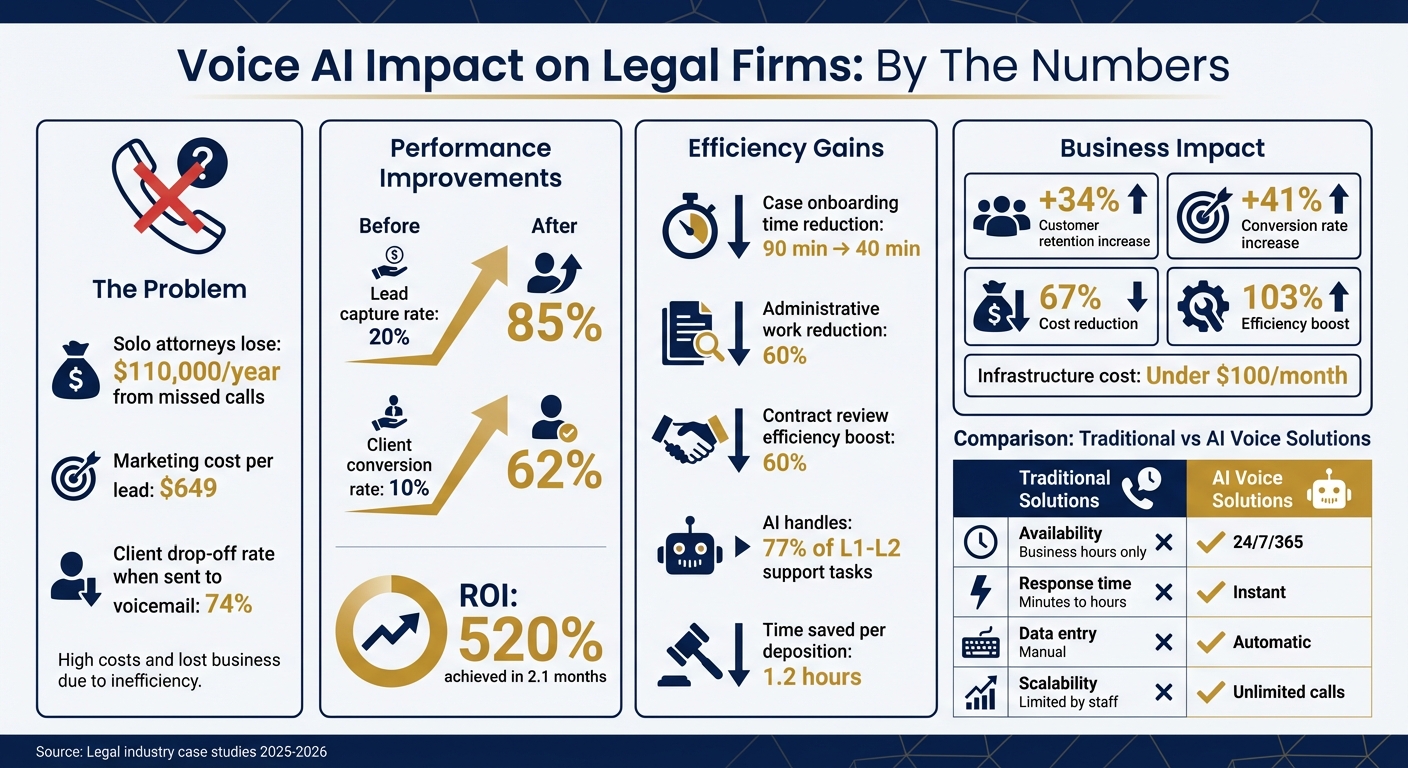
Legal teams lose thousands annually due to missed calls, with solo attorneys potentially losing over $110,000 each year. Voice AI technology solves this by acting as a 24/7 virtual intake coordinator, ensuring no lead is missed. Key benefits include:
- Higher Lead Capture: Boost rates from 20% to 85% and client conversions from 10% to 62%.
- Cost Efficiency: Firms see up to 520% ROI within 2.1 months.
- Streamlined Operations: Automates tasks like conflict checks, data entry, and case updates.
- Compliance Ready: SOC 2 certification and encryption ensure secure handling of sensitive data.
- Custom Features: Tailored scripts, legal-specific transcription, and CRM integration for seamless workflows.
Voice AI transforms how legal teams handle client communication, making processes faster, secure, and more effective.
Voice AI ROI and Performance Metrics for Legal Firms
How To Build an AI Voice Agent for Law Firms (VAPI + n8n Speedrun)
Legal Operations Challenges Solved by Voice AI
Legal teams often grapple with three major hurdles that can directly affect their bottom line: inefficient workflows, strict compliance requirements, and inconsistent client communication. Voice AI tackles these issues by capturing more leads, safeguarding sensitive data, and ensuring clients receive prompt responses.
Improving Efficiency in Case Management
Missing calls can be a costly mistake for legal firms. Did you know that solo attorneys lose over $110,000 each year from unanswered calls, despite spending around $649 per lead on marketing efforts? That’s a significant loss of potential revenue. Voice AI steps in to solve this issue with 24/7 automated intake, offering tailored interviews for specific practice areas like personal injury or immigration law.
But the advantages don’t stop at answering calls. AI agents handle tasks like transcribing and summarizing conversations, logging details directly into CRMs such as Salesforce, Clio, and HubSpot, and even triggering follow-up actions like conflict checks or consultation scheduling - all without human intervention .
Voice AI isn’t just about speed; it’s about working smarter. Intelligent lead screening automatically weeds out unqualified inquiries, allowing legal staff to focus on cases that matter. Routine tasks, like status updates or document reminders, are also managed by AI, freeing paralegals to concentrate on more complex work . For instance, one firm cut its onboarding time from 90 minutes to 40 minutes thanks to AI, eliminating the need for manual form-filling and constant follow-ups.
Efficiency is crucial, but it’s equally important to handle sensitive client data securely - let’s explore how Voice AI meets compliance standards.
Meeting Compliance and Data Security Requirements
While automation makes case management smoother, it also raises concerns about data security and compliance. Legal work requires airtight protection of sensitive information. Modern Voice AI systems meet these demands with SOC 2 certification and end-to-end encryption, safeguarding attorney-client privilege . They go beyond basic voice checks, employing advanced multifactor authentication to block unauthorized access.
These systems are equipped with specialized risk detection protocols and data management tools designed specifically for legal workflows. However, technology isn’t a standalone solution. A human-in-the-loop approach ensures that legal professionals validate AI outputs to maintain ethical standards and accuracy. This also means legal teams need to develop the skills to oversee AI-assisted work effectively with the help of an AI consulting agency.
The results speak for themselves. Litigation teams using AI tools with proper compliance measures have reported a 60% boost in contract review efficiency. The secret lies in choosing vendors who specialize in legal workflows, rather than opting for generic AI tools.
Better Client Communication Through Automation
When 74% of potential clients drop off after being sent to voicemail, it’s clear that delayed responses can cost firms dearly. Voice AI eliminates this problem by answering every call instantly, no matter the time of day, ensuring no lead is lost.
But answering the phone is just the beginning. Voice AI conducts structured interviews to gather key case details, such as incident dates for personal injury cases or vehicle history for Lemon Law matters . It can even schedule consultations by accessing attorney calendars and routing calls to the correct department. Automated follow-up messages and reminders ensure no lead slips through the cracks.
| Feature | Manual/Traditional Intake | AI Voice Solutions |
|---|---|---|
| Availability | Business hours only | 24/7/365 |
| Response Time | Minutes to hours | Instant (first ring) |
| Data Entry | Manual CRM updates | Automatic transcription/logging |
| Lead Filtering | Staff-driven screening | Automated practice-area screening |
| Scalability | Limited by staff capacity | Handles unlimited calls |
The impact is undeniable. In 2025, a mid-size personal injury firm saw its lead capture rate soar from 20% to 85% after implementing Voice AI. Client conversion rates jumped from 10% to 62%, delivering a 520% ROI in just over two months.
"When you have a legal firm, you have high traffic for both SMS and calls. Missing even one is important - and often expensive." - Astrid Rivera, Customer Success Manager at Aloware
Core Features of Custom Voice AI for Legal Teams
Creating a voice AI system that genuinely supports legal teams goes beyond basic speech-to-text capabilities. It must handle intricate legal jargon, distinguish between multiple speakers during depositions, and retrieve precise information from case databases - all while adhering to the strict security requirements of the legal field.
Legal-Specific Speech Recognition and Transcription
General voice recognition tools often struggle with legal terms like "res judicata", case citations, or jurisdiction-specific statutes, leading to errors in transcription. Legal-specific ASR (Automated Speech Recognition) models tackle this issue by being trained on legal vocabulary, including Latin phrases, statutory references, and court formatting nuances.
By integrating Retrieval-Augmented Generation (RAG), these systems can incorporate matter-specific glossaries - such as case captions, party names, and statutes - directly into the transcription process. This approach achieves over 95% accuracy for complex legal terminology.
"The legal industry's reliance on precise documentation means that any transcription errors can have serious consequences, yet manual processes are inherently prone to mistakes and omissions." - Parker Gawne, Founder, Syntora
AI-driven transcription can process hours of deposition audio into searchable text within minutes - approximately 10 times faster than traditional methods. Adding targeted legal glossaries and human review ensures rough drafts reach over 99% accuracy. This "human-in-the-loop" method can cut transcription costs by as much as 80% while maintaining the accuracy essential for legal work.
In legal contexts, ensuring accurate speaker identification is just as important as transcription precision.
Speaker Identification and Real-Time Collaboration
Effective speaker identification is critical for documenting depositions or hearings with multiple participants. Speaker diarization technology leverages multichannel audio processing to distinguish who is speaking, even in challenging environments. Real-time text streaming allows legal teams to follow live proceedings through a browser-based viewer - no specialized software required. Teams can bookmark moments, add comments, and search the live feed instantly, saving an average of 1.2 hours per deposition on note-taking.
Some systems also include a "caller interrupt" feature for intake calls. If an attorney monitoring a live transcript identifies a potential high-value lead, they can step into the conversation with one click. This ensures seamless transitions during critical discussions.
| Feature | Legal Team Benefit | Impact Metric |
|---|---|---|
| Speaker Diarization | Accurate attribution in multi-party depositions | 99%+ accuracy with human QA |
| Real-Time Feed | Instant search and bookmarks for counsel | +1.2 hrs saved per deposition |
| Caller Interrupt | Immediate attorney takeover for high-value leads | 41% increase in conversion |
| One-Click Roughs | Rapid review of proceedings without waiting | < 2 hr turnaround |
Retrieval-Augmented Generation for Legal Research
Building on accurate transcription and speaker tracking, retrieval-augmented capabilities elevate legal research. Instead of merely transcribing, the system can pull real-time data from legal databases, past rulings, and exhibit lists to provide immediate, precise answers.
Before proceedings, attorneys can upload case captions, participant names, and exhibit lists to the AI system. This scoped knowledge base ensures proper nouns and citations are recognized correctly, avoiding the errors common with general-purpose AI.
Attorneys can access relevant case law and exhibits instantly without interrupting their workflow. The system also keeps immutable logs of every RAG query, preserving the chain of custody for legal records while delivering the speed and efficiency of AI.
"AI voice only helps attorneys when it is designed to complete intake work reliably, not when it is treated as a conversational layer that ends at the call." - AgentVoice
This feature can cut legal proceeding costs by 20–40%, while infrastructure costs for custom-built systems using AWS and Twilio typically remain under $100 per month.
NAITIVE AI Consulting Agency's Approach to Custom Voice AI
NAITIVE AI Consulting Agency takes a structured and results-focused approach to developing custom voice AI solutions for legal teams. Their five-step methodology ensures measurable outcomes at every stage. It starts with the Discovery phase, where AI agents collaborate with legal teams to gather specific requirements. Next comes the Proposal phase, during which engineers define clear, measurable goals - like cutting manual transcription time by 30–50% or improving compliance audit success rates. In the Implementation phase, the voice AI solution is integrated into the legal team's existing tech stack seamlessly. This is followed by the Validation phase, involving rigorous testing and continuous monitoring to ensure reliability. Finally, the Handoff phase provides detailed documentation and training, equipping internal teams to manage the system effectively. This end-to-end process directly addresses the operational hurdles faced by legal professionals.
What makes NAITIVE stand out is their commitment to engineering precision. Instead of relying on subjective methods, the agency applies systematic debugging, testing, and performance tracking to ensure their voice AI solutions meet the high standards required in compliance-driven legal environments. Their agent-based systems are designed to adapt dynamically, handling complex legal scenarios such as multi-party depositions or retrieving case-specific data during live calls, rather than relying on rigid, rule-based responses.
"We don't rely on 'vibes' – we add engineering rigor to our LLM-development." - NAITIVE AI Consulting Agency
The results speak for themselves. John, a CEO who adopted NAITIVE's Voice AI Agent, shared that the system now manages 200 outbound calls daily, resulting in a 34% boost in customer retention and a 41% increase in conversion rates. Similarly, Sarah Johnson, CXO, praised the solution for taking over 77% of L1–L2 client support tasks, calling it an "absolute game-changer." Overall, NAITIVE's solutions have delivered a 67% cost reduction and a 103% boost in efficiency, showcasing how their methodical approach transforms legal workflows.
For teams needing ongoing support, NAITIVE also offers AI as a Managed Service (AIaaS). This ensures continuous monitoring and fine-tuning of voice AI systems, keeping them compliant with changing regulations and legal standards. This managed service is especially valuable for the legal sector, where data security and evolving case law demand constant vigilance.
How to Implement Custom Voice AI Solutions
Bringing voice AI into your legal practice involves a structured process that addresses both the technical and regulatory aspects with the help of an AI cloud consulting agency. By following three key phases, you can transform how your firm manages client interactions and case intake.
Step 1: Evaluate Your Current Workflows
Start by pinpointing problem areas in your intake process. Are after-hours calls going unanswered? Are potential leads slipping through the cracks between phone calls and case management systems? These are the kinds of inefficiencies you need to identify.
Set clear goals for your practice. For example, you might aim to reduce staff workload, capture more leads after hours, or respond faster to urgent matters. These insights are essential for tailoring the AI solution to meet your firm’s specific needs.
Step 2: Design and Customize Voice AI Agents
Customization is about more than just creating a realistic voice. You’ll need to design structured protocols to capture vital details like case type, injury severity, or statute of limitations dates. These details help assess case urgency and viability. Additionally, set up routing and escalation rules to ensure high-priority cases reach the right attorney quickly. For instance, a family law firm might handle custody cases differently than uncontested divorces, while a personal injury firm might prioritize cases nearing statutory deadlines.
Integrating the AI agent with your existing tools - such as Clio, MyCase, or PracticePanther - is crucial. This allows the AI to update client records directly within your system, eliminating the need for manual data entry.
"AI voice only helps attorneys when it is designed to complete intake work reliably, not when it is treated as a conversational layer that ends at the call." - AgentVoice
Once the customization is complete, focus on testing for security and compliance before moving forward.
Step 3: Test Security and Compliance Before Deployment
Compliance is non-negotiable in legal settings. Before launching your voice AI solution, confirm it meets all security standards. This includes verifying end-to-end encryption, secure communication protocols, role-based access, and audit trails to safeguard attorney-client privilege and adhere to ethical guidelines. Ensure the system can perform automated conflict checks against your existing databases and complies with State Bar requirements. Additionally, enforce call recording disclosures and role-based access controls.
Testing isn’t just about how natural the AI sounds. Conduct thorough engineering tests to ensure consistent and auditable results. For example, evaluate how after-hours calls are managed, confirm that operational logs provide a clear audit trail, and verify that follow-up actions respect client consent and legal regulations. In a legal environment, having a detailed record of every call and the subsequent actions is absolutely critical.
Voice AI Use Cases in Legal Teams
Voice AI is changing how legal teams operate, from client intake to case management. By improving lead capture, cutting down on administrative tasks, and maintaining consistent service, it’s helping firms run more efficiently and effectively.
Automated Client Intake and Case Updates
Traditional legal intake processes often miss out on a lot of potential leads, which can significantly impact revenue. Voice AI solves this by answering calls immediately - 24/7 - and conducting structured interviews tailored to the firm's practice area. This ensures critical details like injury dates, vehicle information, or immigration status are captured right away.
For example, in early 2026, Frontier Law Center adopted AI voice agents and slashed their average case onboarding time from 90 minutes to just 40 minutes. Features like automated transcription and direct CRM updates remove the need for manual data entry and follow-ups. Beyond intake, voice AI can provide instant case status updates, handle FAQs, send reminders for required documents, and even allow qualified leads to book consultations directly into an attorney’s calendar. It can also perform preliminary conflict checks during the call, streamlining the process even further.
Court Reporting and Documentation
Voice AI systems excel in real-time transcription, turning court proceedings into structured data by identifying legal entities, case types, and incident details. This ensures consistent documentation while meeting compliance standards, thanks to features like full audit trails, confidence scores for AI decisions, and role-based access controls.
"It can take notes, transcribe the call, and hand everything off so your legal staff already knows exactly where the lead stands before they jump in." - Nikolaj Knezevic, Account Executive, Aloware
These transcripts and summaries sync automatically with practice management systems such as Clio, MyCase, and PracticePanther. This eliminates manual data entry, reducing errors and saving time. One case study highlighted a 60% reduction in administrative work through AI-powered documentation. Additionally, multilingual capabilities allow firms to serve a broader range of clients without needing specialized bilingual staff.
Smart Call Routing and Prioritization
Voice AI uses natural language understanding to identify the type of legal matter being discussed and routes callers to the right specialist automatically. High-risk or high-value cases are flagged for immediate attention, ensuring they receive priority.
These systems can also check staff availability in real time using calendar APIs. Some platforms let attorneys monitor live transcriptions, enabling them to jump into a call with one click if a high-priority lead is identified. If the AI struggles to handle a call, it automatically passes it to a human operator, complete with the full conversation history.
| Feature | Traditional Answering Service | Custom Voice AI Agent |
|---|---|---|
| Availability | Limited by staff count | 24/7; unlimited concurrent calls |
| Cost Structure | $15–$20 per call | Under $100/month infrastructure costs |
| Data Integration | Manual entry from messages | Automatic sync with CRM/CMS |
| Routing | Static/Manual | Dynamic based on case type/urgency |
| Lead Qualification | Basic script following | Dynamic follow-up |
Firms that have implemented AI-powered intake have seen case conversion rates jump from 10% to 35%, all while managing high call volumes for under $100 per month in infrastructure costs. These applications not only reduce administrative burdens but also improve client interaction and compliance, allowing legal teams to focus on the actual substance of their cases rather than getting bogged down by phone calls.
Measuring ROI and Success Metrics for Voice AI
To truly understand the value of your voice AI investment, focus on key metrics that reveal its impact. For legal teams, this means examining financial impact, operational efficiency, and client experience - each providing a lens on how voice AI reshapes legal workflows.
Start by analyzing Cost per Interaction (CPI), which compares the expense of client interactions before and after implementing AI. Voice AI can handle thousands of interactions at once, drastically reducing CPI compared to traditional staffing. Another critical metric is Staff Workload Reduction (SWR), which measures how much routine work shifts from paralegals to AI. In fact, AI systems can manage up to 77% of Level 1 and Level 2 client support inquiries on their own, freeing legal staff to focus on more complex, billable tasks. Together, these metrics highlight the operational and communication improvements voice AI can deliver.
"Voice AI's speed and accuracy boost client satisfaction." - Parul Chouhan, Chief of Staff, Intelekt AI
Financial returns often materialize quickly. According to research, 74% of executives report seeing measurable ROI within the first year, with well-planned implementations achieving payback in as little as 60–90 days [25, 26]. To calculate ROI, use this formula:
(Annual Benefits − Annual Costs) ÷ Annual Costs.
Benefits include direct cost savings from reduced labor, increased revenue from better lead conversion, and productivity gains as staff shift to high-value tasks.
Client interaction metrics are equally important. Track First Call Resolution (FCR) and Response Time to measure how efficiently client issues are addressed. Post-interaction surveys can reveal Client Satisfaction (CSAT) improvements, which can increase by as much as 10% due to the elimination of hold times. To establish a baseline, collect data for four weeks before launching AI, then monitor operational metrics (e.g., Average Handle Time and FCR), experience metrics (e.g., CSAT and abandonment rates), and financial metrics (e.g., cost per call reductions and avoided hiring expenses).
By aligning these metrics with your practice's workflows, you can clearly demonstrate how voice AI transforms legal operations.
| Metric Category | Key Performance Indicators | Legal Team Benefit |
|---|---|---|
| Financial | Cost per Interaction, Total Savings | Lower costs for routine client communication |
| Efficiency | Staff Workload Reduction, AI Task Volume | Paralegals focus on complex, billable work |
| Client Experience | First Call Resolution, Response Time | Better client retention and enhanced reputation |
| Growth | Scalability, Lead Conversion Rate | Handle more cases without increasing staff levels |
These metrics provide a solid framework to measure and refine the impact of voice AI in legal settings, paving the way for continuous improvement.
Future Trends in Voice AI for Legal and Compliance
Voice AI is making huge strides in the legal world, with multilingual capabilities leading the way. A notable example came in November 2025, when Harvey teamed up with ElevenLabs to introduce a global multilingual voice interface. This system delivers legal answers in multiple languages. Harvey CEO Winston Weinberg highlighted the importance of this innovation:
"This partnership makes legal AI more global, accessible, and human. With ElevenLabs, we're ensuring every lawyer can engage with Harvey in their own language and context".
Upcoming advancements, such as multilingual voice translation and spoken trial simulations, promise to simplify cross-border legal work by reducing the need for human interpreters.
Natural language understanding is also reshaping how Voice AI manages intricate legal tasks. Modern systems can now extract structured data and flag critical issues, like statutes of limitations, in real time. These advancements pave the way for even more proactive tools that assist legal teams.
On top of better data capture, the latest analytics tools are offering predictive insights that strengthen legal decision-making. Generative AI-powered predictive legal analytics, for instance, can examine thousands of past cases to uncover judge-specific patterns and jurisdictional trends. This helps legal teams estimate the likelihood of success before filing lawsuits. By 2026, it's projected that 75% of law firm tasks could be automated with AI, potentially saving up to 240 hours per lawyer annually. The focus is shifting toward foresight - tools that simulate scenarios and track regulatory changes before they create challenges.
Real-world examples already showcase how these tools can streamline legal operations. For instance, in 2024, the City of Frisco, Texas, implemented WhitegloveAI's conversational system, which effortlessly switches between English, Spanish, and Hindi during traffic reporting calls. This saved their traffic engineers 15–20 staff hours weekly. Similarly, the City of Pacifica, California, used "Rose AI" to handle 60% of after-hours inquiries without human involvement, cutting call wait times by 45% in just three months. Legal teams can achieve similar results by adopting features like emotionally aware agents and voice-to-form tools for court reporting and compliance tasks.
Voice AI is moving beyond simple automation to become a tool for strategic decision-making. With 67% of corporate counsel now expecting their law firms to adopt advanced technologies like generative AI, staying ahead of these trends is crucial. For legal professionals, the key to staying competitive lies in leveraging AI to boost both efficiency and strategic insight.
FAQs
How does Voice AI handle attorney-client privilege?
Voice AI systems do not create an attorney-client relationship. Courts typically do not recognize such a relationship between a person and an AI. Privacy protections rely on adherence to applicable laws and secure data handling practices to ensure sensitive information is managed responsibly.
What practice systems can Voice AI integrate with?
Voice AI works seamlessly with various systems, including CRM platforms, case management tools, telephony services like Twilio and Vonage, as well as internal software such as scheduling and intake systems. By connecting these tools, it automates tasks like legal intake and appointment scheduling, making daily operations smoother and more efficient for legal teams.
How long does it take to see ROI from Voice AI?
Most businesses see a return on investment from Voice AI within just 60 to 90 days. However, the exact timeline can depend on several factors, such as how quickly the system is implemented, how extensively it's used, and how well it integrates with existing workflows.