Case Studies: AI's Role in Process Efficiency
Case studies showing how AI reduces costs, speeds processes, and boosts productivity across customer service, development, workforce, and supply chains.
AI is transforming business operations across industries, delivering faster results and cutting costs. Here’s the big picture:
- 90% of executives have scaled at least one AI use case, with 85% of Fortune 500 companies relying on AI for critical operations.
- AI adoption is driving cost reductions - like 90% savings in invoice processing costs and $3.5 billion in productivity gains for IBM.
- Customer support, software development, workforce management, and supply chain optimization are seeing dramatic improvements. For example, AI-powered chatbots saved Klarna $40 million annually, while Atlassian’s AI agent cut code review times by 45%.
- Companies like UPS, Dow, and Repsol are using AI to optimize logistics, uncover billing errors, and save time, leading to substantial financial benefits.
From faster customer service to predictive maintenance, AI is automating repetitive tasks, improving accuracy, and reshaping how businesses operate. Whether it’s reducing wait times, improving forecasting, or cutting manual labor, AI is delivering measurable results and boosting efficiency.
Key Highlights:
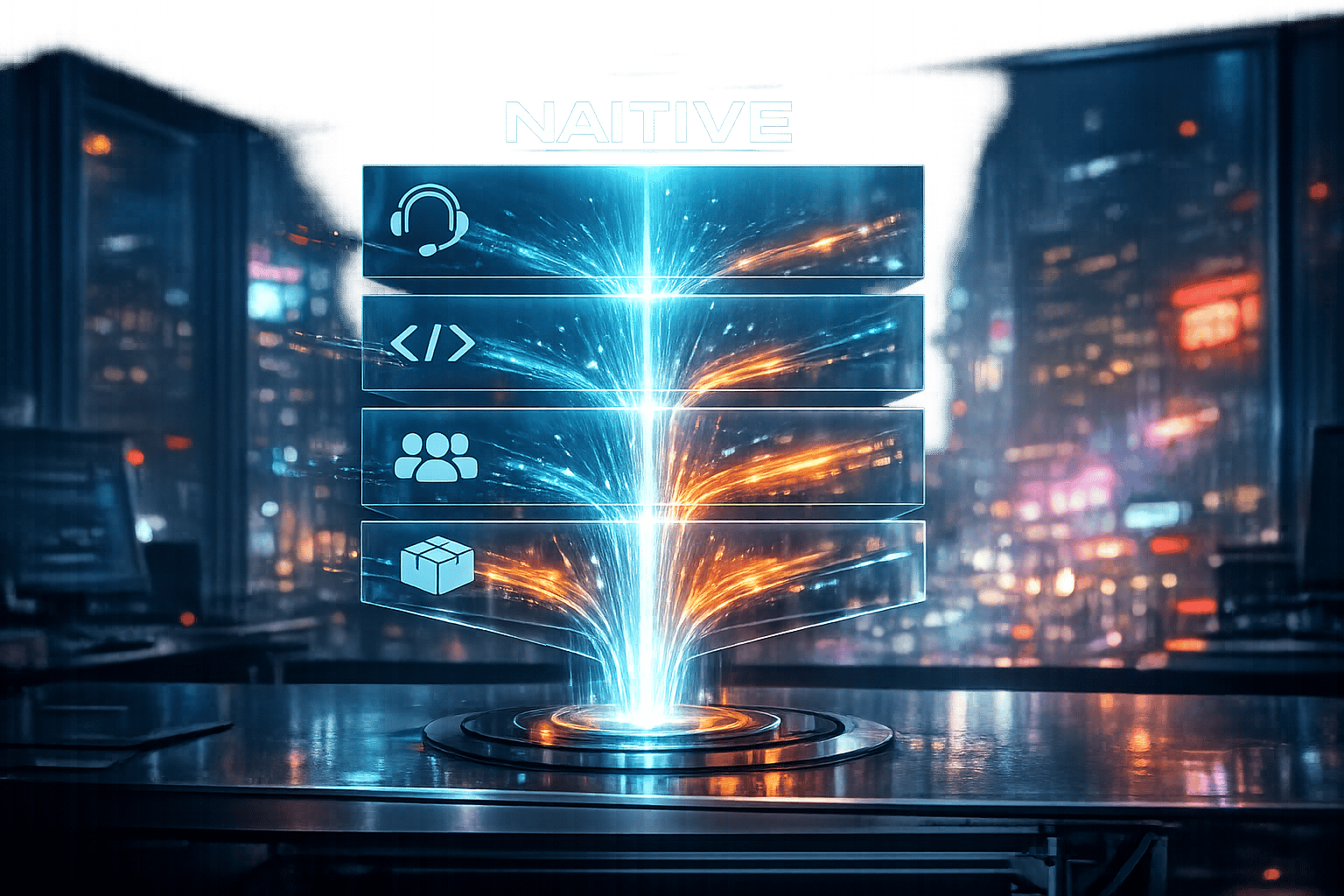
- Customer Support: Klarna’s AI assistant handles 2.3M conversations/month, saving $40M/year.
- Software Development: Atlassian’s AI reviewer reduced pull request times by 45%.
- Workforce Management: IBM’s AI tools saved $3.5B and resolved 94% of HR queries.
- Supply Chain: UPS’s AI system saves $300–400M annually, cutting emissions and fuel use.
AI is no longer experimental - it’s a core driver of efficiency gains and cost savings across industries.
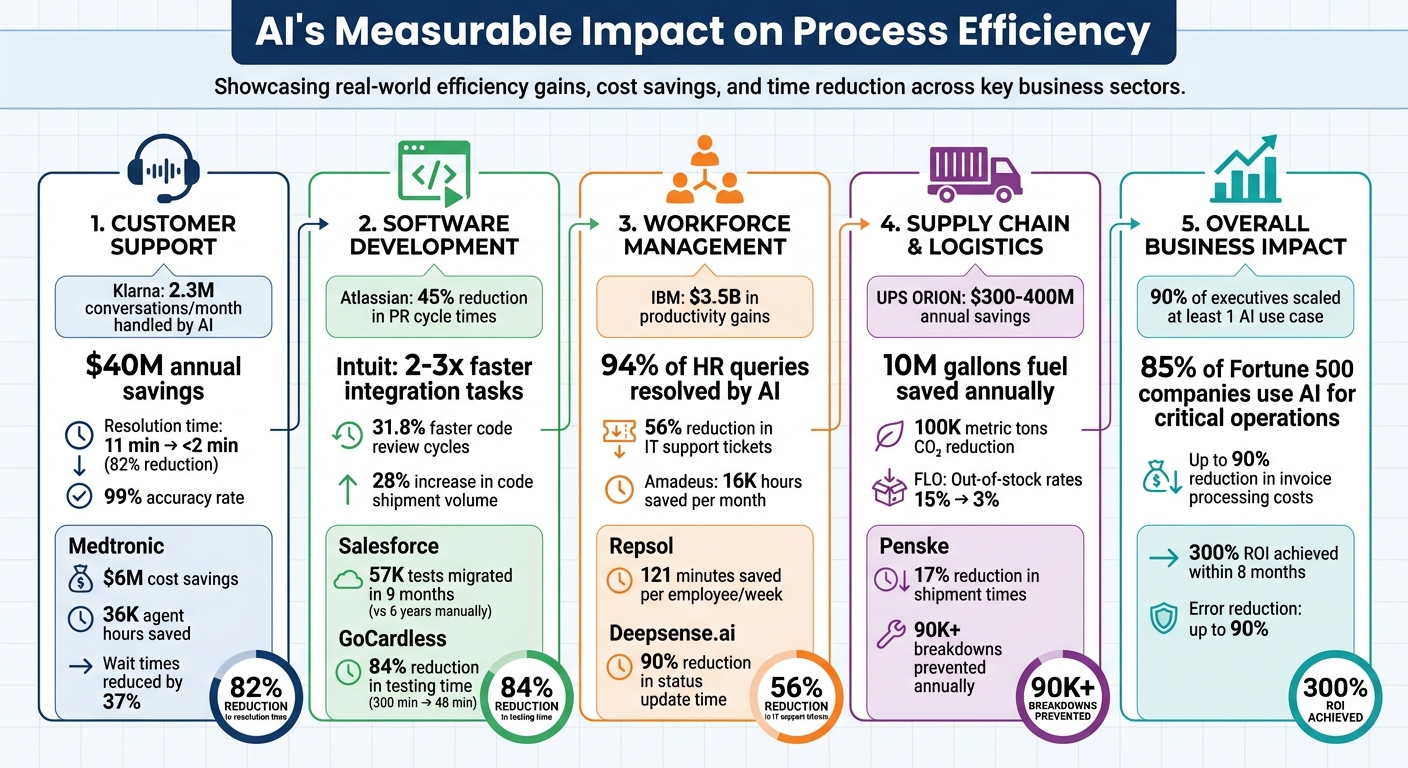
AI Process Efficiency Impact: Key Statistics Across Industries
10 Best AI Business Use Cases & How AI Delivers ROI
Customer Support: Scaling Operations with AI
AI is transforming customer support by driving efficiency and cutting costs. Take Klarna, for example, which introduced an OpenAI-powered assistant in February 2024. This system now handles 2.3 million conversations per month across 35+ markets. It manages everything from refunds to disputes, delivering $40 million in annual savings and taking on work previously done by 700 full-time agents. Impressively, the average resolution time has dropped from 11 minutes to under 2 minutes, all while keeping customer satisfaction levels on par with human agents. These advancements highlight how tools like chatbots and voice assistants are streamlining support operations.
AI-Driven Chatbots and Virtual Agents
AI-powered agents are revolutionizing customer interactions by automating responses and handling more complex queries. For instance, Medtronic rolled out Teneo AI Agents between 2022 and 2023 across 60+ contact centers, supporting patients and clinicians across 10+ business units. These agents even tackle troubleshooting for cardiac devices. The results? $6 million in cost savings, 36,000 agent hours saved, and a 55% reduction in misrouted calls during 2022 alone. On top of that, wait times dropped by 37%, and the system achieved 99% accuracy, surpassing human agents in "Total Call Understanding".
Michael Altieri, Service Delivery Manager of Virtual Assistants at Medtronic, shared: "With Teneo, we achieved better results than we could have imagined, and the success in Cardiovascular led other contact centers to adopt the same approach".
The secret to such success lies in advanced intent-routing capabilities. Using Retrieval-Augmented Generation (RAG), these systems pull real-time data from internal manuals or transaction histories to provide accurate responses. One global bank saw its conversation containment rate jump from under 15% to 68%. Meanwhile, a major e-commerce company reduced its human-agent workload by 60% and cut response times by 40%, bringing them down from 5 minutes to under 1 minute.
Hybrid AI-Human Models
Blending AI with human expertise is another game-changer. A tech company saw a 65% boost in advisor performance and shaved 4 minutes off response times within just three weeks of using a generative AI tool that provides real-time data and suggestions. Similarly, a regional bank in the northeastern U.S. implemented a cloud-based conversational AI agent in 2020. During the COVID-19 pandemic, the AI handled 1.1 million calls over 10 months, resolving 50% of 5 million total requests and cutting human touchpoints by 40%.
GitHub also launched an AI assistant in February 2024 to support its 100 million developers. This tool resolved 60% of cases (over 20,000 customers) in under 7 minutes, freeing up the support team to focus on more complex engineering problems. These hybrid systems use Natural Language Processing (NLP) to detect intent and sentiment, escalating complex or sensitive issues to human agents with full conversation histories. Feedback loops, where agents rate AI responses, ensure continuous improvement in accuracy over time.
24/7 Support with Voice AI
Voice AI takes customer service to the next level by providing round-the-clock support. Atos, in partnership with PolyAI, deployed a 24/7/365 voice assistant for a government-backed financial service. This system replaced the workload of 50–95 full-time agents, cutting agent call volumes by 30%.
Danny Penswick, Senior Operations Manager at Atos, explained: "We used to have to work on Christmas day, but with PolyAI answering calls 24/7/365, we're able to close on public holidays".
This setup operates at just 50% of the cost of a full-time employee.
In Latin America, Estafeta, a logistics company, introduced a voicebot named "Beatriz" in January 2024 using VOCALLS and Azure OpenAI technology. The bot reduced average handling time by 78%, from 420 seconds to 90 seconds, and increased answered call volume for package tracking by 120%. Similarly, Everise, a global customer experience company, integrated Retell AI into its IT help desk, containing 65% of voice calls that previously needed manual agents. This saved 600 man-hours per month, and call wait times dropped from 5–6 minutes to zero.
Saurabh Sodhani, SVP of Digital Transformation at Everise, highlighted: "We were able to contain 65% of voice calls with the bot, which previously would have been directly gone to a manual agent for resolution".
Faster Software Development with AI
AI is reshaping the way software is developed by automating tasks like code generation, testing, and deployment. Companies are no longer just using autocomplete tools but are now leveraging systems that can handle entire workflows. This shift means faster project turnarounds, fewer errors, and more time for developers to focus on complex challenges. Let’s dive into how AI is transforming code reviews, debugging, and beyond.
AI-Powered Code Generation and Debugging
In January 2026, Atlassian introduced "Rovo Dev", an AI agent designed to be the first reviewer on every pull request (PR). The results were dramatic: PR cycle times dropped by 45%, cutting review times by an entire day. Engineers no longer had to wait 18 hours for their first review comment - it happened instantly. Even new engineers were able to merge their first PR five days faster than those without the tool.
Taroon Mandhana, Head of Product Engineering at Atlassian, shared: "Rovo Dev is now the automated, first reviewer on every PR, reducing wait time for reviews, reducing our overall PR backlog, and freeing our team to focus on reviewing larger, more critical code changes".
Intuit developed GenOS, a generative AI operating system, in 2024. This tool analyzes developer logs and internal documentation to offer context-aware solutions directly within IDEs and Slack. The result? Integration tasks were completed 2 to 3 times faster compared to generic AI tools. Similarly, Goldman Sachs fine-tuned AI on its codebase in 2025 to provide tailored coding assistance.
AI-driven tools have also halved the time developers spend on documentation and autocompletion tasks. A study tracking 300 engineers revealed that AI integration reduced PR review cycle times by 31.8% and boosted code shipment volume by 28%. The most active users saw a staggering 61% increase in code output.
Automating Testing and Deployment
AI isn’t just speeding up coding - it’s revolutionizing testing and deployment too. In July 2025, Salesforce used a modular AI agent architecture, Agentforce, to migrate 57,000 unit tests from a legacy xUnit framework to Jest. What would have taken six years manually was completed in just nine months, with a 99.9% pass rate.
GoCardless, a leader in direct bank payments, implemented CloudBees Smart Tests to manage 60,000 test cases. By prioritizing tests most likely to fail based on code changes, the AI cut machine hours by 50% per test run. This saved 8,500 hours in the first month alone and slashed testing times from over 300 minutes to just 48 minutes per run.
Bastian Zamorano, Product Manager for Developer Enablement at GoCardless, stated: "Thanks to CloudBees Smart Tests, we've managed to increase the speed of our pipeline for our engineers, reducing waiting time and costs and increasing productivity and satisfaction all around".
Other organizations have seen equally impressive results. A global financial services firm used AI to backfill unit tests for legacy Java applications, achieving a 180% increase in test coverage across 25 applications in just two months. Coherent Solutions equipped its 360 QA engineers with custom AI assistants, reducing test-case writing effort by 50%, increasing test coverage by 35%, and speeding up documentation by 60%. An e-commerce company reported defect detection rates were 85% faster after integrating AI into its automation framework.
| Testing Metric | Improvement | Company |
|---|---|---|
| Test Migration Speed | 8x Faster | Salesforce |
| Machine Hours Saved | 50% Reduction | GoCardless |
| Test Coverage | 180% Increase | Financial Services Firm |
| Test Execution Time | 84% Reduction (300 to 48 min) | GoCardless |
| Defect Detection | 85% Faster | E-commerce Company |
AI is clearly driving efficiency across the software development lifecycle. If your organization is ready to integrate AI into its development processes, NAITIVE AI Consulting Agency can provide the expertise needed to help you achieve these results.
Improving Workforce Management and Productivity
AI is reshaping workforce management by automating repetitive tasks and providing teams with smarter data, reducing inefficiencies and wasted time. Studies show that desk workers lose 41% of their time on tasks unrelated to their core responsibilities, while 47% of digital workers struggle to locate the information they need to work effectively. AI addresses these issues by streamlining routine work and delivering the right data when it’s needed.
AI for Time Tracking and Resource Allocation
Some companies are leading the way in using AI to optimize time management and resource allocation:
- Deepsense.ai developed an AI assistant in 2026 using the CrewAI framework and LangChain. By integrating tools like GitLab, JIRA, Slack, and Google Drive, the assistant provided real-time project updates, eliminating the need for daily stand-ups. This innovation reduced the time spent on status updates by an impressive 90%.
- SLB (formerly Schlumberger) introduced an AI-driven project discovery tool in 2024 using Microsoft Power Apps and Azure Functions. The tool analyzed global project submissions to identify overlapping efforts, resulting in 800 matches and sparking 150 new innovations in just 28 days. This prevented redundant work and encouraged collaboration across facilities.
By identifying overlapping efforts across geographically distributed teams, the tool fosters collaboration and enables the creation of unified, centrally driven projects.
- Microsoft's Customer and Partner Solutions (MCAPS) team utilized Power Automate Process Mining in 2024 to improve their demand generation workflow. The AI pinpointed a bottleneck in content intake, which averaged 8 days. Automating the process cut their timeline from 12 weeks to 8 weeks, a 33% improvement.
These examples highlight how AI-driven automation not only saves time but also enhances resource efficiency.
Data-Driven Insights for Distributed Teams
AI is also helping distributed teams work smarter by delivering actionable insights:
- IBM implemented its watsonx portfolio and AI agents like AskHR and AskIT between 2022 and 2024 to support its global workforce. Under the leadership of Joanne Wright, Senior Vice President of Transformation & Operations, this initiative resulted in $3.5 billion in productivity gains, a 56% reduction in IT support tickets, and AskHR resolving 94% of common HR inquiries without human assistance.
At IBM, we made ourselves the first client, proving that transformation at enterprise scale is not only possible but delivers significant measurable value.
- Repsol employees saved an average of 121 minutes per week using Microsoft Copilot to streamline tasks like summarizing meetings, managing emails, and drafting presentations. The AI also improved output quality by 16.2% in areas like communication and design.
- Amadeus adopted a Moveworks AI-powered support system, which saved employees over 16,000 hours per month by automating responses to routine requests.
- Dow teamed up with Microsoft in 2024 to deploy autonomous agents for global freight invoicing. These agents scanned over 100,000 PDF invoices annually, flagging billing discrepancies such as $30,000 surcharges where only $5,000 was expected. This solution is projected to save millions of dollars in its first year.
| Company | AI Solution | Primary Benefit | Metric |
|---|---|---|---|
| Deepsense.ai | Project Status Assistant | Automated status reporting | 90% time reduction |
| SLB | Project Discovery Tool | Resource synergy identification | 800+ matches in 28 days |
| Microsoft MCAPS | Process Mining | Bottleneck identification | 33% faster timeline |
| IBM | watsonx AI Agents | HR/IT support automation | $3.5 billion in productivity gains |
| Repsol | Microsoft Copilot | Task & meeting management | 121 minutes saved per week |
| Amadeus | Moveworks AI Assistant | Centralized support | 16,000 hours saved per month |
With the right AI tools, businesses can unlock new levels of workforce efficiency and resource savings. NAITIVE AI Consulting Agency specializes in creating customized AI systems to help organizations achieve these outcomes.
Supply Chain and Inventory Management with AI
AI is revolutionizing supply chain operations by slashing costs and tackling inefficiencies. Businesses are moving away from static planning methods and adopting systems that adapt in real time to market changes. The result? Fewer stockouts, lower fuel consumption, and notable savings each year. This shift is reshaping how companies handle forecasting, routing, and waste management.
Demand Forecasting with AI
Traditional demand forecasting leaned heavily on historical sales data and fixed assumptions. AI has completely changed this by pulling in a wide range of data - like point-of-sale trends, social media chatter, weather forecasts, and even economic indicators. These dynamic inputs help create forecasts that are updated continuously, leading to smarter purchasing decisions.
Take FLO, a European retailer, for example. In 2024, they teamed up with invent.ai to revamp their inventory system. The results? A drop in out-of-stock rates from 15% to just 3%, a 12% boost in sales retention, and a 17% cut in shipment times - all thanks to AI incorporating external signals like weather data alongside sales figures. Similarly, a major FMCG company in Latin America used Sigmoid's AI solution to improve forecasting accuracy by 25%, which reduced costly air-freight shipments by 15% within just six months.
But AI doesn’t just stop at demand predictions - it also streamlines the movement of goods with advanced routing systems.
AI-Enhanced Inventory Routing
AI is reshaping logistics with real-time route optimization. These systems tackle complex challenges by analyzing millions of route combinations in seconds, factoring in variables like traffic, weather, and delivery density. For example, UPS uses a well-known strategy - prioritizing right-hand turns - to cut idling time and improve safety.
UPS’s ORION (On-Road Integrated Optimization and Navigation) system, rolled out between 2012 and 2021, processes 30,000 route optimizations every minute. This has saved the company between $300–400 million annually, cut CO₂ emissions by 100,000 metric tons, and reduced fuel consumption by 10 million gallons each year.
ORION has been a game changer for UPS, impacting 55,000 drivers across 1,000 buildings in the United States.
– Mark Wallace, Senior Vice President of Global Engineering and Sustainability, UPS
Amazon’s DeepFleet AI system also stands out, reducing last-mile delivery costs by 30% in optimized areas through predictive customer availability models and clustering algorithms. FedEx has seen a 20% improvement in on-time deliveries by using AI to anticipate delays up to 72 hours in advance. Walmart, meanwhile, has boosted delivery capacity by 35%, improved trailer utilization by 30%, and saved over $1 billion annually, all by using AI to optimize logistics.
Reducing Waste through Predictive Analytics
AI-powered predictive analytics is helping businesses cut waste by preventing overproduction, optimizing energy use, and lowering emissions. By breaking down emissions data by activity, energy source, and region, AI pinpoints areas for improvement and helps manufacturers align production with actual demand.
For example, thyssenkrupp Materials Processing Europe worked with Deloitte in 2025 to create "pacemaker®", an AI tool for managing material flow in the automotive supply chain. This system not only delivered cost savings of up to 15% but also significantly reduced CO₂ emissions by eliminating overproduction and unnecessary shipments.
The key components of the ideal supply chain are intelligent material management and an optimized use of resources. pacemaker® lays the groundwork for a system that does just that, while also allowing us to reduce our CO₂ footprint and take a more mindful approach to protecting the planet.
– Christian Jabs, Project Head pacemaker® & Head of Group Sales, thyssenkrupp Materials Processing Europe
Early adopters of AI in logistics report impressive results: a 15% drop in logistics costs, a 35% improvement in inventory levels, and fuel savings of 10–15% through optimized routing. For businesses looking to follow suit, demand forecasting is a smart starting point - it offers a quick return on investment, typically within 8–14 months, and requires minimal disruption to operations. NAITIVE AI Consulting Agency specializes in helping companies implement AI solutions that drive measurable gains in supply chain efficiency and sustainability.
AI Applications in Specialized Industries
AI has become a game-changer in industries like transportation, agriculture, and energy, delivering measurable results and transforming operations in highly specialized sectors. Let’s dive into how these technologies are making an impact.
Predictive Maintenance in Transportation
In the transportation sector, predictive maintenance is revolutionizing how companies handle vehicle repairs. By anticipating equipment failures before they occur, businesses are minimizing downtime and saving money.
Take Penske Transportation Solutions, for example. In 2025, they implemented an AI-powered diagnostics system with Hitachi Digital Services across a fleet of over 150,000 vehicles. This system tracks critical components - like engine cooling, tire pressure, brakes, and batteries - every 30 seconds. The results? Over 90,000 breakdowns prevented annually, with each repair taking 15 minutes less, saving millions for their 11,500 technicians across 990 locations.
"As we first started working with Hitachi what was readily apparent to us was how much industry-level experience they bring. We really felt we had a great team to understand how we could better improve our maintenance operations to support our customer."
– Mike Krut, Senior Vice President, IT, Penske Truck Leasing
Another example is a mid-sized oil and gas logistics company operating 127 vehicles in the Permian Basin. After adopting Oxmaint’s AI analytics in late 2025, they saw critical failures drop by 73%, emergency road calls decrease by 84%, and fleet availability rise from 91.4% to 99.2%. The financial impact? Annual savings of $2.1 million, with a return on investment of 7.8x in the first year.
MidWest Logistics (name changed for confidentiality) also saw transformative results. Between 2023 and 2025, they equipped 450 delivery trucks with AI sensors. The system achieved a 91% accuracy rate in predicting breakdowns, reducing monthly incidents from 47 to 13 and cutting repair times from 4.7 hours to 1.8 hours. These efficiencies saved the company $1.7 million annually.
AI isn’t limited to vehicles - it’s also improving manufacturing. At General Motors' Arlington Assembly Plant in Texas, AI monitors welding robots and conveyor motors, predicting 70% of equipment failures at least 24 hours in advance. This proactive approach has significantly reduced unplanned downtime in a facility producing over 1,200 SUVs daily.
AI in Agriculture for Yield Optimization
Farmers are leveraging AI to make smarter decisions about planting, irrigation, and pest control. AI-driven mobile apps can diagnose plant diseases instantly through photo uploads, while intelligent irrigation systems analyze environmental data in real time to deliver water precisely when and where it’s needed. This reduces waste without compromising crop health.
Precision fertilizer application is another major development. AI identifies nutrient deficiencies at the field level, ensuring fertilizers are applied only where necessary, rather than uniformly across entire plots. This targeted approach maximizes resource efficiency and boosts yields.
Energy Sector Efficiency with AI
AI is also transforming energy management, helping providers optimize supply and demand, manage grids efficiently, and reduce outages. By integrating data from sensors, weather forecasts, and market prices, companies are streamlining operations and cutting costs.
In September 2025, an Asian electricity company partnered with Concentrix to implement an AI decision engine. This system automated real-time procurement decisions and replaced outdated forecasting methods, reducing power outages by 50% and fully automating previously manual processes.
Closer to home, a mid-sized US solar farm operator deployed a custom AI grid system in February 2026, developed by Apriorit. The system predicted solar production and market prices, enabling automated energy dispatch during peak demand. This resulted in 30% of total energy being sold at premium prices, while eliminating third-party licensing fees.
In offshore energy, a global oil and gas corporation utilized C3 AI Reliability applications on a platform, integrating three years of data and 20 machine learning models within just 16 weeks. The results? Alert noise dropped by 99%, from 3,600 annual alerts to just 34, and the company saved $4.7 million annually in carbon tax costs for a single platform.
In Australia, Endeavour Energy used AI and Edge Zero sensors to electrify a large bus depot. By enabling flexible managed charging, they avoided a costly A$6.5 million grid upgrade, reducing costs to A$2.5 million and accelerating the timeline. Similarly, SA Power Networks used a digital twin created by Neara to assess flood damage to power lines. This allowed them to re-energize lines in days rather than weeks, avoiding hazardous physical inspections.
For companies in transportation, agriculture, or energy looking to adopt similar solutions, NAITIVE AI Consulting Agency offers tailored consulting services to design and deploy industry-specific AI systems.
Training and Competency Development with AI
AI isn't just reshaping operations - it’s also changing how companies train and develop their workforce. Traditional training methods are often slow, expensive, and one-size-fits-all. AI is flipping the script, offering personalized learning experiences and automating skill evaluations. This means employees can upskill faster and more effectively, while businesses save time and money.
AI for Personalized Learning Paths
Instead of forcing employees through weeks of generic training, AI platforms can assess individual skill levels and create customized learning plans to address specific gaps. For instance, Siemens Energy used Workera's AI platform to evaluate the skills of nearly 100,000 employees. The results? Over 4,900 skill assessments completed, 97% of learners certified in less than 90 days, and a 62% improvement in Generative AI and ChatGPT skills after just two weeks of training.
"People want to learn, but they also want to know what's in it for them. They don't want to start a two-week course and then realize they already know everything and just wasted their time."
- Jyotika Samjee, Head of Global Transformation, Siemens Energy
AI is also bringing training directly into the workflow. For example, Expleo created a GenAI coach for a leading aerospace manufacturer to train quality inspectors. This AI coach used technical manuals and diagrams to answer job-specific questions, cutting training time by 30% to 40%. Thanks to this approach, new inspectors started fieldwork two months earlier than the usual six-month timeline. Meanwhile, Microsoft teamed up with GP Strategies to use AI parser agents that convert long videos into bite-sized microlearning clips. This reduced content development time by 50% and saved 40 work hours every month.
These tailored learning paths not only speed up training but also pave the way for more precise skill assessments.
Automating Employee Skill Assessments
Traditional skill evaluations can be slow and subjective. AI systems are changing that by automating the process, making assessments quicker and more accurate. Take Britannia Industries Limited, a company with over 130 years of history. They adopted Edrevel's AI-powered self-assessment tool across 18 facilities. The result? Assessment time dropped from 10 weeks to just 20 days - a 75% reduction. This efficiency allowed them to shift from annual to quarterly evaluations, saving about $2,500 and gaining 288 productive hours.
"Edrevel's self-assessment tool enabled us to conduct officer assessments, manager reviews, and training recommendations in 20 days versus our typical 10 weeks. The success was so clear that we moved from annual to quarterly assessments for more granular evaluation and sharper training analysis."
- Manivannan K., Technical Training Manager, Britannia Industries Limited
IBM also leveraged AI to streamline HR processes. Their AI assistant, "cHaRlie", powered by watsonx Orchestrate, automated attendance tracking and enrollment monitoring. In just six months of 2023, it handled 8,000 events with perfect attendance tracking accuracy, reduced roster update times by 91%, and boosted employee satisfaction by 15%. This freed up HR managers to focus on more strategic tasks rather than manual data entry.
By automating skill assessments, companies not only accelerate employee development but also enhance overall operational efficiency.
For businesses ready to adopt AI-driven training and assessment tools, NAITIVE AI Consulting Agency offers tailored solutions to meet unique workforce development needs.
Key Takeaways
AI is reshaping how businesses operate, delivering impressive results across industries. For example, HVVG managed to cut its invoice processing time by 70%, reducing the time per invoice from 30 minutes to just 10 minutes. Similarly, Dow used AI to analyze 43,000 shipments, uncovering millions of dollars in hidden shipping costs. A Fortune 500 manufacturer reported a 300% ROI within just eight months, saving $2.3 million annually.
These advancements aren't just about speed - they also bring significant cost savings. AI can reduce errors by up to 90%, lower invoice costs from $15.70 to $3.90 per document, and increase early payment discounts by 467%. One consultancy firm saw an 87% boost in processing speed and a 28% improvement in defect detection within six months. By automating repetitive tasks, AI allows teams to focus on strategic initiatives instead.
The secret to these successes lies in targeting specific pain points with AI-driven solutions tailored to organizational data. As Melanie Kalmar from Dow highlighted:
If we had a better way to assess and track invoicing errors - even a 1 percent improvement would mean substantial savings.
To replicate these results, it's essential to identify your largest bottlenecks and track progress with clear metrics like time saved per task or error reduction rates.
For businesses aiming to achieve similar outcomes, NAITIVE AI Consulting Agency offers customized AI solutions designed to deliver measurable ROI and real-world impact.
FAQs
What’s the best first AI use case to try?
When introducing AI into a workplace, the smartest starting point is human-AI workflow integration. This means letting AI handle repetitive tasks, freeing up people to focus on more complex and strategic decisions. The result? Increased productivity, fewer mistakes, and happier employees.
A great place to begin is with tasks like data entry or document classification. These are straightforward to automate, deliver quick results, and don’t require a large upfront investment. Plus, tackling these tasks first creates a solid foundation for expanding AI capabilities down the road.
How do I measure AI efficiency ROI fast?
To evaluate AI efficiency ROI effectively, zero in on measurable metrics like cost reductions, productivity improvements, or fewer errors. Pinpoint specific KPIs - such as time saved or boosted output - and weigh these benefits against the costs of implementing the AI solution. A simple ROI formula can help you determine the financial impact of improvements, such as streamlining manual tasks or speeding up processes, relative to your investment.
How do I keep AI outputs accurate and safe?
To keep AI outputs accurate and safe, it's important to mix smart practices with solid quality checks. Human oversight plays a key role in reviewing critical AI-generated content to catch errors or inconsistencies. Training models with high-quality, domain-specific data ensures they produce reliable results tailored to specific needs.
Clear workflow parameters are essential to handle variability effectively. Additionally, strict data privacy protocols should be in place to safeguard sensitive information. Regularly monitoring and validating outputs helps maintain a balance of accuracy, consistency, and safety in AI-powered processes.