AI Agents in Corporate Training: Trends 2025
AI agents embedded in workflows personalize corporate training, boost retention and completion, cut admin time, forecast skill gaps, and deliver measurable ROI.
AI agents are transforming corporate training by delivering personalized, real-time learning through tools like Slack and Microsoft Teams. Unlike older systems, these agents integrate directly into daily workflows, saving employees time and boosting efficiency. By 2025, 85% of companies adopted AI agents, driving impressive outcomes like a 300–500% ROI, 70–80% knowledge retention, and 80–90% course completion rates.
Key highlights:
- Market Growth: From $7.38 billion in 2025 to $103.6 billion by 2032.
- Efficiency Gains: Employees spend 50–80% less time searching for information.
- Personalized Learning: AI agents use data to create role-specific training and provide instant answers.
- Multi-Agent Systems: Specialized agents (e.g., content, compliance) automate workflows and reduce admin tasks by 60–80%.
- Predictive Analytics: AI forecasts skill gaps and recommends training before issues arise.
Despite challenges like data privacy and AI "hallucinations", companies using AI agents report faster onboarding, improved productivity, and better learning outcomes. To succeed, businesses must focus on clean data, human oversight, and phased rollouts for smooth adoption.
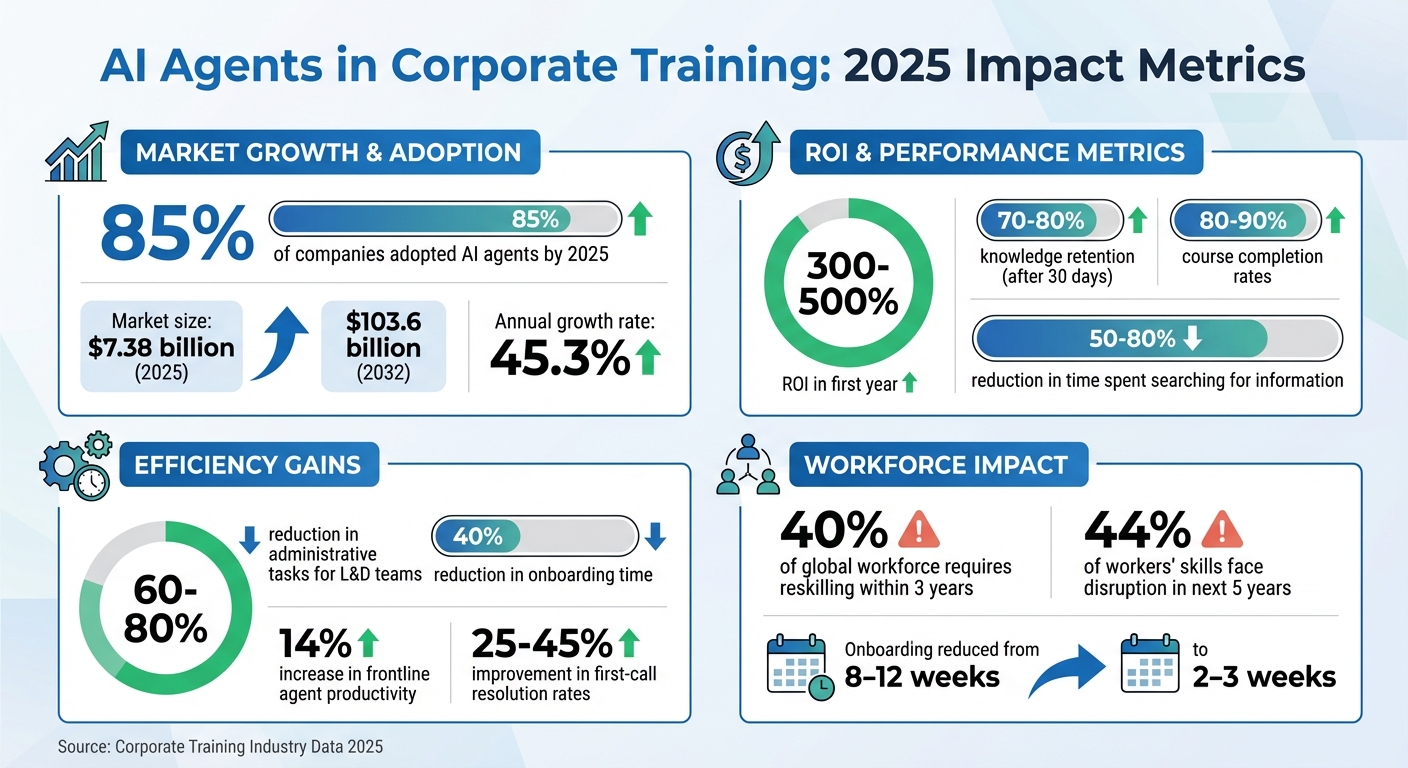
AI Agents in Corporate Training: 2025 Key Statistics and ROI Metrics
Key Trends Driving AI Agent Adoption in 2025
Organizations are increasingly turning to AI agents to tailor learning experiences, streamline workflows with specialized agent teams, and anticipate skill gaps before they affect business outcomes.
Personalized Learning and Real-Time Feedback
AI agents are transforming how employees develop skills by creating detailed, personalized profiles. These profiles pull data from role descriptions, competency frameworks, and learning management system histories to pinpoint gaps in proficiency. Using this information, AI agents craft adaptive microlearning paths that evolve in real time. Techniques like spaced repetition ensure employees focus on acquiring new knowledge rather than revisiting concepts they've already mastered.
One of the most impactful shifts is the rise of in-the-flow coaching. AI teaching assistants integrated into platforms like Slack or Microsoft Teams can instantly retrieve company policies or standard operating procedures (SOPs) to answer technical questions, reducing the need to switch between apps. Rob Porter, Head of Market and Business Development at CoSo Cloud, highlights this transformation:
"AI allows organizations to create highly customized programs tailored to the unique needs of each employee... resulting in a training experience that is no longer generic or impersonal".
A real-world example comes from Deutsche Telekom, which implemented an AI coaching system in 2025. This system improved first-call resolution rates by 5% and significantly boosted customer satisfaction. Beyond answering questions, these agents also generate role-play simulations and provide instant feedback on communication and decision-making. With 44% of workers' skills projected to face disruption in the next five years, these tools are becoming essential. Companies are now expanding these efforts by integrating AI ecosystems to manage learning on a broader scale.
Multi-Agent Systems for Team Collaboration
Instead of relying on a single AI tool, many organizations are adopting multi-agent systems where specialized agents work together to create cohesive learning environments. By 2027, these systems are expected to include content agents, compliance agents, performance agents, nudge agents, and workflow agents, all working in harmony.
These agents connect systems like HR platforms, learning management systems (LMS), customer relationship management (CRM) tools, and project management software to automate workflows. For instance, when a new hire joins, the system can automatically assign onboarding training without human intervention. This approach has cut administrative tasks for learning and development (L&D) teams by 60–80%. Salesforce exemplifies this trend, using AI tutors and upskilling programs to prepare 72,000 employees for advanced AI-related roles in 2025.
The focus has shifted from creating new content to building a "knowledge layer" that allows employees to access existing resources - like SOPs and company policies - through natural language queries. As eLearning Industry explains:
"AI agents do not replace humans - they amplify them. Coaches become more insightful. Trainers become more creative. Ops teams become more strategic".
This collaborative approach between AI and human teams is setting the stage for even more forward-looking applications, including predictive analytics.
Predictive Analytics for Skill Gap Forecasting
AI agents are moving from reactive assistance to proactive forecasting by analyzing employee behavior, career paths, and industry trends. These systems can identify emerging skill gaps and recommend targeted learning plans before they affect performance.
For example, in September 2025, a state government implemented an AI-driven leadership development program. This system analyzed performance data and career trajectories to identify high-potential leaders and provided tailored training to prepare them for strategic roles. It even predicted governance challenges they might face. Similarly, a global cloud provider used AI coaching to certify 15,000 employees on new services in just one month, achieving a 20% increase in completion rates and doubling critical skill metrics.
Matthew Brown from ISG Research anticipates that:
"by 2028, two-thirds of enterprises will require that learning is experienced through Generative AI (GenAI) that can provide intelligent guidance on the skills that should be improved".
Predictive analytics is quickly becoming a cornerstone for organizations aiming to stay ahead of industry disruptions rather than merely reacting to them.
Applications of AI Agents Across Industries
Industries are increasingly customizing AI agent applications to tackle their specific training challenges. From retail floors to hospital settings and IT departments, these systems are driving measurable improvements in both employee performance and business outcomes.
Retail and Customer Service Training
AI agents are transforming retail and customer service training by helping teams navigate more complex customer interactions, as routine inquiries are now largely automated. Role-play simulators powered by AI allow sales representatives to practice challenging scenarios in a safe environment. These simulators offer real-time feedback on both technical skills and soft skills like emotional intelligence and objection handling, ensuring more effective learning.
The results speak for themselves: these systems achieve completion rates of 80–90%, with knowledge retention of 70–80% after 30 days - far outpacing traditional training methods. Additionally, frontline agent productivity has increased by 14%, while companies using AI learning agents report a 25–45% improvement in first-call resolution rates.
As Tue Sottrup, an industry expert, explains:
"AI in customer service is reshaping how agents train. It pushes them to handle complex issues faster and elevates customer experience".
Another emerging trend is the development of a "knowledge layer", where agents can access approved standard operating procedures (SOPs) and product documentation through natural language queries. This eliminates the need to switch between multiple applications, streamlining workflows.
Healthcare and Clinical Upskilling
In healthcare, AI agents are revolutionizing clinical training by leveraging personalized and predictive analytics. Traditional training methods, like using human actors for simulated patient encounters, are expensive and difficult to scale. AI agents solve this by creating high-fidelity clinical simulations based on real-world Electronic Health Records (EHR) and medical knowledge graphs.
Multi-agent systems, such as the AIPatient platform, simulate diverse patient profiles with an impressive 94.15% accuracy. These simulations help healthcare professionals master a wide range of clinical scenarios and provide a standardized framework for evaluating skills like history-taking and diagnostic reasoning.
In addition to medical schools, public health agencies are also adopting AI-driven platforms. For instance, in early 2025, a state government health agency introduced a system to enhance digital skills among public health workers in areas like AI, cybersecurity, and data analytics. By tailoring training plans to individual career goals, the platform reduced overall training time by 40%, while also preparing workers for critical tasks like pandemic response and mental health initiatives.
IT and Tech Reskilling
The IT sector faces an urgent need for workforce transformation, with 40% of the global workforce requiring reskilling within three years due to advancements in AI and automation. AI agents are stepping in by creating "skills fingerprints" for employees. These fingerprints analyze role profiles, competency frameworks, and learning histories to pinpoint skill gaps in real time.
For example, in September 2025, a global cloud provider used AI coaching to certify 15,000 employees on new services in just one month. This reduced learning curves from 8–12 weeks to 2–3 weeks, while more than doubling critical skill metrics. Similarly, a federal government agency launched an AI-powered workforce development program in early 2025, cutting digital skills training time by 40%.
The shift to "in-the-flow-of-work" coaching is also gaining traction. Through platforms like Microsoft Teams or Slack, tech professionals can now access immediate support without disrupting their workflow. Organizations using these systems report a 50–80% reduction in the time spent searching for information, enabling IT teams to focus more on strategic projects rather than documentation. These improvements underscore the growing need for rapid skill adaptation in the tech industry.
NAITIVE AI Consulting Agency's Role in AI Agent Solutions
NAITIVE AI Consulting Agency specializes in creating AI agent solutions that fit seamlessly into daily operations, focusing on personalized learning and workflow integration. They approach corporate training in a whole new way by developing autonomous AI agents that integrate directly into existing systems. These agents act as a knowledge layer, making organizational data instantly accessible through natural language interfaces.
Custom Solutions for Corporate Training
NAITIVE takes the latest AI advancements and applies them to build actionable training systems. Their process follows a structured 90-day roadmap designed to align AI agents with a company's specific objectives.
- Discovery and Scoping (Weeks 1–3): During this phase, the team evaluates training materials to identify the most impactful use cases.
- Build and Validation (Weeks 4–8): Engineers use Retrieval-Augmented Generation (RAG) technology to structure company data. This ensures AI responses are grounded in approved documents like standard operating procedures, policies, and playbooks, maintaining both accuracy and compliance.
NAITIVE's system is designed to match employees' skills with their real-time training needs, creating targeted coaching interventions based on performance data. By embedding AI agents directly into workflows, they eliminate the need for constant context switching - a factor that can drain up to 40% of productivity.
To maintain quality, NAITIVE employs a human-in-the-loop (HITL) approach. Trainers review and approve AI-generated content before it reaches employees, cutting administrative tasks by 60–80%. Their agents also feature "policy-aware tutoring", ensuring that all recommendations align with company rules. This approach not only simplifies the deployment process but also delivers measurable business results.
Measurable Outcomes and Business Impact
NAITIVE’s AI solutions deliver tangible results. Companies using their AI-driven learning paths have reduced onboarding times by 40%, helping new hires become productive faster. In retail environments, clients have seen a 30% boost in sales training effectiveness through microlearning modules delivered exactly when needed.
Challenges and Considerations for AI Agent Adoption
Deploying AI agents, despite their benefits, comes with its share of hurdles. Issues like data quality, employee readiness, and technical complexity often slow adoption. Even with 85% of businesses embracing AI, challenges like outdated content and insufficient training remain prevalent. The gap between implementation and execution is frequently caused by concerns over accuracy, data privacy, and workforce preparedness.
One major issue is the risk of AI "hallucinations", where agents produce incorrect or overly generic responses. This happens when AI isn't anchored in accurate, vetted company content. Data privacy is another significant concern. Organizations face challenges in protecting personally identifiable information (PII) and implementing role-based access controls, which are essential for compliance with regulations like GDPR.
A skills gap further complicates matters. While 89% of businesses anticipate AI reshaping learning and development by 2025, only 25% of employees have received relevant training. This creates a disconnect: companies invest in advanced AI tools, but their teams lack the knowledge to use them effectively. As Roberta Gogos, Principal Analyst and VP at Brandon Hall Group, points out:
"The competitive edge won't come from having AI technology - it will come from using it strategically to build more capable, agile teams".
Another common misstep is prioritizing content creation over knowledge accessibility. Many companies use AI to churn out training materials quickly, but this often leads to a heavy validation workload without necessarily improving learning outcomes.
These challenges influence the balance of benefits and drawbacks when implementing AI agents, as shown below.
Advantages and Disadvantages of AI Agents
| Benefits (Advantages) | Challenges (Disadvantages) |
|---|---|
| 300–500% ROI: Achieved in the first year through efficiency gains | Hidden Costs: High effort needed to verify AI-generated content |
| 70–80% Knowledge Retention: Better than traditional methods due to spaced practice | Hallucinations: Risk of incorrect responses without vetted data |
| 50–80% Reduction in Search Time: Employees access information faster | Data Privacy Risks: Challenges in masking PII and managing access controls |
| 24/7 Scalability: Allows global teams to access personalized coaching anytime | Employee Resistance: Fear of job loss and lack of AI literacy |
| Faster Onboarding: Reduces time-to-competency from months to weeks | Technical Debt: Requires clean data and secure API integrations |
Strategies for Overcoming Adoption Barriers
To address these challenges, organizations should consider a phased rollout strategy. Start with a 90-day pilot program focused on a single department or use case - such as onboarding a small group of 20–50 employees. This allows for testing, measuring results, and building internal trust before scaling up.
Use Retrieval-Augmented Generation (RAG) to ensure AI agents rely on approved policies and standard operating procedures. This approach minimizes hallucinations and enforces compliance by restricting responses to verified company documents. Combine this with a human-in-the-loop (HITL) process, where trainers review AI-generated outputs before they’re shared. Notably, 71% of employees prefer AI-generated content to be reviewed by a human.
Bridging the skills gap starts with upskilling learning and development (L&D) teams. Focus on areas like prompt design, data literacy, and AI-supported facilitation. As Digiqt emphasizes:
"AI augments trainers by handling routine tasks and surfacing insights. Effective facilitation, empathy, and organizational context remain uniquely human".
For seamless technical integration, adopt standard protocols such as Single Sign-On (SSO) and secure APIs to connect AI agents with systems like your LMS, HRIS, or collaboration tools like Slack and Microsoft Teams. Clearly define the scope of what AI can and cannot do - for instance, allowing agents to draft training materials but not approve certifications independently. Lastly, implement audit logs to track agent activity, including prompts, cited sources, and outcomes, ensuring compliance and quality control.
Future Outlook for AI Agents in Corporate Training
Projections for AI in Learning and Development
The AI agent market is on track to experience explosive growth. With a valuation of $3.7 billion in 2023, projections show it could reach a staggering $103.6 billion by 2032, growing at an annual rate of 45.3%. At the same time, the cost of building AI systems is expected to drop by nearly 80% by 2027.
By 2026, 90% of enterprise Large Language Model (LLM) use cases will focus on training smaller, more specialized Small Language Models (SLMs). These future AI agents won’t just provide instant access to existing information - they’ll also contextualize and update data in real time. This capability is already proving to be more effective in improving learning outcomes compared to traditional methods of content creation. The shift highlights a transition from reactive training approaches to proactive workforce development.
The Role of AI Agents Beyond 2025
Looking ahead, AI agents are expected to evolve in ways that redefine corporate training. Within the next 2–3 years, these agents will be able to detect and respond to learners' emotional cues, creating more personalized and engaging experiences. By 2028, 80% of foundation models in production will feature multimodal capabilities, allowing them to process text, voice, images, and video simultaneously. This will enable richer, more contextual training sessions. These advancements will integrate seamlessly with existing systems, boosting both personalization and operational efficiency.
The integration of AI agents will extend beyond training platforms. They’ll pull data from tools like project management software, communication platforms, and HR systems, delivering tailored, context-aware solutions. By 2026, 20% of knowledge workers - even those without technical backgrounds - will be able to create their own AI-driven workflows, cutting their work cycle times by 40%.
Despite these advancements, human expertise remains irreplaceable. Elliot Gowans, General Manager at Access Learning, emphasizes:
"As AI takes on more technical, administrative and repetitive tasks, the human skills that drive connection, creativity and critical thinking will become the true differentiators".
The future of learning is expected to follow a 70/30 model, where 70% of learning continues to come from human interactions, such as mentoring and coaching, while AI enhances the remaining 30%.
Within the next 3–5 years, AI agents will also enable unscripted, natural conversations in AR/VR training environments. Learners will interact with AI-powered virtual colleagues in realistic scenarios, improving soft skills and decision-making in adaptive, immersive settings. These developments signal a future where AI and human expertise combine to create a more dynamic and effective training landscape.
Conclusion
AI agents are reshaping workplace training in 2025, delivering impressive results like a 300–500% ROI in the first year, boosting knowledge retention rates from 20–30% to 70–80%, and increasing course completion rates from 15–20% to 80–90%. These agents don’t just improve engagement - they also slash search times, cut administrative tasks by up to 80%, and reduce onboarding time from 8–12 weeks to just 2–3 weeks. On top of that, multi-agent systems are making strides in areas like compliance management and predictive forecasting.
Despite these advancements, success with AI requires more than just investment. While 92% of companies plan to grow their AI budgets, only 1% currently consider themselves mature in AI adoption. The gap lies in execution. Many organizations face challenges like outdated workflows, the need for safeguards such as Retrieval-Augmented Generation (RAG) to prevent errors, and the importance of maintaining human oversight to ensure quality. Additionally, with nearly 40% of the global workforce needing reskilling within the next three years, the pressure to adapt is undeniable.
To close this gap, expert support is critical. NAITIVE AI Consulting Agency specializes in creating tailored AI agent solutions that drive measurable results. Instead of relying on one-size-fits-all tools, NAITIVE focuses on seamless technical integration with essential systems like learning management systems, HR platforms, and communication tools. Their strategies are built around achieving specific business goals - whether that’s cutting down help-desk tickets, improving first-call resolution rates, or speeding up sales enablement.
This shift from outdated systems to AI-driven workflows offers a clear advantage for organizations ready to innovate. By partnering with NAITIVE, companies can turn technology adoption into a strategic step toward workforce transformation.
FAQs
How do AI agents connect to our LMS, HRIS, and Teams/Slack?
AI agents connect with systems like LMS (Learning Management Systems), HRIS (Human Resource Information Systems), and collaboration platforms such as Microsoft Teams or Slack to streamline data sharing and automate processes. They keep track of updates, pinpoint skill gaps, and design tailored learning paths for employees. These agents also handle tasks like scheduling reminders, delivering focused content, and analyzing performance metrics to recommend training or coaching. This approach shifts learning from being static to dynamic, creating workflows that focus on outcomes and enhancing workforce growth.
How do we prevent AI hallucinations in training answers?
To reduce inaccuracies in AI-generated answers, several strategies can be employed. Techniques like retrieval-augmented methods, which integrate external data sources, help ensure responses are grounded in factual information. Implementing layered safety protocols adds an extra layer of checks to filter out errors or misleading content. Prompt engineering plays a key role in shaping AI outputs by carefully crafting input instructions to guide the system effectively. Additionally, multi-agent systems - where multiple AI models collaborate or cross-verify information - can further refine outputs and enhance reliability. Together, these methods work to minimize errors and improve the overall quality of AI responses.
What should we pilot first to prove ROI in 90 days?
To show ROI in just 90 days, consider using AI-powered training assistants. These tools streamline the preparation process, tailor learning experiences to individual needs, and deliver detailed analytics. By automating and personalizing training, you can make it more efficient and impactful, ensuring fast and measurable outcomes.