How AI agents work. Architectures and industry use cases
How AI agents work, their architectures and industry use cases, plus platforms, integration strategies, security, and practical implementation steps for enterprises.

AI agents are reshaping how businesses operate by performing complex tasks autonomously, reducing costs, and improving efficiency. These systems go beyond traditional automation by analyzing data, making decisions, and adapting to new information without requiring constant human input. Here's what you need to know:
- What They Do: AI agents handle tasks like customer support, workflow automation, and data-driven decision-making.
- How They Work: They range from simple reflex agents to advanced utility-based systems that prioritize and make decisions in dynamic settings.
- Business Impact: Industries like finance, healthcare, and retail are already seeing improved operations, reduced costs, and enhanced customer experiences through AI agents.
- Implementation: Success depends on proper integration, data quality, security, and governance. Starting with low-risk, high-impact use cases is key.
Types and Architectures of AI Agents
Types of AI Agents
AI agents are designed to tackle specific business challenges, each tailored to a particular purpose. For instance, task-oriented conversational agents are the backbone of customer service chatbots. These agents answer questions, resolve issues, and even recommend products - all in real time. Their responsiveness makes them perfect for customer-facing roles.
On the other hand, autonomous workflow agents handle repetitive tasks, analyze data, and keep operations running smoothly. They can even predict and address potential problems before they escalate, acting as vigilant monitors within a system.
Then there are multi-agent systems, which combine different types of agents to tackle complex challenges. For example, tool-using agents might connect through APIs, while learning agents adapt based on feedback. Together, these systems can solve problems far beyond the scope of a single agent.
Each type of agent plays a unique role, setting the stage for understanding how their underlying architectures enable decision-making.
AI Agent Architectures
An AI agent’s architecture defines how it processes information and makes decisions. Reflex agents operate using predefined stimulus-response rules, making them ideal for predictable and structured environments.
For scenarios where the environment isn’t fully observable, model-based agents shine. They track the state of their surroundings to make more informed decisions. Goal-based agents take things a step further by planning actions to achieve specific objectives. Meanwhile, utility-based agents represent a more advanced approach, using utility functions to weigh competing priorities and make decisions in dynamic, ever-changing settings.
Matching Agents to Enterprise Functions
Choosing the right type of agent can make a world of difference in optimizing business operations. For example, in finance, goal-based agents can process invoices, reconcile accounts, and detect irregularities in transaction patterns. In IT operations, model-based agents are invaluable for monitoring system health, predicting failures, and resolving technical issues before they disrupt users.
In human resources, task-oriented conversational agents handle routine inquiries about benefits, time-off policies, and onboarding processes, freeing up staff for more strategic tasks. Meanwhile, supply chain management benefits greatly from utility-based agents, which fine-tune inventory levels, balance shipping costs with delivery times, and adjust procurement schedules based on demand forecasts.
The secret to success lies in aligning an agent's capabilities with the complexity of the task. Reflex agents are a great fit for straightforward, repetitive tasks, while more advanced architectures - like utility-based or learning agents - are better suited for dynamic environments where judgment and adaptability are key.
What is Agentic AI? AI Agents in the Enterprise
AI Agent Use Cases Across Industries
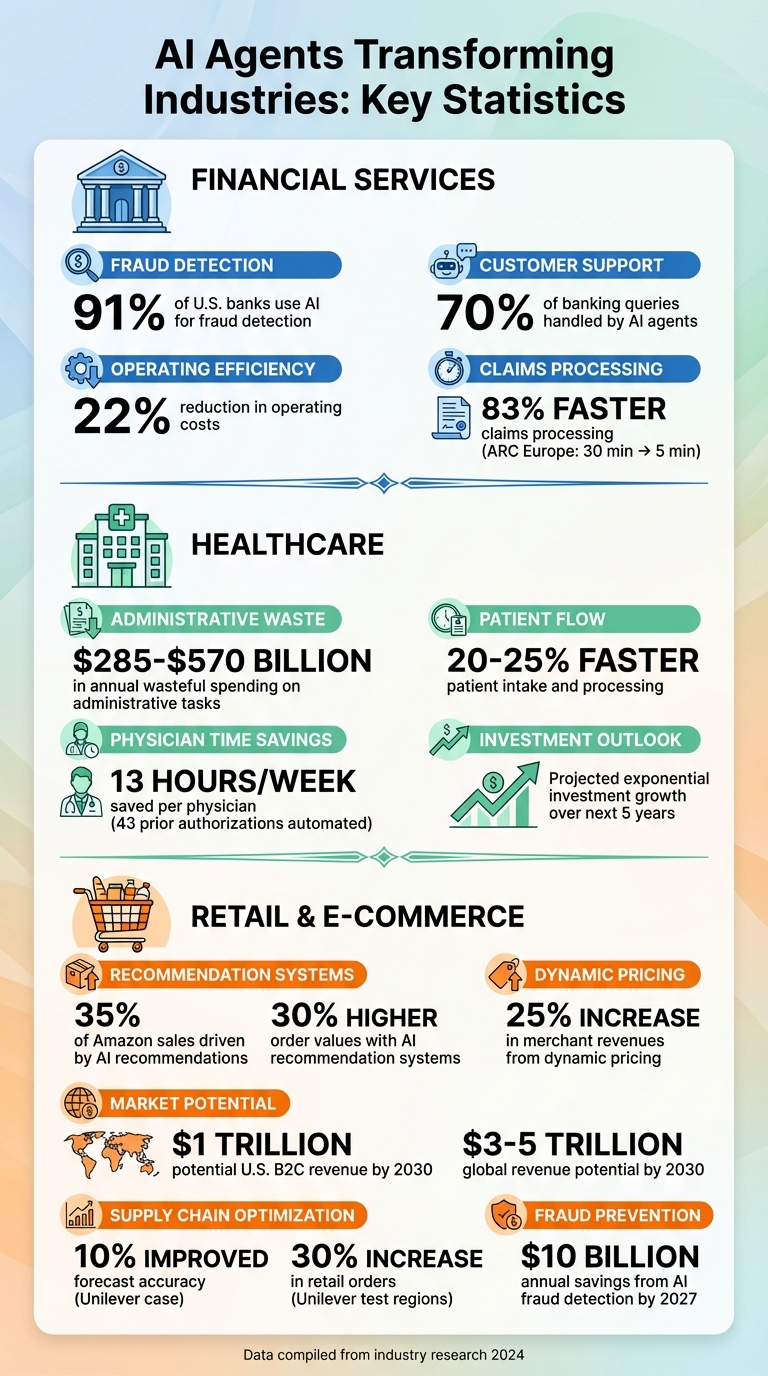
AI Agents Impact: Key Statistics Across Finance, Healthcare, and Retail Industries
AI Agents in Financial Services
AI agents are transforming the financial sector by tackling fraud, improving efficiency, and enhancing customer service. Today, 91% of U.S. banks use AI for fraud detection, allowing them to flag suspicious transactions in real time. These agents are also expected to handle 70% of banking queries, such as checking account balances, processing loan applications, and managing payments - tasks that previously required human intervention. This shift is estimated to cut banks' operating costs by 22%, enabling staff to focus on more complex, advisory roles.
In the insurance sector, AI agents are speeding up claims processing. For example, ARC Europe has implemented an AI agent that reduced claims assessment time by a staggering 83%, cutting the process from 30 minutes to just 5 minutes, all while improving accuracy and consistency.
AI Agents in Healthcare
Just as in finance, healthcare is seeing major efficiency gains with AI agents. Administrative tasks in the U.S. healthcare system contribute to $285–$570 billion in wasteful spending annually. AI agents are stepping in to automate tasks like patient triage, appointment scheduling, and medical documentation, helping to reduce these inefficiencies.
Hospitals using AI agents report 20–25% faster patient intake and processing, which leads to shorter wait times and higher patient satisfaction. Physicians, who spend an average of 13 hours a week handling 43 prior authorizations, benefit from AI systems that automate insurance verification and request submissions, freeing them to concentrate on patient care.
Compliance with strict regulations like HIPAA is non-negotiable in healthcare. AI agents come equipped with safeguards to protect patient data. One standout example is AstraZeneca's collaboration with BenevolentAI, where autonomous AI agents were used in drug discovery. This partnership led to the identification and validation of a novel therapeutic target for heart failure - a process that would have taken much longer through traditional methods. With investment in AI agents expected to grow exponentially over the next five years, their role in streamlining healthcare operations is only set to expand.
AI Agents in Retail and E-commerce
Retail and e-commerce industries are leveraging AI agents to elevate customer experiences and optimize operations. For instance, 35% of Amazon's sales are driven by its AI-powered recommendation engine. Retailers using similar systems have reported up to 30% higher order values, as these recommendations help customers discover products they might have otherwise missed.
Dynamic pricing is another area where AI agents shine. By analyzing factors like demand, competitor pricing, and inventory levels, these systems adjust prices in real time. This approach has increased merchant revenues by as much as 25%. By 2030, the U.S. B2C retail market alone could generate up to $1 trillion in orchestrated revenue, with global estimates ranging between $3 trillion and $5 trillion.
Unilever offers a compelling example of AI in action. The company developed an AI-driven supply chain system for its ice cream business, incorporating real-time weather data and telemetry from over 100,000 AI-enabled freezers. In Sweden, this system improved forecast accuracy by 10% and increased retail orders and sales by up to 30% in test regions, while also cutting down on inventory waste. Additionally, AI-driven fraud detection is expected to save retailers over $10 billion annually by 2027, underscoring the financial benefits of these technologies.
Platforms and Frameworks for Building AI Agents
Enterprise AI Agent Frameworks
When it comes to enterprise AI agents, having complete lifecycle support - from initial development to governance - is absolutely essential. These platforms act as the backbone, bridging the advanced reasoning capabilities of generative AI with the day-to-day systems that drive business operations.
The best frameworks integrate effortlessly with your existing systems. They should connect to your data sources, external tools, language models, and internal enterprise systems without adding unnecessary complexity. This not only streamlines deployment but also saves valuable development time. For industries with strict regulations, features like data governance, traceability, and audit trails are non-negotiable.
Langraph stands out for its ability to manage intricate, multi-agent workflows with built-in transparency and human-in-the-loop functionality. It’s a great fit for use cases requiring manual oversight, such as automating customer service, processing legal documents, or conducting risk assessments. Its graph-based design simplifies the visualization of complex processes, making it easier to align with specific industry needs.
On the other hand, Langflow offers a user-friendly, drag-and-drop interface, making it perfect for rapid prototyping and engaging stakeholders. Its adaptability allows it to integrate with APIs, models, and databases, making it suitable for a wide range of industries. Langflow is particularly effective for building intelligent chatbots, testing prompts, and involving stakeholders in the design phase. However, it may fall short for projects requiring highly specialized or complex AI capabilities.
These frameworks provide the solid foundation necessary for seamless integration of AI agents into enterprise systems.
Connecting AI Agents with Enterprise Systems
Once you’ve chosen the right framework, the next step is ensuring your AI agents can effectively connect with your enterprise IT environment. According to research, 51% of AI professionals already use AI agents, and 78% of enterprises plan to deploy them in production. However, by 2027, more than 40% of AI projects involving agents are expected to fail or be canceled due to rising costs, unclear value propositions, or weak risk management. The key to avoiding these pitfalls lies in a well-thought-out integration strategy.
An API-first approach is critical. This ensures AI agents can easily communicate with existing enterprise systems. Two techniques are especially useful here:
- Retrieval-Augmented Generation (RAG): This allows agents to pull in real-time, accurate knowledge from external sources before generating responses.
- Tool Calling: This enables agents to perform specific actions within workflows by interacting directly with application APIs.
Data quality is equally important. Automated validation processes and a unified data layer ensure that agents rely on accurate, up-to-date information. Poor data implementations can be expensive; the average penalty for non-compliance is $2.4 million per incident.
Security must also be a top priority. Layered measures like prompt filtering, data protection, and role-based access controls are essential. Surprisingly, only 17% of enterprises have formal governance frameworks for their AI projects. Using a modular, cloud-native architecture further enhances scalability and resource efficiency, while APIs ensure agents remain flexible and extensible.
NAITIVE's Expertise in AI Agent Development
At NAITIVE, we specialize in delivering AI agent solutions that drive meaningful business outcomes. With years of experience in agentic AI, our engineers focus on creating measurable results that directly impact your bottom line.
We leverage Langraph for handling regulated, complex workflows and Langflow for rapid prototyping and stakeholder engagement. This allows us to adapt solutions to your specific data environment and integrate them seamlessly with your existing systems, such as CRMs and ERPs.
Our approach is iterative. We start small, focusing on low-risk, high-impact use cases to build momentum and confidence. By developing an AI Minimum Viable Product (MVP), we gather real-world feedback and continuously refine the solution. To ensure smooth adoption, we implement comprehensive change management programs, offering training to address employee concerns and demonstrate how AI agents augment rather than replace human roles.
Real-time monitoring keeps track of agent performance, flagging anomalies and identifying issues early. We also periodically retrain AI models using updated data and conduct A/B testing to ensure ongoing improvements. This approach ensures that your AI agents remain effective, efficient, and aligned with your business goals.
Implementation and Future of AI Agents
How to Implement AI Agents
Rolling out AI agents requires a structured, step-by-step plan. Unlike traditional automation, these systems demand a focus on data readiness and governance from the very beginning.
Here’s a practical roadmap for implementation: start by assessing tasks and potential ROI, then design the technology architecture. Next, enforce regulatory controls, secure system access, and validate performance. For U.S.-based companies, regulatory compliance is a priority from day one to meet data protection laws. Implement identity and access management (IAM) systems that give AI agents the same stringent access controls as human users. Detailed logs of every agent action, decision, and interaction are essential to create audit trails for compliance and troubleshooting.
Security is non-negotiable and requires a multi-layered approach. This includes adding kill switches, segmented access, continuous monitoring, and crisis management plans, all under human oversight. Security concerns are real - 45% of organizations identify vulnerabilities as a critical challenge.
Start with low-risk, high-impact use cases. Early adopters have reported 20%-30% faster workflows and reduced back-office costs. By 2026, it’s projected that 40% of business applications will incorporate task-specific AI agents. However, the risks are real - by 2027, over 40% of AI agent projects are expected to fail due to rising costs or poor risk management. A cautious, well-governed approach is the best way to avoid becoming part of that statistic.
With secure and compliant systems in place, AI agents are positioned to drive even greater enterprise impact in the years ahead.
Future Trends in AI Agents
AI agents are advancing rapidly, evolving from basic tools into sophisticated systems capable of executing complex workflows and amplifying human capabilities.
One major trend is multi-agent orchestration, where multiple AI agents collaborate to tackle complex problems. This shift is reshaping enterprise operations, embedding AI agents directly into core systems like CRM and ERP platforms by 2026. These advancements align with the integration strategies discussed earlier, creating deeper operational efficiencies.
The workplace of the future will rely heavily on collaboration between humans and AI. Employees will need to develop new skills to effectively manage their AI counterparts. We’re moving from AI-assisted workflows to AI-driven execution, where agents adapt and manage processes in real time. Today, AI agents can already accelerate business processes by 30% to 50%, and this capability is only growing.
Advances in natural language processing are also paving the way for smarter, voice-based agents. These agents will offer more natural, conversational interactions, freeing employees to focus on higher-priority strategic work.
As these trends unfold, NAITIVE’s tailored solutions are designed to help your organization stay ahead of the curve.
NAITIVE as Your AI Transformation Partner
NAITIVE delivers AI solutions that go beyond generic chatbots. We specialize in building agentic AI systems that drive measurable outcomes and create meaningful business impact.
Unlike legacy consulting firms, we don’t rely on cookie-cutter approaches or overwhelm you with sales teams. Our process is rooted in understanding your unique business needs and identifying where AI can transform operations. From autonomous agent teams that handle complex workflows to AI voice agents available around the clock, we create solutions tailored to your environment.
Our systems integrate seamlessly with your existing tools - CRMs, ERPs, databases - using the same frameworks and security protocols discussed earlier. We ensure governance, compliance with U.S. regulations, and human oversight where necessary.
What sets NAITIVE apart is our focus on transformation, not just implementation. We’re committed to delivering observable, measurable results that put your business ahead of the competition. This is a pivotal moment in AI evolution, and we’re here to ensure your organization thrives. When you partner with NAITIVE, you’re not just adopting AI - you’re revolutionizing how your business operates.
FAQs
What makes AI agents different from traditional automation systems?
AI agents differ from traditional automation systems in their ability to process information, learn, and make decisions independently. While traditional systems stick to rigid, rule-based operations, AI agents can analyze dynamic inputs, learn from fresh data, and adjust their actions based on evolving circumstances.
This adaptability enables them to tackle intricate tasks, forecast outcomes, and deliver tailored, efficient solutions. For businesses aiming to grow and innovate, AI agents offer a cutting-edge approach to solving challenges and optimizing processes.
What should businesses consider when integrating AI agents into their operations?
When integrating AI agents into a business, it's essential to focus on scalability - ensuring the system can grow alongside the company's needs - and effectiveness, reducing the reliance on constant human oversight. Equally important is reworking workflows so AI capabilities blend seamlessly into existing processes, all while maintaining strong security protocols to safeguard sensitive data.
Building trust in AI systems is another key factor. This can be achieved through transparency and by addressing important ethical concerns. Finally, customizing AI solutions to meet industry-specific needs ensures they tackle the unique challenges of the business and deliver the best possible results.
How can businesses seamlessly integrate AI agents into their existing enterprise systems?
Integrating AI agents into enterprise systems can be straightforward when paired with the right tools and strategies. These agents typically rely on APIs to link with platforms like CRM or ERP systems, ensuring smooth data flow and efficient interaction. Additionally, middleware solutions and low-code or no-code platforms can play a key role in bridging compatibility issues with older, legacy systems, speeding up the integration process.
For a successful implementation, businesses should prioritize data readiness, implement strong security protocols, and establish clear governance frameworks. Ongoing monitoring and effective lifecycle management are critical to ensure scalability and reliability, enabling AI agents to seamlessly support enterprise operations while keeping pace with changing demands.