Voice AI ROI in Sales: Case Study Analysis
How Voice AI cuts lead response to under 60s, recovers missed calls, boosts conversions, and delivers 6–12x ROI for sales teams.

Voice AI is transforming sales by automating repetitive tasks, reducing missed opportunities, and delivering measurable financial outcomes. Businesses using Voice AI achieve faster lead responses (under 60 seconds), higher conversion rates, and reduced costs compared to traditional sales methods. For example, companies have reported:
- 40% boost in lead-to-demo conversions by cutting response times.
- 75% fewer missed calls, recovering lost leads.
- 6–12x ROI through cost savings and revenue growth.
Case studies show Voice AI reduces labor costs, improves efficiency, and drives revenue. Whether it’s re-engaging dormant leads or managing after-hours inquiries, the results are clear: Voice AI is a game-changer for sales teams.
Key Takeaways:
- Automates lead qualification and follow-ups.
- Cuts response time from hours to seconds.
- Improves customer satisfaction with consistent performance.
The article explores real-world examples and metrics to illustrate how Voice AI drives significant ROI across industries.
$1M in Sales in 6 Months Using AI Voice Agents - Thoughtly's Will Del Principe on the Agentic Shift
Voice AI ROI Metrics Explained
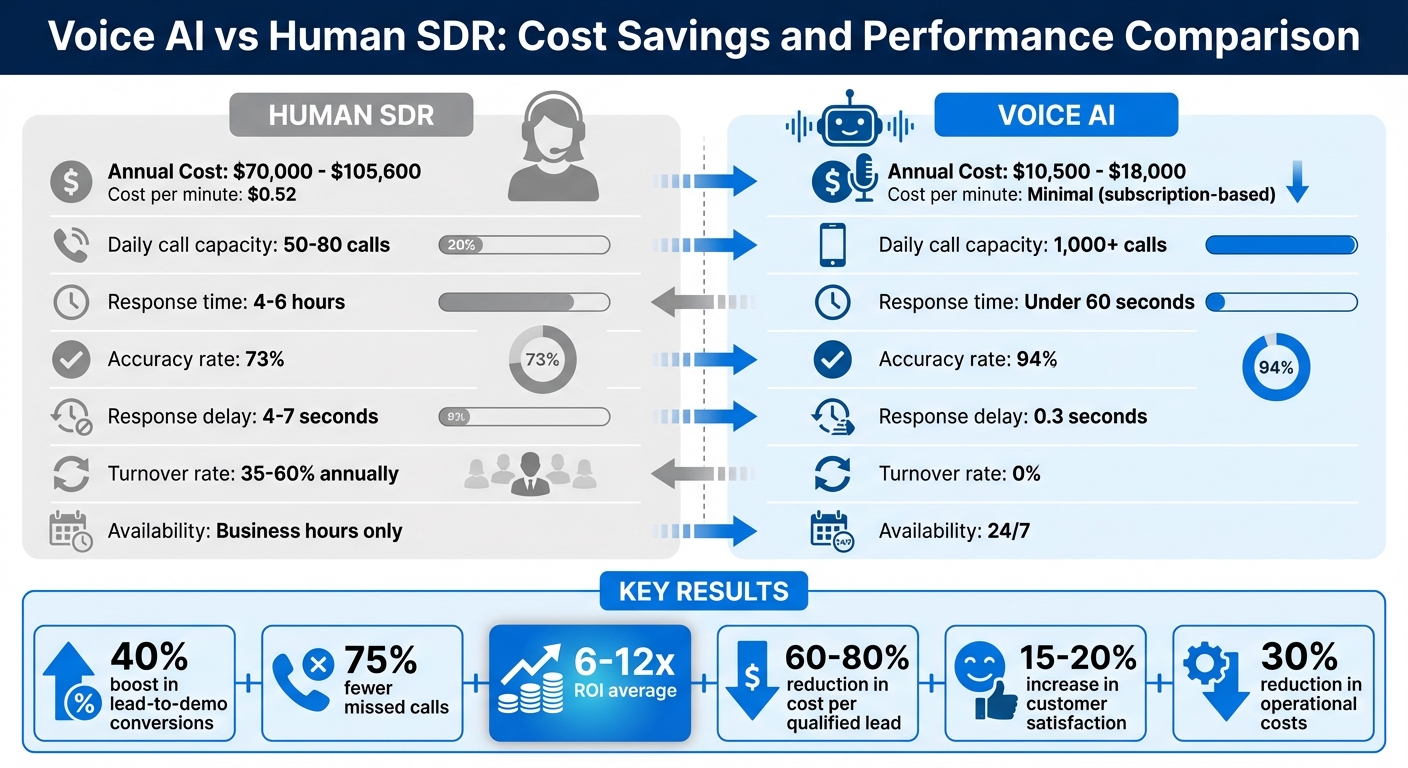
Voice AI vs Human SDR: Cost Savings and Performance Comparison
Tracking the success of Voice AI means looking at three key areas: cost savings, revenue impact, and customer experience. These categories show how Voice AI contributes to your bottom line, not just as a tech upgrade but as a real business tool. Instead of just counting call volumes, success lies in focusing on the outcomes Voice AI delivers.
The best ROI frameworks measure across three levels: operational, financial, and experience. Operational metrics track efficiency, like shorter handle times. Financial metrics look at revenue, such as improved conversion rates and lower costs per lead. Experience metrics, like Customer Satisfaction Scores (CSAT), help predict long-term customer loyalty. For example, responding to leads within 60 seconds instead of hours can boost lead-to-demo conversions by 40%.
A key shift in measurement is moving from "cost per call" to "cost per outcome." This approach highlights the cost of achieving meaningful results, like qualified leads or booked appointments, rather than just tallying calls. For instance, reducing the cost per qualified lead by 60–80% showcases financial impact clearly.
Let’s dive into the details of each category.
Cost Savings and Operational Efficiency
Voice AI slashes operational costs by automating repetitive tasks that typically drain human agents' time. On average, human agents cost about $0.52 per minute, including salary, benefits, and overhead. In contrast, Voice AI doesn’t come with these escalating costs and can handle over 1,000 calls daily, far outpacing the 50–80 calls managed by a human sales development representative (SDR).
The cost difference is even more striking annually. A human SDR costs between $70,000 and $105,600 per year, factoring in salary, benefits, and high turnover rates (35–60% annually for sales teams). Meanwhile, Voice AI operates at a fraction of that cost - around $10,500 to $18,000 annually. Subscription fees range from $200 to $800 per month, with one-time setup costs between $2,000 and $5,000.
Beyond labor expenses, Voice AI eliminates hours wasted on manual tasks like call logging and data entry. It structures data automatically - capturing insights like intent signals and budget details - improving sales forecasts and lead prioritization. According to McKinsey, AI-powered contact centers can cut operational costs by up to 30% while boosting customer satisfaction by 15–20%.
While cost savings are compelling, the revenue growth potential is equally transformative.
Revenue Growth and Conversion Rates
Voice AI directly impacts revenue by capturing leads that might otherwise be lost to competitors. Speed is critical - 78% of customers go with the first responder.
Take a mid-market B2B SaaS company using Zengato's Voice AI. By cutting response times from 4–6 hours to under 60 seconds, its lead-to-demo conversion rate jumped from 12% to 17% - a 40% increase. This also tripled the number of demos booked per SDR. Unlike human agents, Voice AI consistently applies the same qualification standards, ensuring reliable results.
Voice AI also accelerates revenue by shortening sales cycles. For example, a regional law firm struggling with a 40% missed call rate for personal injury cases used Dialora’s AI agents. The solution captured 27% of previously lost leads, adding $85,000 in monthly revenue and achieving an 11x ROI in just one quarter.
Beyond boosting revenue, Voice AI’s consistent performance enhances customer satisfaction, which we’ll explore next.
Customer Satisfaction Scores
Customer satisfaction, often measured through CSAT, plays a major role in retention and profitability. Even a small 5% increase in retention can raise profits by 25–95%. Voice AI improves CSAT by offering 24/7 availability, faster response times, and fewer errors.
For example, Voice AI typically responds in just 0.3 seconds, compared to 4–7 seconds for human agents, and achieves 94% accuracy versus 73% for humans. Customers also tend to spend 23% more when interacting with neutral AI agents, thanks to reduced sales pressure.
In healthcare, Voice AI has shown its value in appointment management. Facilities using AI saw a 31% drop in no-shows, directly boosting both revenue and engagement. High-performing systems often use a "human-in-the-loop" model, often implemented by an AI automation agency, automating routine tasks while reserving complex or sensitive cases for human specialists. This approach helps maintain high CSAT and reduces churn.
Case Study Analysis: Voice AI in Sales
These case studies showcase how Voice AI solutions have delivered measurable returns on investment (ROI) across various industries.
Case Study 1: Mid-Market SaaS Inbound Hotline
A mid-sized B2B SaaS company specializing in project management software faced a bottleneck: over 150 monthly inbound leads and delayed response times. Their sales development representatives (SDRs) often took 4–6 hours to follow up, which hurt conversion rates. In 2025, the company adopted Zengato's Voice AI, cutting response times to under 60 seconds. The results were dramatic: lead-to-demo conversion rates jumped from 12% to 17% - a 40% improvement. Additionally, each SDR tripled their monthly demo bookings, enabling the team to handle a much higher volume of leads.
This example highlights how automation can improve efficiency and boost conversion rates. Next, we’ll see how Voice AI tackled a more complex lead engagement problem.
Case Study 2: Industrial Distributor Quoting
CloudTalk, a communications platform based in Slovakia, faced a common challenge: 6,531 "long-tail" leads in their CRM with incomplete data. These leads were often ignored because manual outreach wasn’t cost-effective. Between 2025 and 2026, CloudTalk deployed an AI Voice Agent to re-engage these dormant prospects. The AI agent conducted 997 conversations, asking targeted questions to uncover budgets, timelines, and pain points. This effort generated €12,800 in sales-qualified lead (SQL) value at a cost of just €750, yielding a 17x ROI. David Cacik, CloudTalk’s Chief Marketing Officer, explained:
"We didn't need the agent to convert. We just needed it to ask the right questions - the ones a BDR would ask in a discovery call and surface the leads worth pursuing".
This case illustrates how Voice AI can revive overlooked opportunities and deliver exceptional returns with minimal investment.
Case Study 3: Healthtech SDR Assist
In the healthtech sector, where technical integration is a frequent hurdle, Voice AI proved to be a valuable tool for streamlining the qualification process. Healthcare technology companies often face lengthy discovery calls focused on technical requirements and compatibility concerns. By automating the initial qualification process, Voice AI identified technical needs, addressed common objections, and freed up SDRs to focus on high-value opportunities.
This example underscores how automation can simplify complex sales processes and allow teams to prioritize their efforts more effectively.
Case Study 4: Telecom Upsell and Retention
A regional law firm was losing 40% of potential cases due to missed after-hours calls. To address this, they implemented Dialora's AI voice agent, which provided 24/7 coverage for intake and qualification. The AI ensured that no leads slipped through the cracks, capturing prospects that competitors might have otherwise secured. The results were striking: the firm saw a 180% increase in qualified consultations and an additional $85,000 in monthly revenue. Within the first quarter, the firm achieved an 11x ROI.
This case demonstrates how Voice AI can help businesses capture missed opportunities and significantly boost revenue, even in highly competitive industries.
ROI Calculation Framework
This framework builds on the earlier metrics to quantify the financial impact observed across various case studies.
Key ROI Metrics Defined
When evaluating Voice AI's return on investment (ROI), focus on two primary areas: cost savings and revenue gains. The standard formula for ROI is simple:
[(Financial Benefits - Implementation Costs) / Implementation Costs] × 100%.
To measure cost per call reduction, compare the costs of human-handled calls with those managed by Voice AI. Human agents typically incur higher per-minute costs. For revenue per call, divide the total revenue generated by AI by the number of AI-handled calls.
The missed call recovery rate represents the percentage of previously unanswered calls that Voice AI successfully handles. Meanwhile, Net Present Value (NPV) offers a clear picture of long-term financial gains by converting future savings and earnings into today's dollar value.
Voice AI's value is built on three primary pillars: Cost Reduction, Revenue Enablement, and Operational Efficiency. The focus varies by industry. For example, legal and professional services often prioritize recovering missed calls due to the high value of each case, while SaaS and B2B sales concentrate on improving SDR productivity and speeding up lead responses.
These metrics are directly linked to the performance improvements seen in real-world applications.
Case Study Performance Comparison
Case studies reveal consistent improvements after implementing Voice AI. For instance, lead response times dropped significantly - from 4–6 hours to under 60 seconds, a reduction of more than 99%. This faster response helped boost lead-to-demo conversion rates by 40%, with one mid-market SaaS company seeing an increase from 12% to 17%.
Missed call rates also saw a dramatic decline. Before adopting Voice AI, companies reported missed call rates ranging from 27% to 40%. After implementation, this dropped to just 5%–10%, representing a roughly 75% improvement. Alongside this, customer satisfaction scores rose by 15%–25%, and First Call Resolution rates improved by 15%–35%.
These operational improvements translate into impressive financial returns. Nishant Bijani, Founder & CTO of Dialora, highlighted the impact:
"AI voice agents for sales deliver 8x average ROI by capturing 27% of previously missed leads and improving conversion consistency".
Overall, the data shows that Voice AI consistently outperforms traditional methods like expanding sales teams, a shift driven by specialized AI consulting firms. While hiring more sales representatives typically yields a 2–4x ROI, Voice AI delivers a striking 6–12x ROI.
NAITIVE AI Consulting Agency: Voice AI Solutions
NAITIVE's Voice AI Expertise
NAITIVE AI Consulting Agency is redefining what Voice AI can do for sales teams. They specialize in creating phone and voice autonomous agents that go well beyond the capabilities of standard chatbots. While some solutions in the market rely on pre-scripted responses, NAITIVE’s agents are designed to handle complex sales conversations, make decisions in real time, and adjust dynamically to the flow of the conversation.
What makes NAITIVE stand out is their blend of cutting-edge engineering and a dedication to delivering measurable business outcomes. Instead of offering one-size-fits-all solutions, they craft custom Voice AI systems that integrate seamlessly with your CRM, sales workflows, and business operations. These agents are not just reactive - they actively qualify leads, answer detailed questions, schedule demos, and tackle objections with fluid, human-like interactions. This level of technical sophistication helps businesses unlock the potential for impressive returns, such as the 6–12x ROI that Voice AI has been shown to deliver.
Custom AI Solutions for Sales Teams
NAITIVE works closely with businesses to build Voice AI systems that align perfectly with their unique sales needs. Whether a company is a mid-market SaaS provider aiming to cut lead response times from hours to mere seconds, or an industrial distributor seeking to automate complex quoting processes, NAITIVE delivers tailored solutions.
Their process begins with a deep dive into your existing sales operations. They identify gaps - like missed calls, delayed responses, or inconsistent follow-ups - that may be hurting your bottom line. From there, they develop custom autonomous agents that not only integrate seamlessly with your CRM but also reflect your company’s expertise and maintain your brand’s tone. The results speak for themselves: 75% fewer missed calls, 40% higher conversion rates, and noticeable boosts in customer satisfaction scores. NAITIVE’s Voice AI solutions don’t just improve sales processes - they transform them.
Conclusion
Voice AI offers an impressive return on investment, with case studies revealing an average 8× return within just 90 days. What makes these results possible? Three standout factors: instant response times (under 60 seconds compared to the usual 4–6 hour delay), 24/7 availability that ensures no lead slips through the cracks, and the "neutral advisor" effect, which encourages customers to spend 23% more.
Tailored Voice AI systems, designed to fit specific workflows and integrate with CRMs, have pushed conversion rates up by as much as 40% and improved lead recovery by 27%. These systems can handle hundreds of calls simultaneously, all without the added expense of scaling staff. Most businesses see these systems pay for themselves in as little as 30 to 90 days.
If your sales team struggles with slow response times or missed opportunities after hours, Voice AI could be the solution you need. NAITIVE AI Consulting Agency specializes in creating custom autonomous voice agents that seamlessly integrate with your sales process, delivering results like those detailed in these case studies. The question is: Can you afford to let your competition take the lead?
FAQs
How do I calculate Voice AI ROI for my sales team?
To figure out the ROI of Voice AI, start by looking at two key areas: cost savings and revenue growth. On the cost side, consider reductions in staffing needs, training expenses, and daily operational costs. For revenue, focus on metrics like improved conversion rates or quicker responses to leads, which can directly boost earnings. Using an ROI framework or calculator can help you combine these numbers to see the full picture. Based on case studies, many businesses see their investment pay off in as little as 30–90 days.
What data do I need to measure cost per qualified lead and conversions?
To figure out your cost per qualified lead and track conversions, you’ll need to collect data on a few critical areas: operational costs, lead qualification metrics, conversion rates, and revenue impacts. Pay close attention to factors like how quickly leads are responded to, how successful your qualification process is, and the revenue generated from those leads. This information gives you a clear picture of performance and helps you evaluate ROI accurately.
How fast can Voice AI pay for itself in sales?
Voice AI offers a fast return on investment (ROI), often recouping its costs within 30 to 45 days through a combination of cost savings and boosted revenue. In fact, many businesses achieve full ROI in as little as 60 to 90 days, making it a smart and efficient choice for enhancing sales efforts.