Voice AI Agents: Cutting Customer Service Costs
Voice AI agents can cut contact center expenses up to 70%, lower per‑call costs, reduce staffing and infrastructure spending, and deliver ROI in 60–90 days.

Voice AI agents are transforming customer service by slashing costs and improving efficiency. Businesses are saving up to 70% on operational expenses, with automated calls costing as little as $0.30–$0.50 compared to $6.00–$12.00 for human-handled calls. These AI agents handle repetitive tasks like order tracking, appointment scheduling, and FAQs, freeing up human agents for complex issues. Key benefits include:
- Cost Savings: Companies like National Insurance Corp saved $9.78 million annually by automating 80% of inbound calls.
- Reduced Labor Costs: AI reduces workforce needs by 20–30%, saving $60,000–$100,000 per year.
- Faster Scaling: AI handles demand spikes instantly, avoiding seasonal staffing costs.
- Lower Infrastructure Costs: Cloud-based systems cut expenses by up to 20%.
Voice AI is not just about cutting costs - it improves response times, reduces errors, and ensures 24/7 availability. With proper implementation, businesses can achieve a return on investment within 60 to 90 days. The challenge lies in seamless integration, effective team collaboration, and ensuring data security. Done right, voice AI can revolutionize customer service operations.
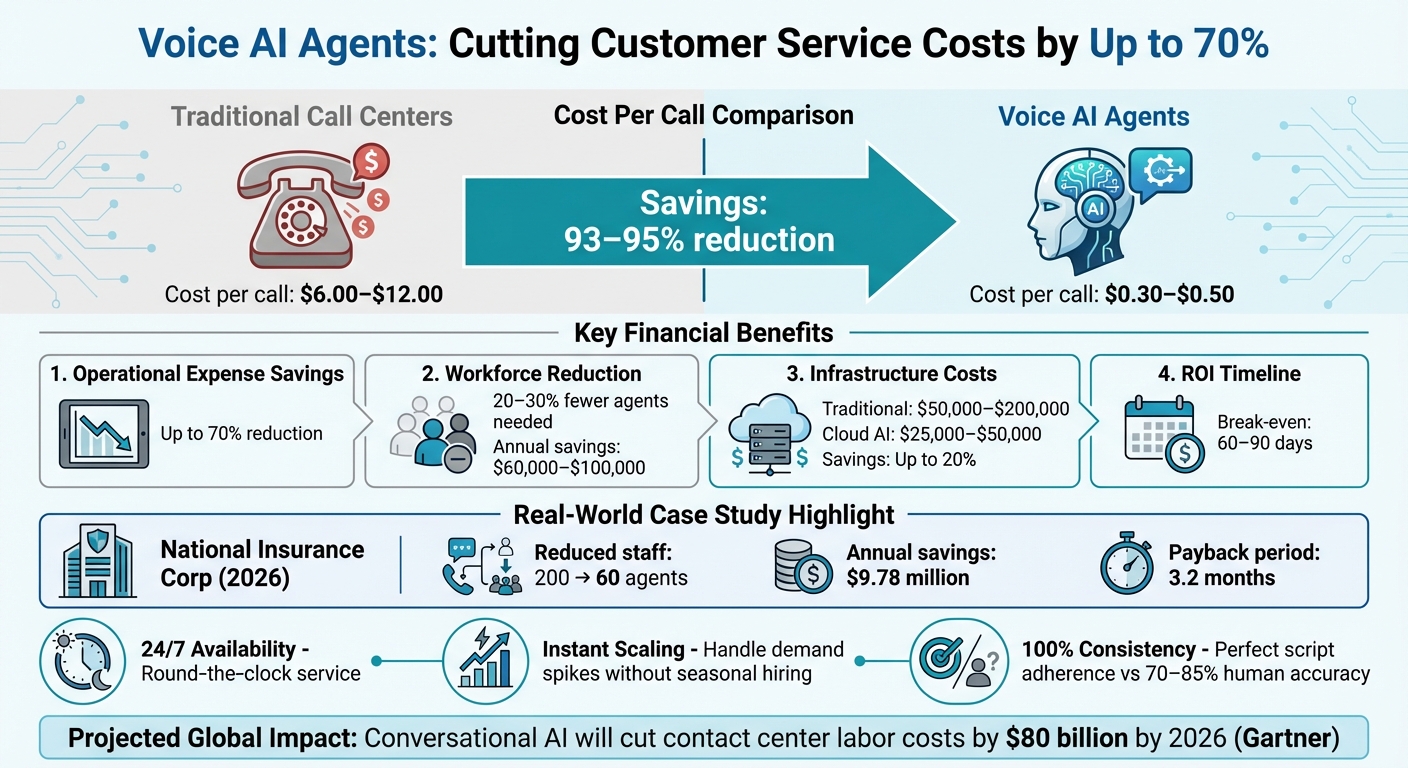
Voice AI Cost Savings vs Traditional Call Centers: Key Statistics
How Voice AI Is Replacing Customer Support Teams (Faster Than You Think!) 🚀
How Voice AI Agents Cut Customer Service Costs
Voice AI agents help businesses save money by automating high-volume calls, cutting down on labor costs, and reducing infrastructure expenses.
Automating Routine Customer Calls
Voice AI agents take over repetitive Tier-1 tasks like answering FAQs, scheduling appointments, tracking orders, verifying accounts, and resetting passwords. They’re available 24/7 and can handle sudden spikes in demand without missing a beat.
The financial benefits are impressive. For example, in January 2026, National Insurance Corp reduced its call center staff from 200 to just 60 specialized agents by automating 80% of inbound calls related to policy inquiries and claims. This move saved them $9.78 million annually, with a payback period of only 3.2 months. Similarly, Morrison & Associates, a legal firm, implemented an AI voice bot for appointment scheduling and client intake. As a result, they slashed administrative costs from $180,000 to $65,000 per year, saving $110,200 annually, while also boosting billable hours by 8%.
AI’s constant availability reduces missed calls and abandoned inquiries by 40%. During busy periods - like product launches or holiday rushes - AI scales instantly, avoiding the costs and delays tied to hiring seasonal staff.
Next, let’s explore how AI further drives savings by cutting labor and training expenses.
Reducing Labor and Training Expenses
Labor costs can make up as much as 95% of a contact center’s budget. Voice AI agents can independently handle up to 70% of interactions, allowing companies to reduce their workforce by 20–30%. This translates to significant savings on loaded labor costs like health insurance (typically $5,000–$8,000 annually), payroll taxes, and retirement contributions, saving businesses $60,000–$100,000 each year.
AI also reduces the need for management. Traditional teams require one supervisor for every 10–15 agents, but AI systems cut management needs by 70–90% since there’s no need for coaching or performance reviews.
Training expenses drop dramatically with AI. Training a new human agent can cost between $5,000 and $10,000 and take 30–60 days before they’re fully productive. In contrast, AI agents are ready to work as soon as they’re configured. Updating policies or scripts is as simple as rolling out a software update - no in-person retraining required.
"Many organizations are challenged by agent staff shortages and the need to curtail labor expenses, which can represent up to 95% of contact center costs."
– Daniel O'Connell, VP Analyst, Gartner
Turnover costs also disappear with AI. The customer service industry typically sees 30–45% annual turnover, with each replacement costing $10,000–$20,000 for recruitment, training, and onboarding. With AI, turnover is no longer an issue, and Gartner projects that conversational AI will cut global contact center labor costs by $80 billion by 2026.
Beyond labor savings, AI also trims infrastructure expenses, especially when deployed via the cloud.
Saving on Infrastructure with Cloud Deployment
In addition to reducing labor costs, voice AI significantly lowers infrastructure expenses. Traditional call centers require $50,000–$200,000 in physical hardware, while cloud-based voice AI solutions cost just $25,000–$50,000.
The savings don’t stop there. With fewer agents, companies can reduce expenses for office space, furniture, utilities, and maintenance. Businesses using AI-powered voice solutions have reported a 15–20% drop in operational overhead due to lowered facility and technology maintenance costs. Cloud providers also handle software updates and maintenance, eliminating the need for in-house IT teams to manage hardware.
Cloud-based systems offer unmatched scalability at minimal cost. AI voice agents can handle up to 10 times the call volume of a traditional call center without requiring additional hardware or temporary staff. Most cloud voice AI deployments break even within 60 to 90 days.
The cost per call further highlights the savings: automated calls cost about $0.30–$0.50 each, compared to $6.00–$7.68 for calls handled by human agents - a 93–95% reduction.
These savings open the door to even more opportunities for businesses to streamline operations and maximize efficiency. For tailored advice on implementing voice AI solutions that drive measurable results, reach out to NAITIVE AI Consulting Agency.
Finding Cost-Saving Opportunities in Your Business
To make the most of voice AI, it’s crucial to identify where it can deliver the biggest financial benefits. Start by analyzing your current call costs, demand fluctuations, and challenges with quality control. This approach helps uncover areas where AI can provide the greatest return on investment.
Calculating Staffing and Per-Call Costs
First, figure out your actual cost per call. Traditional call centers often face significant expenses, with costs per call reaching as high as $12 when accounting for salaries, infrastructure, and overhead, according to Gartner. In contrast, AI-driven systems can reduce per-call costs dramatically, bringing them down to $0.30 to $0.50 - a staggering 93–95% savings.
When calculating traditional staffing costs, include salaries, benefits (typically adding 30–40% of salary), payroll taxes, retirement contributions, and overhead expenses. Recruitment and training costs are also substantial, often totaling $10,000 to $20,000 per agent in hiring expenses, plus an additional $5,000 to $10,000 for training. New agents typically need 30–60 days to become fully productive.
Here’s a real-world example: In 2025, a mid-sized credit management firm in Chicago introduced JustCall's AI Voice Agent to handle verification and payment reminder calls. The results? A 40% reduction in agent workload, a 30% decrease in Average Handle Time, and annual savings of $95,000. On top of that, customer wait times dropped from 8 minutes to under 3 minutes.
To maximize savings, review your phone system data to identify the proportion of routine calls versus those requiring complex problem-solving. Many businesses discover that 60–80% of their call volume involves repetitive tasks like order tracking, scheduling appointments, password resets, or account balance inquiries - perfect candidates for AI automation.
"The average cost per call in a traditional contact center goes as high as $12 when you factor in agent salaries, infrastructure, and overhead." – Gartner
Once you’ve identified these routine tasks, consider how seasonal demand impacts your overall costs.
Managing Seasonal Demand and Scaling
Seasonal fluctuations in call volume can create additional challenges for staffing and efficiency. Hiring temporary workers for busy periods, such as holiday seasons or product launches, often leads to higher recruitment, training, and wage costs.
Voice AI offers a cost-effective solution. Unlike human teams, AI can scale instantly to handle surges in call volume - managing thousands of interactions simultaneously at virtually no extra expense. Gartner projects that conversational AI will save businesses $80 billion in contact center labor costs by 2026 and estimates that one in 10 agent interactions will be automated by the same year.
AI also shines during off-hours, capturing leads and managing peak demand without requiring overtime pay. To assess its impact, consider running a pilot program during a smaller peak period to gauge deflection rates before rolling it out on a larger scale.
Improving Quality Control and Reducing Errors
Beyond cost savings, AI improves service consistency and reduces costly errors. While human agents typically follow scripts with 70–85% accuracy, AI maintains 100% adherence and ensures flawless data capture.
This reliability significantly cuts the need for extensive quality assurance. For instance, traditional teams often require one supervisor for every 10–15 agents, but AI systems can reduce management needs by 70–90%. Additionally, automated interactions cost just 10–15% of a live call, minimizing errors that could lead to follow-up calls or customer dissatisfaction.
For businesses looking to capitalize on these opportunities, NAITIVE AI Consulting Agency provides tailored solutions to analyze operations and implement voice AI systems that deliver measurable results.
Deploying Voice AI for Maximum Efficiency
Implementing voice AI effectively means focusing on areas where it can make the biggest difference. Success hinges on thoughtful planning - starting with impactful use cases, blending AI with human support, and keeping a close eye on performance metrics. The goal? Boost efficiency without sacrificing the quality your customers expect. A good starting point is fine-tuning call handling processes to balance speed and accuracy.
Improving Call Handling Processes
Start by automating high-volume, straightforward tasks like scheduling appointments, checking order statuses, or handling password resets. These types of calls make up about 50–60% of customer interactions and are prime candidates for automation. Before going live, test your AI in "shadow mode" to ensure it delivers accurate results.
Once you're confident in the system's accuracy, roll it out gradually. Begin by routing 20% of calls to the AI, monitoring customer satisfaction and automation rates as you go. As the system proves itself, scale up - first to 50% and eventually to 70–85% of routine calls. Always give customers an easy way to speak with a human (like pressing 0) for more complex issues, which helps reduce frustration. Using intent-based routing can also ensure that customers' needs are correctly identified, cutting down on errors. To handle delays during data processing, program your AI to use natural-sounding filler phrases like, "Let me check that for you", to keep the conversation flowing smoothly.
Combining AI with Human Agents
The most effective strategy often combines AI and human agents. In this hybrid model, AI manages Tier 1 tasks - routine inquiries that make up 70–85% of calls - while human agents handle more complex or emotionally charged issues (15–30% of calls). This approach has been shown to achieve a 92% customer satisfaction rate, compared to 88% for human-only setups and 78% for AI-only systems.
When AI escalates a call to a human agent, ensure the transition is seamless. The AI should pass along the interaction history, including the last three messages, detected intent, and confidence scores. This prevents customers from having to repeat themselves, which is a common frustration. Some systems even use "whisper" transfers, where the AI provides a quick audio summary to the agent before they join the call.
"Identifying the best ways for AI and humans to work together to achieve collective intelligence will become increasingly important." – Diyi Yang, Assistant Professor of Computer Science, Stanford University
Establish feedback loops where human agents correct AI mistakes. This process can cut misclassification rates in half within just three months. As the AI improves, human agents can shift their focus from routine tasks to becoming empathetic problem-solvers with a knack for handling nuanced situations. Combining these steps with advanced analytics can further streamline operations.
Using Real-Time Analytics and Monitoring
Real-time analytics are essential for tracking performance and spotting areas for improvement. Set up dashboards to monitor metrics like handoff success rates, resolution times after escalation, and automation rates for various use cases. If you notice a spike in escalations for a particular issue, it might indicate the AI needs updated training data or a broader knowledge base. Tools like live transcriptions and real-time suggestions can also enhance efficiency.
For businesses aiming to deploy voice AI with minimal risk and maximum impact, NAITIVE AI Consulting Agency offers tailored solutions. They analyze your call data, pinpoint the best opportunities for automation, and seamlessly integrate AI into your CRM and workflows - delivering measurable results from day one.
Measuring ROI and Performance Results
Once voice AI is up and running, the next step is to measure its impact. By tracking specific metrics, you can pinpoint where you're saving money and identify areas needing improvement. Comparing pre- and post-deployment data is key. Prioritize KPIs that highlight financial savings, operational efficiency, and customer experience benefits.
Monitoring Key Performance Indicators (KPIs)
To gauge success, focus on three main areas: financial performance, operational efficiency, and customer experience.
- Financial Metrics: Keep an eye on the cost per interaction. AI typically costs between $0.50 and $5.00 per call, while human agents range from $5.00 to $25.00.
- Operational Metrics: Measure First Contact Resolution (FCR) - AI often achieves over 90%, compared to 70-75% for human agents. Also, track Average Handle Time (AHT), which AI can reduce by 25% to 50%.
- Customer Experience Metrics: Monitor Customer Satisfaction (CSAT) and Net Promoter Score (NPS) to ensure faster service translates into happier customers.
"ROI must balance financial gains, operational efficiency, and customer experience." – Flora An, Sobot
Other important metrics include containment rates (how often AI resolves issues without human intervention) and abandonment rates. For example, 59% of callers hang up after waiting 10 minutes, so a drop in abandonment is a clear sign of improvement. Finally, track agent retention. By handling repetitive tasks, AI reduces burnout, which helps retain employees and cuts hiring costs. Comparing these KPIs to pre-deployment benchmarks will reveal the full scope of AI's impact.
Comparing Costs Before and After Implementation
To validate your KPIs, you’ll need to compare costs before and after AI deployment. Start by collecting at least four weeks of baseline data on call volumes, AHT, and overall expenses. After implementation, track the same metrics month to month. Use this formula to calculate ROI: [(Annual Benefits – Annual Costs) / Annual Costs] x 100.
For instance, in 2025, Agilent, a global life sciences company, adopted Sobot's AI solution. The results? A 25% reduction in overall costs, a sixfold boost in efficiency, and a consistent 95% CSAT score. Most businesses break even within 60 to 90 days. If results fall short after three months, it’s worth revisiting your strategy.
Improving Customer Retention and Satisfaction
The benefits of AI go beyond cost savings - it can also strengthen customer loyalty. Quick, reliable responses keep customers happy and engaged. For example, BuyaCar introduced conversational AI in 2024 and achieved a 33% drop in call abandonment rates, directly reducing lost sales. Studies show that even a 5% increase in customer retention can boost profits by 25% to 95%.
AI also ensures 100% consistent responses, eliminating the variability caused by human agents having off days or incomplete training. This consistency builds trust, especially when customers receive accurate answers the first time. For businesses aiming to fine-tune their AI systems, NAITIVE AI Consulting Agency offers dashboards that link technology performance to business goals. These tools make it easy to demonstrate how AI drives both savings and customer satisfaction to stakeholders.
Solving Common Implementation Problems
Even with a proven return on investment and strong performance, implementing voice AI can come with its fair share of challenges. Issues like integration complexity, team resistance, and compliance concerns can slow things down - or even halt progress - if not tackled early. By 2026, it’s estimated that 70% of customer interactions will involve AI technologies, a significant jump from just 15% in 2023. Addressing these obstacles head-on ensures you can cut costs without compromising service quality.
Connecting with Current Systems
One of the toughest technical challenges is making sure your voice AI integrates smoothly with your existing systems. Start with an integration audit to ensure real-time API access to critical platforms like your CRM (e.g., Salesforce or HubSpot), helpdesk tools (e.g., Zendesk or Gorgias), and contact center software.
Choose platforms with native telephony capabilities and licensed PSTN access to avoid delays and minimize security risks. It’s also essential that the AI can transfer complete conversation transcripts during escalations. To avoid inconsistent information confusing both the AI and your customers, consolidate internal FAQs, help articles, and agent scripts into a single, unified knowledge base.
For optimal performance, use infrastructure that co-locates speech-to-text, AI processing, and text-to-speech systems. This setup ensures response times stay under 200 milliseconds, keeping interactions smooth and efficient. Once these technical foundations are in place, the next step is addressing team dynamics and workflow adjustments.
Managing Team and Workflow Changes
Technology alone isn’t enough - your team plays a critical role in making AI implementation work. While 72% of CX leaders believe their AI training programs are sufficient, only 21% of agents feel adequately prepared. To bridge this gap, assign a dedicated integration leader and get buy-in from key stakeholders like your Head of Support, Sales, and IT teams.
Instead of replacing agents, consider redefining their roles. Shift their focus from repetitive tasks to more complex, judgment-based issues requiring empathy. Simulation-based training can help agents practice working alongside AI before it goes live, reducing the time needed to reach proficiency by 20% to 30%. Teach agents how to quickly interpret AI-generated call summaries to streamline post-call work.
Always include a straightforward "escape hatch" for customers to request a human agent. Start by applying AI to one high-volume, low-complexity use case - such as order status inquiries - covering roughly 10% of calls. This phased approach helps ease the transition. Regularly review transcripts of escalated calls to spot areas of confusion and update the AI’s knowledge base as needed. With team roles redefined, the focus naturally shifts to safeguarding data and ensuring compliance.
Protecting Data Security and Compliance
Data security and regulatory compliance are non-negotiable. In fact, 38% of consumers cite transparency and disclosure as key factors in trusting voice AI. Include any necessary legal disclosures in your initial welcome message, use private network architecture, and monitor AI activity in real time to ensure compliance.
Work with vendors that act as licensed carriers with native PSTN access to avoid third-party handoffs, which can create security vulnerabilities. Modern unified systems that combine telephony, speech-to-text, and AI processing within a single environment provide an added layer of protection.
Leverage trusted data frameworks that allow the AI to access both structured and unstructured data while respecting security boundaries. For situations where users need to review sensitive information or legal documents sent via SMS during a call, adjust your "no-speech-timeout" settings to give them enough time to respond thoughtfully and provide informed consent.
For expert guidance, NAITIVE AI Consulting Agency offers support in designing secure AI architectures that comply with regulations like GDPR and HIPAA - all while maintaining the speed and responsiveness your customers expect.
Conclusion
Voice AI agents have become a game-changer for businesses looking to save on customer service costs. Companies using voice AI report up to 70% reductions in operational expenses, with automated calls costing just 10–15% of what traditional interactions require. Add in the advantages of 24/7 availability and the ability to scale instantly, and the financial benefits are undeniable.
To maximize these savings, a well-thought-out strategy is essential. Start by automating simple, repetitive tasks like order inquiries or appointment scheduling. Meanwhile, reserve human agents for more complex, empathy-driven interactions to maintain high levels of customer satisfaction - often reaching around 92%.
Despite its potential, only 28% of companies have successfully realized measurable benefits from generative AI in customer service. Even more striking, 95% of enterprise AI pilots fail to deliver a solid return on investment. These numbers emphasize the importance of quick, effective implementation.
"The question is no longer whether Voice AI can make a difference, but rather how quickly and effectively it can be implemented to deliver maximum return on investment." - Zudu.ai
Execution quality plays a crucial role in determining success. Seamless system integration, strong change management, and continuous optimization are key factors that set successful implementations apart.
For businesses ready to cut costs without sacrificing service quality, expert guidance can turn a pilot program into a profitable system within 60 to 90 days. NAITIVE AI Consulting Agency offers end-to-end solutions, from integrating voice AI with your CRM and helpdesk systems to ensuring compliance with frameworks like GDPR and HIPAA. They handle the technical complexities, so you can focus on the results: reduced costs, faster response times, and happier customers. By adopting voice AI, businesses can transform customer service into a scalable, efficient, and customer-focused operation.
FAQs
How do voice AI agents help reduce customer service costs?
Voice AI agents are a game-changer for customer service, slashing costs by automating repetitive tasks and managing high call volumes without requiring more staff. Since they’re available 24/7, they eliminate downtime, speed up response times, and boost overall efficiency - helping businesses save on operational expenses.
What’s more, these agents can juggle multiple customer interactions at once, which means companies can rely on smaller support teams. The result? Lower labor costs and happier customers, thanks to faster and more consistent service.
What challenges do businesses face when integrating voice AI into their systems?
Integrating voice AI into existing systems isn’t always a straightforward process for businesses. One major hurdle is achieving accurate intent recognition. If the system misinterprets a customer’s request, it can lead to misrouted calls, unresolved problems, and, ultimately, a dip in customer satisfaction. Another challenge is scalability - voice AI needs to manage high call volumes while delivering consistent performance across a variety of interactions.
System integration adds another layer of complexity. Businesses often struggle to align AI with older, legacy systems or to ensure compliance with strict regulatory and data security standards. On top of that, there’s the human factor - employees and customers who are used to traditional support methods may resist adopting AI-driven systems.
Tackling these challenges takes thoughtful planning, technical know-how, and ongoing management. When done right, businesses can tap into the efficiency and cost-saving benefits that voice AI offers.
How can voice AI enhance customer satisfaction compared to traditional call centers?
Voice AI improves customer experiences by cutting down on wait times, providing round-the-clock availability, and delivering fast, consistent responses. This makes interactions smoother and more efficient for everyone.
On top of that, voice AI agents can manage large call volumes without losing quality, which is a game-changer during busy periods. By answering questions quickly and accurately, voice AI not only reduces frustration but also strengthens trust and boosts customer loyalty.