Voice AI Agents for Customer Support Automation
Reduce support costs with voice AI agents that automate routine calls, integrate with CRMs, deliver sub-200ms responses, and improve customer satisfaction.
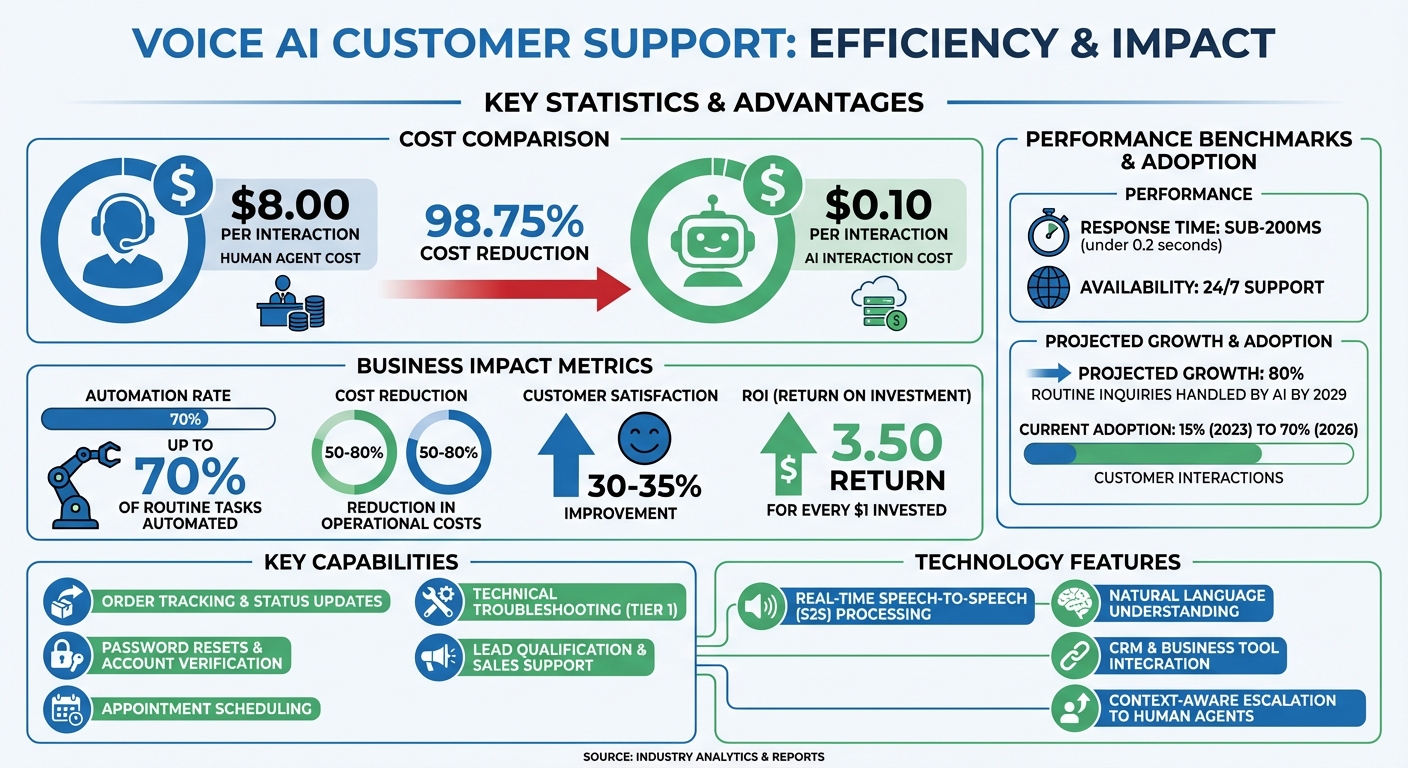
Voice AI agents are transforming customer support by automating up to 70% of routine tasks like order tracking, password resets, and appointment scheduling. With interaction costs as low as $0.10 compared to $8.00 for human agents, businesses can cut call center costs by up to 50% while improving customer satisfaction by 30–35%.
These systems use advanced technologies like real-time speech-to-speech (S2S) processing, natural language understanding, and seamless integration with CRMs and business tools. They deliver fast, accurate, and natural responses, resolving issues instantly while escalating complex queries to human agents when needed. By 2029, AI is expected to handle 80% of routine inquiries, offering 24/7 support and eliminating wait times.
Key benefits include:
- Cost savings: Up to 80% reduction in operational costs.
- Efficiency: Sub-200ms response times and 24/7 availability.
- Integration: Direct access to CRMs, ticketing systems, and more.
- Customer satisfaction: Personalized, context-aware interactions.
Voice AI is reshaping customer service, offering scalable, cost-effective solutions that meet modern customer expectations.
Voice AI Customer Support: Cost Savings and Performance Metrics
Automate Customer Support Calls With This AI Voice Agent!
How Voice AI Agents Work in Customer Support
Voice AI is reshaping customer support by enabling real-time, efficient interactions. At the heart of these systems lies a sophisticated technical framework designed to ensure smooth and natural conversations. Traditionally, voice AI agents followed a four-step process: Automatic Speech Recognition (ASR) converted speech to text, Natural Language Processing (NLP) interpreted the intent, a Large Language Model (LLM) generated a response, and Text-to-Speech (TTS) transformed the reply back into spoken words. While effective, this method often caused delays and missed emotional nuances, leading to the development of Speech-to-Speech (S2S) architectures.
S2S models, like GPT-4o-realtime, process audio directly, skipping the intermediate text conversion. This approach not only reduces latency - delivering responses in under 200 milliseconds - but also captures emotional cues and filters out background noise. These systems are also adept at handling conversational nuances, such as recognizing when someone pauses mid-sentence versus when they’ve finished speaking.
Natural Language Processing and Speech Recognition
Modern voice AI agents go beyond simple keyword recognition. They interpret the intent and context behind your words, aiming to understand what you want to achieve. If there’s a misunderstanding, the system doesn’t restart the conversation; instead, it asks clarifying questions to keep the interaction on track.
These agents are built to handle real-world complexities. They can seamlessly process interruptions, switch between multiple languages, and even adjust their speaking style with natural filler words like "um" to sound more conversational. As Emmanuel Delorme from Sendbird puts it:
"Voice remains one of the most natural and accessible modes of communication. Unlike text-based interfaces, voice does not require a screen, typing, or literacy".
Integration with Business Systems
The real power of voice AI emerges when it connects with existing business tools. Through REST APIs and webhooks, these agents can access customer data from CRMs like Salesforce, update tickets in systems such as ServiceNow, or verify account information instantly. An orchestration layer manages the flow of information between the voice interface and backend systems.
Function calling is a critical technology here, allowing the AI to perform specific actions autonomously. For instance, if you say, "I need to reset my password", the system identifies your intent and executes the appropriate function without human involvement. To ensure responses are accurate and up-to-date, Retrieval-Augmented Generation (RAG) queries your knowledge base in real time. This level of integration enables AI to automate up to 70% of repetitive tasks, such as checking order statuses or scheduling appointments. For tasks beyond automation, the system ensures a seamless transition to human support.
Escalation to Human Representatives
Even the most advanced AI systems know their boundaries. Voice agents are equipped with escalation triggers to pass the conversation to a human representative when needed. For example, if the AI fails to understand a query after three attempts or encounters a particularly complex request, it initiates a handoff. Users can also directly request to speak with a human.
These transitions are designed to be effortless. The AI provides the human agent with a detailed transcript, the reason for escalation, and all relevant data collected during the interaction. This eliminates the need for customers to repeat themselves. Such intelligent routing not only reduces average handle time by 15%–20% but also ensures that complicated issues receive the attention they deserve from a skilled human agent.
Core Capabilities and Use Cases of Voice AI Agents
Modern voice AI agents, powered by advanced speech recognition and seamless system integration, have evolved to handle a variety of customer support tasks. These systems excel at understanding intent, context, and even sentiment, enabling smooth, natural conversations. They connect directly to business tools like CRMs, Shopify stores, and calendars, allowing them to perform real-time actions such as checking order status, processing payments, or booking appointments - all without human intervention. For more complex cases, they can hand off the interaction to human agents, providing all the necessary context to ensure continuity.
Common Use Cases in Customer Support
Despite the rise of digital communication, the phone remains the go-to channel for resolving complex issues - 81% of service professionals agree. Voice AI agents are particularly effective at managing repetitive tasks, freeing up human teams for more nuanced work. For example:
- Order tracking and status updates: AI agents can instantly retrieve and relay information from order management systems.
- Password resets and account verification: These tasks are handled end-to-end automatically, improving efficiency.
- Appointment scheduling: From booking to rescheduling and sending reminders, AI agents help reduce costs. For instance, a single medical practice can save up to $150,000 annually by minimizing no-show appointments.
In technical troubleshooting, these agents tackle Tier 1 issues in industries like telecommunications and retail. They either provide immediate solutions or collect detailed information for escalation. In sales, voice AI handles initial outreach, qualifies leads based on criteria like budget and timeline, and schedules demos directly on representatives' calendars. The impact is substantial - AI can automate up to 70% of routine customer interactions. Additionally, these systems provide uninterrupted, 24/7 service, ensuring customers always have access to support.
Benefits of 24/7 Customer Support
Unlike human teams limited by shifts and time zones, voice AI agents can manage multiple queries at once without compromising quality. This eliminates wait times entirely and ensures consistent service, even during call volume spikes. As Brien Mikell, Director of Customer Engagement at Love's Travel Stops, highlighted in November 2025, their voicebot’s 24/7 availability allows customers to "get answers in seconds without waiting in a queue". With AI interactions costing approximately $0.10 compared to $8.00 for human-handled calls, businesses see an average return of $3.50 for every $1 invested. The difference becomes even more apparent when comparing traditional IVR systems to advanced AI solutions.
Comparison of AI Agent Types
| AI Agent Type | Complexity | Cost Efficiency | Escalation Capabilities |
|---|---|---|---|
| Basic IVR | Low ("Press 1" style menus) | Low (Hidden costs from frustration and churn) | Basic routing; often lacks context transfer |
| Simple AI Agent | Medium (Handles specific tasks) | Moderate (FAQs and simple lookups) | Rules-based handoff to human agents |
| Advanced AI Agent | High (Real-time speech-to-speech) | High (Automates up to 70% of interactions) | Context-aware; passes transcripts and intent |
| Enterprise AI Solution | Very High (Deep integration with CRMs/ERPs) | Maximum (Up to 50% cost reduction) | Seamless omnichannel handoff with full data payload |
The evolution from basic IVR to advanced conversational AI marks a dramatic improvement in customer experience. As Voice.ai aptly describes:
"Think of legacy IVR as a vending machine and modern automated voice as a trained barista. The vending machine delivers predictable items quickly, but the barista listens, adapts, and recommends".
With 69% of consumers favoring AI-powered self-service tools for fast resolutions, businesses that adopt advanced voice agents can meet these growing expectations while cutting operational costs significantly.
Implementing Voice AI Agents for Customer Support Automation
Building on the core concepts discussed earlier, implementing voice AI agents effectively requires a thoughtful approach. Success hinges on careful planning, smooth integration, and thorough testing. Many businesses start with a narrow focus and expand gradually. According to Gartner, by 2026, 70% of customer interactions will involve AI technologies, a sharp increase from just 15% in 2023. With 85% of enterprises and 78% of SMBs planning to adopt AI voice agents by then, early adoption is becoming increasingly important.
Planning and Identifying Use Cases
Every successful voice AI deployment begins with aligning key stakeholders. Bring your Head of Support, Sales, and IT teams on board, and appoint a dedicated Project Owner to connect technical requirements with business goals. This role ensures everyone is working toward the same objectives.
Once your team is aligned, define your primary goal. Are you aiming to cut costs, improve customer satisfaction (CSAT), or streamline operations? AI in contact centers can reduce operational expenses by 30–40% and boost CSAT scores by as much as 35%. After identifying your focus, analyze call logs to pinpoint High-Volume, Low-Complexity (HVLC) tasks - think order status inquiries, password resets, or appointment scheduling.
"Voice agents are not general-purpose assistants; they perform best when they are optimized for a specific, high-value task." – Emmanuel Delorme, Agentic AI Marketer, Sendbird
Start with one clearly defined use case - a "beachhead" - and aim for a 40–60% containment rate before broadening to other tasks. Establish measurable success metrics, such as containment rate, task completion rate, response time (target under 200ms), and CSAT scores. Also, map out the user journey by documenting the "Happy Path" (ideal flow), "Repair Paths" (error handling), and an "Escape Hatch" for seamless escalation to human agents. Finally, define your AI’s persona - its name, tone, and style - to ensure it aligns with your brand.
System Integration and Configuration
Integration is often where deployments face challenges. Start by auditing your systems to confirm the voice AI has real-time API access to your CRM, helpdesk, and contact center platform. As Aloware puts it:
"A standalone AI is a useless silo. It must be part of your central communication platform to be effective." – Aloware
Choose platforms that combine telephony, speech-to-text, and AI inference in a unified system to reduce latency and minimize failures. Ensure your AI pulls from a "Single Source of Truth" by cleaning up internal FAQs and help articles, so responses are consistent. Configure the system to allow "barge-in" functionality, enabling customers to interrupt the AI naturally - just like they would with a live agent.
Security is another critical consideration. Protect sensitive data by implementing encryption, auditing, and compliance with regulations like HIPAA or GDPR. For tasks involving sensitive information, such as PINs or account numbers, maintain DTMF (touch-tone) input support alongside voice recognition.
Testing and Launch
Testing is the dividing line between success and failure. Begin by training your AI with at least 100 variations of how users might phrase a single goal. Conduct internal alpha tests, encouraging your team to challenge the system with complex or unclear queries to uncover gaps. Then, move to a beta phase, directing about 10% of live traffic to the AI while routing the rest to human agents. This A/B testing approach provides valuable data on KPIs like CSAT and task completion rates before scaling up. Controlled pilots, typically lasting 2–4 weeks, allow for fine-tuning while monitoring performance daily.
Pay special attention to "repair scenarios." Ensure the AI can handle "No-Match" (unrecognized intent) and "No-Input" (silence) events gracefully, limiting retries to three before escalating to a human. For situations where customers need time to look up information, such as order numbers, adjust silence detection settings to avoid unnecessary interruptions.
| Metric | Purpose | Target Benchmark |
|---|---|---|
| Containment Rate | % of calls resolved without human help | 40–60% |
| Intent Recognition Accuracy | How well the AI understands user needs | 85%+ |
| First Contact Resolution | Issues resolved on the first call | 80% |
| Response Latency | Time between user input and AI response | <200ms |
| Escalation Rate | % of calls transferred to human agents | <15% |
Train your human agents on how to handle AI-to-human handoffs effectively. They should receive full context from the AI conversation to avoid making customers repeat themselves. Interestingly, only 21% of agents report satisfaction with their AI training, while 72% of CX leaders believe it’s sufficient.
"The 'escape hatch' to a human is a critical feature, not a sign of failure." – Aloware
After launch, review transcripts of escalated or failed calls to identify new intents or gaps in your knowledge base. Use filler phrases like "Let me check that for you" to manage latency during complex data retrievals. With platforms like Aloware offering AI voice agents at around $0.10 per minute - compared to $8.00 for human interactions - a structured implementation strategy can deliver considerable savings and efficiency.
Optimizing and Managing Voice AI Agent Performance
Once your voice AI agent is live, the work doesn’t stop there. To maintain the efficiency and reliability achieved during deployment, you need to focus on constant monitoring and improvement. As Dinesh Goel, CEO of Robylon, aptly says:
"AI without measurement is just automation guesswork".
The metrics you track - and how you act on them - are the difference between an average deployment and one that truly elevates your business. These measurements not only ensure your deployment performs well but also directly impact customer satisfaction.
Key Performance Metrics to Monitor
A solid monitoring strategy requires more than just glancing at dashboards. Think of it as a four-layer evaluation framework:
- Infrastructure Metrics: Keep an eye on latency to ensure conversations flow naturally and audio quality remains high.
- Agent Execution: Measure how effectively the AI follows prompts and maintains consistency.
- User Reaction: Use sentiment analysis and frustration indicators to gauge customer satisfaction.
- Business Outcomes: Look at key results like task completion rates and ROI.
When evaluating performance, focus on semantic accuracy - how well your AI understands the meaning behind customer requests - rather than just transcription accuracy. Aim for semantic accuracy rates of 80–85% at launch, with a goal of surpassing 90% through ongoing refinement. Additionally, track intent recognition rates to ensure customers are routed correctly, whether they’re asking about billing, refunds, or technical issues.
| Metric Category | Key KPIs | Target Benchmark |
|---|---|---|
| Operational | Call Containment Rate, First Call Resolution (FCR), Average Handle Time (AHT) | FCR: 70–80%+; AHT: 4–6 minutes |
| Technical/AI | Semantic Accuracy, Intent Recognition, Turn-level Latency | Accuracy: >90%; Latency: <1.2 seconds |
| Customer Experience | CSAT, Net Promoter Score (NPS), Abandonment Rate | CSAT: 75–85%; Abandonment: <5% |
| Financial | Cost per Resolved Interaction, ROI | ROI: 200–300% within 12–18 months |
Be cautious of dashboards that might look good on the surface but hide deeper issues. Regularly review call transcripts to identify cases where metrics are met, but customer problems remain unresolved. While conversational AI is expected to save businesses $80 billion in customer service costs by 2026, this only happens if you’re tracking the right metrics.
Continuous Learning and AI Refinement
For your voice AI to improve over time, it needs to learn from every interaction. Implement closed-loop feedback systems that flag failed conversations for review by your conversation design team. When human agents correct AI errors, those corrections become valuable training data, cutting error rates by roughly 50% in just three months.
Before rolling out updates, use "shadow mode testing." This involves running new AI models on live traffic while comparing their decisions to human outcomes across at least 2,000 interactions. This method uncovers gaps without impacting customer satisfaction. For example, analyzing an "Intent Confusion Matrix" can reveal overlapping intents or training data issues. Adjusting these areas - like splitting overloaded categories or refining routing rules - can significantly enhance performance.
Monitor customer sentiment during interactions. A drop in sentiment after events like latency spikes or repeated prompts signals the need for adjustments in conversation flow. Group errors by meaning rather than transcription mistakes to identify areas requiring retraining, such as domain-specific vocabulary. When escalating to human agents, ensure your AI provides a complete "context package" with intent history, extracted data, and conversation summaries. This prevents customers from having to repeat themselves.
Using Customer Data for Personalization
Integrating customer data into your AI system takes it from being a basic assistant to a personalized service agent. Generic responses frustrate customers, but CRM integration allows your AI to access customer history, preferences, and past interactions. This enables tailored responses and relevant recommendations.
Modern systems now use "persistent memory layers", allowing AI agents to remember customer details across multiple sessions and channels. For instance, a conversation started via SMS can seamlessly continue over a voice call without requiring the customer to repeat information. This omnichannel approach, powered by unified session IDs, significantly enhances the customer experience.
Set confidence thresholds for low-confidence AI responses. When the system isn't certain, it should automatically hand off to a human agent, ensuring a smooth transition and maintaining customer trust. Start by addressing high-volume missed intents to boost containment rates and overall ROI. With 81% of service professionals noting that phone remains the preferred channel for complex issues, personalization isn’t just a nice-to-have - it’s essential.
For businesses looking to maximize the potential of voice AI, integrating it with existing systems is key. NAITIVE AI Consulting Agency specializes in designing voice autonomous agents with deep CRM integration, ensuring your AI has the tools it needs to deliver personalized, impactful interactions.
Best Practices for Successful Deployment
Deploying voice AI successfully means finding the right balance between automation and human expertise, keeping systems updated, and ensuring your team is fully prepared.
Balancing Automation and Human Interaction
The most effective deployments understand the strengths of both AI and human agents. Voice AI is excellent for handling repetitive tasks quickly and managing high call volumes, while human agents bring empathy and critical thinking to solve more complex issues.
To create a seamless experience, use sentiment-triggered escalation to transfer calls when emotions run high. Implement intent-based routing to connect customers with the right human agents as quickly as possible. Transparency is key - let callers know they're interacting with AI and provide clear instructions, such as using full sentences. Limit how long a customer stays in an automated flow before offering a handoff to a human agent. These steps are vital: 50% of customers may switch to a competitor after one poor interaction, while 70% prefer companies known for excellent customer service.
Start small by automating simple tasks like password resets or order tracking before tackling more complex scenarios. As Pat Higbie, CEO and Co-founder of XAPP AI, advises:
"Start with a quick win, like informational chatbots, especially if you have not done this before. The level of complexity can go up quite dramatically, especially with transactional use cases."
An optimized system should only require human intervention in about 5% of cases. Following these practices sets the stage for continuous improvement.
Regular Updates and Maintenance
Voice AI systems need regular attention to stay effective. As products change, customer language evolves, and company policies shift, your AI must keep up . Think of it as a dynamic system that thrives on consistent monitoring, updates, and fine-tuning.
Review scripts every quarter using real call recordings to ensure clarity and relevance. Keep an eye on "No-Match" events - when the AI fails to understand a user - to identify gaps in training or vocabulary. Periodically audit integrations to ensure smooth data flow with CRM and ticketing systems.
To avoid outdated or inaccurate responses, update the AI's knowledge base as your business grows and evolves . Pieter Wellens, CTO and Co-Founder of Apicbase, emphasizes:
"Your product and your customers are always evolving, so make sure your AI reflects that by feeding it fresh data."
Voice AI maintenance also involves addressing unique challenges, such as managing interruptions (or "barge-ins") and optimizing response times to reduce cognitive load. For global brands, it’s crucial to standardize messaging across languages and dialects to avoid poor translations.
| Maintenance Activity | Recommended Frequency | Key Focus Area |
|---|---|---|
| Script & Prompt Review | Quarterly | Tone, clarity, and empathy |
| KPI Monitoring | Continuous/Real-time | CSAT, FCR, AHT, and abandonment rates |
| Knowledge Base Updates | As needed (product/policy changes) | Accuracy and prevention of AI errors |
| Integration Audits | Periodic | CRM data flow and telephony connectivity |
| AI Model Retraining | Continuous | Improving NLU for accents and phrasing |
Operational Alignment and Team Training
Technical updates alone aren’t enough - your team needs to be fully aligned and trained to work effectively with AI. Proper training ensures smooth collaboration between humans and AI .
Train your team on how the AI works, how to recognize confidence signals, and the process for warm transfers . Agents should actively annotate errors and provide structured feedback for model improvement. This feedback loop can cut intent misclassification by nearly 50% in just three months.
Start with a pilot phase that includes role-specific training, followed by a two- to eight-week period where agents handle escalations while providing daily feedback. Regular 30-minute calibration sessions with product, engineering, and frontline staff can help identify which issues require immediate updates. Lastly, give agents a clear "safety valve" to instantly take over calls if the AI isn’t performing as expected.
For businesses aiming to get the most out of their voice AI, NAITIVE AI Consulting Agency offers specialized programs that combine cutting-edge technology with comprehensive team training to deliver exceptional customer experiences from day one.
Conclusion
Voice AI has reshaped customer support, turning it into a powerful competitive asset. By significantly cutting costs - each AI interaction costs about $0.10 compared to $8.00 for human support - it reduces operating expenses by an impressive 60%–80%. For instance, in 2025, DoorDash automated over 35,000 outbound calls daily with a 94% success rate, while Golden Nugget saved three days of agent time per week by automating 34% of their reservation calls.
These cost efficiencies open the door to broader service enhancements. Beyond saving money, voice AI offers round-the-clock support, scalability, and multilingual capabilities. It can autonomously handle up to 80% of routine inquiries while capturing 100% of call data for actionable insights. With 69% of consumers favoring AI-driven self-service for faster issue resolution, the benefits to customer experience are undeniable.
The technology has come a long way, evolving from basic, menu-based systems to intelligent agents capable of reasoning, adapting, and managing multi-step workflows independently. Businesses investing in AI-powered customer service see an average return of $3.50 for every dollar spent. By 2029, these systems are projected to autonomously resolve 80% of common support issues.
NAITIVE AI Consulting Agency specializes in creating and implementing advanced voice AI solutions that deliver tangible results from day one. With a focus on measurable outcomes, our team combines technical expertise with a client-first approach to build systems that go beyond simple chatbots. Whether it’s reducing handle times by 25–35%, achieving first-contact resolution rates of 80%, or ensuring sub-200ms response times for natural conversations, our solutions drive real operational improvements.
Ready to see how voice AI can transform your customer support? Contact NAITIVE for comprehensive consulting, from strategy to implementation. Visit naitive.cloud to learn how we can help you stay ahead in 2026 and beyond.
FAQs
How do voice AI agents protect customer data and comply with regulations?
Voice AI agents play a critical role in safeguarding sensitive customer data while staying in line with legal standards. They achieve this through advanced encryption, secure access controls, and tools for managing consent. These systems are built to handle data responsibly, following strict guidelines set by regulations like HIPAA, GDPR, TCPA, and PCI DSS - all of which focus on privacy, consent, and secure transactions.
To stay compliant, many voice AI solutions offer features such as consent recording, real-time opt-out options, and audit logs. These tools not only ensure transparency but also foster accountability. By combining cutting-edge technology with adherence to these regulatory frameworks, voice AI agents help businesses minimize risks, build customer trust, and deliver secure, compliant support.
What challenges do businesses face when integrating voice AI into their existing systems?
Integrating voice AI into existing systems comes with its fair share of hurdles for businesses. One major obstacle is compatibility with older systems. Many organizations rely on legacy infrastructure that often needs extensive updates or reconfigurations to work smoothly with modern AI solutions. This can demand a significant investment of time and resources.
Another pressing concern is data security and privacy. Voice AI systems frequently process sensitive customer information, making them a potential target for breaches if proper safeguards aren’t in place. Ensuring robust protection measures is essential to avoid exposing critical data to vulnerabilities.
On top of that, the technical complexity of rolling out AI across various platforms and communication channels can pose a challenge. Without a well-coordinated approach, businesses risk fragmented implementations that fail to deliver the desired results.
Finally, there’s the delicate task of balancing automation with human interaction. While voice AI can enhance efficiency, over-reliance on automation might leave customers feeling disconnected or frustrated if the technology lacks a personal touch. Successfully addressing these challenges calls for meticulous planning, technical expertise, and a thoughtful strategy for integration.
How can businesses evaluate the success of their voice AI solutions?
Businesses can measure the success of their voice AI solutions by keeping an eye on key performance indicators (KPIs) and operational metrics that highlight both efficiency and customer satisfaction. Some key metrics to watch include cost savings, average resolution time, first-call resolution rate, and customer satisfaction scores (CSAT). These numbers offer a clear picture of how well the AI is achieving business goals and improving customer interactions.
It's also important to track technical performance, such as speech recognition accuracy, intent understanding, and response latency, to ensure the system runs smoothly. Evaluating the return on investment (ROI) is another critical step - this means comparing the system's costs against tangible benefits like increased productivity or a lighter workload for human agents. Regularly reviewing these metrics helps fine-tune the system and keep it aligned with the company’s goals.