
https://trendshift.io/
Build measurable enterprise AI: assess readiness, target high‑ROI use cases, design stateful architectures with governance, and measure ROI.

Enterprise AI consulting helps businesses implement AI technologies that align with their specific needs and deliver measurable outcomes. It focuses on selecting the right tools, frameworks, and strategies to solve industry-specific challenges, ensuring compliance and scalability. Here's a summary of the key points:
- Tailored AI Solutions: Off-the-shelf AI often fails to meet complex or regulated industry needs. Custom frameworks with advanced features like long-term memory and state management are better suited for tasks like financial analysis, supply chain optimization, and healthcare applications.
- NAITIVE AI Consulting: This agency uses tools like Dify, Langflow, and OpenAI Agents SDK to create scalable AI systems. Their process involves readiness assessments, identifying high-ROI use cases, and ensuring governance and compliance.
- AI Readiness and Use Cases: Assessing your organization's infrastructure, skills, and regulatory requirements is the first step. Focus on proven, high-impact use cases, like AI-powered financial tools or coding assistants, which have strong adoption metrics.
- Governance and Compliance: Embedding compliance measures from the start ensures AI tools meet data privacy and regulatory standards, especially in healthcare and finance.
- Enterprise AI Architectures: Effective AI systems include layers for data extraction, orchestration, and memory management. Modular designs allow flexibility, while tools like Letta enable persistent memory for complex workflows.
- Autonomous Agents: These systems handle multi-step tasks, adapt to outcomes, and maintain state across sessions. Examples include AI tools for portfolio management and back-office automation.
- Phased Implementation: Start with pilot programs in areas like customer service or document processing to demonstrate quick wins. Expand gradually while addressing employee concerns about job displacement.
- Monitoring and Improvement: Use feedback loops and performance tracking to refine AI systems over time, ensuring they remain effective and secure.
- Measuring ROI: Key metrics like Total Cost of Ownership (TCO), Time-to-Value (TTV), and Automation Rate help businesses evaluate the financial and operational impact of AI.
The goal is to implement AI solutions that drive measurable business outcomes, improve efficiency, and align with long-term objectives.
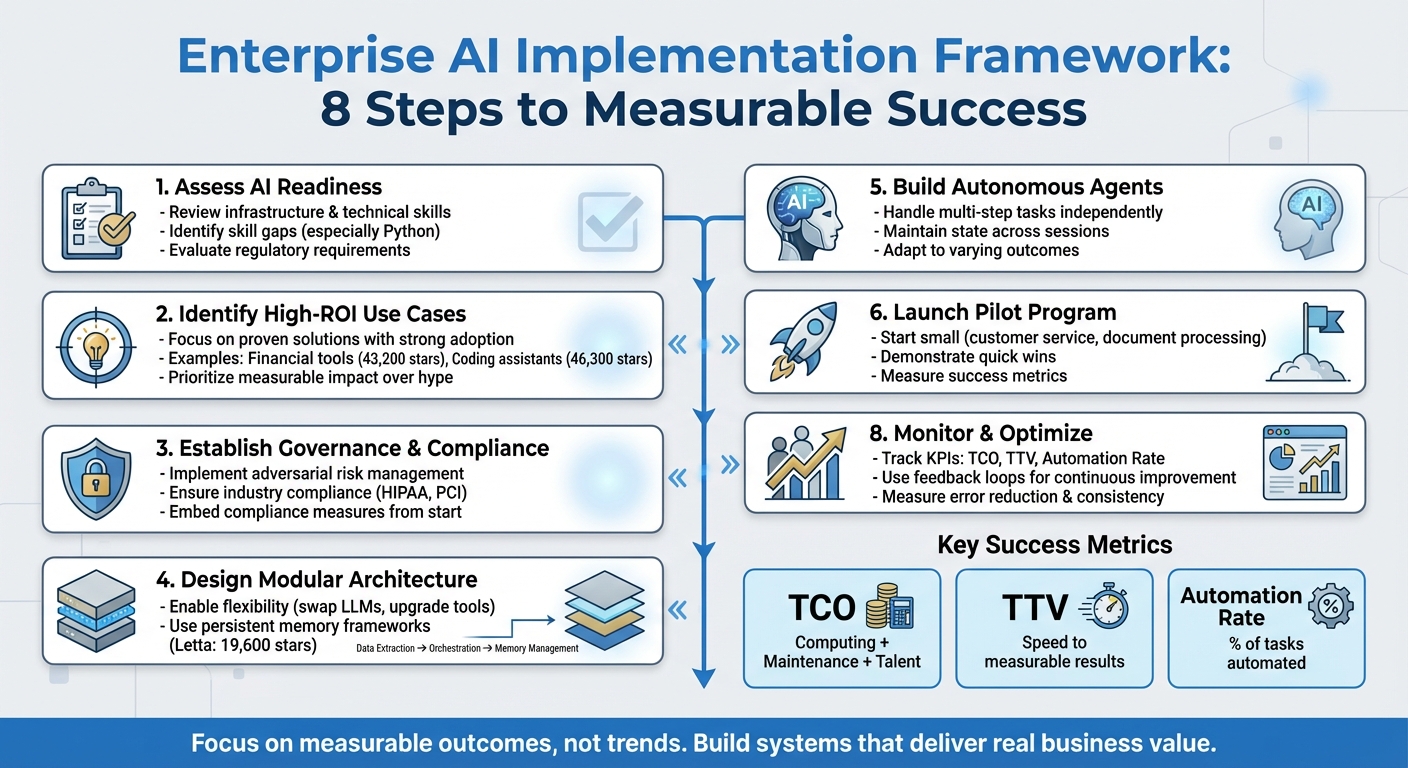
Enterprise AI Implementation: 8-Step Framework for Measurable Business Outcomes
The Four Key AI Consulting Basics (Full Framework)
Building AI Strategies for Specific Industries
Crafting an effective AI strategy begins with understanding your current capabilities and aligning them with the right technologies. Instead of chasing every emerging trend, focus on tools and frameworks that tackle your industry's unique challenges. The key is to evaluate your organization's readiness, identify opportunities with the highest potential return, and establish solid governance from the outset. Let’s break this down into three essential steps: assessing readiness, targeting impactful use cases, and ensuring compliance.
Evaluating AI Readiness
Before diving into AI adoption, it’s crucial to assess where your organization stands. This means reviewing your existing infrastructure, technical skills, and regulatory requirements. For instance, engagement metrics - such as agentic AI frameworks with long-term memory earning around 19,600 stars - can provide insights into technology momentum. Identifying skill gaps, particularly in widely-used languages like Python, is equally important. If your team lacks expertise, consider investing in training programs or bringing in specialized talent to bridge those gaps.
Identifying High-ROI Use Cases
Once you’ve evaluated readiness, the next step is to pinpoint areas where AI can deliver the greatest returns. This requires looking beyond hype and focusing on tools that are gaining traction and delivering results. For example, AI-powered financial tools have accumulated over 43,200 stars, while coding assistants boast around 46,300 stars, signaling strong validation and adoption in real-world applications. By prioritizing solutions with proven momentum, your organization can maximize its return on investment while staying ahead of the curve.
AI Governance and Compliance
After identifying high-value opportunities, governance and compliance must take center stage. Strong governance frameworks are critical for managing risks, especially in regulated sectors. This includes implementing adversarial risk management techniques and adhering to strict data privacy standards to safeguard systems with long-term memory. For example, healthcare organizations must ensure HIPAA compliance, while financial institutions need to follow PCI standards. Companies like NAITIVE AI Consulting Agency address these challenges by embedding compliance measures directly into their AI solutions, ensuring that deployments are both effective and fully aligned with regulatory requirements.
Designing Enterprise AI Architectures and Tools
Creating a solid AI architecture involves three essential layers: data extraction, orchestration, and memory management. The data layer gathers and prepares information from multiple sources. The orchestration layer ensures AI models work seamlessly with that data, while the memory layer maintains context for extended interactions. This structured approach provides the foundation for exploring advanced architectures and autonomous agent designs.
Enterprise AI Architecture Frameworks
Today's enterprises lean toward modular designs that allow for flexibility - like swapping out LLM providers or upgrading data tools - without having to overhaul the entire system. A great example of this trend is the build-your-own-x repository, which has amassed 450,000 stars, showcasing the industry's preference for customizable solutions over one-size-fits-all platforms.
Persistent memory management has become a standout feature in enterprise AI systems. Tools like Letta are leading the way, with the letta-ai/letta repository achieving 19,600 stars and 2,100 forks as of December 2025. These frameworks enable AI agents to retain long-term context, which is especially critical for applications like customer service. In such scenarios, agents need to remember past interactions, customer preferences, and historical data to provide a seamless experience.
Building Autonomous AI Agents
Autonomous agents are designed to handle multi-step tasks, interact with external tools, adapt to varying outcomes, and maintain state across sessions. A prime example of their growing importance is the ai-hedge-fund repository, which boasts 43,200 stars, underlining their effectiveness in high-stakes areas like portfolio management and risk assessment.
The architecture for these agents often includes agentic orchestration frameworks that can manage workflows dynamically. Unlike rigid, predefined scripts, these systems adapt to changing outcomes and handle exceptions independently. For instance, the anthropics/claude-code tool, with 46,300 stars, demonstrates how autonomous agents can write, test, and debug code without human intervention. In back-office tasks or knowledge management, these agents excel at processing documents, updating databases, and routing information with minimal supervision.
Using Dify, Langflow, and OpenAI Agents SDK
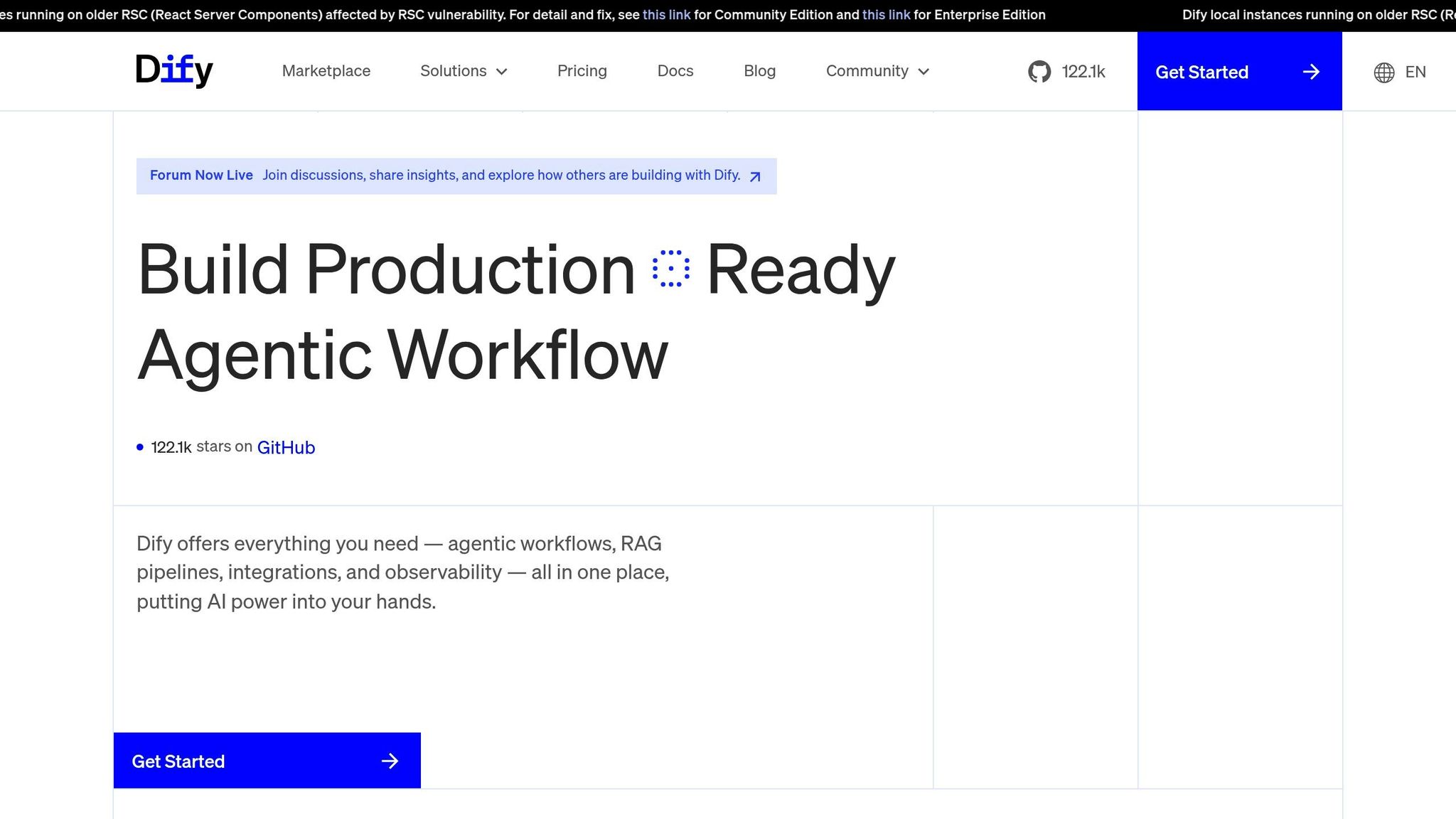
NAITIVE AI Consulting Agency leverages platforms like Dify, Langflow, and OpenAI Agents SDK to build tailored solutions for enterprises. These tools combine data, memory, and AI models into unified workflows, enabling businesses to prototype and deploy AI agents in weeks rather than months. The flexibility to fine-tune every component based on performance data adds to their appeal.
What makes NAITIVE's approach stand out is its focus on measurable outcomes rather than generic implementations. By incorporating specialized tools like google/langextract - which has earned 17,400 stars - they ensure data is properly prepared and flows seamlessly through the architecture. This is crucial because even the most advanced AI models can fail if they lack well-structured data or the ability to retain context from prior interactions. The result? AI systems that not only enhance operations but also deliver tangible returns on investment in real-world settings.
Implementing and Scaling AI Automation
Rolling out AI across an enterprise is a journey that requires thoughtful planning, aligning stakeholders, and ongoing adjustments. The difference between AI projects that stall and those that succeed often comes down to how organizations handle deployment, manage change, and track performance over time.
Phased AI Implementation
Start small. Launch a pilot program in an area where success can be measured quickly - think customer service response times, document processing speed, or code reviews. These are areas where results can build momentum and win support for broader initiatives. For instance, automating software development tasks has proven to be an effective entry point, showing quick adoption in practical settings.
Once the pilot demonstrates its value, extend the implementation to neighboring departments. Using stateful architectures, like Letta (formerly MemGPT), can be a game-changer. These systems retain context across sessions, enabling AI to handle complex, multi-step workflows without starting from scratch each time. This continuity is critical for enterprise-level tasks, where maintaining context can significantly boost efficiency. With a successful pilot in place, the focus shifts to guiding your workforce through these changes.
Managing Change in Large Organizations
The biggest challenge in adopting AI isn’t the technology - it’s the people. Employees often worry about job displacement, and this fear can undermine even the best AI initiatives. NAITIVE AI Consulting Agency tackles this by positioning AI as "Augmented Intelligence" rather than a replacement. The message? AI takes care of repetitive, time-consuming tasks, freeing employees to focus on creative, strategic work that demands human insight.
Creating a culture that encourages experimentation with AI tools is equally important. Employees should feel safe to try new tools, report issues, and explore unexpected applications without fear of backlash. To make this happen, establish cross-functional governance teams. These teams, which include members from IT, operations, compliance, and user departments, ensure that AI systems align with business goals while addressing practical concerns from those who use them daily. Once the workforce is on board, the next step is ensuring the system remains effective over time.
Monitoring and Improving AI Systems
Deploying AI is just the start. To stay effective, these systems need constant monitoring and updates. Many organizations now use agentic memory frameworks to track performance over time, enabling AI agents to improve their responses through feedback loops. This creates a system where performance data directly informs upgrades and adjustments.
NAITIVE’s approach prioritizes measurable outcomes from day one. By using stateful AI architectures that manage their own context and memory, businesses can identify bottlenecks and refine workflows based on actual usage. The goal is simple: build AI systems that not only work well today but also improve over time, adapting seamlessly to evolving business needs without requiring constant manual input.
Measuring ROI and Long-Term Value
Tracking the right metrics from the beginning is critical to demonstrating how AI contributes to your bottom line.
Setting Key Performance Indicators (KPIs)
To measure ROI effectively, focus on metrics like Total Cost of Ownership (TCO), Time-to-Value (TTV), and Automation Rate. TCO encompasses expenses such as computing resources, maintenance, and hiring skilled professionals. Additionally, monitor metrics like error reduction and consistency in output to assess quality improvements.
Engagement metrics can provide deeper insights into how AI tools are being utilized. By analyzing daily activity levels and user interactions, you can pinpoint which initiatives are thriving and which need attention. This approach prioritizes meaningful, sustained engagement over mere usage statistics. These measurable outcomes lay the groundwork for building strong business cases for AI investments.
Creating Business Cases for AI Investments
Using these metrics, craft business cases that link financial outcomes to operational improvements. A well-rounded business case should include clear ROI projections and realistic timelines. For cost efficiency, consider leveraging open-source tools to reduce reliance on expensive proprietary software. For example, curated open-source repositories can lower TCO while still delivering measurable efficiency gains. These insights make it easier to demonstrate the financial and operational benefits of AI investments.
Managing Risks and Ensuring Long-Term Success
To maintain AI's value over time, it’s essential to keep an eye on model vulnerabilities and emerging security threats. Regularly monitor relevant repositories and industry updates to stay informed. Avoid vendor lock-in by incorporating open-source alternatives, which also add flexibility to your AI architecture. Scoring algorithms that assess daily engagement metrics can help you measure the sustainability of your AI initiatives. As regulations and technologies evolve, building systems that can adapt to change will be vital. By integrating risk management into your AI strategy, you can ensure its scalability and long-term impact.
Conclusion: Getting the Most from Enterprise AI
Enterprise AI transformation isn't about jumping on the latest trend - it’s about creating systems that deliver real, measurable results. Success begins with strategies designed specifically for your industry’s unique challenges, supported by scalable architectures that grow alongside your business. Without this strong foundation, even the most promising AI projects can fall short of delivering value.
The technical decisions you make today will shape your AI capabilities for years to come. For example, adopting agentic architectures with persistent memory - like frameworks such as MemGPT and Letta - can empower your AI systems to handle complex, multi-step business processes independently. Python continues to dominate as the go-to programming language for enterprise AI, and keeping an eye on repository engagement metrics ensures you’re selecting tools with active community support rather than risking investment in unproven technologies that might turn into technical debt.
The key to success lies in measurable outcomes. From the start, tracking metrics like Total Cost of Ownership (TCO), Time to Value (TTV), and Automation Rate ensures your AI initiatives are driving tangible business results. Leveraging open-source tools strategically can help cut costs while maintaining performance, and staying vigilant about model vulnerabilities will keep your systems secure as new threats emerge.
As discussed earlier, NAITIVE AI Consulting Agency offers deep expertise to guide you through every stage of your AI journey. From assessing readiness and pinpointing high-ROI opportunities to designing autonomous agent systems and managing organizational change, their approach focuses on delivering measurable results. The goal isn’t just to add another chatbot to your toolkit but to implement AI solutions that genuinely improve your bottom line.
The enterprises that thrive will be those that combine cutting-edge technology with disciplined execution. By focusing on scalable architectures, thoughtful tool selection, and ongoing system enhancements, your organization can fully realize AI’s potential and stay ahead in a competitive landscape. With the right strategies and frameworks in place, your enterprise is positioned to turn AI into a driver of transformative growth.
FAQs
What steps should an organization take to evaluate its readiness for AI implementation?
Before diving into AI adoption, it's crucial to take stock of where your organization stands. Begin by examining your data infrastructure, the technology you currently have in place, and how familiar your team is with AI concepts. Next, outline your strategic goals and explore how AI can help you achieve them. Performing a gap analysis can reveal areas that need enhancement, while a thorough review of your workflows can highlight tasks ripe for automation. This groundwork lays the foundation for a smooth and effective AI integration.
How can companies ensure their AI systems comply with data privacy laws?
Companies looking to align their AI systems with data privacy laws should embrace privacy-by-design principles. This approach ensures that privacy is woven into the system's development process from the very beginning, rather than being an afterthought. Establishing strong data governance frameworks is another key step. This involves setting clear policies that define how data is used and who has access to it. Regular compliance audits are also crucial - they help pinpoint potential vulnerabilities and address them proactively.
Staying up-to-date on regulations like GDPR and CCPA is equally important, even for businesses operating outside their jurisdictions. These laws can have far-reaching effects, influencing global standards. To protect sensitive information, techniques such as data anonymization, encryption, and strict access controls are invaluable. Finally, maintaining detailed audit trails not only enhances transparency but also reinforces accountability in how data is managed.
What are the key metrics to evaluate the ROI of AI solutions?
To evaluate the ROI of AI solutions, it's essential to track metrics that clearly demonstrate their impact on your business. Key areas to focus on include cost savings achieved through automation, revenue growth driven by smarter decision-making, and productivity gains from more efficient workflows. You might also want to look at customer satisfaction scores and how much faster you're bringing new products or services to market. These measurements provide a clear picture of the real-world benefits AI delivers to your organization.