https://www.nocode.tech/
Compare no-code AI platforms that let teams build AI workflows, chatbots, and automations faster—features, hosting options, and pricing for n8n, Make.com, and Flowise.

No-code platforms are changing how businesses create AI solutions. They let nontechnical users build apps with drag-and-drop tools, templates, and pre-built components. These platforms handle backend tasks like hosting and scaling, enabling faster and cheaper development compared to traditional methods. With 84% of companies already using no-code or low-code tools, they’re becoming essential for automating workflows, reducing costs, and speeding up processes.
Key points:
- 84% of organizations use no-code/low-code tools, cutting development time by 90%.
- The no-code AI market is growing at 31–38% CAGR and will reach $25 billion by 2030.
- AI-powered workflows are projected to increase from 3% of enterprise processes to 25% by the end of 2025.
Top platforms include:
- n8n: Offers advanced customization (supports JavaScript/Python), ideal for technical teams. Pricing starts at $20/month.
- Make.com: Best for nontechnical users with a simple interface and 2,500+ integrations. Starts at $9/month.
- Flowise: Focused on conversational AI and LLM-based apps. Open-source, with cloud plans starting at $35/month.
These tools are used across industries to automate processes, build chatbots, and streamline operations. Whether you’re in marketing, customer support, or logistics, no-code platforms can simplify workflows and boost productivity.
This AI Agent Army AUTOMATES Everything (No-Code n8n Tutorial)
Top No-Code Platforms for AI Solutions
When it comes to building AI-powered automation, three platforms consistently stand out: n8n, Make.com, and Flowise. These tools cater to a range of organizational needs, from managing intricate workflows to enabling quick AI prototyping. They provide the practical tools businesses need to implement AI-driven automation effectively. Here's a closer look at what makes each of these platforms worth considering.
n8n: Built for Complex Workflow Automation
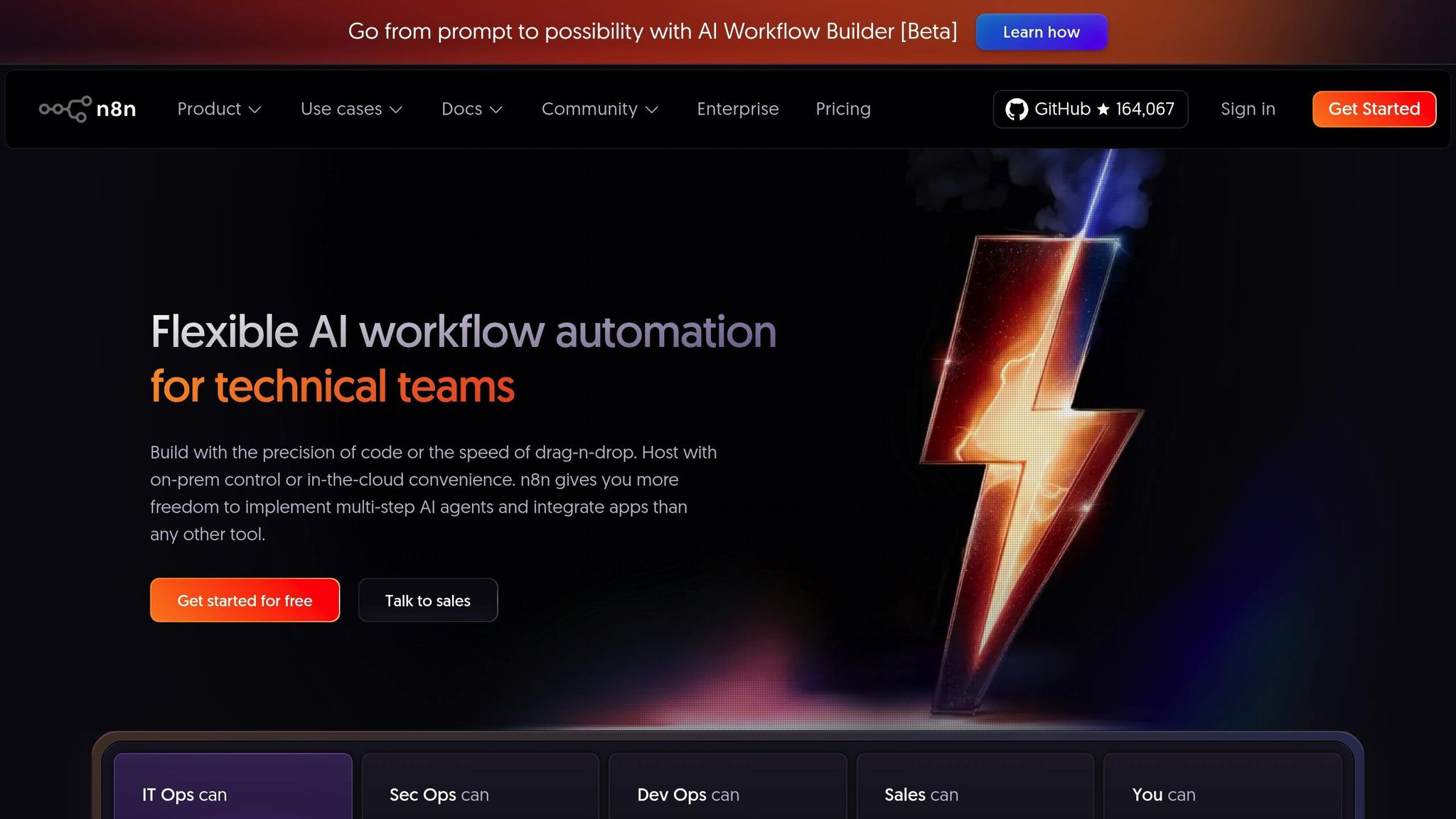
n8n is a "fair-code" platform that strikes a balance between visual automation and technical customization. It’s particularly appealing to technical teams looking for more control than typical no-code tools offer. With over 140,000 GitHub stars, n8n is a trusted choice for handling high-throughput processes, supporting 220 workflow executions per second.
One of n8n's standout features is its ability to integrate JavaScript and Python scripting directly into visual workflows, making it easy to add custom logic. For example, SanctifAI leveraged n8n to empower 400+ team members to complete AI-driven tasks, setting up their first workflow in just 2 hours [doc].
The platform also includes a built-in AI agent builder, allowing users to treat large language models as reasoning engines capable of executing tasks, accessing data, and even managing sub-workflows. It supports advanced techniques like Retrieval-Augmented Generation (RAG) by connecting to vector databases such as Pinecone, Qdrant, and Weaviate. For businesses concerned about data security, n8n provides self-hosting options via Docker or Kubernetes, ensuring sensitive information stays within the organization’s infrastructure.
With over 400 pre-configured integrations and a flexible HTTP request node for connecting to any REST API, n8n offers plenty of versatility. Additionally, its community has contributed 4,000+ starter templates to speed up development. Pricing starts at $20/month for the Cloud Starter plan, which includes 2,500 workflow executions. For those preferring a self-hosted setup, the Community Edition is free and includes unlimited workflows.
"n8n is the fair-code, AI-powered workflow automation platform that gives you the control, flexibility, and intelligence to build real workflows - without the platform lock-in." - NextGrowth
If n8n is ideal for technical teams, Make.com caters to nontechnical users.
Make.com: Simplified Workflows for Teams
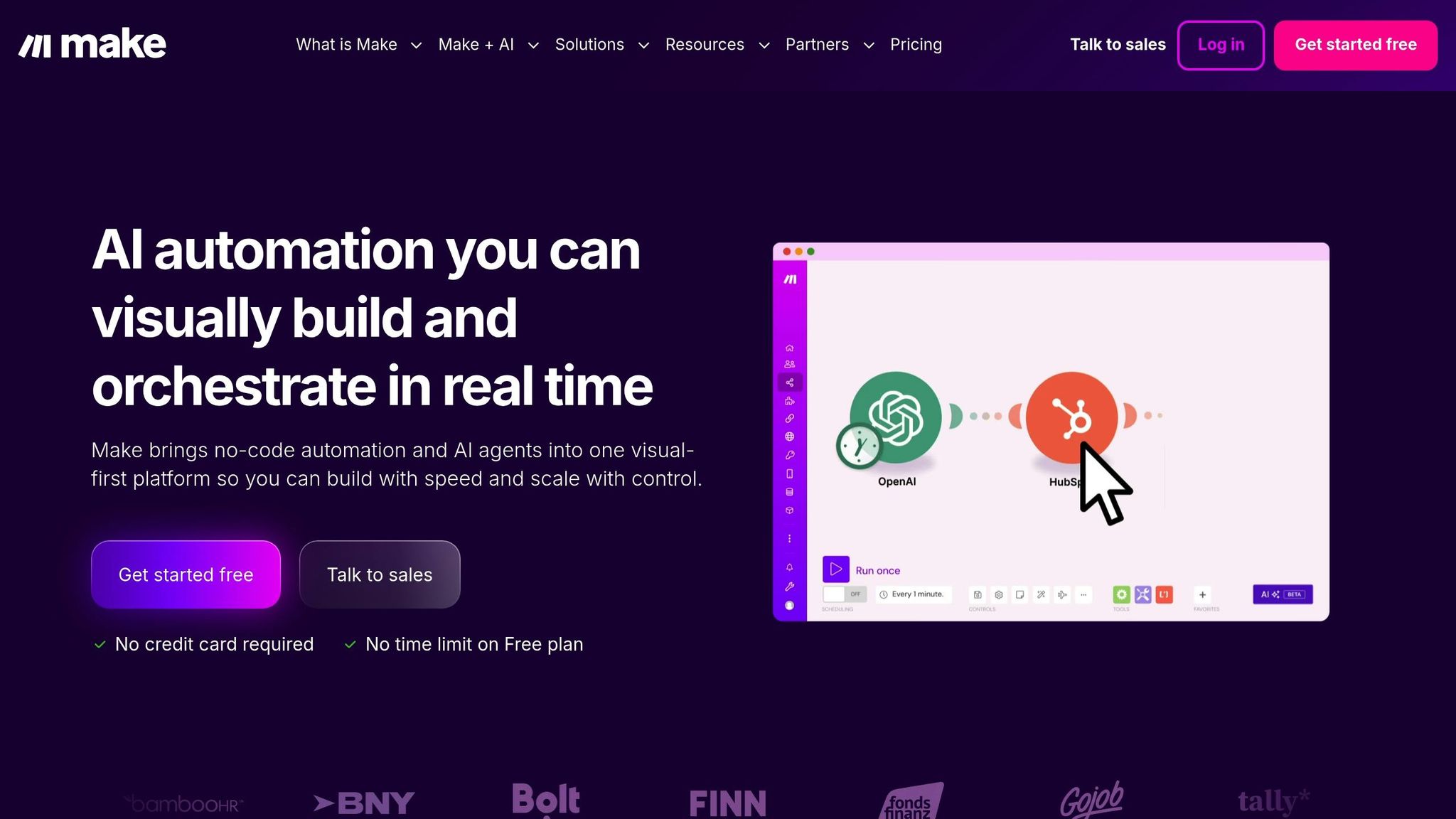
Make.com focuses on accessibility, making it a favorite for nontechnical teams in areas like marketing, operations, and customer support. Its intuitive drag-and-drop interface and "Grid" view allow users to easily design, monitor, and optimize workflows for tasks like lead enrichment or summarization. With over 2,500 native integrations, Make.com offers a much wider range of connections than n8n’s 400+ integrations.
This platform is fully cloud-hosted, offering a plug-and-play experience that eliminates infrastructure concerns. Pricing follows a per-operation model, where each workflow step uses a credit. The free tier includes 1,000 operations per month, while the Core plan starts at $9/month for 10,000 operations. While this pricing structure works well for simple workflows, it can become costly for more complex, multi-step processes.
Make.com also includes enterprise-grade security features, such as SOC 2 Type II compliance and single sign-on (SSO), making it suitable for businesses with stringent security requirements.
"n8n's execution-based pricing encourages building big, complex workflows... Meanwhile, Make's pricing nudges you toward smaller, low-volume workflows." - Nicole Replogle, Staff Writer, Zapier
For organizations exploring conversational AI, Flowise offers a tailored solution.
Flowise: Building Conversational AI Applications
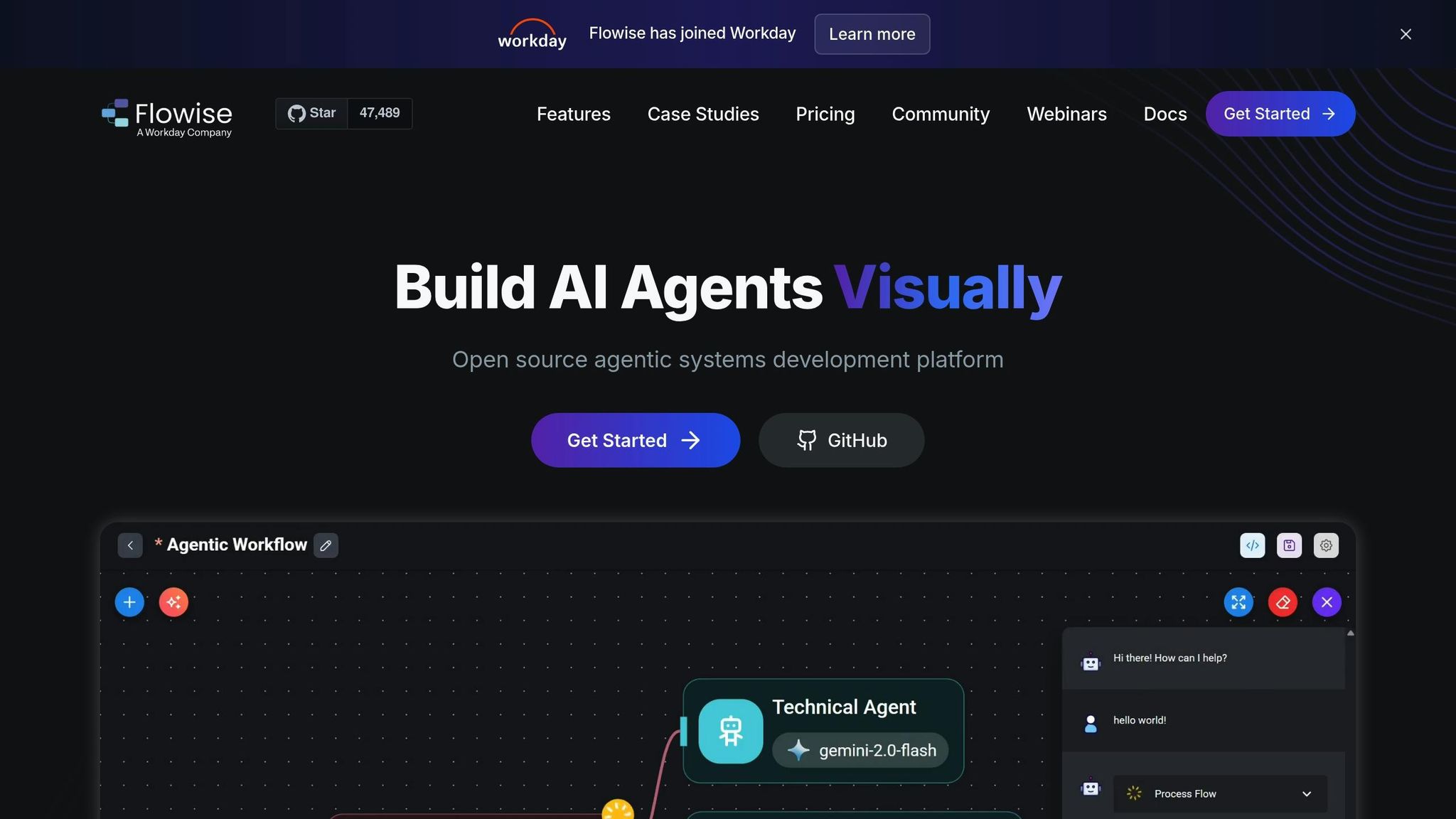
Flowise is designed for teams creating conversational AI and agent-based applications. As an open-source platform, it allows businesses to prototype AI workflows without upfront costs. Whether deployed in the cloud or self-hosted, Flowise offers flexibility, with paid plans starting at $35/month.
The platform is especially effective for developing chatbots, virtual assistants, and knowledge base systems. Its visual interface simplifies the process of chaining together LLM calls, vector database queries, and API integrations. This enables teams to build sophisticated AI applications in hours rather than weeks. Flowise also integrates with popular AI frameworks and supports custom plugins, thanks to its active community [doc].
For organizations experimenting with AI that can reason and act across multi-step tasks, Flowise serves as an excellent starting point. It allows rapid prototyping, real-world validation, and the ability to scale as needs evolve, making it a great fit for teams in the early stages of AI adoption.
Feature Comparison: Selecting the Right Platform
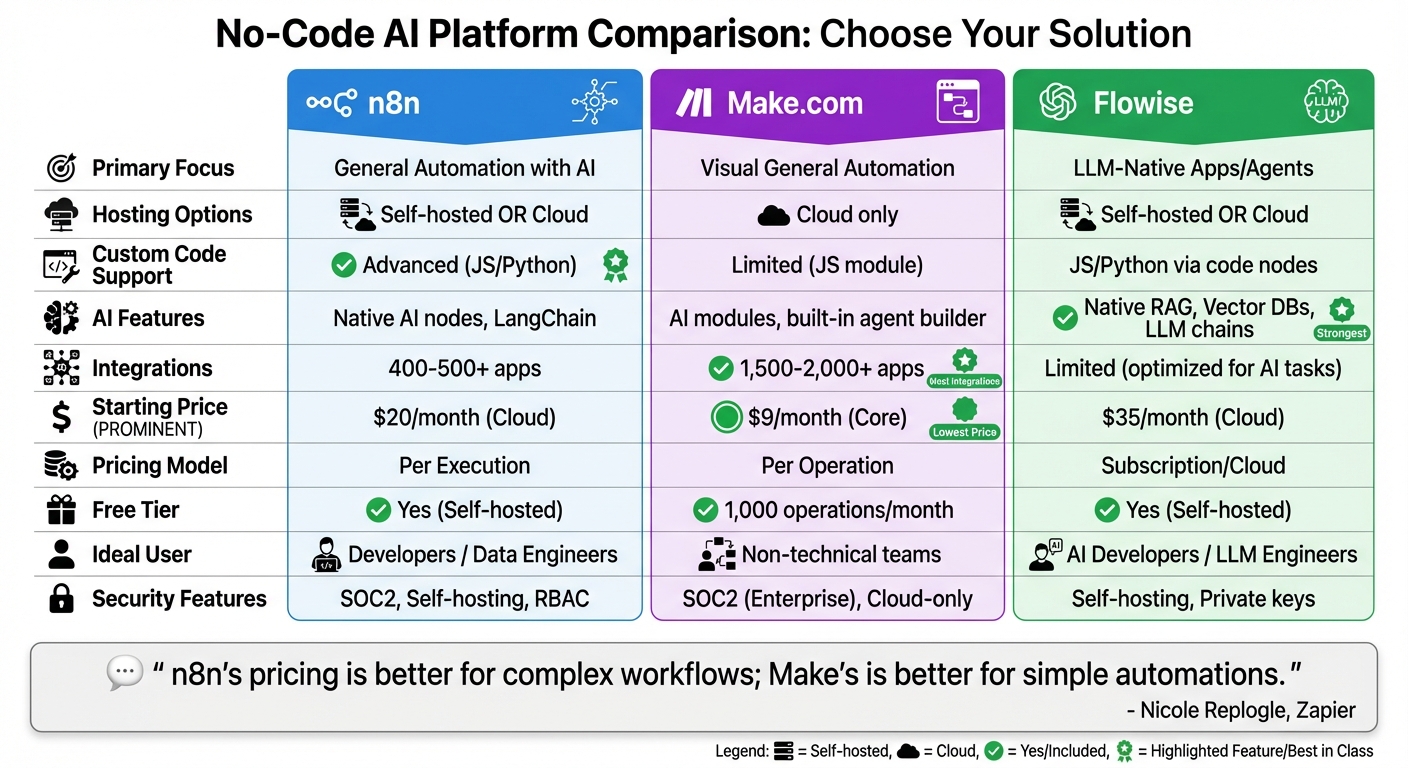
No-Code AI Platform Comparison: n8n vs Make.com vs Flowise Features and Pricing
Platform Capabilities and Pricing Table
When comparing n8n, Make.com, and Flowise, their focus and pricing models stand out as key differentiators. Here's a breakdown of their primary features:
| Feature | n8n | Make.com | Flowise |
|---|---|---|---|
| Primary Focus | General Automation with AI | Visual General Automation | LLM-Native Apps/Agents |
| Hosting | Self-hosted or Cloud | Cloud only | Self-hosted or Cloud |
| Custom Code | Advanced (JS/Python) | Limited (JS module) | JS/Python via code nodes |
| AI Features | Native AI nodes, LangChain | AI modules, built-in agent builder | Native RAG, Vector DBs, LLM chains |
| Integrations | 400–500+ apps | 1,500–2,000+ apps | Limited – optimized for AI tasks |
| Starting Price | $20/month (Cloud) | $9/month (Core) | $35/month (Cloud) |
| Pricing Model | Per Execution | Per Operation | Subscription/Cloud |
| Free Tier | Yes (Self-hosted) | 1,000 operations/month | Yes (Self-hosted) |
| Ideal User | Developers / Data Engineers | Non-technical teams | AI Developers / LLM Engineers |
| Security | SOC2, Self-hosting, RBAC | SOC2 (Enterprise), Cloud-only | Self-hosting, Private keys |
A closer look at pricing highlights an important distinction. For instance, a 10-step workflow executed 5,000 times in a month would count as 5,000 executions with n8n, but 50,000 operations with Make.com. This difference makes n8n's execution-based pricing more suitable for complex workflows, while Make.com's operation-based model works better for simpler tasks.
"n8n's pricing is better for complex workflows; Make's is better for simple automations." - Nicole Replogle, Staff Writer, Zapier
Flowise, meanwhile, offers flexibility with its open-source model under the Apache 2.0 license, allowing free self-hosting. For those who prefer a managed solution, its cloud option starts at $35/month.
This table gives a snapshot of the platforms' distinctions, but their automation focus and AI integration also play a crucial role in determining the right choice.
General Automation vs. AI-Focused Platforms
The platforms aren't just separated by pricing; their architecture and approach to automation define their strengths. While n8n and Make.com treat AI as an enhancement to broader business automation, Flowise is purpose-built for working with large language models (LLMs).
n8n and Make.com excel at connecting tools like CRM systems, marketing platforms, and databases, with AI nodes seamlessly integrated into workflows. This makes them ideal for tasks like automating invoice processing with an AI-powered summarization step. On the other hand, Flowise focuses exclusively on LLM orchestration, offering tools for prompt engineering, integrating vector databases, and building sophisticated LLM chains.
This distinction is crucial when selecting a platform. For example:
- If you're building a customer support chatbot that needs to query a knowledge base, reason through multiple steps, and maintain conversational context, Flowise is designed for that level of complexity.
- For workflows that combine AI with a variety of apps and services, like automating email responses or syncing data across platforms, n8n or Make.com are better suited.
"Flowise is a better choice if you're working with LLMs. n8n shines when you're automating across many apps." - Infintrix Technology
Ultimately, the decision comes down to whether AI is a small part of your workflow or the centerpiece of your solution. General platforms like n8n and Make.com offer flexibility for a wide range of business tasks, while AI-focused platforms like Flowise provide the specialized tools needed for advanced conversational and reasoning-based applications.
Use Cases and Industry Applications
Workflow Automation and Process Optimization
No-code platforms are changing the game when it comes to handling unstructured data - think emails, handwritten documents, passport images, and even social media posts. This shift is reshaping how businesses operate across various departments.
Take the finance sector, for example. AI tools have shaved close cycles from six days to just four, streamlined variance analysis, and reduced manual workloads by a whopping 60%. In supply chain and logistics, platforms like n8n are being used to combine data from weather reports, traffic updates, and inventory systems to create smarter routing plans. One logistics provider, for instance, managed to improve on-time delivery rates by 22% while slashing transportation costs by 18% with AI-powered workflows [15]. In healthcare, automation of prior-authorization processes saved one provider 8,000 staff hours and increased monthly collections by 6%.
Human resources teams are also seeing big wins. Automation tools now generate tailored training schedules and handle FAQ responses for new hires, cutting onboarding times in half through automated document collection and tracking. Meanwhile, legal and compliance teams are using AI to flag risky contract clauses and monitor transaction streams for signs of fraud.
These advancements are just the tip of the iceberg, setting the stage for AI’s growing influence on customer interactions.
Conversational AI and Customer Support
No-code platforms are also transforming how businesses interact with customers. Tools like Flowise allow companies to create multi-agent chatflows that can be embedded directly into their websites. These chatbots use Retrieval-Augmented Generation (RAG) to pull answers from company documents, reducing the inaccuracies often seen in standard chatbot responses.
For customer support teams, AI is making ticket management smarter and faster. Using sentiment analysis and priority detection, these systems assess incoming requests for urgency and emotional tone before routing them to the right team members. RAG chatbots, meanwhile, pull accurate answers from internal PDFs, knowledge bases, and databases, handling routine queries without needing human intervention.
In more sensitive areas, like finance and legal services, platforms integrate "human-in-the-loop" workflows. These require manual approval for AI-generated outputs, ensuring compliance and accuracy remain top priorities.
Marketing and Sales Automation
Marketing and sales teams are also reaping the benefits of no-code automation. AI agents now handle lead qualification by scoring inbound leads and routing them into CRMs like HubSpot. They also assist with market intelligence through automated web scraping, helping sales teams keep tabs on competitor pricing and industry trends.
On the marketing side, automation tools are generating content at scale - everything from blog outlines and product descriptions to campaign drafts. By integrating data from content management systems with AI-powered writing tools, teams can focus their energy on strategy rather than content creation. Automated follow-up campaigns, triggered by prospect behavior, free up time for sales teams to close deals instead of getting bogged down in manual data entry.
The payoff for adopting these no-code solutions is impressive. Most organizations see a return on investment within six to nine months. Enterprise automation, in particular, has been shown to deliver a 240% ROI in the first year alone. Process cycle times drop by an average of 35–40%, and automated validation and compliance checks can reduce error rates by up to 75%.
How to Adopt No-Code Platforms
Adopting no-code AI platforms can be a game-changer, but it takes thoughtful planning to make the most of their potential. Here's how to approach it strategically.
Evaluating Your Organization's Readiness
Start by assessing your current IT setup and identifying your specific needs. For companies dealing with complex legacy systems - especially larger enterprises - you'll want platforms that integrate seamlessly with pre-built connectors. If you're focused on customer-facing AI solutions that involve critical decision-making, look for platforms offering advanced customization options, like support for custom logic and scripts.
Decide whether a cloud-based solution (for faster deployment) or a self-hosted one (for full control over your data) suits your goals. Keep in mind the hardware requirements too. For instance, running Llama-3.1-70b demands approximately 168GB of GPU memory .
Consider your team's technical expertise. If your team has strong coding skills, a code-first SDK might be the way to go. Otherwise, aim for platforms with user-friendly graphical interfaces. For sensitive tasks, implement safeguards like output controls and data loss prevention measures . These steps lay the groundwork for a smooth implementation.
Implementation Best Practices
Once you're ready to move forward, follow these best practices to ensure a successful rollout. Engage stakeholders early on to pinpoint processes where no-code tools can have the biggest impact. Start small with a proof of concept to test performance and integration.
Design workflows in a modular way - this makes debugging and maintenance easier. Use version locking and always test updates in a staging environment before full deployment .
Security and compliance should be a top priority. Use Role-Based Access Control (RBAC) to manage permissions, maintain detailed audit logs, and securely store sensitive information with tools like AWS, GCP, or Azure Vault. This helps you meet compliance standards such as SOC 2, GDPR, and HIPAA. For AI-driven processes, include human review steps at key points to ensure accuracy, especially when AI outputs are unpredictable .
Factors for Long-Term Success
To ensure lasting success, choose platforms that can scale with your needs. Tools like Kubernetes, which enable container orchestration, are great for managing dynamic scaling. Keep an eye on important metrics like latency, throughput, and resource usage to maintain optimal performance .
Opt for platforms with active ecosystems. For example, n8n offers a vibrant community, pre-built templates, detailed documentation, and the ability to develop custom nodes . With 84% of organizations already using no-code tools and predictions that 75% of large enterprises will adopt multiple platforms by 2025, it's clear that these solutions are reshaping the way businesses operate.
Conclusion
No-code platforms are reshaping how enterprises approach AI solution development, cutting timelines from months to just days. Teams leveraging these tools have reported productivity boosts exceeding 60%, particularly among hybrid business-engineering teams. This marks a major shift in how organizations innovate and operate.
The numbers speak volumes about the growing importance of no-code platforms. With the no-code AI market expanding at an annual rate of 31–38% and expected to hit $25 billion by 2030, these tools are no longer experimental - they're becoming essential. AI-driven workflows, which currently make up just 3% of enterprise processes, are projected to surge to 25% by the end of 2025. Furthermore, 84% of organizations are already using low-code or no-code tools, signaling their widespread adoption. These trends highlight the potential of no-code platforms to meet the rising demands of modern businesses.
What makes these platforms stand out is their ability to scale operations without requiring a proportional increase in headcount. They allow businesses to automate repetitive, high-volume tasks like lead qualification, support ticket routing, and contract reviews. At the same time, deterministic logic layers ensure control over AI outputs, balancing flexibility with reliability. This combination makes them ideal for enterprise-grade applications.
As industry leaders like Nicolas Zeeb of Vellum AI point out:
"For operations, product, and data teams, these platforms turn 'idea → automated workflow' into a fast, low-risk loop that doesn't depend on engineering backlogs."
This shift underscores the growing role of no-code tools in driving efficiency and innovation across industries.
FAQs
What are the key advantages of using no-code platforms for AI development?
No-code platforms are transforming AI development by making it faster and more accessible. These tools empower business users to design intelligent workflows without needing to write a single line of code. With their visual interfaces and pre-built integrations, teams can seamlessly link data sources, large language models (LLMs), and SaaS services. This approach eliminates the need for custom coding and minimizes dependence on technical experts.
The advantages are hard to ignore. Companies can roll out AI solutions in a fraction of the time it would take with traditional coding methods, all while keeping compliance and security standards in check. Automated workflows simplify tasks like lead qualification or data analysis, helping teams scale their operations without adding extra staff. By streamlining the development process, no-code platforms cut costs and enable businesses to respond swiftly to shifting market demands.
What are the key differences between n8n, Make.com, and Flowise in terms of features and pricing?
n8n, Make.com, and Flowise each bring something different to the table, catering to various automation needs. Make.com stands out for its user-friendly, drag-and-drop interface, making it a great choice for non-technical users who want to connect apps and automate workflows without diving into code. n8n, on the other hand, offers a more flexible, node-based editor that supports custom JavaScript and external code integration. Plus, it can be self-hosted, giving users complete control over their setup. Flowise takes a specialized approach, focusing on AI and large-language-model (LLM) applications. It’s designed for tasks like chaining prompts or performing vector-store lookups, rather than general app integrations.
When it comes to pricing, Make.com includes a free tier with limited operations, alongside paid plans for heavier usage. n8n provides a free, self-hosted Community Edition, as well as paid options for its managed Cloud service. Flowise is open-source and free to run on-premises, with optional paid SaaS plans for those who prefer hosted solutions. Each platform offers distinct features and pricing models, allowing businesses to choose the one that best fits their automation or AI requirements.
Which industries can gain the most from using no-code AI solutions?
No-code AI platforms have become a game-changer for industries that handle large volumes of data, repetitive workflows, and the need for fast decision-making. Take finance companies, for instance - they can simplify processes like fraud detection, credit scoring, and compliance reporting, all without relying on specialized tech teams. In healthcare, AI can help automate patient triage, extract valuable insights from medical records, and make claims processing far more efficient. Meanwhile, real estate and property management professionals can use AI to qualify leads, analyze leases, and even predict maintenance needs.
The benefits don’t stop there. Technology and SaaS companies use no-code AI for tasks like DevOps monitoring, customer support, and product analytics. Across industries, marketing, sales, and customer service teams are leveraging AI to deliver personalized campaigns, score leads, and offer 24/7 chatbot support. Even HR and operations teams are seeing the value, using AI to automate tasks such as expense approvals, ticket routing, and resume screening. These examples showcase how no-code AI is transforming workflows, boosting productivity, and cutting costs across a wide range of sectors.