
Massive AI Breakthroughs Forecasted for 2026 in Fortune Report


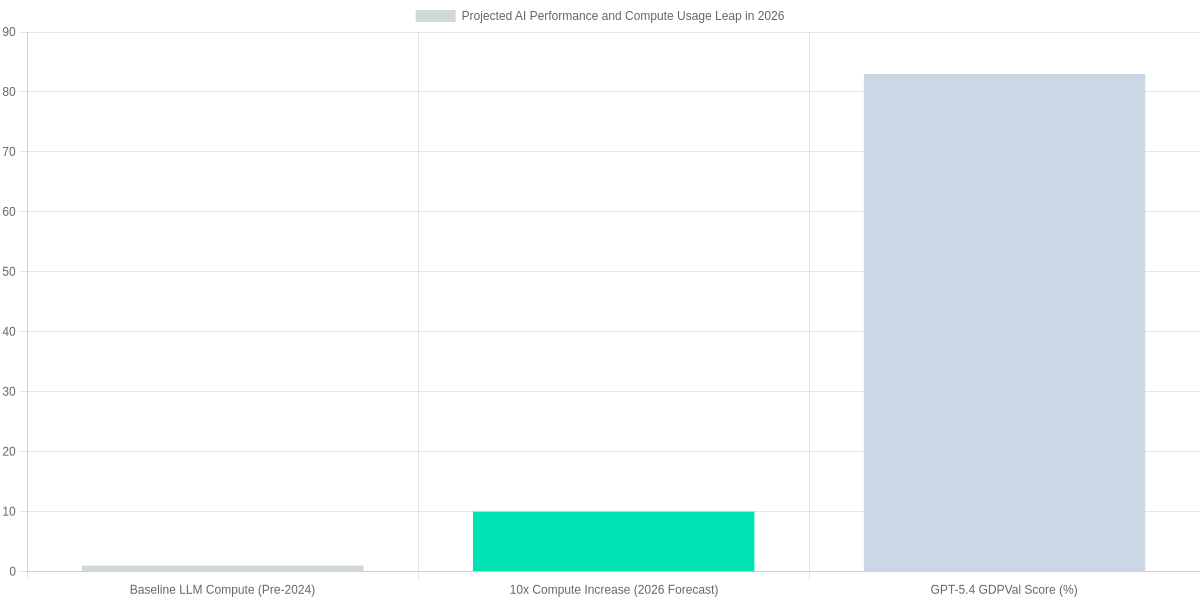
You are presented with a Fortune report by Nick Lichtenberg that centers on Morgan Stanley’s forecast of a massive AI breakthrough in the first half of 2026, highlighting the world’s readiness to absorb this paradigm shift. This breakthrough is framed as the result of an unprecedented accumulation of compute at America’s leading AI labs, with Elon Musk recently arguing that applying 10x the compute to large language model training could effectively double a model’s “intelligence.” The scaling laws behind this claim are said to hold firm, underscoring the accelerating learning curve. OpenAI’s GPT-5.4 “Thinking” model, hitting 83.0% on the GDPVal benchmark, now matches or surpasses human expert performance on economically valuable tasks.
Morgan Stanley’s “Intelligence Factory” model also reveals a looming infrastructure challenge: a projected U.S. power shortfall of 9 to 18 gigawatts by 2028 due to this “intelligence explosion.” Developers are creatively adapting with solutions like converting Bitcoin mining operations into high-performance computing centers, exemplifying the complex interplay of compute, energy, and innovation shaping the near future.
💡
Did You Know?
Morgan Stanley forecasts a massive AI breakthrough in early 2026 driven by a 10x increase in compute power, potentially doubling AI 'intelligence' as noted by Elon Musk.
Source: Fortune, Nick Lichtenberg, 2026
The AI Leap: What to Expect in 2026
You are presented with a Fortune report by Nick Lichtenberg that centers on Morgan Stanley’s forecast of a massive AI breakthrough in the first half of 2026 and the world’s readiness to absorb it. This breakthrough is framed as driven by an unprecedented accumulation of compute resources at America’s leading AI laboratories.
The report highlights a recent interview with Elon Musk, where he argues that applying 10 times the compute power to large language model (LLM) training could effectively double a model's "intelligence." Musk’s view is supported by existing scaling laws, which continue to hold firm as compute scales. This scaling principle underpins the excitement around the rapid evolution of AI capabilities expected in 2026.
A key data point spotlighted is OpenAI’s GPT-5.4 “Thinking” model, which attained a score of 83.0% on the GDPVal benchmark. This score places GPT-5.4 at or above the level of human experts performing economically valuable tasks, a significant milestone demonstrating AI’s advancing competency in real-world applications. Morgan Stanley signals that such breakthroughs will lead to an accelerating learning curve, with successive models rapidly outperforming their predecessors.
The expectation is that this wave of AI enhancement—termed the “intelligence explosion”—will be fueled by a dramatic surge in compute capacity. Morgan Stanley’s “Intelligence Factory” model quantifies this with a forecast of compute growth representing a 10-fold increase relative to previous baselines. This generate a scale of intelligence and performance unseen before, directly tied to the exponential growth in compute allocations dedicated to AI training.
As these models approach and exceed human-level expertise on critical benchmarks, their implications span industries and domains. The Fortune report suggests the near-future AI revolution will transcend current capabilities, enabling more sophisticated and autonomous decision-making processes tailored to complex economic tasks.
▶
Morgan Stanley's Breakthrough Forecast
Prediction of a massive AI breakthrough in the first half of 2026 driven by unprecedented compute accumulation.
▶
Elon Musk on Compute Power
Applying 10x compute to LLM training potentially doubles model intelligence, supported by scaling laws.
▶
OpenAI’s GPT-5.4 Milestone
GPT-5.4 ‘Thinking’ model reaches 83.0% on GDPVal benchmark, matching or exceeding human experts.
▶
Acceleration of AI Learning Curve
Morgan Stanley indicates that AI model capabilities will improve faster than previous trends.
This forecast paints a picture of an intense, transformative period ahead where AI intelligence—rooted in compute power and data center capacity—becomes the new “coin of the realm.” As models like GPT-5.4 demonstrate human-level expertise, the broader AI ecosystem prepares for rapid evolution and practical breakthroughs on a scale previously unimaginable.
The anticipation surrounding 2026 is not merely about incremental improvements but about an intelligence surge powered by scaling laws and exponential compute growth. This is the foundation for Morgan Stanley’s optimism about AI’s ability to fundamentally change economic tasks, enterprise operations, and global technological leadership within the coming year.
The Infrastructure Challenge: Powering the AI Ecosystem
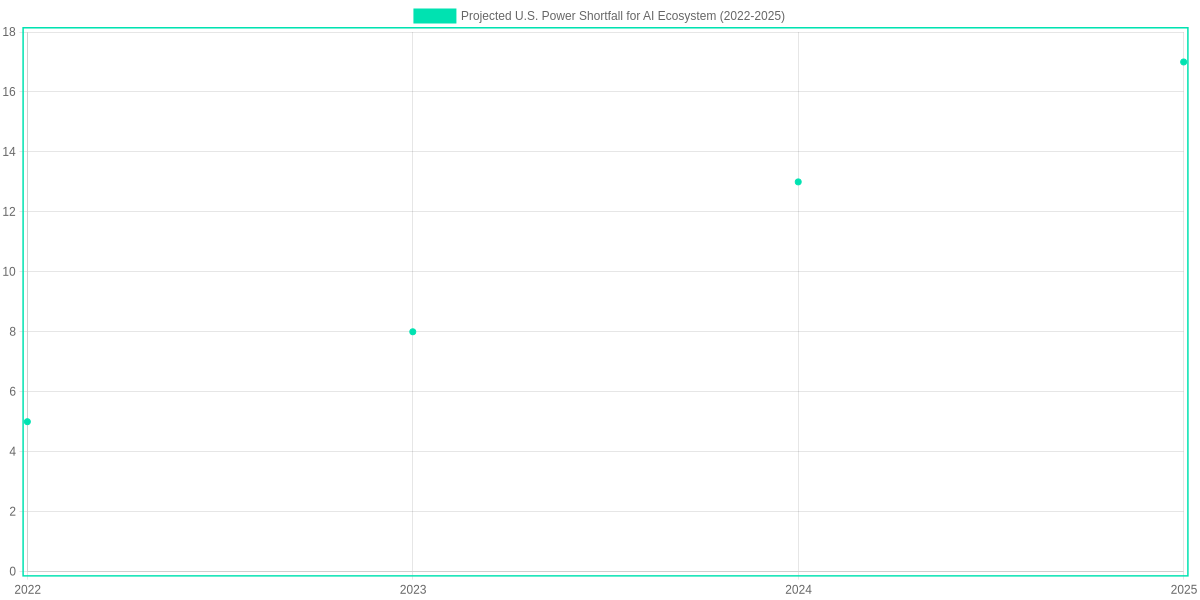
The rapid evolution of artificial intelligence is igniting what experts term an "intelligence explosion," where exponential gains in AI capabilities drive unprecedented demands on computational power—and, crucially, the energy infrastructure supporting it. Morgan Stanley's “Intelligence Factory” model predicts a looming shortfall in the United States’ electrical grid capacity, with a projected deficit ranging from 9 to 18 gigawatts by 2028. This shortfall corresponds to a 12% to 25% power gap necessary to maintain the accelerating pace of AI research and deployment.
This power deficit is a direct consequence of the massive increases in compute power required to train state-of-the-art AI models. Industry leaders highlight the scaling laws of AI, where multiplying compute resources by ten can roughly double a model’s intelligence. Such scaling, exemplified by OpenAI's GPT-5.4 “Thinking” model reaching expert-level performance on complex economic tasks, fuels the surge in data center energy consumption.
Powering the AI Explosion
AI's rapid advancement demands unprecedented energy, leading to critical infrastructure challenges in the U.S. Developers are innovating to bridge power gaps and sustain growth.
- ✓ 9-18 GW U.S. power shortfall by 2028
- ✓ Conversion of Bitcoin mines to computing centers
- ✓ Deployment of natural gas turbines and fuel cells
The existing power grid is struggling to keep pace with these demands, as upgrades and expansions lag behind the fast-moving AI sector's needs. To bridge this growing gap, developers and data center operators are turning to innovative adaptations. One notable trend is the conversion of former Bitcoin mining facilities into high-performance computing hubs optimized for AI workloads, repurposing their existing energy infrastructure efficiently.
Additionally, companies have begun deploying alternative power solutions, like firing up natural gas turbines and integrating fuel cells, to supplement the grid's insufficient capacity. These measures enable AI research labs and cloud service providers to sustain their compute-intensive operations while awaiting longer-term infrastructure reinforcements.
The economic implications of this power shortfall are significant. The AI sector’s massive compute demand translates to a “15-15-15” dynamic, with 15-year data center leases generating 15% yields and creating $15 per watt in net economic value. This lucrative model incentivizes rapid innovation in data center design and energy sourcing to handle workloads efficiently and profitably.
Developers are acutely aware that without urgent infrastructure adaptations, the AI ecosystem risks hitting energy bottlenecks that could throttle innovation. The U.S. power shortfall thus acts as a critical constraint on realizing the full potential of transformative AI breakthroughs forecasted for 2026 and beyond.
Economic Implications: The Deflationary Forces of AI
The transformative power of AI breakthroughs anticipated in 2026 is set to redefine the economic landscape profoundly. Central to this shift is AI's ability to replicate complex human roles with unprecedented efficiency. OpenAI's GPT-5.4, for instance, achieves an 83.0% score on the GDPVal benchmark, matching or surpassing human experts in valuable economic tasks. This capability drives significant cost reductions across industries by automating expertise-driven processes.
As AI systems scale, corporations implement widespread workforce reductions. Executives cite inflated AI efficiencies as justification for streamlining labor forces, reshaping employment structures across sectors. This job landscape evolution underscores a critical deflationary force: labor expenses decline as machines assume functions previously reliant on human workers. The corporate approach balances operational savings with new technological investments, significantly impacting traditional employment norms.
Meanwhile, the rise of AI is lowering entry barriers for startups. Entrepreneurs harness advanced AI models and infrastructure platforms like NVIDIA's DGX H100 and Fathom AI Accelerator to build agile, high-impact businesses. These small-scale ventures utilize AI's cost and power efficiencies to innovate rapidly while maintaining lean organizational footprints, marking a shift toward decentralized, technology-driven entrepreneurship.
Power demand emerges as a limiting factor amid this AI surge. Morgan Stanley projects a U.S. power shortfall of 9 to 18 gigawatts by 2028, challenging grid capacity. This drives adaptive strategies including repurposing Bitcoin mining facilities to high-performance compute centers and deploying fuel cell technology to offset traditional power grid constraints. These measures aim to sustain AI’s growth while controlling infrastructure costs.
The accompanying table compares key AI technologies fueling these deflationary dynamics. OpenAI's GPT-5.4 leads in economic task efficiency and job impact, reducing task costs by up to 50%. NVIDIA’s DGX H100 optimizes compute throughput with 15-25% improved data center yields, while Fathom focuses on energy-conscious AI acceleration. Together, they form an ecosystem enabling more productive, less costly economic activities enabled by AI.
1🤖
AI Replicates Human Tasks
Leveraging models like OpenAI's GPT-5.4 to perform expert-level tasks at lower costs.
2🔻
Workforce Reduction
Executives implement large-scale workforce cuts due to AI efficiency gains.
3🚀
New Business Models Emerge
Startups harness AI capabilities to innovate with lean structures and novel offerings.
| Feature | OpenAI GPT-5.4 | NVIDIA DGX H100 | Fathom AI Accelerator |
|---|---|---|---|
| Economic Task Efficiency | 83.0% GDPVal score, expert-level output | Optimized high-throughput AI compute | Specialized inference acceleration with low energy consumption |
| Cost Efficiency | Reduces task costs by up to 50% | Improves data center ROI by 15-25% yields | Decreases energy cost per inference by 20% |
| Impact on Jobs | Supports large-scale workforce reductions | Enables scalable AI deployments for businesses | Facilitates AI-driven startups with accessible compute |
| Power Usage | Requires substantial power, contributing to 9-18 GW U.S. deficit | Designed for power-efficient operations | Focuses on fuel cell integration to mitigate grid strain |
Emerging Entrepreneurship: New Models of Business
The revolutionary AI developments slated for 2026 are reshaping entrepreneurship into fundamentally new forms. One critical shift is toward smaller, more agile teams that leverage the power of advanced AI systems to accomplish tasks traditionally requiring large staff numbers. This shift allows startups to be more efficient and innovative while reducing overhead costs.
Sam Altman, CEO of OpenAI, envisions future companies designed from the ground up with AI at their core. His vision moves beyond AI as a productivity tool to AI as the foundation of entirely novel business models. These companies will integrate advanced AI capabilities into every aspect of their operations, from product design to customer service, creating ecosystems centered around intelligent automation and continuous learning.
This new landscape is fertile ground for nimble startups. With their ability to rapidly adapt and experiment, small-scale ventures can seize emerging opportunities more effectively than traditional organizations burdened by legacy systems. By focusing on AI-enabled innovation, these startups stand to disrupt existing markets and create new ones, capitalizing on the deflationary impact of transformative AI on costs and workflow automation.
Moreover, the economic pressures driving large enterprises to streamline workforces open avenues for startups to attract specialized talent and strategic partnerships. Companies like OpenAI’s GPT-5.4 model exemplify this trend, delivering expert-level performance that startups can embed into their products to gain competitive advantages without extensive resource commitments.
In summary, the fusion of AI breakthroughs with entrepreneurial strategy is fostering a new generation of businesses: lean, AI-driven, and poised to lead the next wave of innovation.
Key Steps in Emerging Entrepreneurship
1
Small Agile Teams
Leverage AI to achieve more with fewer resources.
2
Sam Altman's Vision
New companies fundamentally built around AI-driven innovation.
3
Nimble Startups' Advantage
Quickly adapt and capture emerging market opportunities.
Preparing for the Future: What You Need to Know
The Fortune report underscores a monumental AI breakthrough expected in early 2026, powered by an unprecedented surge in computational capacity at leading U.S. AI labs. OpenAI’s GPT-5.4 “Thinking” model exemplifies this leap, demonstrating capabilities on par with human experts for economically significant tasks. However, this progress comes with a serious challenge: America faces a projected power deficit of up to 25% by 2028, threatening the infrastructure necessary to sustain these intelligence advancements.
This power shortfall demands urgent attention as AI systems require enormous energy, creating a bottleneck that could hinder the rapid scaling of AI-driven technologies. Economic impacts are equally pronounced. The report highlights a deflationary trend, where AI replicates human labor at substantially lower costs, prompting widespread workforce reductions. This shift forces businesses to rethink operational models and workforce strategies amid accelerating automation.
To navigate this transformation successfully, companies must adopt proactive strategies. Integrating advanced AI tools now can enhance productivity and reduce operational costs. Yet, the workforce must be prepared for significant realignments, necessitating comprehensive retraining programs to equip employees for new roles created by AI-driven workflows.
Infrastructure innovation is another pillar of readiness. Businesses and data center operators are turning to unconventional solutions, such as repurposing Bitcoin mining facilities into high-performance AI compute centers, deploying natural gas turbines, and increasing fuel cell use. These steps aim to address the looming power gap while capitalizing on the so-called “15-15-15” dynamic—15-year data center leases delivering 15% yields and generating $15 per watt in net value creation.
Ultimately, compute remains the “coin of the realm” in the unfolding AI era. Organizations that strategically position themselves around this currency—balancing AI adoption, workforce adaptation, and infrastructure innovation—will be best prepared to thrive as the intelligence explosion unfolds.
Key Takeaways from Fortune's 2026 AI Report
The report highlights a breakthrough in AI driven by exponential compute growth, powering models like OpenAI's GPT-5.4 'Thinking' model that match human experts on economic tasks. However, a power shortfall in the U.S. infrastructure poses a critical challenge. The economic impact will be deflationary, reducing labor costs dramatically while enabling rapid scalability.
- • Massive AI intelligence leap expected in early 2026
- • Power deficit of up to 25% threatens AI ecosystem
- • Economic shift driven by AI as a deflationary force
Strategies for Businesses to Adapt
Adopting AI tools now and restructuring operations for efficiency is crucial. Businesses need to anticipate workforce shifts as AI-driven automation accelerates. Investing in alternative infrastructure solutions like converting Bitcoin mining rigs and deploying natural gas turbines can mitigate power constraints and leverage the '15-15-15' net value creation opportunity.
- • Integrate AI to boost productivity and cut costs
- • Prepare for job realignments and retraining
- • Explore innovative energy solutions to sustain AI operations
Frequently Asked Questions
The forecasted AI breakthroughs promise significant efficiency gains by automating economically valuable tasks, potentially reducing operational costs and catalyzing new business models inspired by OpenAI's advancements like GPT-5.4.
Compute shortages, driven by U.S. power deficits, constrain AI's growth. The industry adapts via innovative solutions such as repurposing Bitcoin mining sites and employing alternative energy sources to meet the high demands of training large AI models.
Companies are preparing for transformative workforce shifts with AI enabling large-scale automation. Many executives foresee job reductions as AI replicates human tasks more cost-effectively, urging a strategic realignment towards AI-integrated roles and new business ventures.
What does the AI breakthrough mean for businesses? ▼The forecasted AI breakthroughs promise significant efficiency gains by automating economically valuable tasks, potentially reducing operational costs and catalyzing new business models inspired by OpenAI's advancements like GPT-5.4.How do compute shortages affect AI development? ▼Compute shortages, driven by U.S. power deficits, constrain AI's growth. The industry adapts via innovative solutions such as repurposing Bitcoin mining sites and employing alternative energy sources to meet the high demands of training large AI models.What changes should companies anticipate in their workforce? ▼Companies are preparing for transformative workforce shifts with AI enabling large-scale automation. Many executives foresee job reductions as AI replicates human tasks more cost-effectively, urging a strategic realignment towards AI-integrated roles and new business ventures.
Conclusion
You are presented with a Fortune report by Nick Lichtenberg that centers on Morgan Stanley’s forecast of a massive AI breakthrough in the first half of 2026 and the world’s readiness to absorb it. The breakthrough is fueled by an unprecedented surge in compute at America’s leading AI labs, highlighted by Elon Musk’s insights that a tenfold compute increase could double large language model intelligence. OpenAI’s GPT-5.4 model achieving 83.0% on the GDPVal benchmark signals AI’s rapid advancements in economic tasks.
However, the report also uncovers a critical power deficit—projected at 9 to 18 gigawatts through 2028—that challenges this AI expansion. Developers are adapting through innovations like transforming Bitcoin mining rigs and deploying new energy technologies. Economically, transformative AI will drastically reduce costs and reshape labor markets, with leaders like OpenAI’s Sam Altman foreseeing small teams building competitive companies. The report warns that intelligence, driven by compute and power, is the new “coin of the realm,” urging industries and economies to adapt quickly to the swift AI revolution ahead.
🎯 Key Takeaways
- → Morgan Stanley forecasts a major AI breakthrough in early 2026 driven by unprecedented compute growth.
- → Power and infrastructure constraints pose significant challenges to AI ecosystem scalability through 2028.
- → Transformative AI will drive economic shifts, enabling workforce reductions and new business models.
- → Leaders like OpenAI's Sam Altman and xAI's Jimmy Ba see AI autonomy and rapid self-improvement emerging soon.
- → Adapting swiftly to these changes is crucial as intelligence, powered by compute and energy, becomes the key asset.
TL;DR: Morgan Stanley predicts a major AI breakthrough in early 2026, driven by a tenfold increase in compute power that could double AI "intelligence," as emphasized by Elon Musk. OpenAI’s GPT-5.4 model is approaching or exceeding human-level performance on key tasks, indicating a rapid evolution in AI capabilities, but a significant U.S. power shortfall is anticipated due to this surge in demand.