https://newsletter.marktechpost.com/
How AI agents and hyperautomation transform enterprise workflows, cut costs, and measure ROI using tools like OpenAI Agents SDK, n8n, and Langflow.
Enterprise AI is no longer about simple automation. Today, it's transforming businesses by introducing autonomous agents that handle complex tasks, boost productivity, and deliver measurable results. Companies like IBM have already achieved a $4.5 billion productivity increase by 2025, leveraging AI to automate workflows and save employees up to 60 minutes daily. Tools like OpenAI's Agents SDK, n8n, and Langflow are enabling businesses to streamline processes, cut costs by up to 30%, and improve decision-making with predictive analytics.
Key takeaways:
- AI agents are automating multi-step workflows, saving time and reducing low-value tasks by 25–40%.
- Generative AI adoption has reached 88%, with custom GPT usage increasing 19x this year.
- Hyperautomation is driving a 25% productivity boost and reshaping industries like finance and healthcare.
- Tools such as OpenAI Agents SDK, n8n, and Langflow simplify AI deployment and customization.
The shift isn't just about adopting AI but rethinking workflows to maximize its potential. Enterprises that act now are gaining a competitive edge, while others risk falling behind.
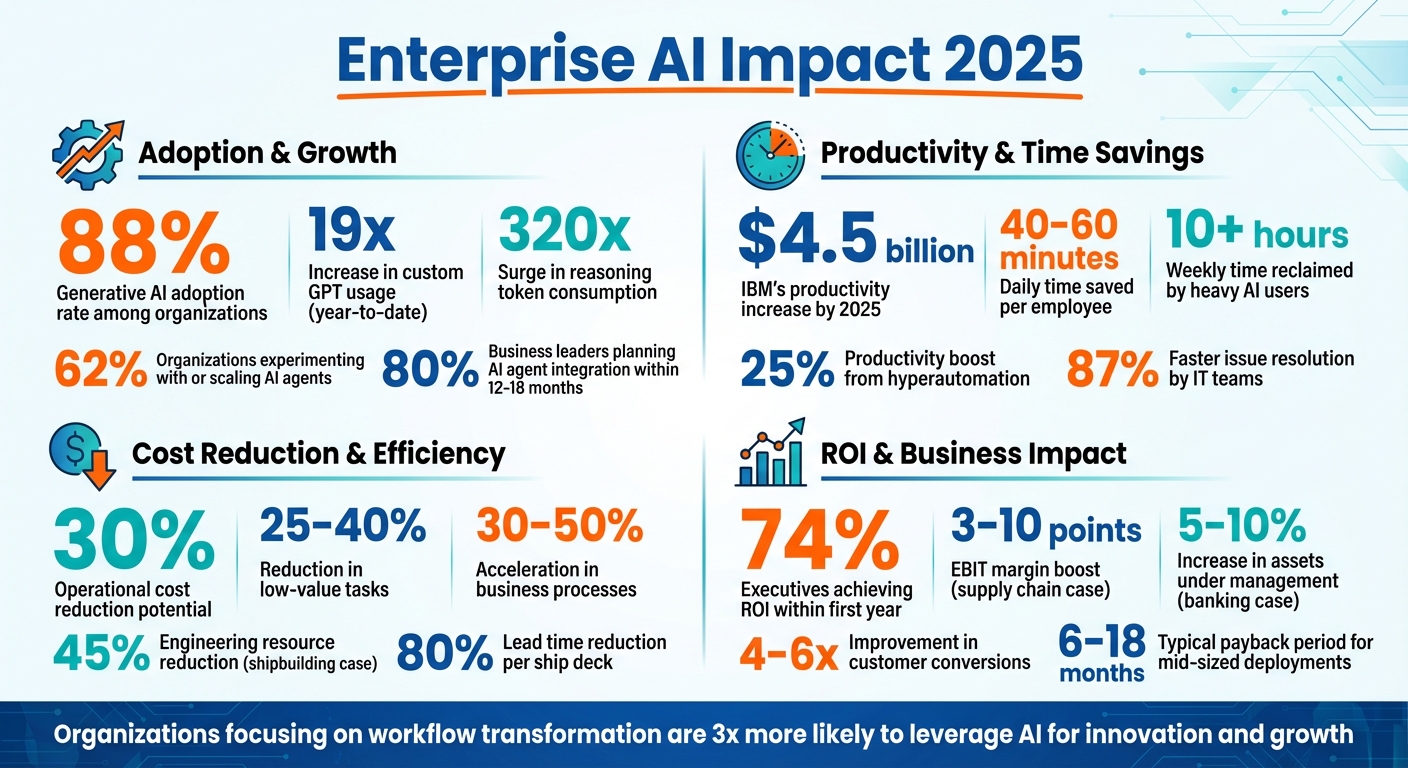
Enterprise AI Impact: Key Statistics and ROI Metrics for 2025
The Agent Factory: Building a Platform for Enterprise-Wide AI Automation
Top Trends in Enterprise AI Consulting for 2025
Enterprise AI consulting is undergoing a transformation in 2025, with three major trends reshaping the landscape. These developments highlight how AI is moving beyond basic automation to become a strategic force in business transformation. For instance, generative AI adoption has reached an impressive 88% among organizations regularly using AI in at least one business function. The rise of hyperautomation is slashing operational costs by 30% while driving a 25% productivity boost. Additionally, predictive modeling is enabling AI to bridge the gap between business goals and actionable outcomes, advancing from simple responses to autonomous execution.
Generative AI in Business Operations
Generative AI has transitioned from basic chatbot applications to powering structured and repeatable workflows. Custom GPT usage has skyrocketed, increasing 19 times year-to-date, while reasoning token consumption - critical for complex problem-solving - has surged by an astounding 320 times. This evolution reflects a significant shift: 62% of organizations are now experimenting with or scaling AI agents capable of planning and executing multi-step workflows on their own.
These advancements are making a tangible difference in workplace efficiency. AI tools are saving employees 40–60 minutes daily, with heavy users reclaiming over 10 hours each week. Tasks that were once limited to technical teams are now accessible to non-technical staff, as evidenced by a 36% increase in coding-related messages from workers outside traditional IT roles. IT teams report resolving issues 87% faster, and 75% of workers say AI has improved both their speed and the quality of their work. OpenAI highlights the new challenges organizations face:
"The primary constraints for organizations are no longer model performance or tooling, but rather organizational readiness and implementation".
While generative AI is streamlining operations, hyperautomation takes optimization to the next level by cutting costs and reshaping workflows.
Hyperautomation for Reducing Costs
Hyperautomation has evolved beyond robotic process automation (RPA) to agentic automation, where AI agents manage complex, dynamic tasks that require reasoning and autonomous decision-making. This shift is accelerating business processes by 30–50% and reducing low-value tasks by 25–40%. Shared AI platforms are providing the infrastructure needed to scale these capabilities, helping organizations cut operational costs by up to 30%.
In May 2025, an industrial goods company implemented AI agents to simulate supply chain planning. These agents identified risks and suggested solutions, boosting EBIT margins by 3 to 10 points. Meanwhile, a global shipbuilding company deployed a multiagent system to automate intricate design tasks, reducing engineering resource needs by 45% and cutting lead times per ship deck by 80%. Deloitte underscores the distinction between RPA and these advanced systems:
"Unlike RPA, AI agents don't just react; they reason and take action".
This capability allows organizations to rethink workflows entirely, rather than merely automating existing processes. Building on these operational improvements, predictive modeling is further transforming decision-making.
Predictive Modeling with Data Analytics
Predictive analytics serves as the backbone for advancing conversational AI into agentic AI, capable of planning and executing tasks autonomously. The 320-fold surge in reasoning token consumption underscores how predictive models are being used for intricate decision-making. Companies that excel in this area are 3 times more likely to leverage AI for innovation and growth rather than just cost-saving measures.
For example, a Southeast Asian bank introduced AI agents to provide real-time predictive insights to relationship managers. This initiative resulted in a 5–10% increase in assets under management and a four- to sixfold improvement in customer conversions. However, as BCG points out:
"The effectiveness of [AI agent] outputs depends entirely on the quality of those systems and the underlying data. The need for quality extends beyond clean, well-structured databases to the predictive models that agents rely on for decision making".
While challenges remain - such as LLM-based agents achieving only a 58% success rate on single-turn tasks - organizations focusing on data quality and robust measurement frameworks are already reaping substantial rewards.
Tools for Enterprise AI Automation
When it comes to scaling AI automation in enterprises, three standout tools lead the way: OpenAI Agents SDK, n8n, and Langflow. These tools not only simplify automation but also align with NAITIVE's mission of delivering measurable results for businesses.
OpenAI Agents SDK for Autonomous AI
The OpenAI Agents SDK is a Python-based framework designed to help developers create AI systems capable of solving complex problems and coordinating specialized agents. At its core, the SDK relies on four main components:
- Agents: Large language models (LLMs) equipped with specific instructions and tools.
- Handoffs: Seamless delegation between specialized agents.
- Guardrails: Input and output validation to ensure compliance.
- Sessions: Automatic conversation history management for continuity.
One standout feature is the agent loop, which automates the process of calling tools and analyzing results until a goal is met. Developers can choose between two coordination patterns: the Manager Pattern, where a central agent oversees specialized agents, or the Decentralized Pattern, where agents collaborate directly.
In July 2025, Invideo AI reported a tenfold increase in video production speed by leveraging OpenAI models for agent-driven workflows. With tracing capabilities that visualize decisions in real time, debugging becomes more straightforward, ensuring enterprise-grade reliability. Adoption is growing rapidly - 80% of business leaders plan to integrate AI agents into their strategy within 12 to 18 months, and over 33% aim to make agents a core part of their operations. As Charles Lamanna, Microsoft’s Vice President of Business & Industry Copilot, notes:
"Agents connect AI to tools, APIs, data, and organizational knowledge, and they can operate autonomously inside critical processes".
For companies just starting with AI agents, it’s smart to begin with low-risk, repetitive tasks like invoicing or data entry. To maintain oversight, tracing tools should be implemented early, and for higher-risk tasks - such as handling refunds or account deletions - agents should escalate unresolved issues to humans after a set number of failed attempts.
For seamless integration with existing systems, n8n is a powerful companion tool that simplifies workflow automation.
n8n for Workflow Automation
n8n bridges the gap between AI and business systems, offering over 500 pre-built integrations and an HTTP Request node that connects to any REST API. Whether it’s Slack, Google Sheets, or Stripe, n8n enables AI agents to interact effortlessly with these tools. It’s a favorite among developers, earning over 140,000 GitHub stars.
The platform’s "Nodes-as-tools" feature allows AI agents to use workflow nodes - like sending messages on Telegram or updating a Notion database - as callable functions. With SOC2 compliance and self-hosting options, organizations retain full control over their data.
Take SanctifAI, for example. This enterprise AI company built its first workflow with n8n in just two hours, skipping the need for custom development. In many cases, n8n reduces development time by up to threefold compared to writing custom Python code. As Nathaniel Gates, CEO of SanctifAI, puts it:
"There's no problem we haven't been able to solve with n8n".
n8n’s pricing model is based on full workflow executions rather than individual steps, offering predictable costs as businesses scale. For instance, finance teams can automate lead management and payment processing by linking Stripe with CRM systems, while healthcare providers use multi-agent workflows to coordinate scheduling and patient interactions through platforms like WhatsApp, Telegram, and Google Calendar.
To optimize costs and ensure reliability, organizations can set up event-driven triggers, error-handling logic, and use the $fromAI() function to streamline parameter definitions for AI tools.
While n8n excels in automation, Langflow takes the lead in rapid AI prototyping and customization.
Langflow for Custom AI Development

Langflow is a go-to tool for teams looking to prototype AI solutions like LLMs, retrieval systems, and AI agents - all without starting from scratch. With its intuitive node-based editor and over 130,000 GitHub stars, Langflow makes it easy to integrate with industry-specific APIs.
As a model-agnostic platform, Langflow supports a variety of AI models, including OpenAI, Anthropic, HuggingFace, and even local-only models via Ollama. This flexibility is crucial for industries requiring zero-trust architectures. Solutions built with Langflow can be exported as JSON files and deployed as REST APIs or embedded widgets, making it simple to share and manage across teams.
Phil Nash, Developer Advocate, highlights its accessibility:
"Langflow is typically the most beginner-friendly due to its visual interface. You can drag and drop components without writing code, making it easy to understand agent flows".
| Feature | Langflow | Traditional Coding |
|---|---|---|
| Development Speed | High; drag-and-drop prototyping | Slower; requires extensive coding |
| Customization | High; supports custom Python nodes | Maximum; fully customizable |
| Cost | Low; free to self-host | Variable; higher costs |
| Privacy | High; supports local models and self-hosting | Depends on implementation |
For advanced use cases, Langflow allows teams to inject custom Python code into nodes, enabling tailored solutions for complex workflows. However, since Langflow lacks enterprise governance features like role-based access control, external tools such as LangSmith or Langfuse are recommended for production monitoring. For organizations prioritizing compliance and data privacy, especially in self-hosted setups, Langflow is a strong contender.
Industry-Specific AI Implementation Methods
Top companies are rethinking workflows from scratch to achieve large-scale results with AI systems. This shift goes beyond simple chatbots answering questions - it's about creating systems that can autonomously handle multi-step tasks.
In the finance sector, mentions of "AI agents" in earnings calls surged 4x quarter-over-quarter in Q4 2024. Today, 62% of organizations are testing AI agents, with healthcare leading the charge. Between January 2024 and June 2025, 73% of investment-related startups backed by Y Combinator focused on agentic AI.
Another key concept is Sovereign AI, which ensures that data, models, and computational resources stay within specific national or organizational boundaries. This is essential for meeting strict privacy and residency laws. Deloitte highlights this trend:
"For enterprises, sovereignty may also mean retaining ownership of proprietary data pipelines rather than using vendor-hosted environments".
These trends are shaping how industries craft their AI strategies.
AI Solutions for Finance
Financial institutions are adopting workflow strategies tailored to their unique challenges, particularly in compliance and risk management. One such method, prompt chaining, uses sequential large language model (LLM) calls to extract data, summarize it, and flag risks - all while maintaining a clear audit trail. For global operations, a Router pattern helps identify an issuer's region (like the US or EU) and applies the appropriate regulatory framework, such as SEC or CSRD rules for ESG disclosures.
A standout example comes from Tiger Analytics, which integrated IBM Watson to process one terabyte of data daily for a financial client. This system predicted customer churn with 92% accuracy, leading to a $2 million ROI by identifying at-risk customers early. AI-powered analytics can also boost client retention rates by 35% through precise pattern detection.
When it comes to high-stakes decisions, such as trades or major transactions, Human-in-the-Loop (HITL) protocols are essential. These safeguards ensure manual approval for critical actions, with clear escalation paths - for instance, involving a human after three failed AI attempts or before irreversible steps are taken.
| Workflow Pattern | Best Financial Use Case | Primary Benefit |
|---|---|---|
| Prompt Chaining | Drafting credit memos | High control and auditability |
| Routing | ESG disclosure checks (US vs. EU paths) | Dynamic handling of regulatory frameworks |
| Parallelization | Peer benchmarking or stress tests | Reduced latency for large datasets |
Similar approaches are reshaping healthcare operations as well.
AI in Healthcare
In healthcare, predictive analytics is revolutionizing how providers allocate resources and improve patient care. For example, Analytics8 processed 5 petabytes of patient data for a major clinic using Google BigQuery and Apache Airflow. This initiative achieved 85% accuracy in predictive insights, cutting costs by 25% and delivering a 4:1 ROI within six months. Big data analytics can enhance operational efficiency in healthcare by up to 30%.
The industry is also turning to Physical AI, which merges intelligence with physical tools like robotic assistants and smart wearable devices in clinical settings. Launch Consulting emphasizes the importance of safety in these advancements:
"Healthcare systems focused on integrating AI safely into regulated environments... explainability and clinician oversight to protect patient safety".
Governance is evolving quickly, with 58% of heavy AI adopters expecting a major shift in governance within the next three years as AI takes on more decision-making responsibilities. SAP's Chief AI Officer underscores the importance of the human element:
"The successful ones are the ones that easily allow human behavior to adapt quickly".
For healthcare, this often means starting AI systems in "Shadow Mode" - where they make recommendations but humans execute the actions. This approach ensures the AI's logic is validated without exposing operations to unnecessary risks.
Measuring Success in AI Automation
After exploring AI tools and their industry-specific applications, it’s clear that measuring the impact of AI automation is crucial to showcasing its real value. Tracking the right metrics can separate successful AI initiatives from expensive missteps. In fact, 74% of executives report achieving ROI within the first year when they focus on the right indicators. But the real challenge lies in proving that AI delivers results.
Key Metrics for AI Performance
Let’s start with the automation rate - the percentage of tasks your AI handles from start to finish without human assistance. For instance, in 2025, CVS Health reduced live agent chats by 50% within just 30 days of implementing agentic AI. Similarly, LPL Financial handles 40,000 interactions monthly through AI, saving between $15 and $50 per interaction.
The financial benefits go beyond cutting costs. Consider deflection savings, calculated by multiplying the average cost per ticket by the number of tickets AI prevents. Another critical metric is resolution accuracy, which measures how often AI resolves issues without needing human correction. High-volume processes have seen error rates drop by 25–50% and a 15–30% reduction in full-time employee (FTE) hours.
While speed and cost savings are vital, quality metrics are equally important. For example, Apollo.io reduced approximately 40% of inbound support tickets in late 2025 with an AI agent, significantly speeding up resolution times. However, challenges remain - AI agents achieve about 58% success on single-turn tasks, but this drops to 35% for multi-turn interactions. This may explain why 32% of organizations have reported negative outcomes due to AI inaccuracy.
Advanced teams are now adopting more sophisticated evaluation methods, such as ACCT (cost per successful resolution). This metric, which divides total operational costs by correct outcomes, is reviewed weekly to ensure consistent performance.
NAITIVE's Focus on Measurable Results
NAITIVE builds on these core metrics to deliver measurable outcomes that directly impact your bottom line. The process begins with establishing baseline metrics using 3–6 months of historical data to clearly quantify improvements after deployment. This approach ensures that success is based on hard data, not anecdotal evidence.
Unlike generic chatbot solutions, NAITIVE reimagines workflows instead of simply automating existing ones. Research shows that high-performing organizations are three times more likely to revamp workflows for better results. While only 39% of organizations report measurable EBIT impact at the enterprise level, NAITIVE focuses on creating systems that drive revenue growth, not just efficiency gains.
Fiona Tan, CTO of Wayfair, highlights the potential of AI in business:
"AI agents can be applied to numerous use cases, and the number of businesses adopting them should be 100%. I can quickly point to dollars saved".
NAITIVE tracks metrics like automation rates, deflection savings, resolution accuracy, and the strategic impact of decisions. Each deployment includes automated data collection to demonstrate quick wins and build stakeholder confidence. With 39% of executives reporting productivity gains that have at least doubled, the key is focusing on the right metrics.
For mid-sized AI deployments, the typical payback period ranges from 6 to 18 months. NAITIVE accelerates this timeline by establishing clear KPIs, implementing step-by-step autonomy protocols, and addressing performance gaps weekly. These efforts validate success and reinforce NAITIVE's dedication to delivering AI automation that drives real, measurable results. It’s not just about building AI systems - it’s about proving they work.
Conclusion
Enterprise AI is redefining how businesses operate, leading to measurable outcomes like significant time savings and revenue growth. These shifts aren’t just minor upgrades - they represent game-changing advancements that set market leaders apart from their competitors.
Despite these opportunities, enterprises face tough challenges when it comes to implementation. While 80% of business leaders plan to adopt AI agents within the next 12 to 18 months, the real hurdles lie in organizational readiness and execution - not in the performance of the AI models themselves. Success in this space demands more than just deploying tools like OpenAI Agents SDK, n8n, or Langflow. It requires a phased approach, starting with assistive AI agents and gradually moving toward more advanced multi-agent systems. To navigate this journey, companies need experienced partners who understand the complexities of AI integration.
NAITIVE specializes in transforming business operations through strategic AI solutions. Using lightweight tools like Smolagents alongside enterprise platforms like Semantic Kernel, we help businesses cut operational costs while ensuring security and reliability. Our approach focuses on setting clear metrics, applying deterministic guardrails, and delivering actionable results. By aligning with the AI tools and trends previously discussed, NAITIVE ensures seamless integration across your enterprise.
The most successful organizations aren’t just automating - they’re rethinking their workflows entirely. They adhere to the 10/20/70 rule: 10% focused on algorithms, 20% on the technological backbone, and 70% on transforming business processes and empowering people. These companies strike a balance between human oversight for critical tasks and AI autonomy for driving innovation. They also choose partners who can deliver measurable success. Together, these strategies highlight a future where thoughtful AI partnerships lead to enduring business growth.
With AI driving efficiency and innovation at an accelerating pace, the time to act is now. NAITIVE’s proven frameworks, combined with the automation tools and strategies outlined earlier, position your business to capture this competitive edge and achieve meaningful, measurable results.
FAQs
What makes AI agents different from traditional automation tools?
AI agents stand out from traditional automation tools by offering a level of sophistication that goes beyond rigid, rule-based scripts. Traditional tools are designed to perform specific tasks only when exact conditions are met. In contrast, AI agents, powered by large language models (LLMs), can interpret intent, navigate ambiguity, and make decisions on the fly. They’re capable of managing entire workflows, adapting to new situations, and even correcting errors - all without needing constant human oversight.
What sets AI agents apart is their ability to maintain contextual memory, seamlessly integrate with external tools or APIs, and independently handle multi-step processes. This makes them ideal for handling complex tasks like booking reservations, troubleshooting technical problems, or generating detailed reports. Their dynamic capabilities position them as a powerful option for modern enterprise automation, capable of addressing challenges that static systems simply can’t manage.
Which industries benefit the most from hyperautomation and predictive modeling?
Hyperautomation and predictive modeling are reshaping industries that deal with high volumes of repetitive, data-driven tasks. Take e-commerce as an example: a mid-sized online retailer utilized AI-driven automation tools to slash customer service response times by an impressive 85%. Alongside that, satisfaction scores jumped by 32%, and the company saved 40 staff hours every week. These numbers highlight how automation can bring clear, measurable benefits to retail and online businesses.
But it’s not just e-commerce. Industries like finance, manufacturing, and healthcare are also embracing AI to streamline workflows, gain real-time insights, and boost efficiency. A recent "State of Enterprise AI" report by OpenAI predicts that by 2025, more than 1 million businesses will integrate AI into their daily operations. This underscores the growing influence of AI across a wide range of sectors.
What challenges do businesses face when adopting AI solutions?
Adopting AI solutions isn’t without its hurdles. These challenges often touch on technical, organizational, and strategic aspects, making the process more complex than it might initially seem. For starters, businesses frequently need to rethink and redesign their workflows to make AI integration seamless. This means aligning AI technologies with specific business goals, which can lead to significant shifts in work structures and the creation of shared AI infrastructure to ensure decisions driven by AI are both relevant and effective.
One of the trickiest parts of implementing AI is finding the right balance between AI autonomy and human oversight. Without clear governance in place from the beginning, companies risk facing unintended consequences. At the same time, they need to leverage AI’s efficiency to its fullest. Another technical hurdle is ensuring high-quality data while integrating diverse data sources into a cohesive system. On top of that, the scarcity of skilled AI professionals can slow down the development and deployment of solutions.
Beyond technical issues, there’s also the human factor. Resistance to change and skepticism about AI’s return on investment (ROI) are common roadblocks. To overcome these, organizations need to show tangible results early on to gain trust and support. Teams also require guidance to adapt to AI-powered processes.
Tackling these challenges calls for a well-rounded approach. Strong governance, clean and reliable data pipelines, access to skilled talent, and a clear connection to business objectives are all essential for laying the groundwork for successful AI adoption.