Why Enterprises Need Tailored AI Consulting
Why off-the-shelf AI falls short and how custom AI consulting solves integration, compliance, and scaling to boost enterprise ROI and production.

Generic AI solutions often fail to deliver results for enterprises. Despite high adoption rates, most companies struggle to see returns on their AI investments. The problem? Off-the-shelf tools can't handle legacy systems, meet strict industry regulations, or align with unique workflows. This leads to wasted resources, stalled projects, and poor ROI.
Custom AI consulting is the solution. By aligning AI with a company’s specific needs, it bridges the gap between strategy and execution. Tailored consulting addresses integration challenges, improves ROI, and ensures scalability. For example, a manufacturer saved $8.04 million annually with a custom predictive maintenance system, achieving a 518% ROI.
Key Insights:
- 73% of Fortune 500 companies started AI projects, but only 38% saw expected ROI.
- 42% of organizations abandoned AI projects in 2025 due to poor alignment.
- Custom AI projects deliver 18% ROI on average, compared to 7% for generic tools.
- Tailored solutions address industry-specific needs, reduce downtime, and improve workflows.
Custom AI consulting transforms AI from isolated experiments into solutions that drive measurable business outcomes.
Don't Do AI Until You Do This - AI Strategy (Part 2)
Problems with Generic AI Solutions in Enterprises
Generic AI tools often fail to meet the specific needs of enterprises. Trying to force these tools into tailored operations can drain resources and slow down progress.
Integration Problems with Existing Systems
One of the biggest hurdles is integrating generic AI tools with outdated systems. Around 48% of IT and development teams spend their time maintaining and integrating these tools instead of focusing on innovation. This is a significant resource drain that holds organizations back.
The challenges don’t stop there. Deploying advanced AI on fragile infrastructures with siloed data creates even more problems. For example, when AI models with 80% accuracy are used in workflows with multiple steps, small errors can snowball. After just five steps, the failure rate can skyrocket to 70%. This leads to constant human intervention, which defeats the purpose of automation.
"If you think of Agentic AI - AI that performs tasks - as a car, then you can imagine Generative AI as the engine, and data as the fuel."
– Mike Sinoway, CEO of Lucidworks
Another issue is the limited context windows that AI agents operate within. As task chains grow longer, crucial information can get lost, creating confusion and inconsistencies in business processes. It’s no surprise that 88% of AI proof-of-concepts never make it to full production.
These integration challenges not only disrupt day-to-day operations but also highlight the broader limitations of generic AI.
Missing Industry-Specific Features
Generic AI tools also struggle to meet the unique demands of specific industries. Healthcare providers, manufacturers, and financial firms all face different compliance and regulatory hurdles. Tools designed for mass-market use simply don’t address these specialized needs.
This often leads to disjointed AI initiatives that fail to align with a company’s strategic goals. For instance, data scientists may spend up to 45% of their time just cleaning and preparing data because these tools lack tailored data connectors. Additionally, many generic AI vendors lock companies into specific cloud environments, which limits flexibility. For industries with strict data sovereignty requirements, such as government or defense, this is a major roadblock. In fact, 96% of organizations deploying generative AI report higher-than-expected costs due to the need for customizations.
Unclear ROI and Scaling Limitations
The technical and operational issues of generic AI tools also make it hard to measure return on investment (ROI). About 71% of organizations admit they lack visibility into the sources of their AI-related costs. Without clear cost control, AI projects often become expensive experiments rather than meaningful investments.
High technical debt is another problem, affecting 86% of organizations. This debt can reduce AI returns by as much as 29%, and fixing it can consume nearly a third of implementation budgets. On top of that, 62% of companies find themselves stuck in "pilot purgatory", where projects fail to scale beyond initial testing phases. Instead of focusing on innovation, valuable AI talent often ends up troubleshooting issues caused by fragmented systems and incompatible architectures.
The result? Wasted resources, frustrated teams, and AI projects that fail to deliver on their promise.
How Custom AI Consulting Solves Enterprise Problems
Custom AI consulting focuses on aligning AI solutions with a company’s specific goals, data environment, and existing systems. By crafting a tailored roadmap, it tackles unique challenges from the beginning, creating a connection between technology and meaningful business outcomes.
Building Enterprise-Specific AI Plans
One of the first steps in custom AI consulting is addressing integration challenges and industry-specific needs through a comprehensive technical assessment. This starts with a deep evaluation of your data infrastructure, legacy systems like ERP and CRM platforms, and current workflows. Consultants take stock of data sources, evaluate their quality, and pinpoint compatibility issues. They then design modular API architectures that seamlessly integrate with your existing systems. Instead of requiring costly overhauls, these services adapt to your current infrastructure.
The outcome? A multi-year roadmap that prioritizes projects based on feasibility and return on investment (ROI). For example, consultants may identify pilot projects that can yield significant value - often $500,000 or more in annual returns - within just 12 weeks. This structured approach ensures AI initiatives are targeted, delivering results where they matter most.
Step-by-Step Implementation for Measurable Results
Custom AI consulting employs a phased implementation strategy designed to minimize disruptions while achieving clear, measurable outcomes. This process typically unfolds in five stages, each with specific goals and deliverables:
| Implementation Phase | Typical Duration | Key Objectives |
|---|---|---|
| Discovery & Assessment | 1–3 Weeks | Audit data systems, map workflows, and identify high-impact use cases |
| Strategy & Roadmap | 4–6 Weeks | Prioritize initiatives by ROI, establish governance, and secure funding |
| Pilot Implementation | 7–18 Weeks | Validate high-value use cases in a controlled setting |
| Scale Deployment | 19–40 Weeks | Expand AI across departments and integrate with ERP/CRM systems |
| Optimization | Ongoing | Continuously retrain models, optimize costs, and monitor performance |
This phased model ensures that AI solutions are tested and refined during pilot phases before rolling them out on a larger scale. By planning for production from the outset, consultants help avoid common pitfalls where pilots remain isolated experiments.
To support this, consultants establish robust MLOps frameworks, which include automated model versioning, deployment pipelines, and real-time performance monitoring. These frameworks reduce the time it takes to bring models into production by up to 40%, while also minimizing errors and system failures often seen with rushed, generic solutions.
Once implementation is complete, advanced AI systems can further enhance workflows through tailored automation.
Using Advanced AI Solutions and Agents
Advanced AI systems address the limitations of generic tools by offering autonomous capabilities customized for specific tasks. These include AI agents for managing complex processes, voice agents for customer service, and automation tools that eliminate repetitive tasks. Consultants ensure these systems are seamlessly integrated into daily operations, providing targeted training to make AI tools a natural extension of your business processes.
Take this real-world example: In 2025, a healthcare network with 147 facilities implemented an AI Voice Assistant integrated with Epic EHR to handle 342,000 patient calls per month. Built on GPT-4 and Google Speech-to-Text, the system managed 68% of call volume and reduced appointment no-shows from 28% to 12%. This generated $16.51 million in annual value from an initial investment of $1.95 million.
This move toward "Agentic AI" - systems capable of adapting and making decisions - marks a major shift in enterprise operations. Unlike rigid automation scripts that struggle with changing conditions, these intelligent systems handle exceptions, learn from their outcomes, and continuously improve. Custom AI consulting ensures these capabilities are implemented where they can deliver the greatest impact.
Proven Benefits of Custom AI Consulting
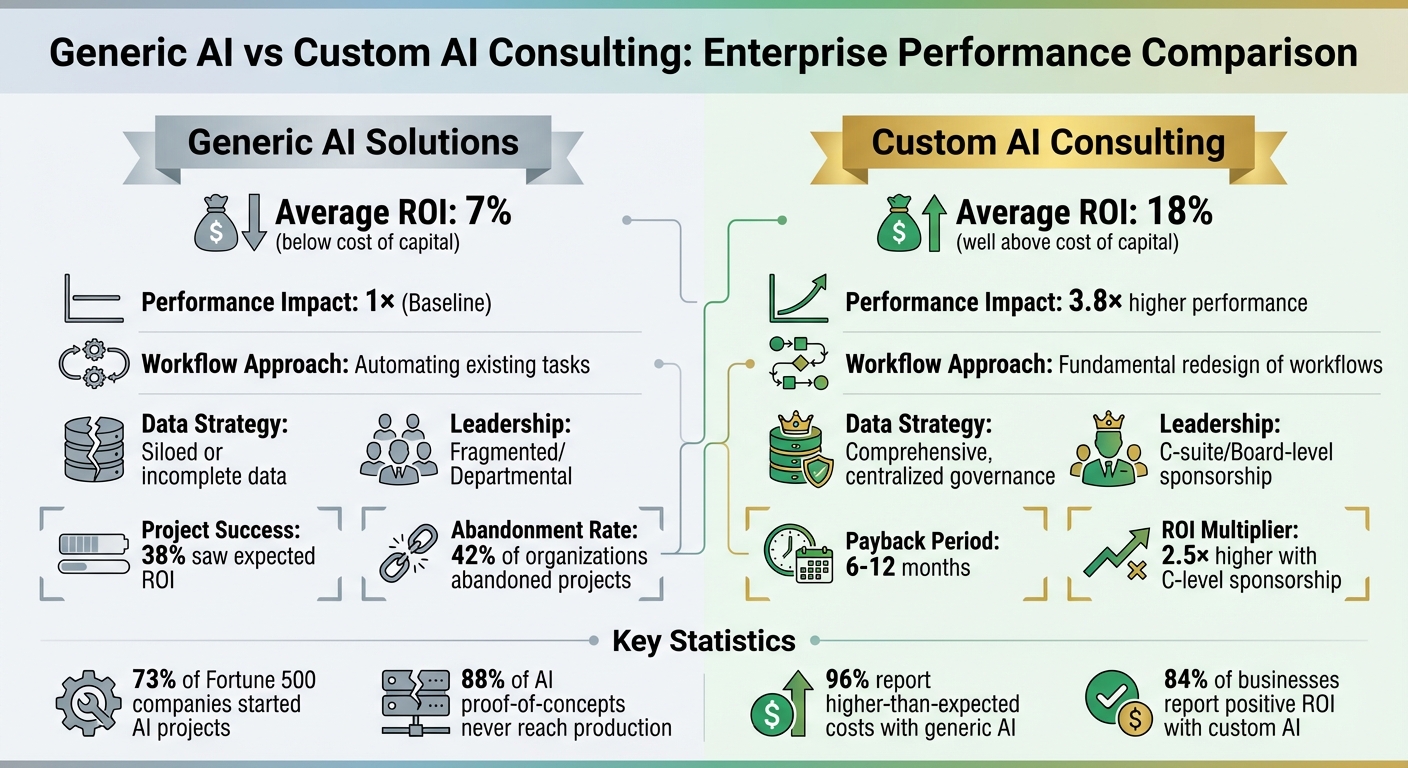
Generic AI vs Custom AI Consulting: ROI and Performance Comparison
Comparison: Generic AI vs. Custom Consulting
The difference in performance between generic AI tools and custom AI consulting is striking. Generic AI projects typically deliver an average ROI of just 7%, often falling short of covering the cost of capital. In contrast, organizations working with custom AI consulting partners achieve an average ROI of 18% - a far more attractive figure. Companies leveraging custom AI implementations report performance improvements that are 3.8 times greater than those in the lower half of AI adoption. Additionally, payback periods for these custom projects are now as short as 6 to 12 months, compared to the traditional 12–18 months. Dedicated C-level sponsorship further amplifies results, with organizations seeing a 2.5× higher ROI on their AI initiatives.
| Feature | Generic AI Solutions | Custom AI Consulting |
|---|---|---|
| Average ROI | 7% (below cost of capital) | 18% (well above cost of capital) |
| Performance Impact | 1× (Baseline) | 3.8× higher performance |
| Workflow Approach | Automating existing tasks | Fundamental redesign of workflows |
| Data Strategy | Siloed or incomplete data | Comprehensive, centralized governance |
| Leadership | Fragmented/Departmental | C-suite/Board-level sponsorship |
This comparison highlights how custom AI consulting delivers far greater value and impact, transforming enterprise outcomes in ways generic solutions simply cannot.
Measured Results from Custom AI Solutions
Real-world examples showcase the tangible benefits of custom AI consulting, proving its ability to drive meaningful results.
Take the case of a pharmaceutical company with $4 billion in annual R&D spending. In August 2025, they deployed a custom generative AI tool to verify supplier invoices against complex contracts. Within just four weeks, the system identified $10 million in value leakage - equivalent to 4% of their spend - while maintaining 95% accuracy.
In March 2025, a European automotive supplier implemented custom AI for automating code generation, quality assurance, and documentation. This saved 20–30% of time while also improving code quality. Similarly, a heavy-industry manufacturer developed a custom technician maintenance copilot, which reduced maintenance workloads by 40% and increased overall equipment effectiveness by 3%.
"Core solutions, though complex, deliver sustainable, scalable returns."
– IBM Institute for Business Value
Another standout example comes from a shipbuilder that integrated agentic AI into its design processes in December 2025. This innovation cut engineering efforts by 40% and reduced design and engineering lead times by an impressive 60%. In January 2026, publisher Wiley launched a custom customer contact triage agent. This tool managed service spikes and drafted personalized responses, leading to a 40% increase in case resolutions.
These examples illustrate how custom AI consulting doesn’t just improve efficiency - it redefines workflows, enhances competitive positioning, and unlocks transformative potential for enterprises.
Conclusion: Transforming Enterprises with Custom AI Consulting
When you look at the challenges and tailored solutions discussed earlier, the value of custom AI consulting becomes hard to ignore.
Custom AI consulting transforms AI from being just another expense into a powerful business advantage. It bridges the gap between ambitious goals and practical execution, helping companies avoid becoming part of the 42% that abandon AI projects due to poorly aligned strategies.
The key to AI success lies in the 10-20-70 rule - 10% algorithms, 20% technology, and 70% people and processes. This highlights the need for tailored consulting. Agencies like NAITIVE AI Consulting Agency go beyond simply building AI systems. They reimagine workflows from the ground up, integrate unique business contexts into AI models, and establish governance frameworks that align with standards like NIST AI RMF 1.0 and ISO/IEC 42001.
The payoff? Custom AI solutions can lead to tangible results, such as reducing operational costs by up to 20% and cutting labor expenses by 30%. These systems are designed to work seamlessly with specific data, constraints, and business logic to deliver meaningful outcomes.
"Despite massive AI investments, only 25% of companies are seeing ROI. The best are doing differently: rethinking workflows, aligning incentives, and focusing ruthlessly on value." – Vladimir Lukic, Global Leader, Tech and Digital Advantage, BCG
The market for AI consulting is expected to hit $90 billion by 2035, fueled by companies that understand AI transformation is not merely a tech upgrade - it’s a complete business overhaul. With 84% of businesses reporting positive ROI from their AI initiatives and AI-focused companies generating 25–35 times more revenue per employee, the evidence is clear: custom AI consulting is no longer optional - it’s essential.
FAQs
Why don’t off-the-shelf AI solutions deliver the expected ROI for enterprises?
Generic AI solutions often miss the mark when it comes to delivering the return on investment (ROI) businesses anticipate. Why? They’re not built to address the unique goals and challenges of a specific enterprise. Without a customized approach, these tools may struggle to tackle particular business problems, leading to scalability issues and inefficiencies.
A common pitfall with off-the-shelf AI is the lack of a clear, detailed roadmap. Many projects start strong as pilot programs but hit roadblocks when scaling to full production. This is where custom AI consulting makes a difference. By tailoring solutions to fit the business, it helps improve efficiency, align operations with objectives, and lay a solid foundation for long-term success.
How can custom AI consulting help integrate AI with existing systems?
Custom AI consulting enables businesses to integrate advanced AI technologies into their existing systems without the hassle or expense of replacing them. Specialists evaluate your current setup, pinpoint areas for integration, and craft solutions that seamlessly link older systems with cutting-edge AI tools.
Through customized interfaces or AI-powered adapters, legacy systems can continue operating effectively while gaining access to modern capabilities like automation and predictive analytics. This method reduces operational disruptions, upholds security and performance standards, and delivers tangible gains in efficiency and cost management. NAITIVE AI Consulting Agency excels at guiding businesses through this transformation, helping them harness AI's potential while keeping their foundational systems intact.
What are the key benefits of customized AI solutions compared to off-the-shelf tools?
Tailored AI solutions bring measurable benefits that go well beyond what generic tools can offer. They have the potential to increase enterprise EBITDA by 10%–25%, accelerate critical processes by 30%–50%, and drive notable cost reductions and revenue growth. Altogether, these enhancements contribute to an estimated $2.6 trillion–$4.4 trillion in global annual value.
By focusing on the specific needs of your business, customized AI tools provide more accurate automation, sharper decision-making, and stronger alignment with your operational objectives - delivering a better return on investment.