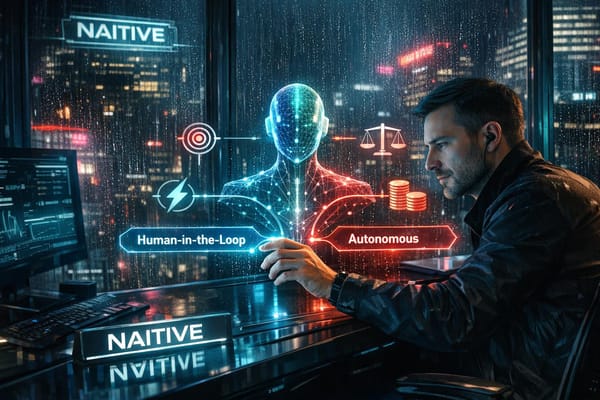
Dynamic Trust Models for Autonomous Agents
Explore how dynamic trust models and zero-trust architectures enhance collaboration between humans and autonomous agents, improving security and efficiency.

Dynamic trust models are reshaping how humans interact with autonomous systems by continuously adjusting trust levels based on real-time data. These systems analyze physiological signals, like heart rate and eye movement, and behavioral patterns to ensure trust aligns with an agent’s performance. Unlike static methods, dynamic models respond to changing conditions, improving decision-making in industries such as finance, logistics, and customer service.
Key Takeaways:
- Trust Calibration: Balances under- and over-reliance on AI for better collaboration.
- Real-Time Insights: Physiological and behavioral data detect trust shifts instantly.
- Security Focus: Zero-trust architectures verify every interaction to prevent risks.
- Business Integration: Trust scores guide access control and operational decisions.
Dynamic systems not only enhance reliability but also support secure, efficient AI deployment. This approach is essential for businesses aiming to stay competitive while managing risks in an AI-driven world.
Recent Research on Dynamic Trust Models
Key Findings on Trust Dynamics
Recent research has shown that trust between humans and autonomous systems is far more intricate than traditional security models account for. Unlike simple frameworks, trust operates on multiple levels, influenced by behavioral and environmental factors that can shift an agent's perceived reliability. In fact, studies suggest trust isn't a fixed state - it requires ongoing evaluation as conditions evolve. One particularly interesting finding is the concept of "reasoning manipulation", where long decision-making chains in AI systems can subtly stray from intended paths, introducing new vulnerabilities. These insights are paving the way for more nuanced approaches to integrating trust data into practical applications.
Role of Physiological and Behavioral Data
Incorporating physiological signals into trust modeling has opened up new ways to understand how humans interact with autonomous agents. Researchers at the University of Colorado Boulder conducted a study using seven bio-signals, including electrocardiogram (ECG), respiration, and eye-tracking, to measure trust levels. This multi-signal approach provides objective and non-intrusive insights, overcoming the limitations of traditional methods. Participants also reported their trust levels using visual analog scales, allowing researchers to compare these subjective assessments with their physiological responses. Interestingly, the results suggest that changes in physiological signals can indicate shifts in trust even before users are consciously aware of them. This early detection could be key to addressing potential mismatches between human expectations and system performance in real time. These findings set the stage for further exploration of trust in real-world scenarios.
Trust Experiments: Insights from Human–Agent Scenarios
A large-scale study examined trust dynamics in human–autonomy teaming tasks, collecting 2,304 observations from 12 participants. These tasks simulated high-stakes environments like space missions, military operations, and public safety scenarios. In the experiments, participants worked with simulated autonomous systems in a "human-on-the-loop" setup, making quick decisions under pressure. Using ordinary least squares regression, researchers developed predictive models with a Q² accuracy of 0.64, showing that physiological signals can reliably track trust changes in real-time. One striking discovery was how quickly trust could shift - sometimes within seconds - highlighting the importance of real-time monitoring systems. Additionally, combining multiple physiological signals significantly improved trust prediction accuracy compared to using a single signal. This finding is especially relevant for industries aiming to deploy reliable AI systems. For instance, organizations like NAITIVE AI Consulting Agency are already applying these integrated trust models to enhance the performance and security of their autonomous technologies. These experimental results are shaping the next generation of trust-aware systems.
Zero-Trust Architectures for Autonomous Agents
What Is a Zero-Trust Architecture?
A Zero-Trust architecture is built on a simple but powerful idea: "never trust, always verify." Unlike older security models that assume safety within a defined perimeter, Zero-Trust treats every interaction - whether it's from an autonomous agent, user, or device - as a potential threat. This means that every agent must repeatedly prove its identity and get authorization for every action, without relying on any pre-existing trust. Traditional perimeter-based models often create a false sense of security by assuming that anything inside the network is automatically safe. Zero-Trust flips this assumption by enforcing constant verification and dynamic access control.
This model depends on several critical technologies. For example, Decentralized Identifiers (DIDs) and Verifiable Credentials (VCs) provide cryptographic proof of an agent's identity, making impersonation much harder. An Agent Name Service (ANS) also plays a key role, enabling protocol-agnostic discovery to confirm agent capabilities. Together, these tools create a system designed to handle specific security challenges effectively.
Addressing Security Risks in Autonomous Systems
Autonomous systems face complex security threats that traditional setups aren't designed to handle. For instance, identity spoofing allows attackers to impersonate legitimate agents, while reasoning manipulation subtly alters the decision-making processes of agents, leading them off course. Dormant payloads - malicious code that stays hidden until activated - pose another significant risk. Even worse, if one agent is compromised, the attack can spread across the network by exploiting trust relationships between agents.
Zero-Trust architectures tackle these issues head-on. They enforce strict identity checks at every interaction, continuously monitor agent behavior to spot anomalies, and use dynamic privilege management to ensure agents only get the minimum access needed for specific tasks. Many implementations also include Trust-Adaptive Runtime Environments (TARE), which adjust security measures in real time based on trust scores. If suspicious activity is detected, these environments can quickly limit an agent’s capabilities or isolate it entirely.
Benefits of Zero-Trust for Businesses
By adopting Zero-Trust principles, businesses can significantly reduce the risk of data breaches. Limiting access to only what's necessary helps protect sensitive information, while continuous monitoring and detailed access controls make it easier to comply with regulations like those outlined in the NIST Cybersecurity Framework. These practices not only safeguard data but also enhance stakeholder confidence by showing a proactive commitment to security.
Zero-Trust architectures also provide flexibility and resilience against evolving threats. Their modular design allows businesses to implement updates and improvements gradually, avoiding the need for full system overhauls. Additionally, this approach supports secure, dynamic collaboration across various locations and platforms, enhancing operational efficiency.
For companies ready to adopt Zero-Trust, specialized consulting firms like NAITIVE AI Consulting Agency can offer tailored solutions. These experts can help design, implement, and manage Zero-Trust frameworks that meet specific business needs, paving the way for secure and scalable AI deployments.
Business Applications of Dynamic Trust Models
Integrating Trust Models into Business Processes
Dynamic trust models can be seamlessly incorporated into business workflows using trust computation engines. These tools enable real-time trust scoring for both employees and AI systems, creating a safer and more adaptive operational framework.
The process often involves technologies like Attribute-Based Access Control (ABAC) and Just-in-Time (JIT) credentials. These systems dynamically adjust access permissions based on trust levels. For instance, an AI agent might start with limited access and earn greater permissions as its trust score improves. If anomalies arise, the system can immediately scale back the agent’s access until the trust level is restored.
This dynamic approach doesn't just boost security - it also ensures resources are used efficiently. Businesses can maintain a flexible security stance that adapts to changing conditions, balancing operational efficiency with compliance and safety. Beyond securing operations, this method opens doors to trust-driven advancements in business processes.
Many companies turn to experts for help in implementing these systems. For example, NAITIVE AI Consulting Agency specializes in designing and deploying trust models tailored to specific business needs, ensuring alignment with operational goals and regulatory requirements.
Driving Innovation Through Trust-Based AI
Dynamic trust models don’t just enhance security - they also pave the way for innovation. By automating workflows that traditionally required constant human oversight, these models enable businesses to rethink and improve operations in areas like customer service and supply chain management.
With real-time trust assessments, autonomous systems can take on more complex tasks. As these systems prove their reliability through consistent trust scoring, businesses feel more confident delegating critical operations. This results in improved agility and operational consistency, giving companies a competitive edge.
Trust-based AI systems can also adapt to changing business conditions, continuously refining their recommendations and learning from both successes and setbacks.
Case Example: Building AI Trust in Customer Service
A great example of dynamic trust models in action is their use in customer service. Imagine an autonomous customer service agent that evaluates its performance in real time, using metrics like customer feedback, resolution rates, and interaction quality.
When the agent achieves a high trust score, it can independently handle more complex inquiries. On the other hand, a low score might trigger actions like escalating the case to a human representative, simplifying its communication, or adding extra verification steps.
This adaptability leads to measurable improvements - faster resolutions, happier customers, and lower costs by reducing the need for human intervention. It’s a clear demonstration of how dynamic trust models can enhance both reliability and customer satisfaction.
For instance, NAITIVE AI Consulting Agency could develop such a system for a U.S.-based retail company. The implementation process would include integrating trust models with existing customer relationship management systems, training staff to interpret trust scores, and fine-tuning the system based on the business’s specific performance metrics.
This approach fundamentally changes customer service, transforming it from a reactive process into a proactive, continuously evolving system. By building trust through proven competence, these models ensure flexibility and responsiveness as needs shift over time.
Future Directions in Trust Modeling for Autonomous Agents
Improving Trust Computation Techniques
The evolution of trust computation is moving beyond static methods, paving the way for dynamic, real-time systems. Researchers are now focusing on predictive models that use advanced regression techniques and feature extraction methods to analyze and forecast trust dynamics as they happen. By tracking trust fluctuations, these models can provide actionable insights and support real-time decision-making processes.
However, scaling these techniques to handle larger and more diverse datasets remains a significant hurdle. Additionally, validating these models on unseen participants is critical to ensure their reliability across different populations and scenarios.
Using Real-Time Behavioral Data
Integrating real-time behavioral data is pushing trust modeling into new territory. Cutting-edge systems now leverage live data from sources like electrocardiograms, respiration rates, electrodermal activity, EEG, eye-tracking, and user interaction metrics. These dynamic assessments allow trust levels to be adjusted moment by moment, offering unparalleled responsiveness. By monitoring these behavioral and physiological signals, systems can anticipate trust shifts before they impact performance, enabling autonomous agents to adapt swiftly to user needs and environmental changes.
Of course, this level of integration comes with challenges. Algorithms must be designed to sift through massive data streams, selecting only the most relevant features while maintaining the speed needed for real-time applications. Additionally, privacy and user acceptance are crucial considerations. Comprehensive monitoring must respect user autonomy and adhere to data protection standards. Successfully addressing these challenges will help ensure that real-time trust systems are both effective and ethical, laying the groundwork for tackling future issues in security and adaptability.
Preparing for Next-Generation Autonomous Agents
As autonomous agents grow more sophisticated, traditional security measures are no longer sufficient. These agents, capable of complex reasoning and decision-making, require advanced trust models to address emerging risks like dormant payloads, reasoning manipulation, multi-agent propagation, and identity spoofing.
Zero-trust architectures will continue to play a central role, but they must evolve. Innovations such as Trust-Adaptive Runtime Environments (TARE) are emerging as promising solutions. These systems dynamically adjust their strictness based on trust scores, offering a more flexible defense against adaptive threats.
Striking the right balance between autonomy and control, efficiency and safety, and progress and accountability will be critical as AI agents operate with less human oversight. Achieving this balance will require collaboration across technology, policy, and business sectors. For organizations navigating these challenges, consulting firms like NAITIVE AI Consulting Agency offer valuable expertise in crafting trust modeling solutions that meet current needs while preparing for what lies ahead.
Agentic Access: OAuth Isn't Enough | Zero Trust for AI Agents w/ Nick Taylor (Pomerium + MCP)
Conclusion: Using Dynamic Trust Models for Success
Dynamic trust models are changing how AI is integrated into businesses and how autonomous operations are managed. Recent studies show these models bring measurable benefits, improving both security and operational efficiency. By adopting these systems, organizations can unlock new levels of performance and reliability.
Key advancements like real-time behavioral monitoring, zero-trust architectures, and predictive analytics are opening doors to more dependable AI processes. Companies that integrate these technologies today can gain a competitive edge, especially as industry leaders like PwC and McKinsey highlight 2025 as a pivotal year for implementing AI trust frameworks.
But success in this evolving landscape isn't just about adopting new technologies - it’s about fostering effective collaboration between humans and AI. As AI transitions from being a simple tool to becoming an active teammate, employees will need to develop new skills to work alongside these systems. This shift is redefining how teams operate and interact in the workplace.
Dynamic trust models also have practical applications, particularly in customer service. For example, these models enable AI systems to adapt in real time, improving responsiveness and boosting customer satisfaction. The result? Better service and stronger business outcomes.
For organizations ready to take the plunge, combining ethical oversight with continuous monitoring is essential. Implementing explainable AI principles ensures transparency, making it easier for humans to understand AI-driven decisions. To help businesses align their technology investments with strategic goals, NAITIVE AI Consulting Agency offers expert guidance. Their approach ensures companies can harness the power of autonomous systems while maintaining the trust and security needed for sustained success.
FAQs
How do dynamic trust models enhance real-time collaboration between humans and autonomous agents?
Dynamic trust models are essential for creating smooth collaboration between humans and autonomous agents. These models adjust trust levels in real-time by analyzing factors like an agent's performance, reliability, and behavior within specific contexts.
The continuous evaluation of trust enables these agents to operate independently when suitable while still leaving room for human oversight when needed. This approach strikes a balance that boosts efficiency and instills confidence in the technology, making it simpler for businesses to incorporate autonomous systems into their workflows.
How do physiological and behavioral data influence trust levels in autonomous systems?
Physiological and behavioral data are key to fine-tuning trust between humans and autonomous systems. By examining things like heart rate, facial expressions, or how users interact, these systems can get a clearer sense of user confidence and adjust their behavior in real time.
Take this scenario: if a user appears stressed or hesitant, the system might respond by offering more detailed explanations or extra reassurance. This kind of tailored interaction not only builds trust but also enhances the overall experience of working with autonomous agents.
How does a Zero-Trust architecture improve security for businesses using autonomous agents?
Zero-Trust architecture strengthens security by insisting on constant verification of all users, devices, and systems - whether they’re operating within or outside the network's boundaries. For companies utilizing autonomous agents, this model ensures that every interaction and data exchange is thoroughly authenticated and authorized, significantly lowering the risk of breaches.
Adopting Zero-Trust principles allows businesses to safeguard sensitive data managed by autonomous agents, restrict access to essential systems, and react swiftly to potential threats. This vigilant security framework becomes even more crucial as autonomous agents function in highly complex and interconnected ecosystems.