https://aisnoop.org/
Monitor AI trends, deploy secure self-hosted agents, and automate workflows with Langflow and n8n to reduce costs and boost efficiency.

AI Snoop is a platform designed to help businesses effectively implement and manage enterprise AI solutions. It focuses on monitoring advancements in AI, providing actionable insights, and offering tools like Langflow and n8n to streamline automation, improve efficiency, and enable autonomous decision-making systems. Key highlights include:
- AI Monitoring: Tracks trends like multi-agent systems and Retrieval-Augmented Generation (RAG).
- Automation Tools: Langflow and n8n simplify AI integration and prototyping, reducing manual coding.
- Cost Savings: Automating workflows can cut costs by up to 67% and improve efficiency by over 100%.
- Security Features: Includes self-hosting, role-based access control, and human-in-the-loop safeguards.
- Enterprise Use Cases: Helps businesses automate processes, create custom AI solutions, and enhance customer engagement.
For companies aiming to stay competitive, AI Snoop offers tools and insights to integrate AI securely and efficiently into daily operations.
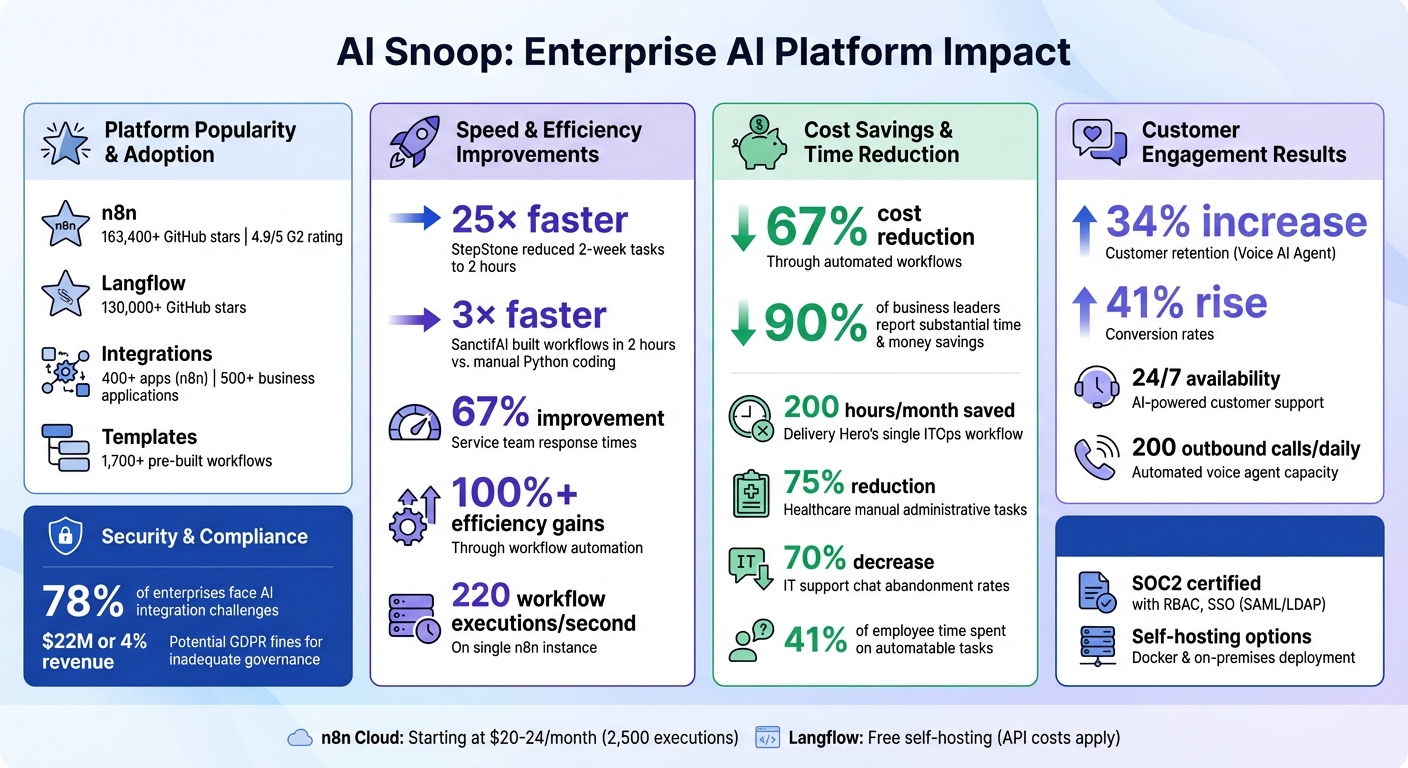
AI Snoop Platform Benefits: Cost Savings, Speed Improvements, and Efficiency Gains
Core Features of AI Snoop
Tracking Enterprise AI Developments
AI Snoop keeps a close eye on how enterprise AI evolves, particularly in areas like agentic workflows and multi-agent systems - both of which are transforming automation strategies in the business world. Agentic workflows allow AI to make decisions that adapt to specific contexts. Meanwhile, multi-agent systems take collaboration to the next level by using specialized agents - think research, writing, and review agents - that work together to tackle complex tasks.
The platform uses tools like n8n and Langflow to track these advancements. These tools have become central to enterprise AI. For example, n8n boasts over 163,400 stars on GitHub and an impressive 4.9/5 rating on G2. Similarly, Langflow has surpassed 130,000 GitHub stars. AI Snoop also monitors trends such as model agnosticism, where companies adopt multiple AI providers (like OpenAI, Anthropic, HuggingFace, and Ollama) to maintain flexibility and avoid being locked into a single vendor.
These insights pave the way for understanding how automation tools like n8n and Langflow are reshaping workflows.
Automation Tools: Langflow and n8n
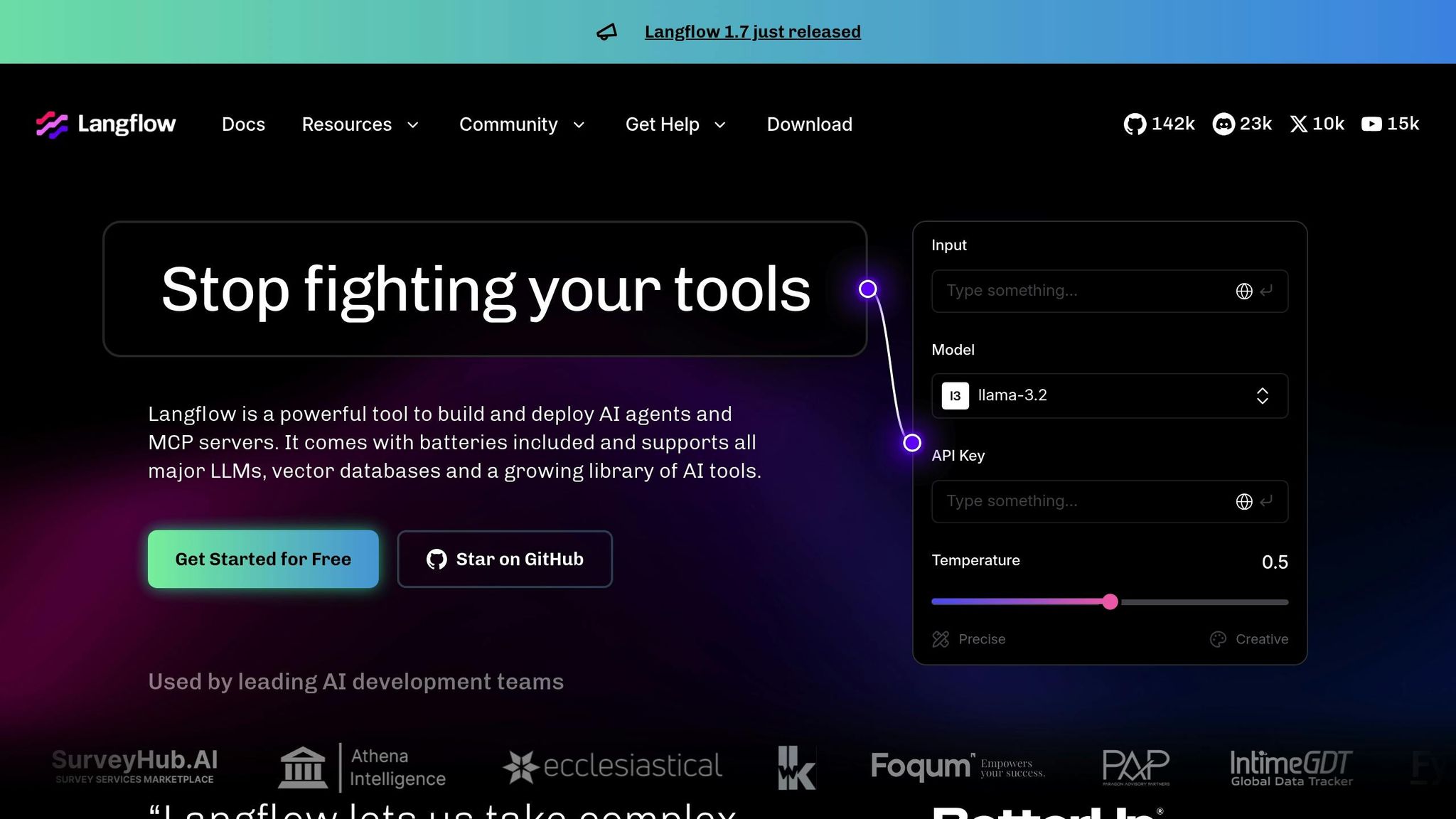
Both n8n and Langflow are game-changers when it comes to integrating apps and accelerating AI prototyping. n8n connects with over 400 apps, supports 220 workflow executions per second on a single instance, and includes 1,700 pre-built templates - cutting down on the need for manual coding. It’s a favorite for orchestrating workflows across major platforms like Salesforce, Slack, and Google Sheets.
Langflow, on the other hand, is tailored for AI-first prototyping. Its visual editor allows users to design LLMs, retrieval components, and RAG (Retrieval-Augmented Generation) pipelines without writing repetitive code. Users can easily switch between AI models, expand functionality with custom scripts, and create sophisticated AI logic that even non-technical team members can grasp.
The efficiency gains are striking. For instance, Nathaniel Gates, CEO of SanctifAI, and his team built their first n8n workflow in just two hours, managing collaboration across more than 400 workforces - a development speed three times faster than manually coding Python scripts for LangChain. Similarly, Luka Pilic, Marketplace Tech Lead at StepStone, achieved a 25× speed boost by using n8n. What typically took two weeks was completed in just two hours. Pilic explained:
"We've sped up our integration of marketplace data sources by 25X. It takes me 2 hours max to connect up APIs and transform the data we need. You can't do this that fast in code."
Both tools strike a balance between simplicity and customization. n8n supports JavaScript for tailored workflows, while Langflow uses Python for added flexibility. Pricing for n8n’s Cloud plans starts at $24/month for 2,500 executions, while Langflow is free to self-host, with costs tied to third-party AI APIs.
These tools also integrate seamlessly with AI security measures, ensuring reliability and control.
Building and Securing AI Agents
AI Snoop offers self-hosting through Docker and on-premises setups, giving enterprises full control over their data. Security features include Role-Based Access Control (RBAC), SSO (SAML/LDAP), and encrypted secret stores for managing credentials securely.
To ensure safety and manage costs, the platform supports Human-in-the-Loop (HITL) guardrails and event-driven triggers. HITL introduces manual approval steps, safety checks, and override options before AI carries out critical actions. This keeps AI systems within predefined limits, reducing risks like unpredictable behavior or hallucinations. Additionally, the Model Context Protocol (MCP) enables seamless integration between agents and external tools or servers.
Event-driven triggers and error-handling mechanisms ensure workflows only run when necessary, preventing unnecessary expenses. Structured output and auto-fixing parsers guarantee agents produce valid JSON data, ensuring smooth downstream processes. Dennis Zahrt, Director of Global IT Service Delivery at Delivery Hero, highlighted the impact of n8n workflows:
"We have seen significant efficiency gains since we started using n8n for user management. It's powerful and simple."
For monitoring and observability, AI Snoop recommends tools like LangSmith and Langfuse to track token usage, capture errors, and maintain detailed execution logs. Memory management options include Postgres Chat Memory for auditing, Redis for fast caching, and Zep for long-term context storage.
These features empower businesses to deploy AI solutions that are fast, secure, and scalable.
How to Automate Any Business With AI in 3 Steps (Beginner's Guide)
How Enterprises Use AI Snoop
Enterprises are tapping into AI Snoop's capabilities to reshape their operations, focusing on custom solutions, process automation, and enhancing customer engagement.
Creating Custom AI Solutions
Companies are using AI Snoop to develop tailored solutions for their unique challenges. Tools like Langflow's drag-and-drop interface make it easy to prototype RAG pipelines quickly, even for teams without extensive coding knowledge. Meanwhile, n8n integrates these AI models with over 500 business applications, including Salesforce, Slack, and Google Sheets, streamlining workflows across departments.
A standout feature is multi-agent orchestration, which simplifies complex tasks by assigning them to specialized agents. For instance, research agents gather data, writing agents create content, and review agents ensure quality. This setup is further customized with System Messages, enabling agents to follow industry-specific rules and behaviors. To maintain control, companies implement human-in-the-loop approvals for critical tasks. For added security, enterprises can self-host AI Snoop using Docker or on-premises solutions, ensuring compliance and protecting sensitive data. Some businesses have even adopted "Employee as a Service" (EaaS), deploying AI agent teams to handle 24/7 data analysis and problem-solving without the traditional costs of a human workforce.
These custom solutions naturally pave the way for automating daily business processes.
Automating Business Processes
AI Snoop's automation frameworks have delivered measurable efficiency gains. For example, companies like Delivery Hero and StepStone have reduced workflows that once took weeks to just hours by leveraging n8n.
The system combines pre-defined rules with AI's ability to adapt to dynamic scenarios. Rules ensure outputs stay consistent, while AI handles complex decision-making. Features like rate-limiting, retries, and local data compression help control costs and prevent runaway processes. With over 1,700 pre-built templates, teams can quickly deploy solutions across IT, HR, and marketing, breaking down complex processes into smaller, reusable workflows. Visual builders with built-in logs make debugging and monitoring straightforward, saving time and effort.
Improving Customer Engagement with AI
AI Snoop isn't just about streamlining internal operations - it also transforms how businesses engage with customers by blending automation with personalization.
With AI Snoop, businesses can provide 24/7 customer support and deliver hyper-personalized experiences. By analyzing vast datasets, companies can offer product recommendations and content tailored to individual preferences.
Predictive tools further enhance engagement by identifying at-risk accounts, recommending products based on shopping patterns, and using sentiment analysis to gauge customer satisfaction in real time. This allows businesses to address issues proactively and improve customer loyalty.
In March 2025, SanctifAI demonstrated the power of AI Snoop by using n8n's visual builder to create scalable workflows for a 400-person workforce. Remarkably, they rolled out their first production workflow in just two hours - three times faster than coding with Python for LangChain. CEO Nathaniel Gates highlighted this success, stating:
"There's no problem we haven't been able to solve with n8n."
Another example is a Voice AI Agent solution that managed 200 outbound calls daily, leading to a 34% increase in customer retention and a 41% rise in conversions. By combining automation with human oversight, businesses ensure routine queries are handled efficiently while maintaining their brand's voice and consistency. Integrating AI Snoop with existing CRM systems through APIs and middleware ensures data accuracy and reliable outputs. Emily Holland, VP of Client Success at Kaplan, summed it up well:
"The organizations winning at customer engagement are those using AI to be more human, not less."
Benefits of Using AI Snoop
AI Snoop doesn't just streamline operations - it offers a range of strategic advantages, from keeping you informed about the latest AI trends to helping you cut costs and enhance security. Let’s dive into how this platform can make a difference.
Access to Current AI Trends
Staying updated on AI advancements is no longer optional - it's a necessity. AI Snoop equips decision-makers with the insights needed to navigate their technology strategies effectively. With this platform, you can evaluate trade-offs, such as whether to prioritize privacy with open-source, model-agnostic solutions or opt for proprietary ecosystems like OpenAI that prioritize speed.
This is particularly relevant since 78% of enterprises report challenges in integrating AI into their existing tech stacks. Two emerging trends are reshaping how businesses approach AI: visual-first development using node-based editors, which makes AI more accessible to non-technical product managers, and infrastructure tailored to meet evolving zero-trust and privacy standards.
Jonathan Blomgren, Studios Director at BetterUp, highlights the value of these tools:
"Langflow lets us take complex product ideas and quickly bring them to life through visual flows that anyone can understand."
These insights not only simplify decision-making but also pave the way for cost savings.
Cost Savings and Scalability
AI Snoop’s automation workflows directly contribute to cost efficiency. In fact, 90% of business leaders report substantial savings in both time and money with AI Snoop. By automating repetitive tasks like data entry and ticket triaging - tasks that consume 41% of employee time - teams can focus on more meaningful work.
Consider these results: service teams using AI agents have improved response times by up to 67%, while generative AI in IT support has slashed chat abandonment rates by 70%. In healthcare, automation has reduced time spent on manual administrative tasks by as much as 75%. Platforms like Langflow and n8n further reduce costs by minimizing the need for specialized AI engineering talent during the prototyping phase. And since these AI agents operate continuously without additional labor costs, scaling your virtual workforce becomes effortless.
Scott Rines, President at Swoop, shared how AI Snoop has transformed their approach to data:
"Healthcare marketing data can be overwhelming... Our AI Assistants allow teams to break free from data paralysis by honing in on the insights that matter most."
These operational efficiencies are supported by top-tier security measures.
Security in AI Development
AI Snoop takes security seriously, incorporating enterprise-grade protections to safeguard your systems. Tools like Langflow and n8n come with secure-by-default configurations, including hardened CORS policies and stricter cookie settings to reduce risks like cross-site request forgery. This focus is critical, as AI platforms often handle sensitive credentials such as API keys and database passwords, making them attractive targets.
Human-in-the-loop interventions further enhance security by allowing manual oversight and safety checks before AI executes actions in your workflows. SOC2 certification and role-based access controls ensure that only authorized personnel can modify sensitive processes. For businesses with stringent data privacy needs, self-hosting options align with zero-trust architectures. Considering that inadequate AI governance can lead to fines of up to $22 million or 4% of annual revenue under GDPR, these features are indispensable.
Anna Holman, Web Content Strategist at IBM, underscores the importance of robust governance:
"AI governance is essential to instill trust and reliance in the data-driven decisions made by organizations using the insights from these platforms."
Getting Started with AI Snoop
Key Takeaways
AI Snoop is reshaping how businesses embrace AI by combining visual workflow orchestration with top-tier security. Its standout feature? The ability to connect with over 500 integrations using tools like n8n and Langflow, making it possible to deploy advanced AI agents quickly and efficiently.
To cater to different business needs, AI Snoop offers two deployment options: a managed cloud service starting at $20/month for 2,500 executions, or self-hosted Docker containers for businesses that require full control over their data. Companies like SanctifAI have already taken advantage of this flexibility. Their CEO, Nathaniel Gates, highlighted its versatility:
"There's no problem we haven't been able to solve with n8n".
Other success stories include Delivery Hero, which saved 200 hours every month with a single ITOps workflow, and StepStone, which slashed a two-week task down to two hours - a 25x speed improvement. These examples showcase how AI Snoop can deliver tangible results, setting the stage for the next steps in deployment.
Next Steps
Ready to dive in? Start by choosing the deployment model that aligns with your enterprise's requirements. If you’re looking for speed and simplicity, the n8n Cloud option is a great choice. It offers a five-minute setup and a 14-day free trial - no credit card needed. For industries with strict data regulations, the self-hosted Docker option provides unlimited workflows without any software costs.
Once you’ve selected your deployment model, set up an n8n instance and secure API credentials for your preferred large language model (LLM), such as OpenAI, Google Gemini, or Anthropic. From there, use pre-built templates to design workflows effortlessly. For example, you can integrate "Chat Trigger" and "AI Agent" nodes with a Chat Model and Memory node to enable seamless multi-turn conversations.
For enterprises focused on security, don’t overlook features like human-in-the-loop approval processes and event-driven triggers. These tools help manage costs by ensuring AI models only run when needed. As Luka Pilic, Marketplace Tech Lead at StepStone, explains:
"It takes me 2 hours max to connect up APIs and transform the data we need. You can't do this that fast in code".
FAQs
How does AI Snoop protect data and ensure compliance with regulations?
Currently, there’s limited information about the specific security measures or compliance certifications associated with AI Snoop. Unlike tools such as n8n, which highlight adherence to standards like SOC 2, the documentation for AI Snoop’s underlying technology (known as the 'Sno' memory layer) doesn’t explicitly reference features like encryption, access controls, or compliance with frameworks such as GDPR or CCPA.
For a clearer understanding of how AI Snoop handles data security and regulatory compliance, it’s best to consult the platform’s official documentation or contact their support team directly for more details.
What are the advantages of using Langflow and n8n for AI integration?
Langflow offers a straightforward, low-code platform for creating AI-driven applications like agent-based systems and retrieval-augmented generation (RAG) tools. With its drag-and-drop interface, teams can visually design workflows while still having the option to incorporate custom Python code when necessary. Langflow supports any large-language model (LLM) and vector database, enabling businesses to quickly build AI prototypes and scale them for production - all without being tied to a specific vendor. Its modular structure also makes managing governance and security more efficient, simplifying workflow audits and version control.
n8n serves as an excellent companion to Langflow, providing a robust workflow automation tool that includes over 500 pre-built integrations, code nodes, and support for AI agents. Its visual editor allows teams to test and adjust workflows in real time, cutting down on development time and effort. With self-hosting options, SOC 2 compliance, and the flexibility of cloud or on-premise deployment, n8n ensures enterprises retain control and security over their critical AI initiatives. Together, Langflow and n8n help businesses streamline AI adoption, speed up innovation, and scale automation across a variety of workflows.
How can businesses track and measure the efficiency improvements from using AI Snoop?
Measuring how AI Snoop improves efficiency starts with setting clear benchmarks for the tasks you’re automating or streamlining. For example, track how long processes like data analysis, customer support, or supply chain decisions take before and after adopting AI Snoop. Then, calculate the time saved and translate that into a productivity gain, either in hours or dollars. For instance, if your team’s average hourly rate is $45, you can quantify the financial impact of the time saved.
Don’t stop at time savings - evaluate cost reductions, too. Look at how AI Snoop cuts down on labor hours or infrastructure costs. Also, pay attention to quality metrics like error rates, rework percentages, or adherence to service-level agreements (SLAs). Automation often leads to fewer mistakes and greater consistency, so these numbers can tell a compelling story. Combine these data points into a single efficiency metric, such as a percentage improvement in time, cost, and quality, to make reporting straightforward.
For ongoing tracking, take advantage of AI Snoop’s built-in analytics tools to visualize performance trends over time. Regularly reviewing these insights helps ensure the platform continues to provide measurable value while highlighting opportunities for further refinement.