https://aifeed.fyi/
Practical guide to deploying AI agents with frameworks, security, metrics, and use cases for automating workflows and improving enterprise efficiency.
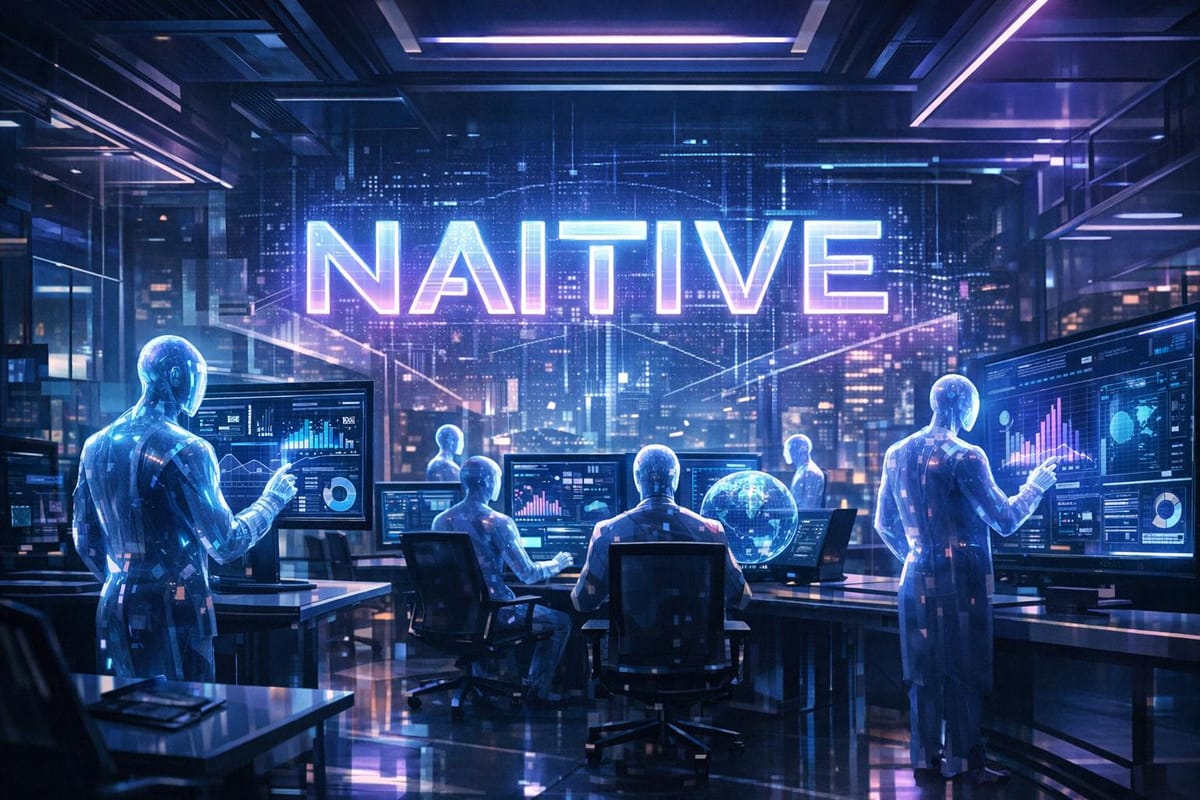
AIFeed is your guide to navigating the fast-paced world of AI agents in 2026. It simplifies the process of deploying autonomous systems that reduce repetitive tasks and improve efficiency. With over 230,000 organizations, including 90% of the Fortune 500, already leveraging AI agents, the shift from demos to production-level systems is critical. AIFeed offers practical tools like Langflow and OpenAI Agents SDK, along with advice tailored to your business needs - whether it’s compliance, data privacy, or deployment preferences.
Key Points:
- AI Agents Adoption: 78% of businesses use AI in some capacity, with 90% of Fortune 500 companies integrating automation workflows.
- Efficiency Gains: AI agents can cut iteration cycles by 70% and development time by 75%.
- Use Cases: From customer service to finance, AI agents streamline processes, reduce errors, and save time.
- Frameworks Highlighted: Tools like Dify, Langflow, and OpenAI Agents SDK cater to different needs, from visual builders to deep integrations.
AIFeed helps businesses make informed decisions about AI tools and strategies. For execution, NAITIVE specializes in crafting tailored AI systems that deliver measurable results.
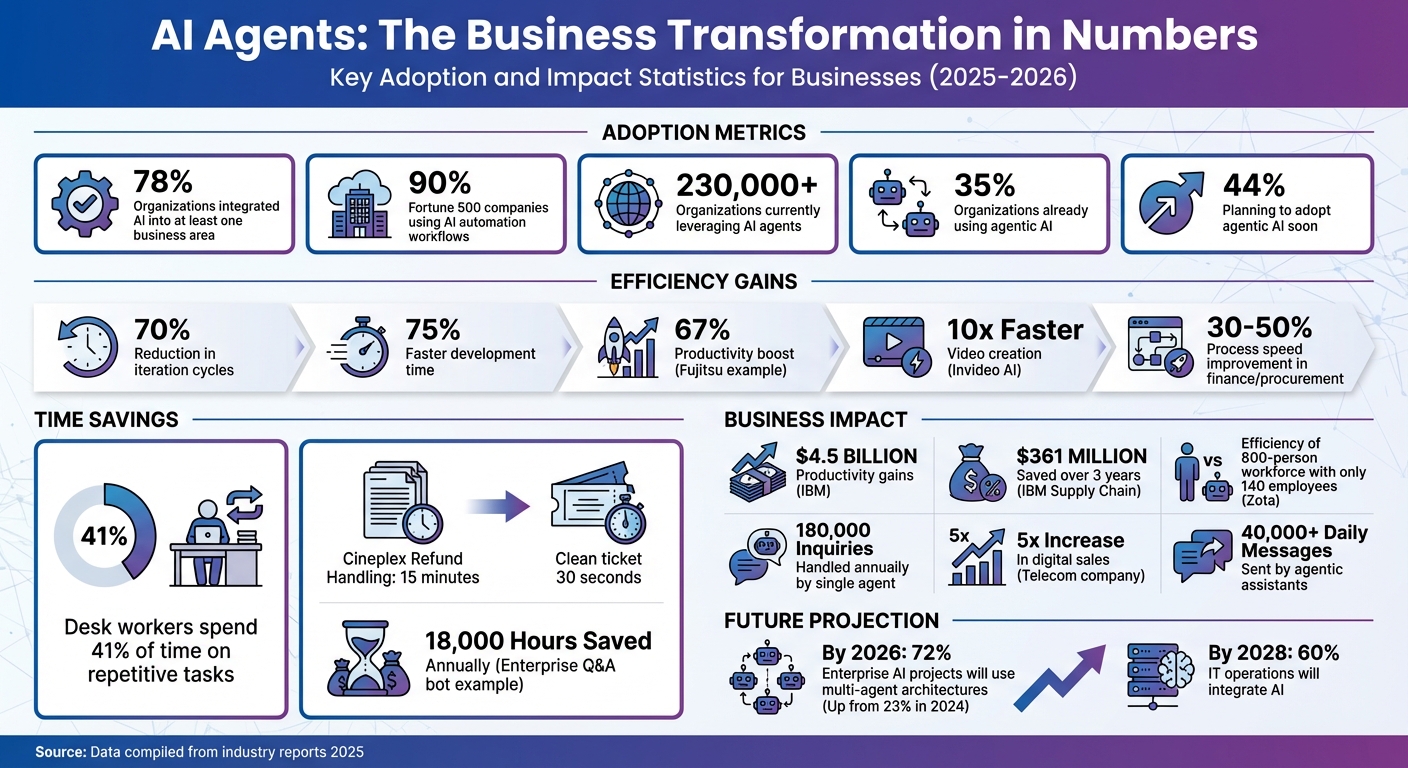
AI Agents Business Impact Statistics 2025-2026
AI Consulting and Automation Fundamentals
Why AI Agents Matter for Business
The transition from traditional automation to AI agents is reshaping how businesses operate. Companies today grapple with what’s often called the "impossible equation" - delivering exponential growth while working with fixed budgets and stretched-thin teams. AI agents break free from the limitations of rigid, rule-based systems by introducing tools that can reason, adapt, and work autonomously within predefined boundaries [12, 14].
As of March 2025, 78% of organizations have integrated AI into at least one area of their business. Meanwhile, desk workers still spend 41% of their time on repetitive tasks.
Take Zota, a global payments marketplace, as an example. In 2025, Zota embraced an AI-first strategy, doubling its merchant base from 500,000 to 1 million. By using Salesforce's Agentforce, they launched a merchant FAQ agent in just five weeks. This agent now handles 180,000 inquiries annually, allowing a team of 140 employees to operate with the efficiency of an 800-person workforce.
NAITIVE AI Consulting Agency specializes in building autonomous agent teams that tackle complex workflows while delivering measurable results like cost savings and faster processes. Our approach emphasizes collaboration between technical and business leaders to ensure every AI solution achieves practical, meaningful outcomes. Instead of relying on sales-driven tools or chatbots masquerading as "AI agents", we focus on creating systems that handle multi-step workflows. This frees your team to concentrate on strategic growth.
"Agentic AI is a strategic growth multiplier, not a cost-cutting tool. Focus on building your AI strategy around scaling capabilities, not reducing headcount."
- Salesforce
This principle guides every step of our process - from the initial assessment to deployment and ongoing optimization - laying the groundwork for substantial improvements across industries.
Where AI Automation Works Best
AI automation proves most effective in areas where repetitive tasks meet high-volume demands. It shines in scenarios that require speed, consistency, and 24/7 availability.
In customer service, for instance, Cineplex introduced an advanced copilot agent in 2024/2025 under the leadership of Monique Binder, VP of Guest Services. Over just five months, this agent processed more than 5,000 refund requests, cutting the average handling time from 15 minutes per request to just 30 seconds.
"Our copilot has processed over 5,000 refund requests in just 5 months - while reducing our handling time, back-office work and increasing both guest experience and our agent CSAT."
- Monique Binder, VP of Guest Services, Cineplex
In finance and procurement, AI agents streamline processes like transaction reconciliation and invoice management. By cross-referencing data in real time, these agents reduce manual errors and speed up closing cycles. For example, Fujitsu deployed Azure AI Agent Service across its workforce of 35,000 employees to automate sales proposal generation, boosting productivity by 67%.
AI agents also transform sales and marketing by automating tasks like lead enrichment, CRM routing, and managing content pipelines. These tools speed up production cycles by 70%, while automated A/B testing continuously improves campaign performance. Invideo AI, using OpenAI models as of July 2025, has enabled users to create videos 10x faster by leveraging AI-driven workflows.
In logistics and supply chain management, AI agents optimize operations in real time. They monitor inventory levels, predict demand trends, and trigger reordering processes automatically, eliminating the need for human intervention in routine decisions.
At NAITIVE, we use these insights to craft tailored AI agent solutions that deliver immediate value and drive scalable growth. Our process begins with identifying high-impact use cases - typically aligned with Level 1 or Level 2 in the agentic maturity model. By establishing a unified data source, we ensure agents work with reliable, centralized information rather than fragmented datasets. This solid foundation allows us to develop AI voice agents that are indistinguishable from humans and autonomous teams capable of executing complex, cross-departmental workflows.
How to Build and Manage AI Agents
The AI Agent Development Process
Creating an enterprise-level AI agent involves a well-structured lifecycle, moving from initial planning to ongoing improvements. It begins with assessment and design, where you set clear objectives, choose suitable models, and determine the tools your agent will need. Next comes the development phase, where you establish the core logic, connect to internal data sources using RAG (Retrieval-Augmented Generation), and define custom functions for essential tasks.
Once the development is complete, the agent is deployed into your product's interface, with conversation state management ensuring context is preserved. The final step is optimization - this involves running evaluations (or "evals"), refining prompts, and monitoring factors like latency and costs to ensure the agent operates effectively.
"Agent Builder transformed what took months of orchestration, custom code, and manual optimization into hours - getting an agent live in two sprints instead of two quarters."
- OpenAI
At NAITIVE, this structured approach has proven to reduce development time by 75% compared to manual methods. Instead of spending months on custom coding, teams can now deploy functional agents within weeks by using visual tools for rapid prototyping and code-first frameworks for precise control when needed. This method ensures you have all the necessary components ready before diving into the build.
What You Need Before Starting
Before jumping into development, it’s crucial to have a few key elements in place. First, you’ll need models: reasoning models for complex planning and faster, non-reasoning models for straightforward conversational tasks. Next, you’ll require tools, such as built-in functions (like web or file search) or custom APIs that connect to your systems.
Effective state and memory management is also essential to maintain conversation context. Additionally, orchestration capabilities are necessary to manage transitions between specialized agents when handling more complex tasks.
Your data infrastructure plays a pivotal role too. For internal knowledge access, managed vector stores are critical - they handle chunking, embedding, and re-ranking documents automatically. Governance policies are equally important, with input guardrails to prevent jailbreak attempts and output guardrails to ensure responses align with your brand standards and contractual obligations.
Lastly, security measures like encryption, multi-factor authentication (MFA), SAML SSO, and compliance with GDPR and CCPA regulations are non-negotiable for production environments. Without centralized oversight and active lifecycle management, you risk issues like shadow AI, budget overruns, and security vulnerabilities.
Measuring AI Agent Performance
Once your agent is live, monitoring its performance is key. Here are the main areas to focus on:
- Accuracy: This measures the agent’s success rate in completing tasks and how often it provides incorrect information (hallucinations). Using evaluation platforms and trace grading to refine prompts can improve accuracy by 30%.
- Cost: Track token usage per session and cost per task. To manage costs, optimize token consumption and assign simpler tasks to smaller models while reserving advanced models for complex logic.
- Speed: Metrics like latency (time to first token) and total execution time are crucial. You can improve speed by using non-reasoning models for quick, conversational exchanges.
| Metric Category | Key Performance Indicator | Optimization Strategy |
|---|---|---|
| Accuracy | Task success rate; % of hallucinations | Refine prompts using evaluation platforms and trace grading |
| Cost | Token consumption per session; cost per task | Cache responses and use smaller models for simple tasks |
| Speed | Latency (Time to First Token); execution time | Use non-reasoning models for quick responses |
| Reliability | Frequency of guardrail triggers; tool call errors | Implement structured outputs and automated policy checks |
| Adoption | Daily active users; user feedback | Integrate agents into existing tools like Microsoft Teams or Slack |
Reliability focuses on how often guardrails are triggered and the frequency of tool call errors, while adoption tracks daily active users and gathers feedback from them. Embedding agents into platforms employees already use, like Microsoft Teams or Slack, can significantly boost adoption rates.
AI Tools and Frameworks for Enterprises
Dify, Langflow, and OpenAI SDK Explained
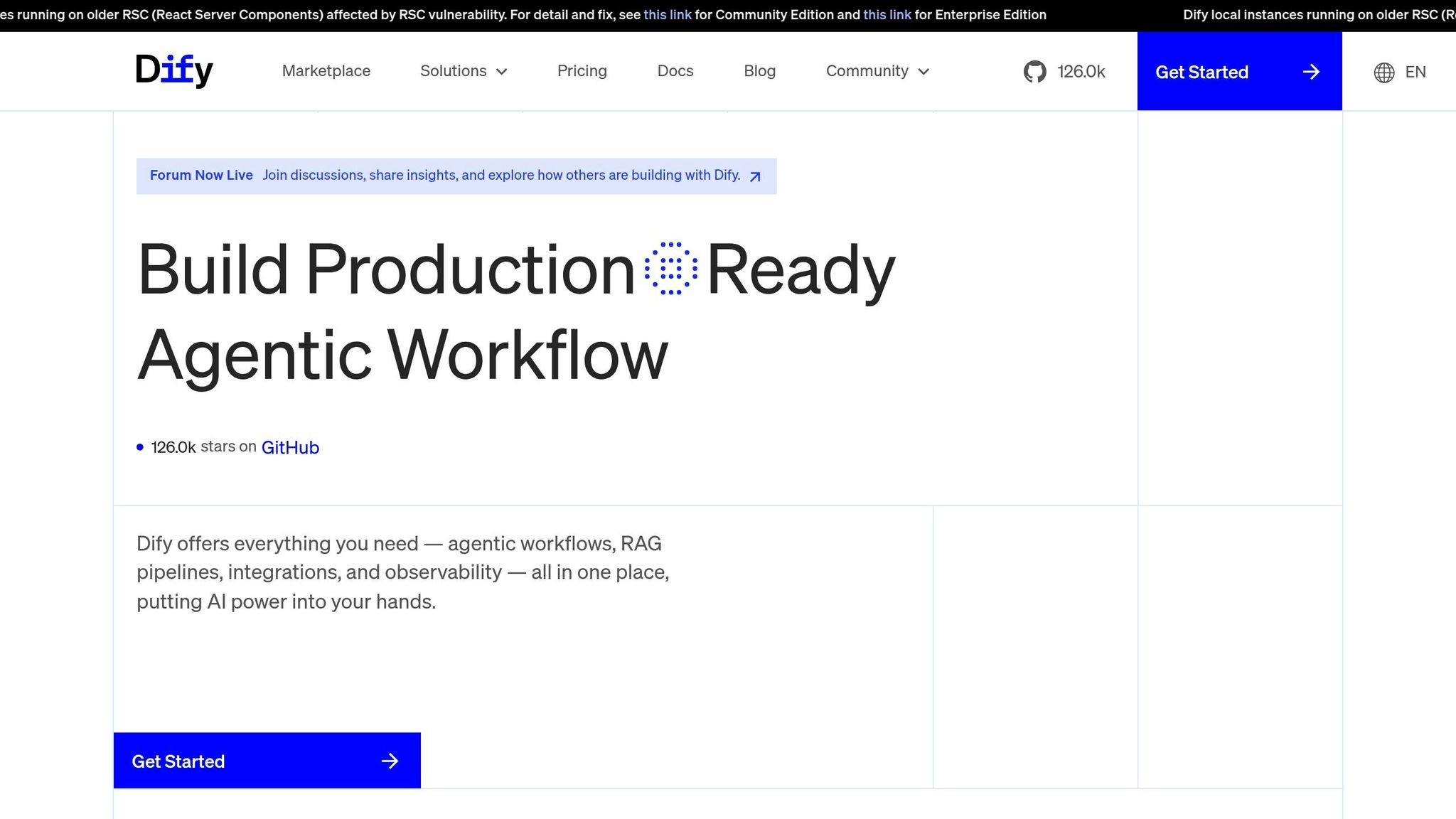
Dify is an open-source platform designed for creating agent-based workflows. With its drag-and-drop Studio, users can build AI applications efficiently. It supports Retrieval-Augmented Generation (RAG) pipelines and offers enterprise-level observability features. Dify has gained significant traction, boasting 126,000 GitHub stars and over 1 million deployments across 400,000 teams. A notable example is an enterprise Q&A bot built on Dify that supports more than 19,000 employees across 20+ departments, saving 18,000 hours of manual work annually.
Other frameworks cater to different needs and scenarios:
- Langflow: This tool features a component-based visual flow editor. Its Tool Mode transforms components like calculators or search functions into standalone tools. Langflow also supports the Model Context Protocol (MCP), which allows seamless integration of complex resources. Teams can switch between OpenAI, Anthropic, or local models without modifying code.
- OpenAI Agents SDK: Designed for production environments, this lightweight Python-first framework minimizes abstractions while introducing Handoffs for agent delegation. It includes built-in tracing, guardrails, and session management, giving developers fine-tuned control over integrations in Python or TypeScript environments.
"In a rapidly evolving AI landscape, tools enabling rapid validation aren't just helpful, they're existential. For Volvo Cars, strategically navigating this AI frontier, this is where Dify delivers value."
- Ewen Wang, Head of AI & Data APAC, Volvo Cars
At NAITIVE, we tailor framework selection to suit your team’s technical expertise and the complexity of your workflows. For example, Dify is ideal for quickly deploying internal AI assistants, especially for non-technical teams. Langflow shines in prototyping multi-model workflows with custom Python components, while the OpenAI Agents SDK is perfect for deep integrations requiring high performance and low overhead.
How to Integrate These Frameworks
Integrating these frameworks into your existing systems requires a strategic approach, aligning each tool with your current infrastructure.
- Dify: Connects using OpenAPI and Swagger standards, with applications exportable as YAML files. This ensures portability and version control.
- Langflow: Utilizes the MCP to link agents to external systems. Components can be converted into Toolset ports, allowing for a smooth transition from prototype to production.
- OpenAI Agents SDK: Embeds directly into your codebase. Developers can define Python functions as tools, while the SDK manages conversation history and runs parallel input validations to maintain security and quality.
To get the most out of these frameworks, start with built-in Evals and Tracing. These features help monitor performance, identify bottlenecks, and refine prompts or model selections based on execution logs. Additionally, setting Maximum Iteration limits in tools like Dify or Langflow can prevent infinite loops, which could otherwise result in runaway API costs. For instance, actions with high-end models like GPT-4 typically cost between $0.01 and $0.10 per action.
This systematic integration process ensures that each framework is utilized effectively, setting the foundation for a clear comparison of their capabilities.
Framework Comparison
| Feature | Dify | Langflow | OpenAI Agents SDK |
|---|---|---|---|
| Primary Interface | Visual Studio (Drag & Drop) | Visual Flow Editor | Python Code (SDK) |
| Core Strength | RAG Pipelines & Operations | Component-based Tool Integration | Lightweight Handoffs & Guardrails |
| Agent Strategies | Function Calling & ReAct | Reasoning Engine + Tool Mode | Agent Loop + Handoffs |
| Best For | AI assistants, internal apps | Rapid prototyping, multi-model flows | Custom software integrations |
| Memory | TokenBufferMemory / Conversation Vars | Rolling Context Window | Automatic Session History |
| Extensibility | DSL (YAML), MCP | Custom Components, MCP Client | Python Functions as Tools |
| Learning Curve | Low | Medium | Low |
| Deployment | Self-host, Cloud, Enterprise | Self-host, Cloud | Python Environment |
The trend toward multi-agent orchestration is growing rapidly. By 2025, 72% of enterprise AI projects are expected to involve multi-agent architectures, a significant jump from 23% in 2024. Initial implementation typically requires 2 to 6 weeks of developer time, with infrastructure costs ranging from $100 to $500 per month for resources like vector databases, Redis, and compute.
What's Next for AI Consulting and Automation
AI Predictions for 2026
The next big step in artificial intelligence builds on existing frameworks but focuses on something called agentic capabilities. In simple terms, agentic AI can now independently observe, plan, and execute workflows, essentially acting like the brain behind critical business operations. Right now, 35% of organizations are already using agentic AI, and another 44% are gearing up to adopt it.
Companies are increasingly deploying specialized agent teams that work together much like human departments. By 2026, this approach is expected to grow even further, continuing the trend from 2025, when 72% of enterprise AI projects involved these multi-agent setups - up from just 23% in 2024. These teams can handle end-to-end processes, from managing content pipelines to developing software, with very little human involvement.
The benefits are already clear. For instance, a global telecommunications company uses agentic assistants that send over 40,000 messages daily across its mobile and broadband services, boosting digital sales by five times. IBM, on the other hand, has implemented agentic AI across its workforce of 270,000 employees, achieving an estimated $4.5 billion in productivity gains. Other industries, like finance and procurement, have seen process speeds improve by 30%–50%.
However, this transformation is also reshaping the workforce. Research shows a 16% drop in employment among young professionals (ages 22–25) in roles heavily influenced by AI by late 2025. Meanwhile, 45% of AI leaders predict fewer layers of middle management as companies restructure around cross-functional teams focused on overseeing agents. AI-native organizations are already achieving 25 to 35 times more revenue per employee compared to traditional companies.
"If predictive AI is the left brain for logic and optimization, and generative AI the right brain for creativity and synthesis, then agentic AI serves as the executive function that turns creative probability into business impact." - BCG
NAITIVE's Position in AI Development
NAITIVE has been ahead of the curve, building agentic AI systems from the start, long before others moved beyond basic chatbots. This early focus has placed the company at the forefront of today’s agentic AI revolution. Over the years, NAITIVE has honed its ability to orchestrate agent teams, implement step-by-step autonomy protocols, and embed custom business contexts into AI decision-making processes.
At the heart of NAITIVE’s strategy is zero-based process redesign. Instead of just automating existing workflows, the company reimagines processes entirely, focusing on desired outcomes. This approach aligns with the 10/20/70 rule for AI success: 10% is about algorithms, 20% is the tech infrastructure, and the remaining 70% is all about redesigning people and processes. NAITIVE zeroes in on this critical 70%, which many consulting firms tend to overlook.
When deploying agent systems, NAITIVE uses what BCG calls a "Trust Protocol." This protocol introduces autonomy in four stages: Shadow Mode (assisted), Supervised Autonomy (human-in-the-loop), Guided Autonomy (human-on-the-loop), and Full Autonomy. This gradual rollout helps teams build trust in the AI while keeping control over high-stakes decisions. To ensure transparency, NAITIVE also sets up a Virtual Control Tower, allowing clients to monitor every agent’s performance and flag any unusual activity.
What sets NAITIVE apart is its commitment to measurable results. The company’s team combines deep technical expertise with a clear understanding of business needs. As the industry shifts from custom-built agents to ready-to-use, industry-specific solutions, NAITIVE’s solid foundation in agentic AI ensures it can deliver specialized agent teams that generate real, measurable ROI.
Conclusion and Key Takeaways
The Bottom Line on Enterprise AI
When done right, AI agents can deliver serious returns. Take IBM, for example - their AI deployment for 270,000 employees resulted in an estimated $4.5 billion boost in productivity. On top of that, optimizing their supply chain across more than 2,000 suppliers saved them over $361 million in just three years. The numbers don't lie: companies using advanced AI platforms report a 70% drop in iteration cycles and 75% faster development timelines.
The best approach? Start with low-risk, high-impact applications. For instance, Dun & Bradstreet used AI for risk evaluation and shaved 20% off procurement task times. Similarly, IBM's AskHR tool handles over 2.1 million employee interactions annually, automating more than 80 HR tasks. These aren't just ideas for the future - they're real-world examples of AI delivering results today. No wonder 78% of companies plan to adopt AI agents, with predictions that 60% of IT operations will integrate AI by 2028.
"The difference between success and failure often hinges on how organizations integrate AI agents into their business processes." - Alla Slesarenko, Content Marketing Manager, OneReach.ai
These examples highlight the importance of weaving AI agents into your business strategy.
Your Next Steps with AIFeed and NAITIVE

The evidence is clear: integrating AI strategically can create measurable value. So, what’s next?
Turn to AIFeed as your go-to resource for understanding frameworks, identifying impactful use cases, and staying informed about agentic AI. It cuts through the clutter and focuses on solutions that work in real-world scenarios.
When you're ready to move from planning to execution, NAITIVE brings the expertise to make it happen. Unlike repackaged chatbots, NAITIVE specializes in building agentic AI systems from the ground up. Whether you’re looking for autonomous voice agents, multi-agent orchestration, or tailored AI solutions that deliver measurable ROI, NAITIVE creates systems designed to transform your operations - not just automate tasks.
The Agent Factory: Building a Platform for Enterprise-Wide AI Automation
FAQs
How do AI agents help businesses work more efficiently?
AI agents are self-operating tools driven by sophisticated language models, capable of managing multi-step tasks without needing constant human oversight. Unlike traditional systems that simply respond to queries, these agents can carry out tasks like web browsing, interacting with software, or organizing data, effectively transforming manual processes into automated workflows.
By taking over repetitive tasks - such as creating reports, drafting emails, or summarizing meeting notes - AI agents allow employees to dedicate their time to higher-value, strategic activities. They can also handle more intricate operations, like running marketing campaigns or streamlining supply chains, with greater precision and efficiency. Companies that integrate AI agents often experience quicker decision-making, reduced operational costs, and the ability to manage larger workloads, all while maintaining consistent quality and achieving tangible results.
What should organizations consider when implementing AI agents?
Implementing AI agents in your organization calls for a thoughtful approach and a well-laid-out plan. Begin by pinpointing specific areas where these tools can make a noticeable difference. For instance, they can take over repetitive tasks or improve customer support interactions. However, for AI agents to work effectively, your data must be reliable, well-organized, and compliant with privacy laws - this ensures sound decision-making.
It's equally important to prepare your team for this shift. Offer training sessions, clearly define roles, and emphasize that AI agents are there to assist, not replace, human workers. When selecting tools, opt for scalable platforms that integrate smoothly into existing workflows and offer options for monitoring and fine-tuning performance.
To measure success, set clear metrics like accuracy, response time, and return on investment (ROI). Use these benchmarks to assess how well the system is performing and make adjustments as needed to maintain efficiency and control costs.
How do AI agents transform traditional business operations?
AI agents act as smart, autonomous digital assistants designed to simplify and automate complex tasks. They go beyond the capabilities of basic chatbots by using advanced language models to interpret intent, choose the right tools, and carry out tasks on their own. Whether it's creating detailed reports, handling customer service inquiries, or overseeing data-intensive projects, these agents are built to manage a wide range of responsibilities.
When integrated into enterprise systems, AI agents can speed up decision-making, adapt processes in real time, and scale operations effortlessly across different departments. This not only boosts efficiency and cuts costs but also allows employees to focus on more creative and strategic work. At the same time, businesses can enhance customer satisfaction and build stronger loyalty.