AI Cost Reduction Strategies: Case Studies
Case studies showing how AI cuts labor, logistics, and customer-service costs—automation, predictive maintenance, and custom agents deliver ROI in 6–18 months.

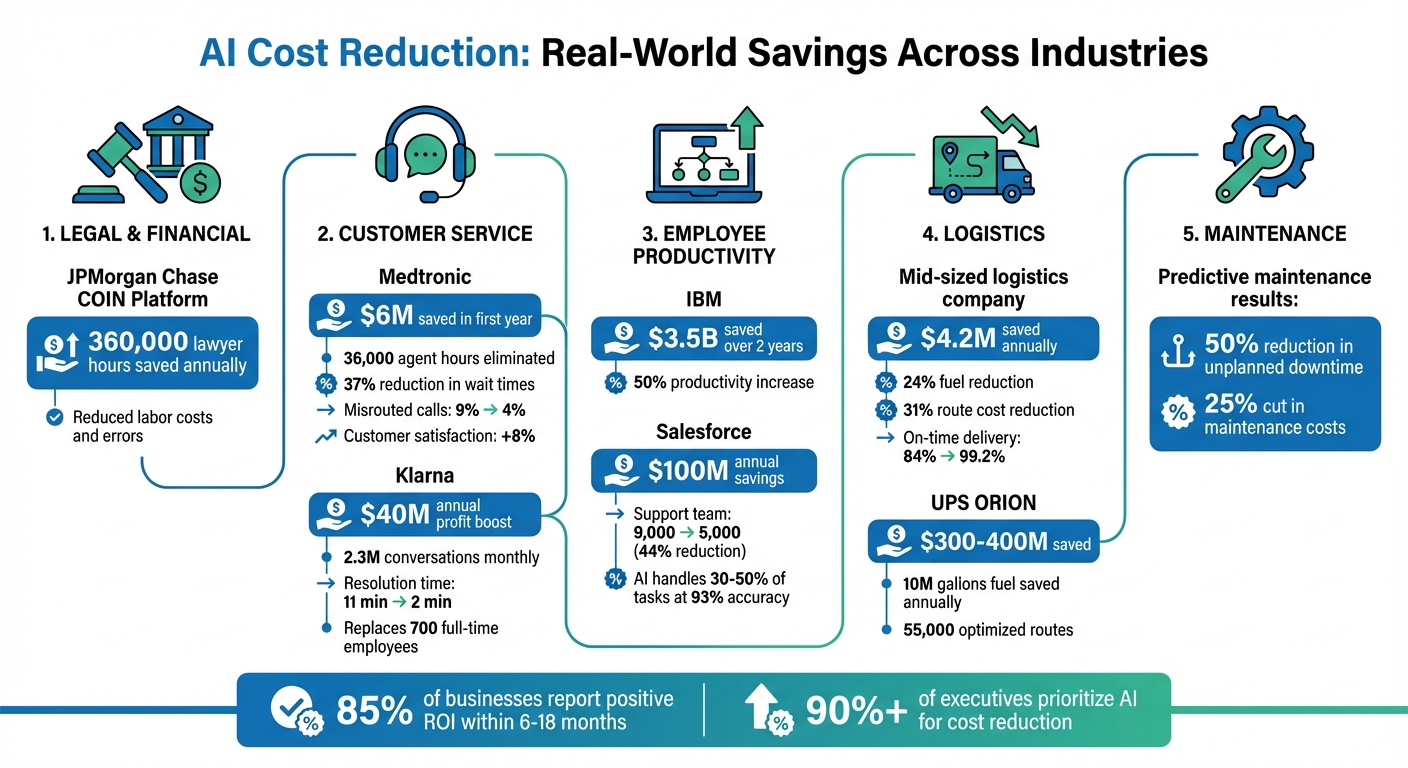
AI is transforming how businesses cut costs while maintaining quality. From automating repetitive tasks to optimizing processes, AI delivers measurable savings across industries. Companies like JPMorgan Chase, UPS, and Medtronic have saved millions by using AI for legal work, logistics, and customer service. Key highlights include:
- Automation: JPMorgan's COIN platform replaced 360,000 lawyer hours annually, reducing labor costs and errors.
- Predictive Maintenance: AI systems cut unplanned downtime by 50% and maintenance costs by 25%.
- Customer Service: Medtronic saved $6M in a year by deploying AI agents, cutting misrouted calls and improving satisfaction.
- Employee Productivity: IBM saved $3.5B over two years by automating manual tasks.
- Logistics: AI-driven route optimization saved a logistics company $4.2M annually, reducing fuel consumption by 24%.
These case studies show AI's potential to save time, reduce expenses, and improve efficiency. Businesses starting with targeted AI projects often see ROI within 6–18 months, making AI a key tool for cost management.
AI Cost Reduction Results: Savings Across Industries
Case Study: Customer Service Automation
AI Avatars for Customer Support
In 2022, Medtronic discovered its outdated IVR system was misrouting 37% of calls, leading to longer wait times and frustrated customers. To address this, Service Delivery Manager Michael Altieri spearheaded a plan to modernize their approach.
The company introduced Teneo AI agents across more than 60 contact centers, covering 10 business units. Before deployment, they conducted a thorough seven-month vendor risk assessment to ensure compliance with HIPAA regulations. Leveraging Retrieval-Augmented Generation (RAG), the AI agents accessed Medtronic's knowledge base to provide accurate and timely responses. The results were impressive: the system achieved a 99% accuracy rate and understood 90% of calls effectively.
While Medtronic focused on healthcare, Klarna brought a similar transformation to global retail. In early 2024, Klarna launched an OpenAI-powered assistant across 35 markets, supporting multiple languages. This AI assistant took over tasks like handling inquiries, processing refunds, and resolving disputes. It now manages 2.3 million conversations monthly - work that would otherwise require 700 full-time employees.
Results and Savings
The outcomes were immediate and impactful. Medtronic saved $6 million in the first year alone, eliminating 36,000 agent hours. Call wait times dropped by 37%, while misrouted calls fell from 9% to just 4%. Additionally, customer satisfaction scores climbed by 8%, all while maintaining high-quality service.
For Klarna, the financial rewards were even more striking. The company estimates its AI assistant has boosted annual profits by $40 million. Resolution times shrank dramatically, from 11 minutes to under 2 minutes, and customer satisfaction remained on par with human agents. Michael Altieri reflected on Medtronic's success:
"With Teneo, we achieved better results than we could have imagined, and the success in Cardiovascular led other contact centers to adopt the same approach".
Beyond these two examples, other companies have also seen dramatic improvements. Heldenverlies, for instance, reduced its telephone expenses by 60% by replacing its external call center with an AI phone bot that now handles 80% of incoming calls autonomously. Medtronic's Cardiovascular Group also saw its cost per contact drop from $25.96 to less than $12.
These examples highlight how AI is reshaping customer service, delivering not only cost savings but also faster, more efficient support that aligns with larger digital transformation goals.
Case Study: Employee Productivity Optimization
AI Time Tracking Software
IBM faced a major challenge: manual tasks in their support functions were consuming too much time and money. Between 2023 and 2025, the company revamped its processes with AI-driven task mining and process intelligence. This technology captured how work was actually being done at the desktop level, pinpointing inefficiencies that traditional methods missed.
For OneDigital, a company specializing in employer benefits and wealth management with over 5,000 employees, interview scheduling was a significant drain on resources. It cost them $120,000 annually and took up 40% of their talent acquisition team's time. In 2024, under the leadership of VP of People Innovation & Technology John Bruce, OneDigital adopted Paradox's conversational AI. The result? Scheduling costs dropped to nearly zero, and the team was able to redirect those hours toward strategic projects.
Salesforce took a broader approach to internal processes. They introduced the Agentforce platform, replacing outdated scripted macros with AI agents capable of handling complex workflows. The impact was substantial: AI agents now manage 30% to 50% of internal tasks with a 93% accuracy rate. This efficiency allowed Salesforce to reduce its support team from 9,000 to 5,000 employees in just 12 months - a 44% reduction in payroll expenses - and cut $100 million from annual operating costs.
Multi-Year Cost Impact
These AI-driven improvements delivered lasting financial benefits. IBM's two-year overhaul saved the company approximately $3.5 billion and boosted enterprise operations productivity by 50%. The savings were reinvested into AI and hybrid cloud advancements, fueling a cycle of ongoing innovation. Organizations looking to replicate these results often partner with an AI consulting agency to build custom agentic frameworks.
Other companies experienced similar long-term benefits. Global-Tech Manufacturing adopted AI-powered Intelligent Document Processing for accounts payable, cutting 8,000 hours of manual work annually. They slashed the cost per invoice from $15.70 to $3.90 - a 75% drop - and reduced their month-end close cycle from 12 days to just 4. Forecast accuracy also improved dramatically, rising from 75% to over 92%. Meanwhile, a global biopharma company saved 20% to 30% on agency costs by using GenAI for marketing content, and a major consumer packaged goods company sped up its marketing processes by about 40%.
The takeaway is clear: AI doesn’t just speed up existing tasks - it redefines how teams work. By automating low-value tasks, employees can shift their focus to strategic initiatives that drive growth. These examples highlight how AI is transforming workflows and significantly cutting operational costs.
Case Study: Logistics Process Automation
Route and Order Optimization
This case study highlights how AI is reshaping logistics by cutting costs and improving efficiency across industries.
Logistics providers face constant pressure to deliver more while reducing expenses. Between 2023 and 2024, a mid-sized third-party logistics company with a fleet of 320 vehicles tackled this challenge using AI-driven route optimization. Under the guidance of Manager Sri Lakshmi, the company replaced fixed daily routes with real-time adjustments. The results were striking: route costs dropped by 31%, fuel consumption decreased by 24%, and on-time deliveries soared from 84% to 99.2%. These changes translated into annual savings of $4.2 million.
UPS implemented a similar strategy on a larger scale with its ORION (On-Road Integrated Optimization and Navigation) system. By 2016, ORION optimized 55,000 routes across the United States, analyzing 250 million address data points and factoring in real-time traffic. Mark Wallace, Senior Vice President at UPS, said:
"ORION has been a game changer for UPS, impacting 55,000 drivers across 1,000 buildings in the United States when it is fully deployed."
The system saved UPS 10 million gallons of fuel annually, cutting costs by an estimated $300 million to $400 million. Even a small adjustment, like eliminating one mile per driver per day, saves UPS up to $50 million annually.
AI is also revolutionizing freight invoice auditing. In November 2024, Dow Chemical partnered with Microsoft to deploy AI "Freight Agents" for logistics invoice verification. With over 100,000 PDF invoices processed annually, manual verification previously took weeks. The AI now detects billing errors in minutes, addressing an industry-wide average error rate of 3%. Senior IT Director Mike Weideman remarked:
"Seeing how an agent could solve the riddle of hidden losses autonomously, and in minutes rather than weeks or months - we knew this was the future."
Manual vs. Automated Comparison
The transition from manual processes to AI-powered systems dramatically increases efficiency and reduces costs.
Traditional route planning often takes 4 hours per day and relies on static schedules that can't adjust to real-time conditions like traffic or weather. AI systems slash this planning time to just 30 minutes, enabling dispatchers to focus on exceptions and customer service instead of routine tasks.
AI's financial impact is equally compelling. Labor costs decrease by 12% due to reduced overtime and administrative work. Transportation expenses drop by 9%, thanks to optimized fuel usage and lower maintenance costs. Inventory costs see a 7% reduction as AI forecasting lowers average inventory levels by 27%. Additionally, error-related costs decrease by 2% through fewer mistakes in shipping and picking.
| Metric | Manual System | AI-Automated System |
|---|---|---|
| Planning Time | ~4 hours per day | ~30 minutes per day |
| On-Time Delivery | ~84% | 99.2%–99.5% |
| Fuel Consumption | High (fixed routes) | 24% reduction |
| Inventory Errors | High (manual counting) | 62% reduction |
| Route Adjustment | Static (morning plans) | Real-time, adaptive |
| Audit Process | Manual (weeks/months) | Autonomous (minutes) |
These improvements directly enhance cost efficiency, demonstrating the tangible benefits of integrating AI into logistics. Early adopters typically experience a 15% reduction in overall costs, with some achieving a 267% ROI within the first year . Over three years, the median ROI for logistics AI projects reaches 3.5x.
Custom AI Solutions for Business Needs
NAITIVE AI Consulting's AI Integration Services
When it comes to AI, one size rarely fits all. Off-the-shelf tools often miss the mark, leaving businesses with solutions that don't fully address their unique needs. The best results come from AI systems designed to fit seamlessly into a company’s workflows and tackle industry-specific challenges.
NAITIVE AI Consulting Agency focuses on creating customized AI solutions that target key cost drivers. They specialize in deploying autonomous multi-agent systems - systems that handle complex, multi-step processes, manage phone and voice interactions, and automate business workflows. These aren't your typical chatbots. NAITIVE’s agents can independently perform tasks like invoice processing or supply chain coordination with a level of precision that rivals human accuracy.
Their process begins with a deep dive into a company’s operations. By analyzing labor-heavy tasks, error-prone manual processes, and inefficiencies, NAITIVE identifies areas where AI can make the biggest financial impact. From there, their technical team develops advanced AI systems that integrate smoothly with existing tools and infrastructure. These tailored solutions align perfectly with earlier cost-reduction strategies, addressing specific operational hurdles.
Measurable Business Outcomes
NAITIVE doesn’t just deliver AI systems - they deliver results you can measure. Their clients track improvements in key areas like faster processing times, fewer errors, and direct cost savings from automated workflows.
Businesses using NAITIVE’s autonomous agents often see immediate benefits. Faster response times and streamlined processes help cut labor costs, minimize errors, and reduce overall transaction expenses. NAITIVE ensures every engagement is built around clear metrics, setting benchmarks before deployment and monitoring performance closely after launch. This results-focused approach ensures that businesses not only implement AI but also see its tangible impact.
Conclusion: Lessons from AI Cost Reduction
AI's Growing Role in Cost Management
The examples speak volumes: AI is not just about cutting costs - it’s about transforming how businesses function. Take UPS, for instance. By optimizing delivery routes, they shaved off 100 million drive-miles annually and saved a staggering $300–$400 million in operating costs. JPMorgan Chase offers another striking example, replacing 360,000 hours of manual legal work with AI that completes the same tasks in mere seconds. The momentum is clear, with over 90% of executives acknowledging AI’s importance in cost reduction over the next 18 months.
Companies leveraging AI for cost optimization report swift and significant savings. Predictive maintenance powered by AI, for example, can slash unplanned downtime by up to 50% and cut maintenance expenses by as much as 25%. By identifying inefficiencies - whether it’s billing errors or supply chain bottlenecks - AI helps prevent small issues from snowballing into major cost burdens.
These case studies highlight the importance of a strategic, phased approach to harnessing AI’s potential.
Getting Started with AI Implementation
The path to AI integration often starts small. Many organizations begin with a single high-impact process as a pilot project, using it to prove value before scaling up. This method has shown consistent results, with 85% of businesses reporting positive ROI within 6–18 months.
A crucial first step is setting a clear financial baseline. Define specific, measurable goals - like “cut invoice processing costs by 40% by Q3” - instead of vague efficiency targets. Running manual processes alongside AI systems during the initial phase can also validate results and build confidence in the technology. As Melanie Kalmar, Dow’s Chief Information Officer, aptly stated:
"The results sell the idea, from end users all the way up to the CEO. If I can tie delivering something to substantial cost savings like that, there's no selling".
NAITIVE AI Consulting Agency specializes in helping companies pinpoint impactful opportunities, integrate tailored AI solutions into existing workflows, and establish clear metrics for success. Their focus on autonomous agents and workflow automation aligns with proven strategies across sectors, from logistics and customer service to financial operations.
Case Study: How a PE-Backed E-Commerce Company Cut Costs by 84% with AI Instead of BPO
FAQs
Which business process should I automate first to cut costs fastest?
To cut costs quickly, consider automating tasks that are repetitive, time-consuming, and prone to errors or delays. Examples include processing invoices, reviewing contracts, and managing inventory. Businesses have reported saving tens of thousands of dollars each year by streamlining these processes, often seeing results in just a few months. Prioritize high-volume tasks in areas like finance, legal, or manufacturing to achieve the most immediate savings.
How do I measure AI ROI and payback before scaling beyond a pilot?
To figure out the ROI and payback period for AI before scaling, start by setting clear, measurable KPIs. These could include time savings, fewer errors, or increased revenue. For example, you can translate time saved into a dollar amount by factoring in labor costs or calculate how much money is saved by reducing errors.
Next, determine the payback period - how long it takes for the benefits to offset the initial investment. Beyond direct numbers, keep an eye on indirect perks like streamlined workflows or improved decision-making. Regularly tracking these metrics will give you a better sense of ROI and help you decide when it’s time to scale.
What data, security, and compliance steps are needed for AI agents in customer service and logistics?
Deploying AI agents in fields like customer service and logistics comes with a critical responsibility: ensuring data security and meeting compliance requirements. To align with standards such as GDPR, HIPAA, or SOC 2, it's essential to implement measures like encryption, access controls, and audit logs. When handling sensitive information, anonymization techniques and strict protocols for managing personally identifiable information (PII) are non-negotiable.
To further protect customer data and prevent breaches, use HTTPS and TLS 1.3, and maintain a routine of regular system monitoring. These practices not only safeguard information but also help meet the stringent regulatory demands in industries such as healthcare and finance.