AI Agents for Real-Time Customer Insights: Use Cases
How AI agents deliver instant customer insights—sentiment, churn prevention, routing, and personalization—to boost retention, speed, and revenue.
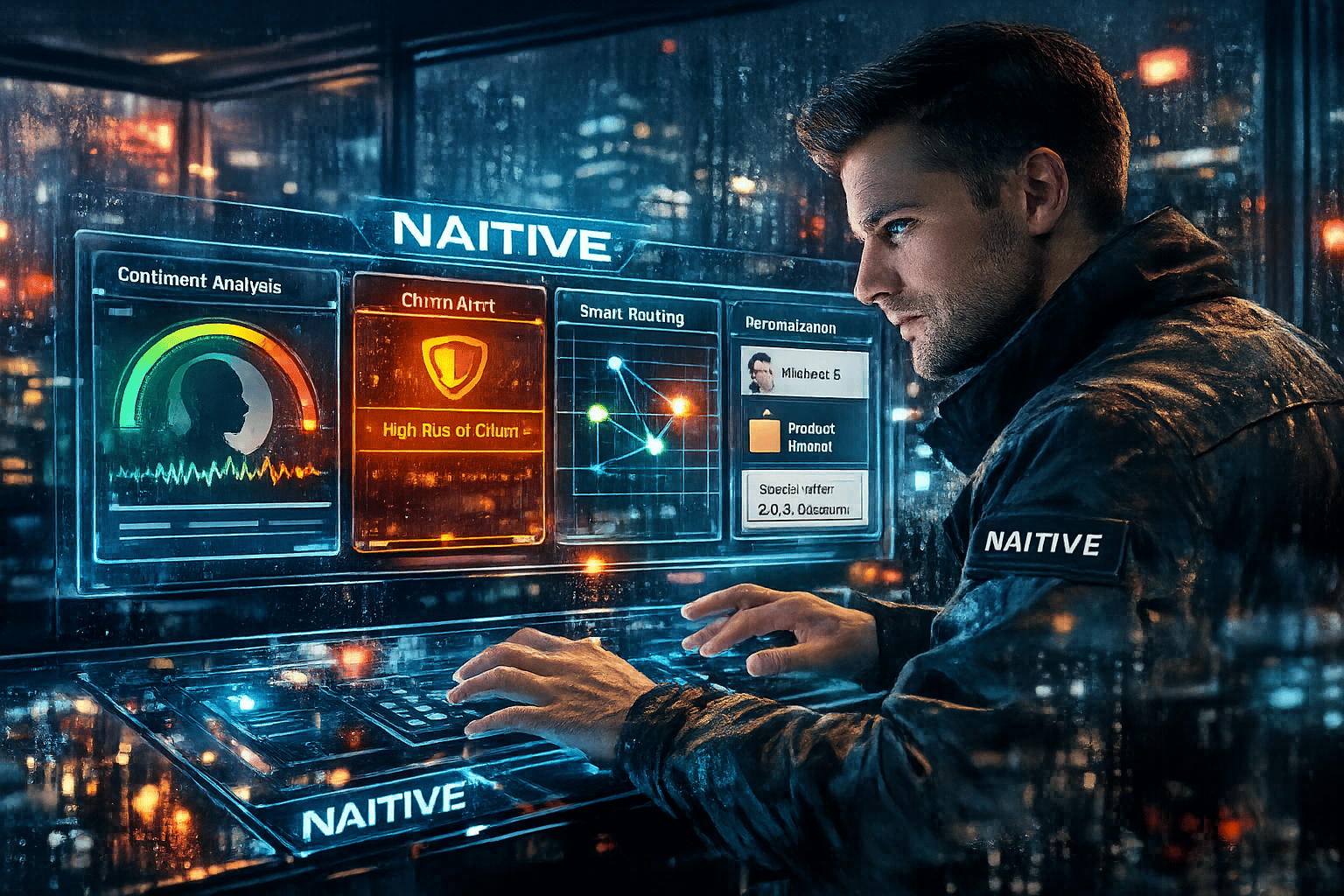
AI agents are reshaping how businesses interact with customers by delivering real-time insights and and building multi-agent teams automating tasks. Here's what you need to know:
- Why it matters: Traditional methods like surveys often arrive too late to fix issues. AI agents analyze data instantly, enabling businesses to act in the moment.
- Core benefits:
- Handle 70–80% of routine tasks without human input.
- Reduce customer churn by 60% through sentiment analysis and proactive intervention.
- Boost efficiency by 43% with faster responses and automated workflows.
- How it works: AI agents use tools like Natural Language Processing (NLP) and Large Language Models (LLMs) to understand customer needs, analyze unstructured data, and execute tasks like refunds or account updates in seconds.
- Key use cases:
- E-commerce: Recover up to 35% of abandoned carts and increase sales by 25% with personalized recommendations.
- Healthcare: Monitor patients remotely, cut costs by 40%, and free up over 15,000 hours annually for clinicians.
- Customer Service: Reduce ticket resolution times by up to 93% and improve response times to just 6 seconds.
AI agents are transforming industries by turning raw data into actionable insights, helping businesses retain customers, grow revenue, and improve service quality.
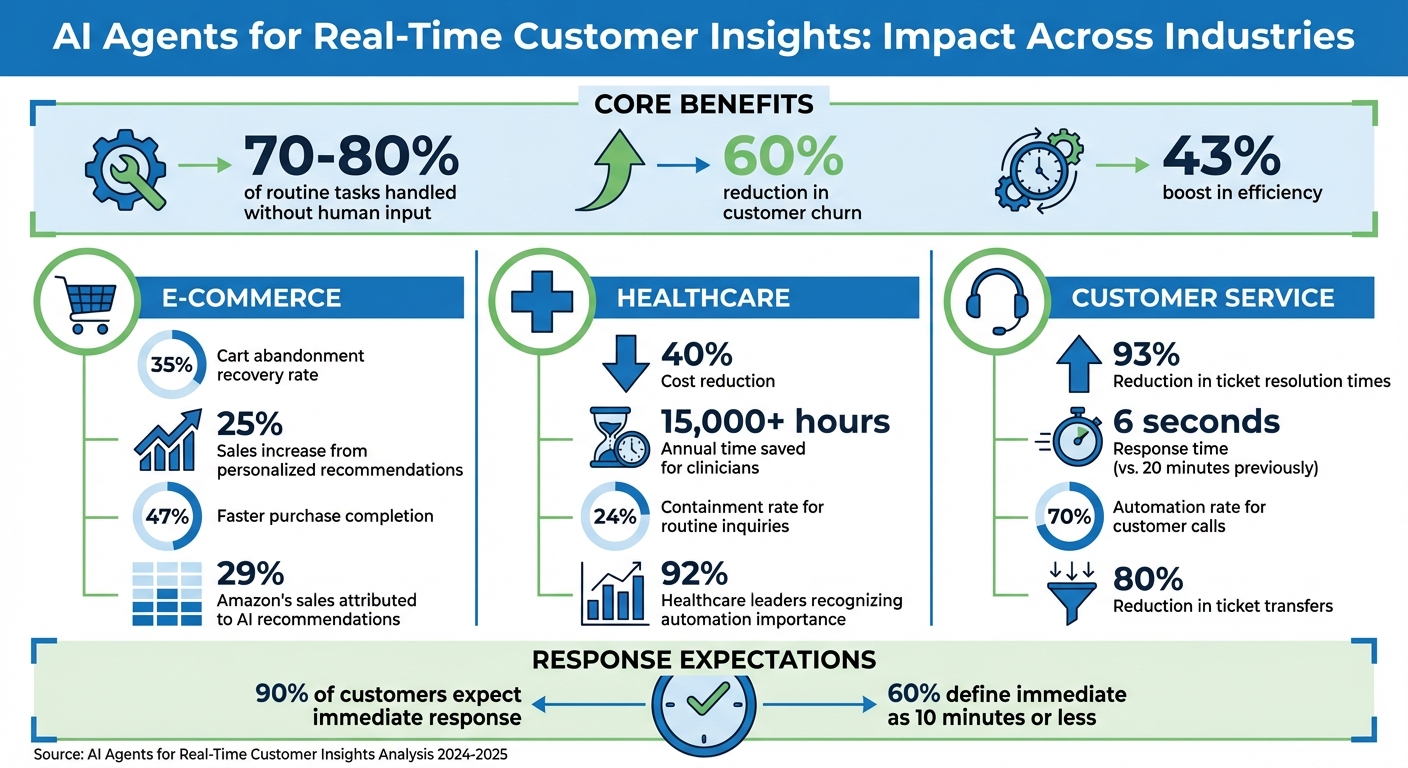
AI Agents Impact on Customer Service: Key Statistics and Benefits Across Industries
How to build an AI agent for customer insights
What Are Real-Time Customer Insights?
Real-time customer insights provide instant data on customer behaviors, preferences, and needs as they happen. This means businesses can process and act on information within seconds or minutes, engaging with customers while they’re still interacting [10, 11]. The ability to respond in the moment makes these insights incredibly valuable.
This approach is a sharp departure from traditional analytics. Right now, only 50% of business decisions rely on customer insight data, much of which comes from delayed reports that are often too late to make a difference. Real-time insights flip this model, helping businesses spot issues and seize opportunities before it’s too late.
Key Characteristics of Real-Time Insights
Real-time insights are powered by three key features: speed, actionability, and context awareness.
- Speed: Data flows through streaming pipelines and gets analyzed in seconds. This rapid processing eliminates the delays seen in older batch systems, handling what data engineers call "V-speed" - the velocity at which data is generated.
- Actionability: Instead of waiting for post-event analysis, businesses can shift to proactive engagement. AI tools can trigger immediate responses - like personalized offers or service recovery - while the interaction is still live. For example, pairing real-time sentiment tracking with quick interventions can cut customer churn by 60%.
- Context Awareness: Real-time insights help businesses understand a customer’s specific needs and emotional state in the moment. Whether it’s spotting minor frustrations or identifying serious churn risks, AI analyzes live data to tailor responses appropriately.
Real-Time Insights vs. Traditional Analytics
The differences between real-time insights and traditional analytics are stark. Traditional analytics rely on structured data - think CRM fields or survey results - processed in batch cycles. By contrast, real-time insights draw from unstructured data sources like emails, calls, and Slack messages, analyzing them continuously. Traditional reports often arrive too late, missing shifts in customer sentiment or losing out on timely opportunities.
While traditional analytics are great for executive reporting and long-term trends, real-time insights focus on immediate action. They enable quick interventions like churn prevention, personalized outreach, and growth strategies. For instance, businesses now aim to respond to live chat inquiries within 15 seconds, though the current average is about 35 seconds. Additionally, AI-driven customer-care systems can automate 65% of tasks and up to 70% of customer contacts, but only when insights are delivered quickly enough to act.
How AI Agents Deliver Real-Time Customer Insights
Modern AI agents can pull data from a variety of sources - calls, chats, emails, social media, and platforms like Salesforce or Zendesk - by using bi-directional API integrations. This allows them to access customer histories and update systems instantly . That means they can handle tasks like processing refunds or updating account details without human intervention.
The secret sauce here is Natural Language Processing (NLP). This technology helps AI agents understand the deeper meaning behind customer messages. They can detect emotional tone, identify intent, and even pick out specific details like order numbers during live interactions . With the help of Large Language Models (LLMs), these agents can independently tackle complex, multi-step tasks . For example, they can respond to customer inquiries in as little as 6 seconds, a huge improvement over the typical 20-minute response time seen in high-demand situations. All of this is made possible through sophisticated data processing techniques.
Data Collection and Analysis by AI Agents
AI agents excel at collecting and analyzing data efficiently, which allows them to provide instant, actionable insights. They handle both structured data (like CRM records and transaction logs) and unstructured data (such as emails, call transcripts, and social media posts) simultaneously . Using Retrieval-Augmented Generation (RAG) vs. fine-tuning, these agents can search a company’s knowledge base or website in real time, ensuring their responses are accurate and tailored to the situation. They also maintain context across multiple channels, so customers don’t have to repeat themselves . To ensure all this happens securely, strict operational guidelines are followed.
Core Capabilities of AI Agents
AI agents rely on three main abilities to deliver real-time insights: sentiment detection, anomaly identification, and predictive modeling. They can continuously monitor emotional tone, flag unusual activity in transactions, and escalate issues immediately. This proactive approach has been shown to reduce customer churn .
Predictive modeling, powered by machine learning, helps identify patterns that hint at future customer actions - like potential churn or interest in new products - by analyzing real-time behavior data . These systems are also highly accurate, with the ability to recognize agents during calls and evaluate their performance with an 80% to 90% success rate. Some energy companies have automated 70% of their customer calls, while others have slashed costs by 80% for handling complex inventory questions compared to human agents.
"What makes today different is that an AI agent application can qualify leads, resolve tickets, schedule services, and update backend systems without constant human babysitting." – Nurix AI
Industry Use Cases for Real-Time Customer Insights
E-commerce: Personalized Recommendations and Cart Abandonment Recovery
E-commerce has taken a leap forward, evolving from static recommendation systems to AI-powered digital sales associates that actively guide shoppers throughout their journey. These AI agents, using tools like Retrieval-Augmented Generation and Knowledge Graphs, provide real-time, fact-checked, and inventory-aware suggestions. The impact is substantial: AI-driven personalization boosts e-commerce sales by an average of 25%, with personalized recommendations now accounting for as much as 26% of total e-commerce revenue.
But it’s not just about recommendations. These AI agents also excel at addressing cart abandonment, a persistent issue where 70% of online shopping carts are left behind globally, with mobile abandonment rates soaring to 85.65%. By recognizing hesitation signals - like prolonged pauses or repeated visits to checkout pages - AI systems can intervene while the shopper is still active, recovering up to 35% of abandoned carts. They tackle common friction points, such as clarifying shipping fees, return policies, or sizing details, which often deter customers from completing purchases. Amazon, for instance, credits 29% of its sales to AI-powered, behavior-based recommendations.
This conversational, proactive approach doesn’t just increase sales - it also speeds up the shopping process. Shoppers complete their purchases 47% faster compared to traditional browsing methods.
Healthcare: Patient Support and Monitoring
The healthcare sector is embracing AI to enhance patient care, especially outside traditional clinical settings. AI agents now integrate with wearables and connected health devices to monitor vital signs in real time. They send reminders for medications, alert providers when readings deviate from safe ranges, and even track post-surgery recovery, flagging early signs of complications for immediate attention.
The operational benefits are equally impressive. A healthcare provider in California achieved a 24% containment rate for routine inquiries, while a major North American health insurer cut operational costs by 40% after implementing an AI agent system. These tools also address clinician burnout, saving over 15,000 hours annually through automated documentation processes. With 92% of healthcare leaders recognizing automation as key to addressing staff shortages, the role of AI is becoming increasingly critical.
"The real payoff comes from eliminating follow-ups. When AI agents handle routine execution, clinicians and staff spend less time chasing and more time delivering care." – Kore.ai
AI agents also provide 24/7 triage and symptom-checking services, acting as digital health assistants that reduce emergency room congestion. They ensure seamless handoffs between departments, flagging missing data or delays that could compromise patient safety. Additionally, by analyzing patient sentiment across channels, these systems enable proactive outreach to address dissatisfaction before it escalates.
Customer Service: Smart Ticket Routing
Customer service operations are undergoing a transformation, with AI agents revolutionizing ticket routing. By using Natural Language Understanding (NLU), these systems can immediately identify customer intent and urgency as messages come in. Instead of relying on manual categorization, AI extracts structured data - like order numbers or product IDs - to enrich tickets with relevant context before passing them to human agents. They also monitor for negative sentiment or angry language, prioritizing and escalating high-risk tickets to specialized teams.
The results are game-changing. Mobily, a telecommunications provider serving over 1.2 million customers in Saudi Arabia, slashed customer wait times from 20 minutes to just 6 seconds with an AI-powered social media agent. Similarly, E.ON, an energy company with 50 million customers, achieved a 70% automation rate across more than 2 million customer calls. Mister Spex, an online optician serving 7 million customers across Europe, saved over 30 seconds per call by connecting their AI agent directly to their CRM system for instant verification and routing.
AI-driven ticket routing delivers measurable efficiency, cutting ticket transfers by 80% and reducing resolution times by up to 93%. This matters because 90% of customers expect an immediate response, with 60% considering "immediate" to mean within 10 minutes or less.
"What we liked most about Cognigy.AI was the connectors and low-code capability... which leads to a faster time to market, and the ability to release more services and conversations." – Mubarak Alharbi, Digital Experience General Manager, Mobily
These examples highlight how AI is reshaping customer interactions across industries. For businesses looking to implement these advancements, NAITIVE AI Consulting Agency offers expert guidance to ensure success.
Business Applications of Real-Time Customer Insights
Churn Prevention and Retention Strategies
AI systems are redefining how businesses handle customer dissatisfaction. By monitoring sentiment across channels like voice calls, chat, email, and social media, these tools can pick up on dissatisfaction signals as they arise. But they don’t stop there - AI goes deeper, analyzing behaviors such as reduced login frequency or sudden drops in app usage to predict when a customer might leave. Once a customer hits a risk threshold, the system triggers retention workflows, offering solutions like discounts or product alternatives.
This proactive approach changes the game. Instead of waiting for customers to voice their complaints - or worse, cancel their service - AI identifies and resolves issues like billing errors before they even come to the customer’s attention. By blending real-time sentiment analysis with predictive models, businesses can step in at just the right moment, transforming potential churn into loyalty.
Upselling and Cross-Selling Opportunities
AI doesn’t just help retain customers - it also identifies opportunities to grow accounts. By analyzing real-time behavioral data, these systems can pinpoint ideal moments for upselling and cross-selling. For instance, AI might notice when a customer’s feature usage exceeds 85% or when a contract renewal is approaching. Each account gets a propensity score (0–100), providing clear reasoning behind recommendations so sales teams can act with confidence.
Take Snowflake, for example. In 2023, its AI-driven micro-moment targeting boosted cross-sell conversion rates by 45%. Similarly, Salesforce used its Einstein AI platform to create dynamic bundles tailored to customer needs, increasing average deal sizes by 33%. These AI tools also save time - what once took 14 to 26 hours of manual analysis now takes just 1 to 2 hours.
| Signal Pattern | Recommended AI Play | Agent Action |
|---|---|---|
| Utilization ≥ 85% + renewal in 90 days | Seat expansion bundle | Targets admins, proposes add-on seats, books review |
| Premium feature usage in pilot team | Feature tier upgrade | Highlights value; launches nurture campaign; schedules demo |
| New team activation + champion NPS ≥ 9 | Multi-team bundle | Maps stakeholders; initiates introductions; books expansion call |
| Intent surge without adoption | Use-case enablement | Sends tutorials; offers a workshop |
Timing is everything. AI identifies key moments - such as when a user completes a major task or hits a capacity limit - and delivers tailored offers right then. Companies using intent data and AI scoring have reported revenue expansion contributions as high as 45%.
Voice-of-the-Customer Analytics
Traditional surveys often fall short, with response rates hovering at just 3 to 5% and feedback arriving too late to address issues. AI-powered voice agents solve this problem by offering conversational feedback sessions that feel natural, achieving response rates of 30 to 50%. These agents also capture emotional cues - like tone, pitch, and hesitation - that written surveys can’t, providing a richer understanding of customer sentiment.
Real-time thematic analysis uncovers trends across thousands of interactions simultaneously. For example, if there’s a sudden 20% spike in negative feedback within 30 minutes, managers receive instant alerts with actionable guidance. This allows teams to resolve issues before a customer hangs up, turning potentially bad experiences into positive outcomes. Such tools have been shown to improve call center efficiency by up to 25% and cut operational costs by 20%.
"Agentic AI isn't just a tool. It's a strategic capability that enables customer service to evolve from a reactive cost center to a proactive value creator." - BCG
These insights don’t just stay in the call center. AI systems feed sentiment data directly into CRM platforms, making it accessible to marketing and product teams. This shifts Voice-of-the-Customer programs from after-the-fact analysis to real-time action, allowing businesses to adapt on the fly. For companies ready to take the leap, NAITIVE AI Consulting Agency specializes in creating AI solutions that deliver measurable results. This approach highlights how real-time insights are reshaping customer engagement and paving the way for even more advanced AI applications.
Future Trends in AI-Powered Customer Insights
AI's current applications are already transformative, but the trends on the horizon promise to push boundaries even further, offering businesses predictive and proactive capabilities.
Personalization at Scale
AI is evolving from basic customer segmentation to intent-based intelligence, which goes beyond analyzing past behavior to predicting future needs. This allows for real-time, tailored interactions. For example, Klarna's AI assistant managed the workload of 700 full-time agents in early 2024, cutting response times from 11 minutes to under 2 minutes and reducing repeat inquiries by 25%. Even for first-time visitors, semantic models can make relevant recommendations without relying on prior browsing history, solving the "cold start" problem.
The ability to preserve customer history across all channels ensures smoother interactions, eliminating the frustration of repetitive questions. With 61% of consumers expecting AI-driven interactions to feel personal and 63% likely to switch brands after a single poor experience, the stakes are high. By 2026, it's estimated that AI will automate 10% of customer service interactions, a significant leap from 1.6% in 2024. Companies prepared for this shift can collaborate with NAITIVE AI Consulting Agency to develop autonomous agents capable of not only making suggestions but also executing actions like processing refunds or applying discounts based on individual customer contexts.
Multimodal Signal Analysis
Modern AI systems are integrating multiple data sources - voice tone, visual cues, and behavioral signals - to create a comprehensive understanding of customer needs. In 2024, Verizon used generative AI to predict the reasons behind 80% of incoming service calls in real time, directing customers to the right agents and preventing an estimated 100,000 customer defections that year. Similarly, Bradesco's Smart PIX system allows customers to transfer money through voice, text, or photos on WhatsApp, resolving 90% of issues without human involvement.
These advancements rely on Small Language Models (SLMs) that transcribe and analyze audio to detect intent shifts faster than text-only systems. H&M’s virtual assistant, for instance, achieved a 70% autonomous resolution rate in 2025, increasing conversion rates by 25%. Combining multimodal insights with predictive capabilities, AI is setting the stage for even more proactive customer service.
AI-Driven Forecasting and Recommendations
The future of AI lies in systems that don't just respond but anticipate. By 2029, agentic AI is expected to autonomously resolve 80% of common customer service issues. These systems go beyond scripted chatbots, offering the ability to plan and execute complex tasks. For instance, they can collaborate with specialized agents - such as handling billing or logistics - to resolve customer needs from start to finish.
This shift is supported by advanced, low-latency architectures that leverage tools like Kafka and Flink for real-time behavioral data processing. Current AI-driven operations are already boosting productivity by 15% to 30%, with some organizations aiming for improvements of up to 80%. Microsoft CEO Satya Nadella has noted that AI enhances "front-end deflection rates and agent efficiency", resulting in happier customers and lower costs. With 80% of consumers already relying on "zero-click" results for at least 40% of their searches, AI is clearly moving toward a future where it anticipates and fulfills customer needs before they even articulate them. This evolution is redefining how businesses interact with customers across every touchpoint.
Conclusion
AI agents are transforming customer engagement by shifting the focus from reactive problem-solving to proactive, data-driven strategies. Instead of relying on retrospective tools like NPS surveys delivered long after an issue arises, businesses can now intervene in real time to address dissatisfaction before it leads to churn.
The impact of this shift is clear. Companies using real-time sentiment monitoring have reduced customer churn by as much as 60%. For example, Mobily slashed response times from 20 minutes to just 6 seconds, and Mister Spex shaved over 30 seconds off call times while improving satisfaction scores. These operational improvements translate directly into stronger financial performance.
AI agents also enhance efficiency by automating complex workflows across systems like CRMs, ERPs, and billing platforms. They handle these multi-step processes in real time without requiring human intervention. Paired with continuous sentiment analysis across voice, chat, and social channels, businesses gain the ability to make decisions rooted in current behavioral trends rather than outdated survey data.
To get started, focus on high-API density workflows where AI agents can coordinate actions across multiple systems. Use confidence-based escalation triggers to ensure human agents step in only when necessary. This approach allows for seamless AI integration and delivers measurable outcomes. NAITIVE AI Consulting Agency specializes in crafting these tailored solutions - developing autonomous agents that don't just provide insights but act on them, driving meaningful results that redefine business operations.
Real-time insights aren't just a tool - they're becoming the standard for modern customer engagement. The choice is clear: lead this transformation or risk being left behind.
FAQs
What data do AI agents need to generate real-time customer insights?
AI agents depend on real-time customer data to function effectively. This includes information like live session behavior, historical insights, sentiment signals across various channels, and contextual details about interactions. These elements work together to deliver precise and timely insights about customers, helping the AI respond more accurately.
How do AI agents decide when to escalate to a human agent?
AI agents transfer tasks to a human when situations surpass their capabilities. This can happen when tasks become overly complex, emotional nuances are identified, the user's intent is ambiguous, negative sentiment is detected, or when automation falls short. To ensure a seamless transition, they provide structured context during the handoff, preserving continuity and improving the overall customer experience.
How long does it take to deploy real-time AI agents in my business?
Deploying real-time AI agents can take anywhere from just a few hours to several days, depending on the level of complexity involved. For simpler setups, it’s possible to go live in as little as an hour. On the other hand, enterprise-level deployments - especially those involving system integration, thorough testing, and training - can stretch from days into weeks.
Cloud-native platforms and prebuilt templates are often the go-to for speeding up the process. However, when it comes to tailored solutions, extra time is needed for careful planning and rigorous testing to ensure everything runs smoothly.