
https://aiagentsdirectory.com/
Guide to AI agents: compare directories, platforms, ROI metrics, and pick agents for workflow automation and industry-specific needs.

AI agents are transforming businesses by automating tasks, improving workflows, and increasing efficiency. This article explores what AI agents are, how they work, and why tools like the AI Agents Directory are essential for finding the right solutions. Key takeaways:
- What are AI agents? Advanced software that autonomously manages tasks, from simple operations to complex workflows.
- Why use an AI Agents Directory? It simplifies the search for AI tools, saving time and guiding businesses to solutions that fit their needs.
- Types of AI agents: Business function agents, industry-specific agents, and platforms for large-scale deployments.
- How to choose AI agents: Map business goals, evaluate features (like integration and security), and measure ROI using clear metrics.
- Market insights: 80% of business leaders plan to adopt AI agents in the next 12–18 months, with the market growing at 45% annually.
The AI Agents Directory offers a centralized resource for exploring tools, categorized by functionality and industry, making it easier for businesses to adopt effective automation solutions.

AI Agents Adoption Statistics and Business Impact 2025
AI Agents EXPLAINED in 14 minutes and TOOLS for building one
Main Categories in the AI Agents Directory
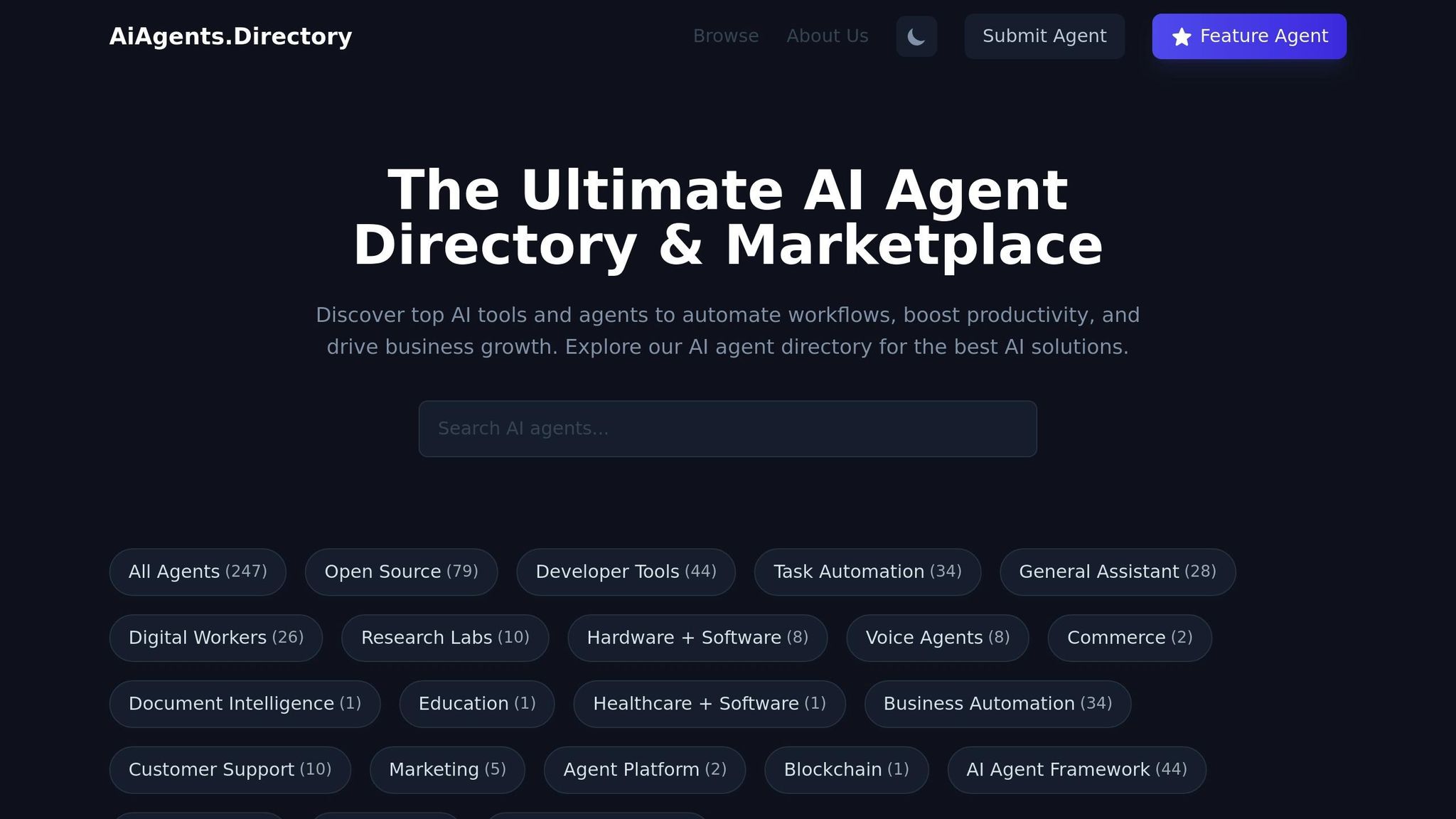
The AI agents directory groups solutions into three main categories based on their roles. Knowing these categories can help you quickly pinpoint the agents that best fit your operational and technical needs. Here’s a closer look at each category to help you align solutions with your enterprise goals.
Business Function and Workflow Agents
These agents are designed to automate tasks across key business areas like customer support, sales, finance, HR, IT, and marketing. They manage complex, multi-step workflows that require system integration, going beyond traditional rule-based automation. Unlike static systems that fail when processes evolve, these agents understand context, evaluate options, and act independently.
For example, an IBM survey revealed that 86% of executives expect AI agents to enhance process automation and workflow redesign by 2027. The benefits are already evident: studies show up to 80% faster processing times in finance workflows when generative AI and automation agents are used. In DevOps, these systems have solved 37% of CI/CD pipeline errors without human input in some companies. A PwC survey conducted in May 2025 found that 79% of businesses are already using AI agents, reporting 66% productivity boosts, 57% cost reductions, and 55% quicker decision-making in IT, marketing, finance, and service areas. These results highlight how AI agents can directly contribute to achieving enterprise automation objectives.
Industry-Specific and Vertical Agents
These agents are tailored to handle the unique demands of industries like banking, healthcare, manufacturing, and professional services. They come equipped with integrations and compliance features specific to each sector, ensuring they meet regulations like HIPAA or GDPR. Instead of modifying generic tools, these agents are purpose-built to address specialized workflows, data sources, and governance requirements. Acting as digital experts, they break down complex goals into actionable steps, leverage software tools, and monitor their progress across systems dynamically.
Agent Platforms and Orchestration Tools
For larger-scale deployments, agent platforms provide a unified solution by combining the capabilities of specialized agents. These platforms are designed for scalability and enterprise-wide integration. The market for agentic AI is expected to grow by 43.8% annually, reaching nearly $196.6 billion by 2034. Leading platforms offer over 100 pre-built connectors to integrate seamlessly with tools like Salesforce, SAP, Epic, SharePoint, and Slack. Key features include multi-agent orchestration for coordinating tasks, no-code and low-code builders for rapid deployment, and robust governance with role-based access and audit logs. The best platforms also support flexibility, allowing connections to any data source, AI model, or cloud provider, ensuring businesses can avoid vendor lock-in.
How to Use the AI Agents Directory for Your Business
Choosing the right AI agents for your business begins with understanding your specific needs and following a structured evaluation process. The goal isn’t to simply adopt the most advanced technology - it’s to address your business challenges and align solutions with measurable results. Here’s how to go from browsing the directory to implementing agents that make a real difference.
Mapping Business Goals to AI Solutions
Start by identifying the areas in your operations that slow things down. Where are your teams stuck doing repetitive tasks? Which workflows depend on manual steps? Could customer interactions be faster or more efficient? Once you’ve pinpointed these bottlenecks, set clear, measurable goals to assess how well an AI agent can improve those areas.
Then, match your needs to the right type of AI agent:
- Assistive agents handle repetitive tasks within a single system.
- Knowledge agents retrieve information from your databases and documents.
- Action agents manage multi-step workflows across integrated systems.
- Multi-agent systems coordinate multiple specialized agents for complex, end-to-end processes.
Use the directory's filters to quickly find agents that align with your challenges. If you’re new to this, consider starting with simpler assistive agents before moving to more advanced multi-agent setups.
Shortlisting and Evaluating Agents
When narrowing down your options, use specific criteria to ensure the agents meet your business needs. Look at their autonomy and ability to plan tasks. Can the agent understand a high-level goal, break it into actionable steps, and track its progress?. Also, check whether the solution includes pre-built connectors to integrate seamlessly with your existing systems.
Security and governance are non-negotiable for enterprise use. Choose platforms that offer features like role-based access control, PII masking, audit trails, and configurable guardrails to prevent unauthorized actions. Additionally, ensure the platform supports flexible deployment options - whether SaaS, on-premise, or hybrid - and complies with regulations while handling production-level workloads.
Don’t just consider the upfront costs. Look at the total cost of ownership, including fees based on usage, compute power, and AI models. For instance, n8n’s cloud plans start at $24 per month, while Dify’s professional plans begin at $59 per month, with enterprise pricing available upon request. Open-source options like Autogen allow for self-hosted deployment, which can help you avoid being tied to a single vendor.
Match the platform’s complexity to your team’s expertise. No-code or low-code solutions are great for teams without deep technical knowledge, while hybrid approaches work better for those needing more customization. Establish human-in-the-loop feedback mechanisms to refine agent performance and ensure it aligns with user expectations. Once you’ve selected the agents, integrate them into a coordinated system to drive broader automation.
Designing Multi-Agent Architectures
After shortlisting your agents, the next step is designing a system that coordinates them effectively. Managing workflows involving multiple agents requires careful planning to ensure reliability and scalability. Break complex processes into smaller, task-specific steps and define clear goals for each agent.
Evaluate your platform’s ability to orchestrate workflows. Look for features like logic handling, event triggers, and state management, which are crucial for ensuring agents can handle complex tasks smoothly, even during high-demand periods.
A strong data pipeline is essential. It ensures agents have the right information to make better decisions. Keep human oversight in place for critical decisions, so agents enhance - rather than replace - human judgment. Design your system to handle real-time tasks, especially for user interactions or streaming data, and include error recovery and monitoring features to maintain reliability.
Finally, choose platforms that strike a balance between innovation and reliability. Opt for solutions that adopt emerging standards and provide clear roadmaps for future updates. For example, NAITIVE designs architectures that integrate seamlessly with your existing infrastructure while remaining flexible enough to evolve as your business grows. This ensures your AI systems remain effective as new tools and technologies emerge.
Measuring ROI From AI Agents
Figuring out the return on investment (ROI) for AI agents requires a broad approach that looks at more than just numbers. It’s about assessing operational efficiency, revenue growth, risk management, and workforce optimization. On average, companies investing in AI see a return of $3.70 for every $1 spent. Some even report returns as high as $10 per dollar invested. Yet, nearly 80% of businesses using generative AI say it hasn’t made a noticeable impact on their bottom line. This highlights how essential it is to measure success the right way.
To start, set clear goals and define key performance indicators (KPIs) before rolling out your AI systems. Decide what success means for your business - whether it’s cutting costs, boosting productivity, reducing errors, or improving customer satisfaction - and establish a baseline to measure progress. ROI measurement should include both tangible benefits (like labor cost savings, faster turnaround times, and fewer mistakes) and intangible benefits (such as better decision-making, a stronger brand image, and happier employees). Don’t forget to account for all costs, including upfront expenses like software licenses and hardware and ongoing costs like cloud usage, support, and updates. Use this formula to calculate ROI:
(Net Return from Investment – Cost of Investment) / Cost of Investment × 100
Keep in mind that AI projects often take time to deliver full value - typically around 14 months or more.
Key Metrics for Enterprise ROI
To measure ROI effectively, focus on metrics that align with your business goals:
- Productivity metrics: Look at reductions in processing time, tasks completed per hour, labor cost savings, faster response times, and improved issue resolution rates.
- Financial metrics: Measure cost savings from reduced staffing needs or reassigning employees, revenue growth from faster sales cycles, better customer retention, new service offerings, and overall cost of ownership.
- Quality and accuracy metrics: Track error rates before and after AI implementation, the percentage of tasks completed without human help, customer satisfaction scores, and Net Promoter Scores (NPS).
- Risk and compliance metrics: Monitor hallucination rates, intervention rates when guardrails are triggered, override rates during human reviews, data leaks, and model drift.
For perspective, about 68% of AI agents in production can handle up to 10 steps before needing human input, and 74% still rely heavily on human evaluation.
Tracking Operational Impact Over Time
Measuring ROI isn’t a one-and-done task. It’s an ongoing process. Regularly tracking metrics helps you turn short-term results into long-term improvements. Companies like NAITIVE set baseline KPIs and incremental improvement targets, using real-time dashboards to spot trends and areas that need adjustment.
Compare AI agent performance with human performance for the same tasks to see where AI is excelling and where human expertise is still essential. In the U.S., redesigning workflows around a mix of people, AI agents, and robots could unlock about $2.9 trillion in economic value by 2030.
Check your KPIs monthly or quarterly, tweak agent settings, refine prompts, and update training data based on performance trends. Also, gather input from employees and customers to capture qualitative insights that numbers alone might miss.
The AI agents market is expected to grow at a 45% annual rate over the next five years. Right now, 62% of businesses are experimenting with AI agents, and 23% have scaled them in at least one area of their operations. Instead of just plugging AI into existing workflows, redesign processes around these tools to unlock their full potential and maximize ROI. This approach not only validates your AI investments but also helps shape a smarter automation strategy for the future.
How to Navigate AIAgentsDirectory.com
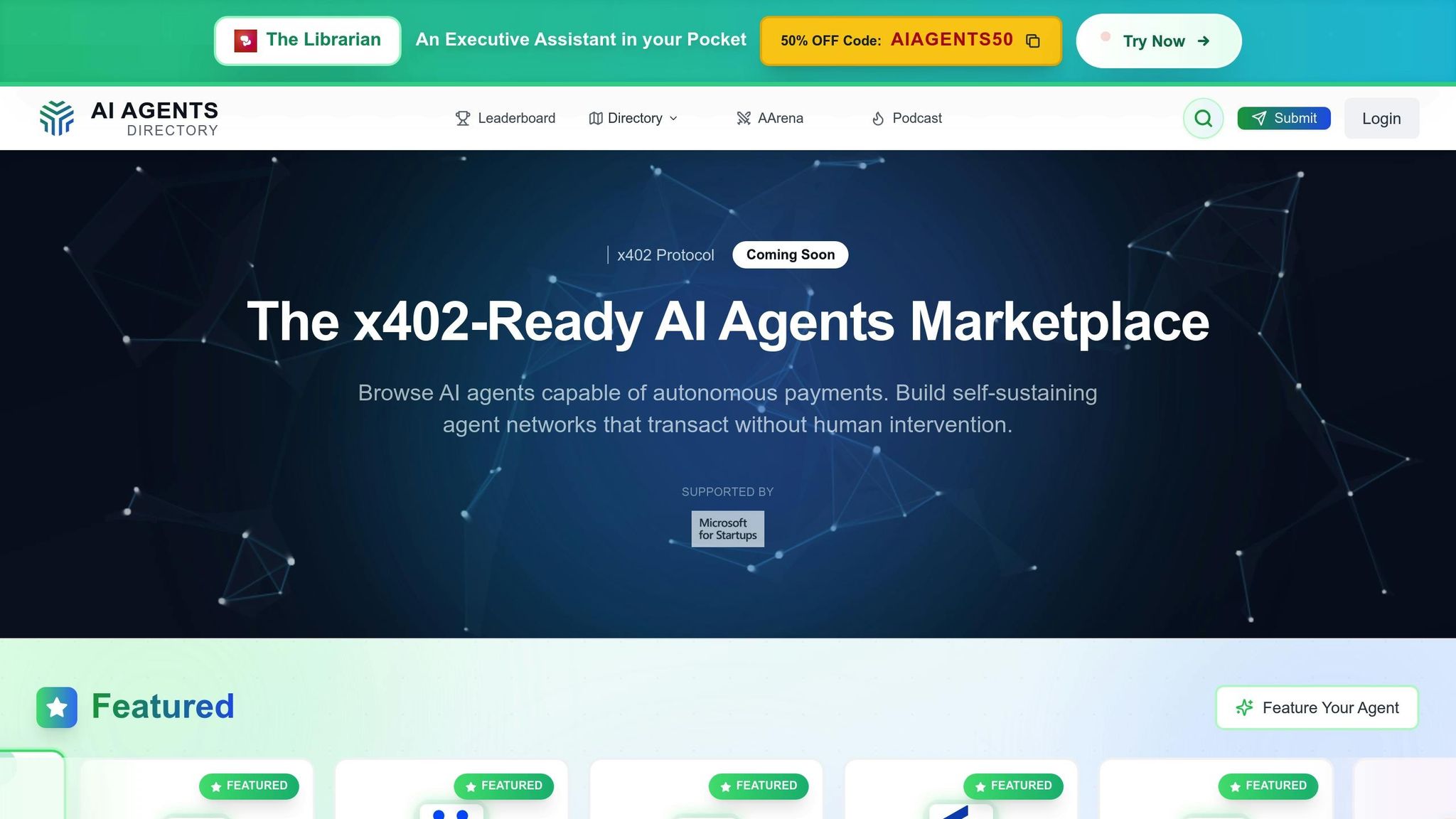
AIAgentsDirectory.com is a comprehensive platform that organizes hundreds of AI tools into a searchable and filterable directory, making it easier to find the right solutions quickly. The site categorizes agents into Featured, Newly Added, and Trending sections for easy browsing. For instance, as of December 2025, agents like Mailmodo AI and Teammates.ai were highlighted under Featured, while BeatViz AI MV Generator and img2img AI appeared in the Newly Added section. Trending options included TheLibrarian.io and Agentverse. This structure helps users discover effective tools at a glance.
Browsing and Filtering Options
To refine your search, take advantage of the platform's filtering tools. The Popular Categories section organizes agents by their functionality and use cases. For example, in December 2025, the directory featured categories like AI Agents Platform with 183 agents, Productivity with 135 agents, and AI Agents Frameworks with 106 agents. Additional categories include Voice AI Agents, Images, and AI Video Agents, each showing the number of available solutions.
If you have a specific need, use the search bar to enter queries like "customer support automation." You can further narrow down results by category, industry, or integration options. For a broader view, click the View All links under each category to access full lists with additional filtering options.
Understanding Listing Attributes
Each listing provides detailed information about the agent's capabilities, pricing, supported channels, and deployment options. Look for tools that handle complex tasks, manage multi-step workflows, and deliver clear, measurable outcomes. It's also important to check whether the agent operates autonomously or requires human oversight. Compatibility with your existing tech stack - such as CRM, ERP, communication platforms, or data warehouses - is another critical factor.
The effectiveness of an agent often depends on its training and data. Review customization and training options to ensure it aligns with your specific needs. Use side-by-side comparisons to evaluate which solutions meet your operational goals and budget. These attributes provide a solid foundation for assessing each agent’s potential fit for your organization.
From Directory Entry to Enterprise Solution
Once you’ve identified promising solutions, the next step is aligning them with your automation goals. Test shortlisted agents in a controlled environment using your data and workflows. NAITIVE supports this transition, helping you move from directory exploration to tailored deployment.
According to recent data, nearly 80% of business leaders report adopting AI agents, with 66% of them seeing measurable improvements in productivity. These numbers highlight the importance of careful evaluation and seamless integration. Turning a directory listing into a fully operational enterprise solution requires balancing automation with proper governance, ensuring scalability, and implementing oversight to manage risks and compliance.
NAITIVE’s team collaborates with you to design multi-agent systems, optimize workflows, and monitor performance metrics, ensuring your AI investment delivers meaningful and long-term results.
Conclusion
AI agents are making a noticeable impact across industries by helping businesses cut costs, streamline operations, speed up decision-making, and improve customer experiences. To achieve these results, it’s crucial to follow a structured, business-focused strategy. Starting with cost-saving use cases and gradually expanding to revenue-generating applications simplifies ROI tracking and speeds up the realization of benefits.
However, achieving success with AI agents requires more than just picking the right tools. Companies need reliable, real-time AI data that’s well-governed, while also addressing challenges like integration complexity, scalability, and compliance requirements[37,38]. A well-organized AI agents directory can make this process easier, offering industry-specific solutions that help businesses deploy faster and more effectively[7,39].
NAITIVE AI Consulting Agency supports businesses every step of the way - from pinpointing automation opportunities with the most potential to designing multi-agent systems that deliver tangible results. Unlike traditional chatbots, our autonomous AI agents are built to revolutionize operations. With a blend of technical know-how and a focus on outcomes that directly impact your bottom line, we’re here to help you achieve meaningful transformation.
FAQs
What makes AI agents different from traditional automation tools?
AI agents function as autonomous digital teammates, capable of planning, reasoning, and adjusting their actions to achieve specific goals. Unlike traditional automation tools that stick to rigid, rule-based scripts, these agents leverage advanced technologies like large language models to interpret unstructured inputs - such as natural language - and respond dynamically based on the situation. They can learn from past interactions, allowing them to make decisions on the fly and manage complex workflows with greater ease.
Traditional automation tools, on the other hand, are built for repetitive, predictable tasks. They rely on fixed rules, like "if-then" logic, making them effective for straightforward processes such as payroll or data transfers. However, these tools require manual updates whenever there’s a change in processes or data formats. AI agents stand apart by bringing contextual understanding and the ability to adapt, offering businesses a smarter, more responsive approach to automation.
How can businesses choose the right AI agents for their needs?
To choose the right AI agent, businesses should start by focusing on the impact it can have on their operations. Look for solutions that can deliver measurable returns on investment, align with your business objectives, and provide quick, tangible benefits. Work closely with subject-matter experts to ensure the AI agent addresses practical needs while maintaining transparency in its decision-making processes.
The next step is to assess the technical compatibility. Pay attention to crucial factors like data privacy, security compliance, ease of use, and how well the agent integrates with your current tools and workflows. It’s important that the solution is scalable, adaptable to your specific needs, and can integrate seamlessly into daily operations. Additionally, a solid governance model is key to managing compliance and mitigating risks.
Lastly, make sure the AI agent’s features align with your requirements. It should have strong capabilities in natural-language understanding, decision-making, and retaining context. The agent should also support integrations and be designed for continuous learning, so it improves over time. By considering these factors, businesses can select an AI agent that not only meets their current needs but also evolves with them, providing ongoing value and efficiency.
How can businesses calculate the ROI of using AI agents?
To figure out the ROI of AI agents, start by pinpointing measurable outcomes. Focus on three main areas: speed, cost savings, and new capabilities.
- Speed: Look at how much faster tasks are completed with the AI agent compared to the old methods.
- Cost savings: Measure reductions in labor costs or operational expenses.
- New capabilities: Evaluate revenue growth or strategic advantages from tasks the AI agent makes possible, like automating complex workflows.
Once you’ve identified the benefits, use this formula to calculate ROI:
[ \text{ROI %} = \frac{\text{Benefits} - \text{Costs}}{\text{Costs}} \times 100 ]
Here, Benefits include both direct savings (like lower staffing costs) and indirect gains (such as better customer satisfaction or increased sales conversions). To make the ROI tangible, track metrics like cost per task, task success rates, and efficiency improvements. For example, you could present results like: "$1,250,000 saved in Q1 2025."
This kind of clear financial data makes a strong case for expanding AI solutions across the company.